
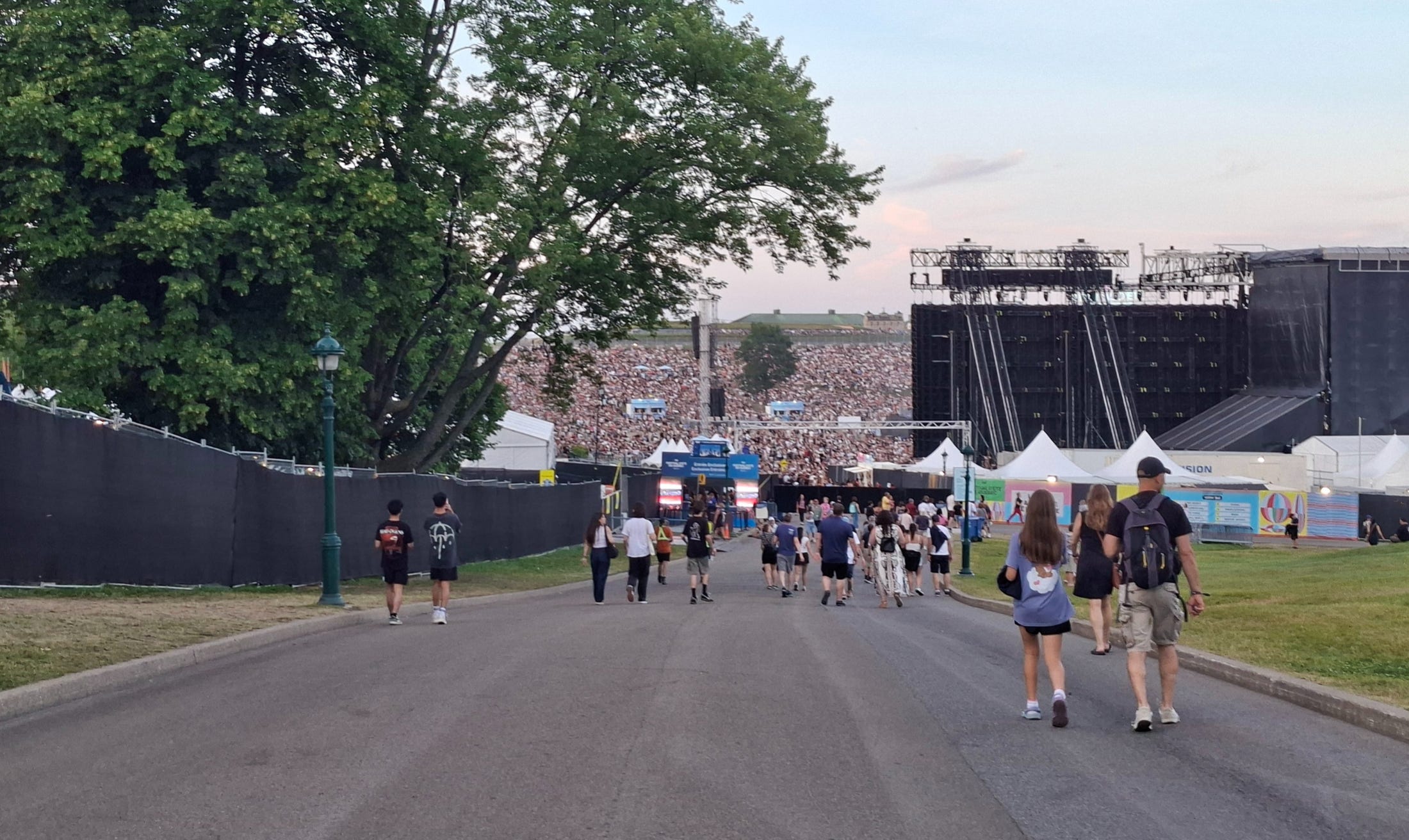
The Festival d’été de Québec (the FEQ) wrapped on Sunday night. I live in the heart of the downtown and the FEQ for me is much more about watching the crowds than the shows. 100,000 people (give or take) go in and out of the downtown every night. A steady stream of partiers walk by my front door between 4 and 7:30 PM and then walk past the other way between 9:30 and 1 AM. I see twenty cars or so towed every day.
The total capacity of the festival is 125,000 spread across five stages. By March, the 105,000 available day passes (priced at $180 each) sold out in just a few hours.
That is a lot of people for a city of 549,459 (or 850,000 if you include the surrounding area). Consider that Ottawa, with its one million residents, likely surpassed 30,000 attendees for a few of biggest Jazzfest shows. At the Plaines of Abraham stage, the crowd is regularly larger than 80,000 (its capacity is 100,000).
To move that many people that many nights in a row takes an enormous effort by the city. For eleven days of the year, Quebec City is forced to abandon its car fanaticism and embraces alternative modes of transportation.
There are only four roads that lead into the city’s downtown: Sainte-Foy, René-Lévesque, Grande-Allée and Honoré-Mercier. That last road is actually half a highway that dead-ends at the Plaines of Abraham. To accommodate so many people, roads have to be closed. Roads are closed for the entire festival from Rene-Lévesque and Honoré-Mercier (in front of the National Assembly) over to the Grande-Allée, and on the Grande Allée up to the Concorde Hotel.
Perhaps counter-intuitively for car activists, last year, the city closed one lane of the Grande-Allée and created a temporary east-west bike corridor (there was a transit strike on during the FEQ last year). This year, they maintained this temporary artery and made other changes too, due mostly to pre-construction work for the future Tramway. Car traffic was reduced to one-way on the Grande Allée for the entire downtown (direction away from the festival) to make space for buses that ran in both directions.
On René-Lévesque, which has previously been the (pre-tramway construction) east-west bus route, parking was banned and one lane towards the downtown was used entirely by buses waiting for their turn to shuttle concertgoers home. This was the primary west-bound way out of the city for car traffic.
The data show that the city’s planning was a big success. The city registered 74,500 trips made by bike, with a 9% increase of traffic on the Grande-Allée bike lanes (this doesn’t include people like me and my friends who didn’t bike over any of the city’s bike counters). Car traffic didn’t decrease with the half-closed Grande-Allée, and there weren’t any significant traffic problems, aside from what you’d expect with so many people trying to get to the FEQ.
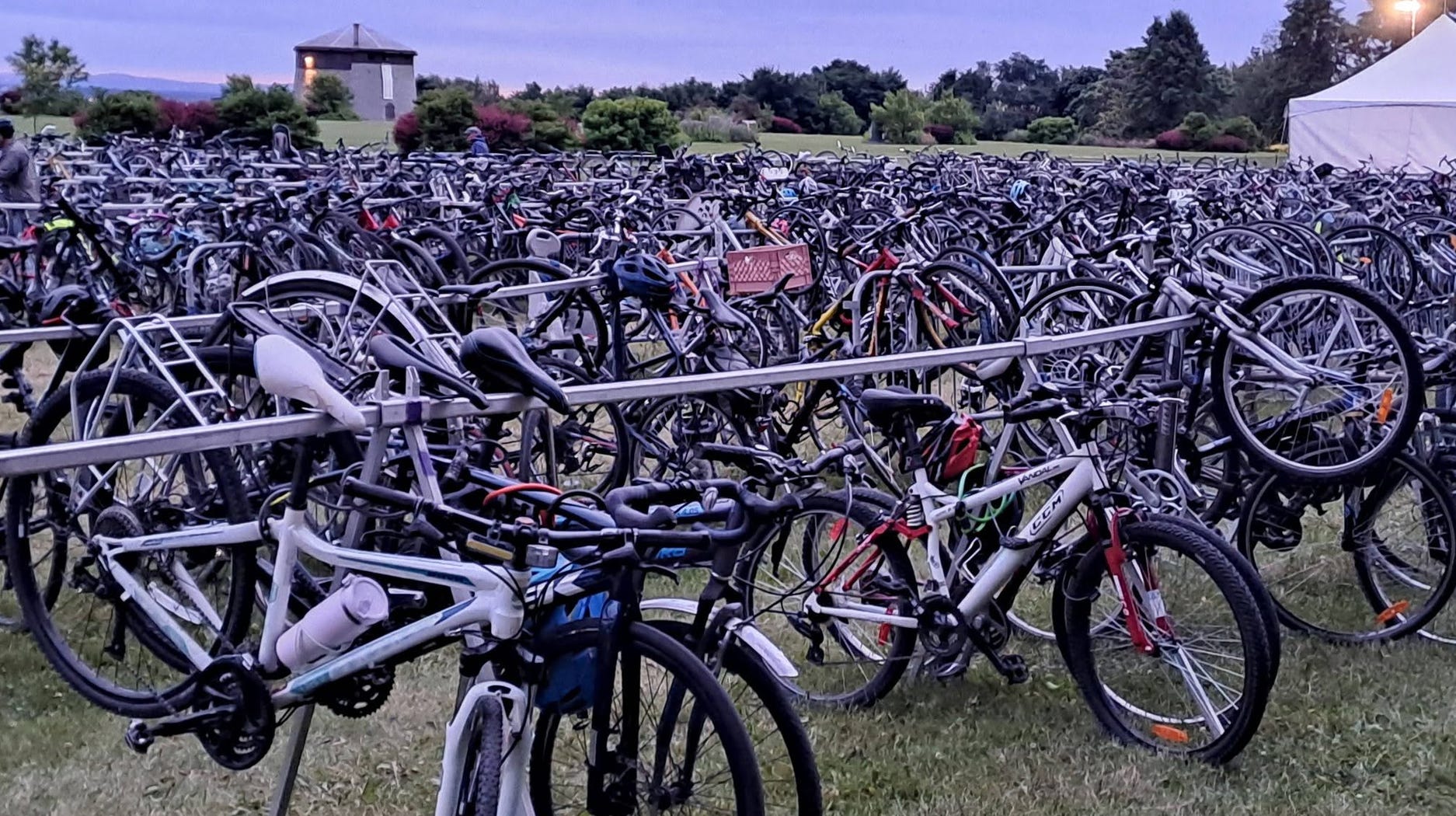
As for public transportation, the city organized four special shuttles for the suburbs, and increased service on its regular lines. 277,500 people took public transit to the FEQ. The city’s bus service, the RTC, also manages a network of e-bikes, which have also seen a strong growth since their launch a few years ago. The city registered 178,000 trips taken on àVélo to get to the FEQ (there are only 2,300 bikes in the entire network).
To accommodate all the cyclists, there were two enormous bike parking stations, including a helmet lock-up for anyone who took àVélo.
Of course, there are still too many cars. The city made 1,480 interventions to improve the flow of traffic (including by having cops stand around staring at their phones at every intersection). The volume made some drivers impatient. I saw many an illegal manoeuvre, many a 5-pt turn (people in this city are incapable of making a 3-pt turn), and one fender-bender. My family returned to Quebec City right in the middle of the traffic of opening night. My cabbie refused to take René-Lévesque because he heard it was a nightmare (it’s never actually a nightmare) and he tried to drive us up to Sainte-Foy via the Côte Sherbrooke. This (predictably) ended with him doing several idiotic manoeuvres on side streets (which also doubled our driving time).
What I love most about the FEQ is that it shows residents a vision of mobility that doesn’t rely so heavily on cars.
I think these lessons learned in Paris are critical for mobility activists to understand, and our annual dance with alternatives gives us a good time to check in on how well we’re doing.
Reducing Car Use Improves Quality of Life for Most Residents
Without question, fewer cars improves pretty much everything about our neighbourhood. The FEQ would be impossible if the roads all stayed open to vehicule traffic. The challenge is that most of the people who drive downtown don’t actually live downtown. We’re an attraction; the suburbs are where people live, they argue. Instilling respect for people who live downtown is a cultural shift that activists need to think through as we advocate for car-free cores.
Pushing Cars Out Does Not Harm the Urban Economy
The FEQ is an enormous economic opportunity and so in this case, there’s little question that the crowds bring with them money ready to spend. And with $9 Coors Light within the FEQ grounds, there’s an even greater reason to buy your beer at the Depanneur.
Car-Free Cities Must Provide Attractive Alternatives
This is fundamental. Without àVélo, fewer people will bike. More people using àVélo will trigger groups to use a mix of personal and city bikes. But without bike lanes, few people will take a bike if it will get them killed. Safe, protected lanes are a must, and the city has done a lot of work to give cyclists this infrastructure. Public transit shuttles that pick people up in central locations in the suburbs are key, and they must have enough capacity to move everyone quickly. This year, the RTC had music blaring at its stops downtown, with personnel directing everyone towards the right shuttle. Shoutout to the annual 420 Festival route.
Cities Need to Get Deliveries Under Control
Businesses need to be able to access their goods. Deliveries have to be timed in such a way to avoid crowds and access closed streets if necessary. Plus, delivery trucks need to be smaller.
Cities Must Also Regulate Cyclists
The proliferation of àVélo users has reminded me that Quebec Cityers bike as well as they drive (poorly). There has to be education given on how to safely drive past people, how not to blow through a pedestrian intersection (always slow down and look around you!) and other cycling basics. One of the things that all drivers in this city lack is maintaining eye lead. No one seems to look past the end of the hood of their car, and cyclists suffer from the same affliction.
Cities are fighting a tough opponent. In Quebec, the average weight of personal vehicles has grown by 140 kilograms in the past ten years. People are driving larger, heavier vehicles (yes, that’s one reason why you see more potholes, folks). Finding parking for these highly stupid machines is more and more difficult. As car companies push these enormous vehicles on the population, our collective battle over our collective space will become even harder.
There is no reasonable justification for why people need enormous vehicles. Literally, not one. Quebecers especially, who are shorter on average than Canadians, do not need the extra head and leg room. If our cities don’t get a handle on the alternatives, we will be held hostage by the F150s or F250s or Rams of the world, and the success of future FEQs will be challenged by the proliferation of these road monsters.
But that will be for next year to figure out. For now, the city basks in the glow of a successful 11-day party.
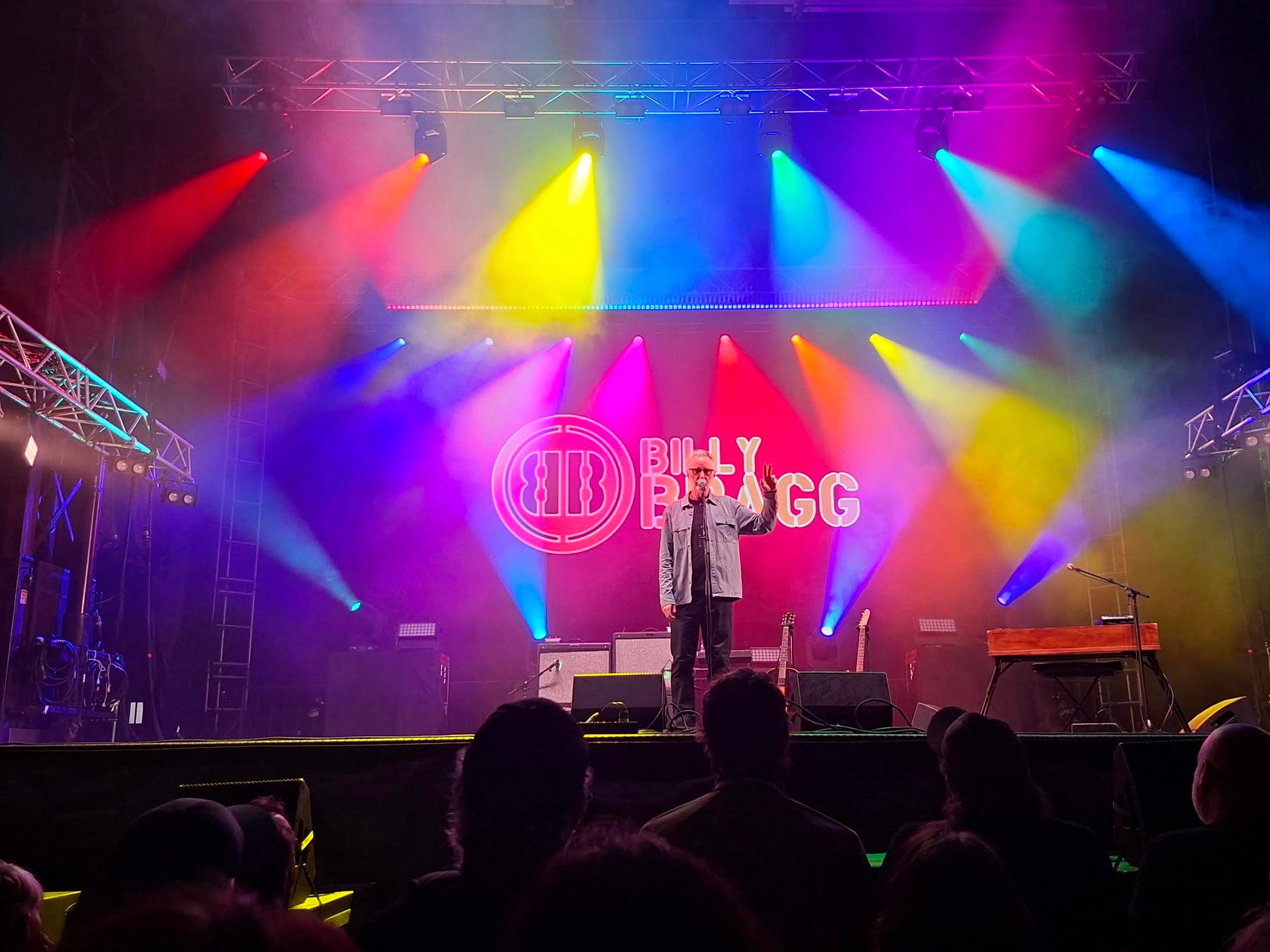
I did spend most nights at the FEQ. I saw some really great acts (Billy Bragg, Melody Gardot, Les Louanges, Kanazoé Orkestra, Alphonse Bisaillon, Basia Bulat). I, of course, walked. But that’s the benefit of living so close to Canada’s largest annual music festival. And even better — my hostas survived. Usually by the end of the FEQ, there is a body-sized hole in my plants where someone drunkenly fell into.
Comments
Nothing yet. Say the first thing.
Sign in to join the conversation.