
We spend considerable time questioning if artificial intelligence is ready for healthcare applications—considering its accuracy, safety, explainability, and regulation. While working on a research paper, I became more curious about this issue from a different angle.
Are healthcare professionals ready for AI?
This question influenced our research on healthcare professionals’ concerns regarding medical AI.
When I started reviewing the literature, I wasn’t particularly interested in another list of technological barriers. We already understand that AI can make errors, algorithms can be biased, healthcare data is often messy, privacy concerns are important, regulation is complex, and black-box systems are difficult to trust. My main interest was focused on the human aspect of the issue.
As a clinical health psychologist working in medical foresight, this is the part of technological transformation that fascinates me most. While we can endlessly discuss a technology's capabilities, healthcare systems are fundamentally composed of people. These individuals don’t perceive technological change as a mere abstract concept; instead, they experience it through their work, identities, relationships, responsibilities, fears, and hopes for the future.
I wanted to explore what happens psychologically when a technology capable of handling tasks traditionally performed by highly trained professionals is introduced. What exactly are healthcare professionals concerned about?
And maybe even more importantly: what are we actually talking about when we call someone “resistant to AI”?
We screened 217 records and ultimately included 32 studies examining healthcare professionals’ attitudes toward medical AI. One of the first things that became clear was that lumping every negative reaction together as “resistance” doesn’t make much sense.
There is a significant distinction among saying:
“I’m not convinced this works.”
“I’m worried about using this.”
and:
“I don’t want this technology anywhere near my practice.”
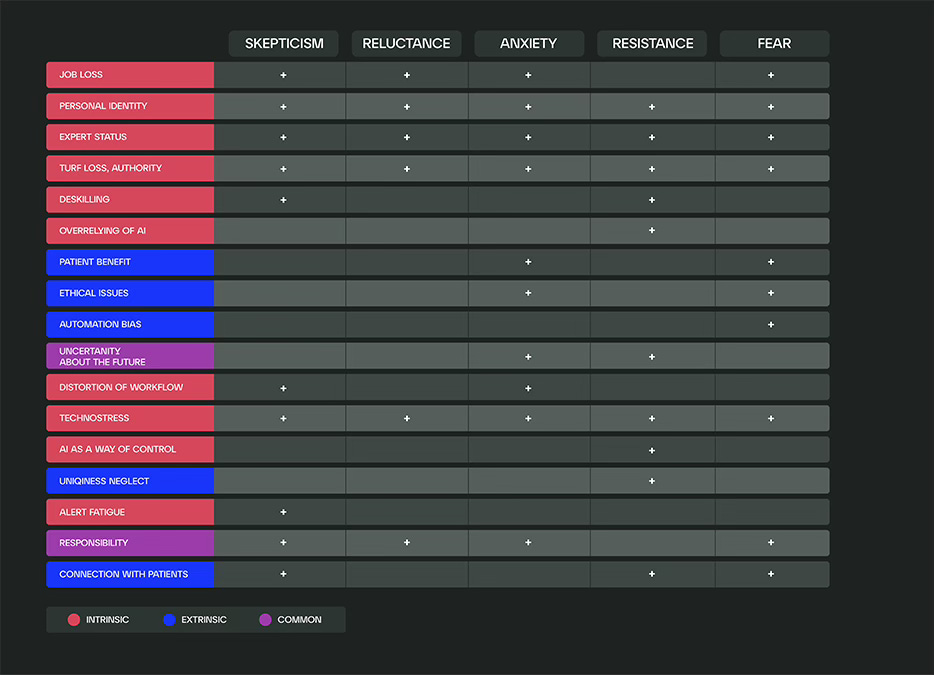
So I organized the negative attitudes we encountered along a spectrum:
skepticism → reluctance → anxiety → resistance → fear.
Skepticism is mostly a matter of cognition. Just present the evidence. Reluctance introduces hesitation. Anxiety introduces a stronger emotional component: What if something goes wrong? Resistance becomes active opposition, and fear represents the strongest form of aversion.
What caught my attention was how the literature was grouped. Fear was the most common attitude, showing up in 13 of the 32 studies. Anxiety was present in eight studies, skepticism in six, resistance in three, and reluctance in two.
However, the more intriguing question wasn’t about how frightened healthcare professionals were, but rather what they feared. This is where the story became far more interesting than “doctors are scared that robots will take their jobs.”
Job replacement is probably the most obvious fear associated with AI.
And yes, we found it. In an international survey of radiologists and radiology residents, 38% reported fear of replacement. Among anesthesiologists in another study, 45% were concerned about AI’s future impact on the need for anesthesiologists and their income.
Medical students were also impacted. In the research included in our review, worries about AI were already affecting some students' decisions to pursue fields like radiology.
Consider this carefully. AI doesn’t actually need to replace a job to impact it, the mere possibility can influence who decides to pursue that career.
As a futurist, I consider this especially significant. We often wait to recognize transformation until after it occurs—such as jobs vanishing, workflows shifting, or new technologies becoming routine. However, the earliest indicators of change often show up much sooner, in the expectations people hold.
A medical student deciding not to enter a specialty because of what they believe AI might do to it ten years from now is already a consequence of AI, it’s already influencing behavior in the present.
But job loss was only one piece of a much bigger psychological puzzle.
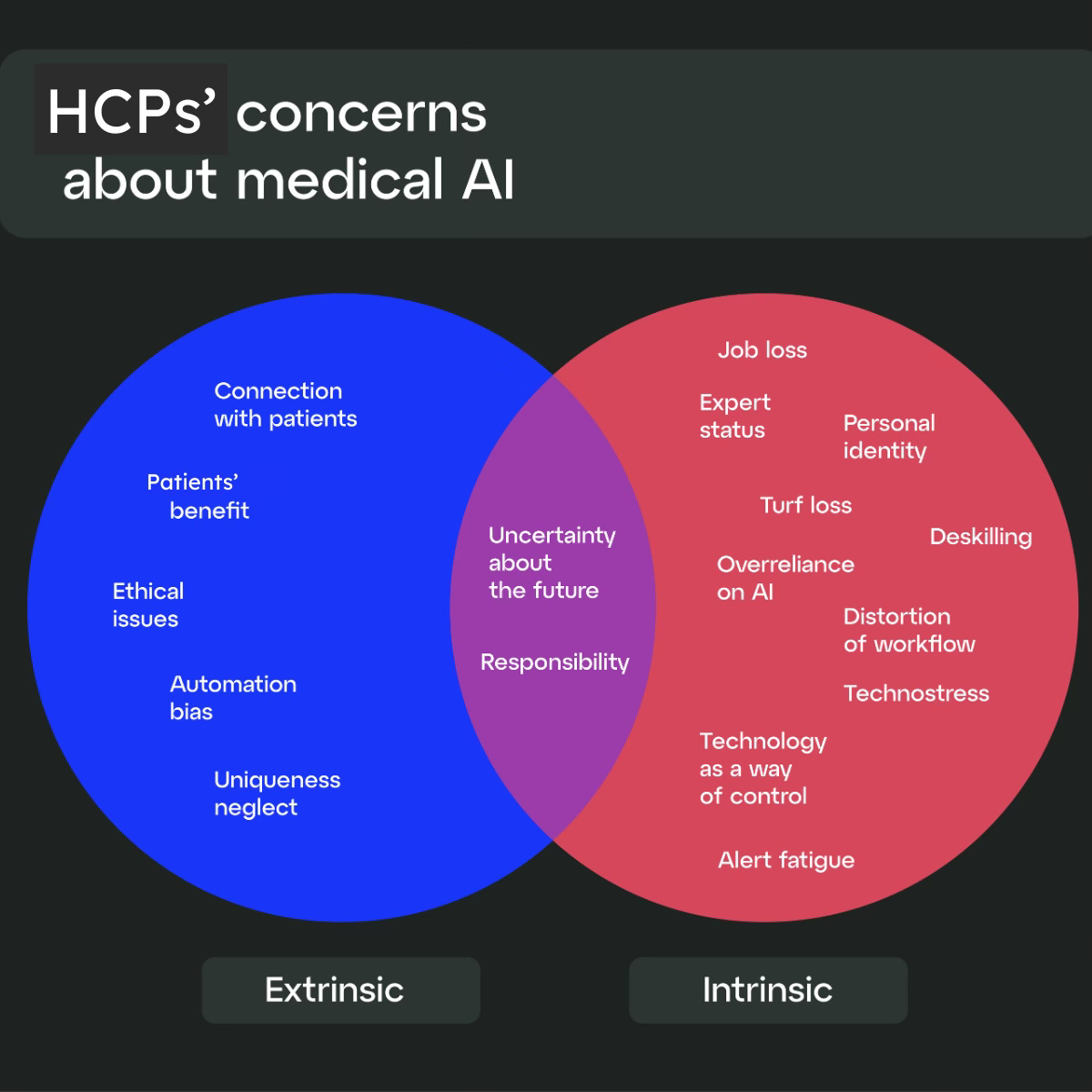
Across the literature, I identified 15 sources of negative attitudes, and I divided them broadly into two groups.
The first were intrinsic concerns: fears about what AI might do to healthcare professionals themselves and to their professional roles.
These included job loss, professional identity, expert status, loss of authority, deskilling, overreliance on AI, disruption of workflow, technostress, AI being used as a mechanism of control, and alert fatigue.
The second were extrinsic concerns: fears about what AI might do to patients and patient care.
These included questions about patient benefit, ethics, automation bias, whether AI could recognize the uniqueness of an individual patient, and what might happen to the human connection between clinician and patient.
And two concerns sat somewhere between both worlds:
uncertainty and responsibility.
Who is responsible when AI is wrong: The physician? The hospital? The developer? The patient who consented to its use? That question becomes much less philosophical when the algorithm is sitting beside you during an actual clinical decision.
To me, this is one of the most intriguing discoveries.
Many worries about medical AI aren’t actually related to the technology itself, instead, they concern professional identity.
Medicine is not simply a collection of tasks. Becoming a physician, nurse, radiologist, psychologist, or another healthcare professional means acquiring expertise over many years and gradually developing a professional identity around that expertise. We don’t simply do our professions. To some extent, they become part of how we understand ourselves.
Then a technology arrives and begins performing parts of what previously demonstrated that expertise.
Diagnosis, pattern recognition, risk prediction, clinical decision support, data interpretation.
What happens then?
One of the studies we included specifically examined professional identity threat. It found two particularly important threats: challenges to physicians’ expertise and challenges to their role as independent healthcare professionals. Both contributed to perceived self-threat and resistance toward AI.
Interestingly, medical students experienced stronger identity threats and resistance than practicing healthcare professionals.
I keep coming back to this finding because I think it changes the conversation.
If resistance is partly an identity response, showing someone another graph about algorithmic accuracy isn’t necessarily going to solve it.
Maybe the real question isn’t just:
“Do healthcare professionals trust AI?”
Instead, it might be:
“How does AI influence healthcare professionals’ beliefs about their future worth?”
Those are very different questions, and they require very different solutions.
Another concern repeatedly appearing in the literature was deskilling.
Imagine using AI decision support every day for years. What happens when the technology suddenly isn’t available?
Postgraduate trainee physicians in London worried that clinical AI could reduce opportunities to develop clinical judgment, practical skills, decision-making, accountability and professional responsibility.
Healthcare professionals in emergency and intensive care settings raised similar concerns around deskilling, workflow disruption and alert fatigue.
There is an uncomfortable paradox here.
AI is often presented as something that can make clinicians better at their jobs. Healthcare professionals are also asking whether relying on it could eventually make them less capable of doing those jobs without it.
Both things can potentially be true, and I think we need to be able to hold those two ideas at the same time.
Being excited about what AI can add to medicine should not prevent us from asking what excessive reliance on it might slowly take away.
Then we reach another layer of resistance that I find particularly important.
Healthcare professionals weren’t only protecting themselves; they were also defending a core principle of medicine: the individuality of each patient.
The concept appearing in this literature is uniqueness neglect. Humans tend to see their own health circumstances as highly individual. An algorithm, meanwhile, is easily perceived as something that works through patterns, averages, statistics, and standardization. Medicine is full of people who don’t fit neatly into averages.
Anyone who has spent enough time around healthcare knows this instinctively. Real patients arrive with multiple conditions, strange combinations of symptoms, social circumstances, preferences, fears, histories and exceptions. They rarely look like the perfectly isolated variable in a dataset.
In one study in our review, 78.65% of respondents identified AI’s inability to interpret the patient within a global clinical context as their biggest concern.
That number says something important. Healthcare professionals are not only questioning whether the algorithm can identify the disease but also asking whether it can recognize the individual who has the disease.
As a psychologist, that distinction matters enormously to me, and as someone studying the futures of healthcare, I think it may become one of the defining questions of AI-enabled medicine, because if AI makes healthcare more accurate but less capable of seeing the person behind the data, I don’t think we can call that progress without qualification.
This is where the story becomes more nuanced.
Concern about AI does not automatically equal rejection of AI.
Healthcare professionals can simultaneously recognize its enormous potential and feel deeply uncertain about what its adoption means for their profession. In fact, I think this is where some conversations about AI adoption go wrong. We divide people far too easily into those who are “pro-AI” and those who are “against AI.” Humans are considerably messier than that. You can be excited about AI and worried about it. You can believe it will improve patient care and simultaneously fear that something deeply human may disappear from medicine.
Some evidence points to a positive development: gaining knowledge alters the relationship.
In the international radiology research covered in our review, participants with limited AI knowledge more often expressed fear of being replaced, whereas those with intermediate or advanced knowledge tended to support adoption. Across the literature, education repeatedly emerged as one of the most important tools for reducing uncertainty.
However, “AI education” isn’t just about instructing clinicians on which button to click. Healthcare professionals must grasp the capabilities of these systems, as well as their limitations. They need enough AI and data literacy to critically evaluate outputs rather than blindly accept or reflexively reject them. They need to understand bias, limitations, uncertainty and ethical implications.
They require opportunities to utilize these systems within practical clinical settings. Most importantly, they shouldn’t be just the end users of medical AI, instead, they should be involved in its development.
One study I examined found that involving healthcare professionals in AI development positively affected acceptance. That makes intuitive sense: technology feels very different when it is something being imposed upon you versus something you helped shape.
It might seem obvious, but healthcare has a long history of introducing technologies into clinical workflows before consulting the users about their needs. We have a chance to avoid making the same mistake with AI.
When healthcare professionals hesitate to adopt AI, it’s common to view it as mere resistance to innovation. However, I believe this perspective is too simplistic.
If a physician is concerned about liability when an algorithm makes a mistake, that’s not irrational technophobia. If a trainee is concerned about missing chances to enhance their clinical judgment, it is not opposed to technology. Similarly, if a radiologist questions how their professional role might evolve in the coming decade, it doesn't necessarily mean they are resisting change. Ultimately, if a clinician worries that an algorithm won’t understand the contradictory, deeply individual reality of the human sitting in front of them, perhaps we should listen.
Our review ultimately pointed toward several interconnected solutions: better education, meaningful involvement of healthcare professionals in AI development, transparent regulation, clearer responsibilities, and a deeper understanding of the psychological sources of resistance.
But I think there is an even larger lesson here, something that we absolutely understand and address when we talk about medical AI:
Implementing medical AI involves more than just technology; it requires a human-centered transformation.
We excel at envisioning technological futures: faster systems, improved models, more precise predictions, and increased automation, but we tend to forget that every technological future is also a psychological future.
We are asking healthcare professionals to integrate tools that may alter how they work, how they make decisions, how they relate to patients, how expertise is defined, and ultimately how they understand their own professional role.
You cannot solve that transformation with a better algorithm alone.
The future of healthcare isn’t a rivalry between humans and AI, but getting there requires us to stop treating fear as an obstacle that needs to be eliminated and start treating it as information.
Fear tells us where people believe something valuable may be lost.
Expertise, autonomy, responsibility, clinical judgment, human connection, the ability to see a patient as an individual rather than a collection of data points.
That doesn’t imply that all fears will become real. Instead, each fear reveals what is important to the individuals who will actually experience and operate within the healthcare systems we are designing. When healthcare professionals tell us what they are afraid of, they may also be telling us exactly what we need to protect as medicine changes, and that is where truly human-centered AI should begin.
This piece is based on our peer-reviewed scoping review, “Health Care Professionals’ Concerns About Medical AI and Psychological Barriers and Strategies for Successful Implementation,” published in the Journal of Medical Internet Research.

Comments
Nothing yet. Say the first thing.
Sign in to join the conversation.