
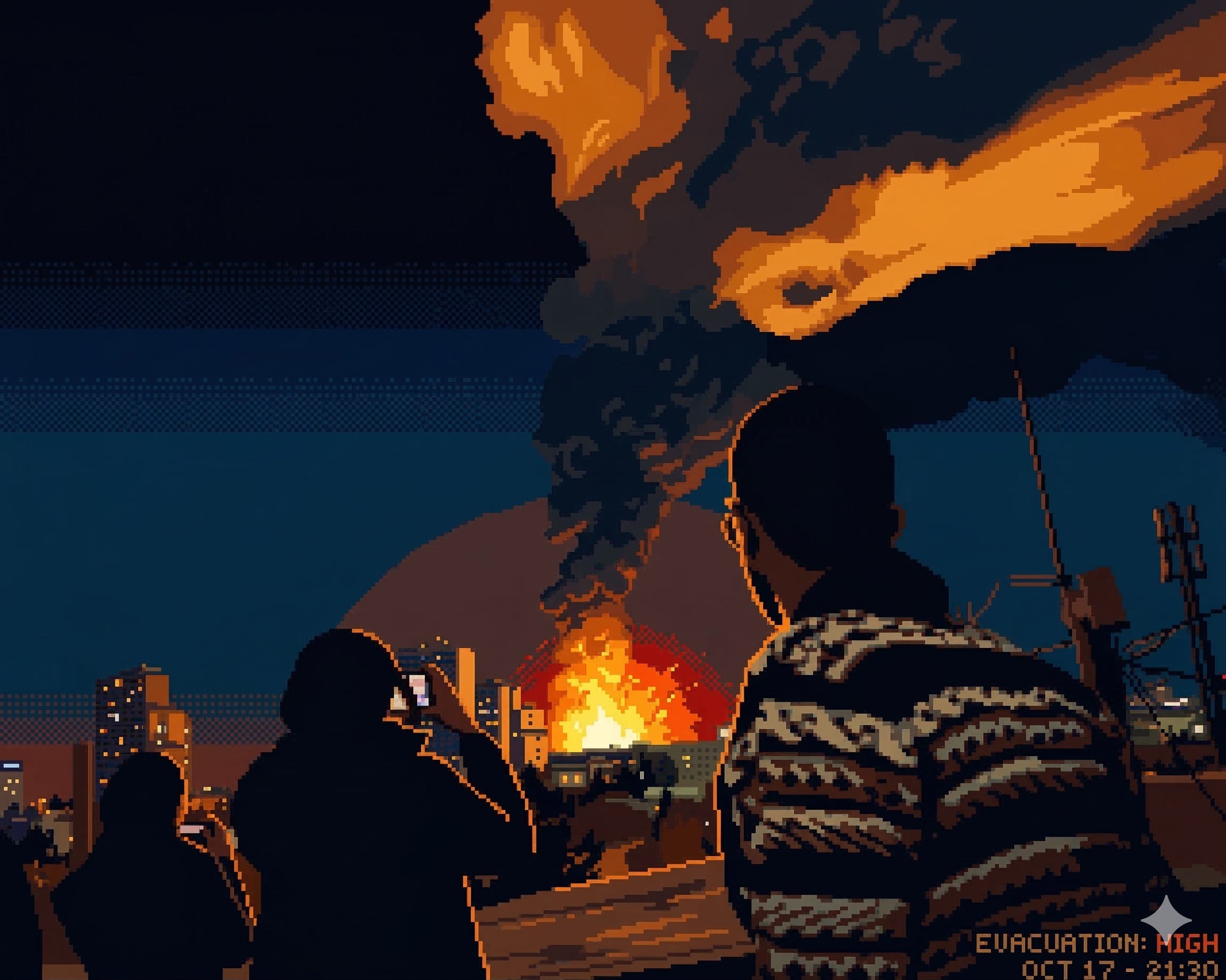
Thick black smoke was still rising in the sky, soot covered the streets and cars, balconies filled with black gunk, and the toxic air had filled the lungs as Tehran woke up after a night of airstrikes on the city’s oil depots on Sunday.
The sky over Tehran went black Sunday morning.
Four oil depots and a petroleum logistics site had been struck overnight. By the time the city of ten million people woke up, thick smoke had swallowed the skyline, soot had settled on balconies and cars, and rain was falling — black, oily rain, toxic with what the burning facilities had released into the air. Residents woke up with burning throats and eyes. Authorities warned of acid rain; people were told to stay inside.
One resident, trying to flee the south of the city, looked back at the fires and described what she saw: the night had looked like day, she said, and the day was so dark it looked like a moonless night: “So dark, like our futures.”
Five thousand miles away, in an 85-mile stretch of Louisiana between Baton Rouge and New Orleans, over 200 petrochemical plants and refineries operate alongside the people who live there. The corridor processes roughly 25% of the country’s petrochemical products. The area is called Cancer Alley, a name that dates to the late 1980s, when residents began using it to describe documented disease clusters in communities along the river.
A 2025 Johns Hopkins study measured 17 carcinogenic air pollutants across the corridor and found cancer risks in the area up to eleven times higher than EPA estimates. The three chemicals driving the majority of that risk are ethylene oxide, chloroprene, and formaldehyde. I didn’t know what any of these chemicals actually do (the publication describes them in a very sciencey way), so I looked them up:
Ethylene oxide is a gas used in chemical manufacturing and as a sterilant for medical devices; the EPA classifies it as a known human carcinogen, and long-term exposure has been linked to increased risks of leukemia, lymphoma, and breast cancer.
Chloroprene is the chemical used to make neoprene: the spongy synthetic rubber found in wetsuits, gaskets, and industrial seals. The EPA classifies it as a “likely human carcinogen.” The facility located in Cancer Alley is adjacent to an elementary school that will be closing.
Formaldehyde, the most familiar of the three, used in building materials, household products, and as a preservative. It’s classified by the International Agency for Research on Cancer as a known human carcinogen.
The Johns Hopkins researchers found that these three chemicals together account for the large majority of cancer risk across the corridor, with ethylene oxide dominating in areas closest to production facilities.
You’ll be shocked to hear that the impacted communities are predominantly Black and working-class, located on land that was plantation country before it became industrial corridor. Many of them became free towns established by formerly enslaved people after the Civil War, now surrounded by plants built on the same land. In March 2025, the Justice Department dropped a federal lawsuit (started by the Biden administration) against the plant identified as having the highest localized cancer risk in the region. The withdrawal was, at least based on public reporting, linked to the administration’s policy of ending DEI initiatives.
These two places — Tehran under a burning sky, Cancer Alley under its permanent chemical haze — are not the same story, but they rhyme in a specific way. One is acute; the other is chronic. What they share is what comes after. The oil depot strikes were explosive, but the effects compound: disrupted fuel supplies, food price shocks, a refugee pressure building at the edges of an already strained region, the long tail of toxic exposure for people who had nowhere to go and went outside anyway. Cancer Alley moves more slowly, but the structure is the same: an initial decision, or a series of them, whose costs accrue quietly over decades in the bodies of people who didn’t make those decisions and have limited recourse against them. In neither case does the accounting ever quite catch up to the damage.
These are the conditions that Kentucky Route Zero and Norco were built to illuminate — not the moment of rupture, but everything that follows it. They show what it looks like when systems fail people not just once but continuously, at the most basic level, in ways that are hard to see and harder to prosecute. Part of why these games became increasingly resonant to me, and part of why their text-forward form matters, is that they are structurally oriented toward that second and third order reality. You don’t see or experience the explosion; you live or visit the town after the explosion, ten years later, still living in its wake.
I need to make a brief detour before I get into the games themselves. Bear with me.
In the before times, way, way back in the 1900s, there was the MUD.
MUD stands for Multi-User Dungeon. Inspired by text-based dungeon crawls like Zork, a team of researchers at the University of Wales in Aberystwyth developed an open-source codebase known as AberMUD, named after the town in which it was developed. AberMUD allowed multiple players to connect and adventure with one another in real time. This was the late 1970s. By the 1980s and into the 90s, MUDs had proliferated into dozens of variants and offshoots1 — MUSHes, MOOs, MUCKs — each with its own rules about combat, roleplay, and how much of the world players themselves could build and modify. MUDs walked so World of Warcraft could run.
Williamson’s post goes into far more detail, but the basic mechanic was simple: you typed commands and the game responded in prose, describing what you found, who was there, what happened next. Every room, every object, every encounter existed only in language. There were no graphics to render a dungeon or a forest or a tavern; the game told you it was there, and your brain did the rest. In the more sophisticated versions, the system was elaborate enough to function like a Dungeon Master, tracking your choices and responding to them dynamically. In simpler ones, it was closer to interactive fiction, i.e., a story that branched based on what you typed. Either way, the line between game and collaborative storytelling was thin.
I first encountered MUDs in the early 1990s. My uncle had a laptop he’d let me use occasionally, and later my dad brought home his own work laptop. We didn’t have a home computer of our own for a while, so my access was intermittent and the internet, such as it was, remained fairly exotic. I can’t remember exactly how I learned what a MUD was — probably something my grandmother had heard about on 60 Minutes, honestly — but I remember actively seeking one out and finding it. What I found was less the multi-user experience the name implies and more like the aforementioned coded Dungeon Master: a system that responded to typed commands with prose descriptions of what was happening around me. Go north. Look around. Open door. The game would tell me what I found.
I thought this was absolutely wild stuff. I had a Super Nintendo, yes, but that was fundamentally a closed loop. The story was prewritten and much of the choices, such as they existed, were on rails. Importantly, although much of the coding in MUDs were likewise tethered, cartridge games felt like they were always on rails whereas the MUD felt like I had real agency. Thus the impact of my choices felt greater.
To put it plainly, I was completely absorbed. Not because the graphics were good — as I said, there were no graphics — but because the gap between what the text told me and what I could imagine filled in so completely that the world felt more real than many things I could see. I was a reader, but to have this additional layer unfold, to incorporate a dynamism and reactivity to my own impressions, reactions, moral code and so on, was one of the coolest things I had ever experienced.
This is, I think, the foundational insight of the entire genre, and it’s one that modern game design keeps rediscovering and reinventing: what truly makes these communities and experiences endure is not the mechanical complexity but the imaginative collaboration: players and systems building a shared world that exists entirely in language and in the minds of the people engaging with it.
MUDs also had a particular relationship with the ephemeral that I didn’t fully appreciate at the time. A MUD was a world that existed only while people were in it, tending it (for the most part, see the footnote below). Shut down the server and it was simply gone — no archive, no museum, no save state. This is not incidental to what MUDs were and it’s part of why they rhyme so strongly with what KRZ and Norco are processing: the knowledge that most of what communities build and feel and sustain together is exactly this fragile: felt intensely an then gone, but I digress.2
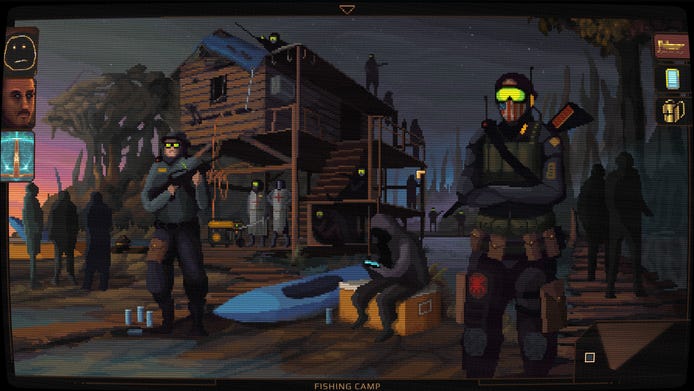
Norco takes its name and its geography from the real place in Cancer Alley. Its characters are trapped in a slow-motion apocalypse, caught between the worsening ravages of climate change and the oil companies’ ever-escalating hunger for growth, while violence and economic decay proceed unabated. Yet what choice do they have? This place is home.3
There is a response, reliable as weather, that tends to appear whenever someone describes a place like Norco or Cancer Alley: why don’t they just leave? It is offered sometimes with genuine puzzlement and sometimes as a kind of closing argument — proof that the suffering is, on some level, chosen, and therefore not a claim on collective concern.4
I’ve been thinking about this through the lens of Schmidtz and Brennan’s A Brief History of Liberty, which opens with a distinction that turns out to be load-bearing for a lot of American political argument. Isaiah Berlin, they explain, described two kinds of freedom: negative liberty, which is freedom from — the absence of obstacles imposed by others — and positive liberty, which is freedom to, meaning the actual capacity to act. The distinction matters because the two are easy to conflate and consequential to keep separate. Schmidtz and Brennan illustrate it cleanly: for a bird to be free to fly, it must have wings. “For me to be in this sense free to fly implies that I have a working aircraft at my disposal, and not merely that flight control has cleared me for takeoff.”
The United States has historically centered negative liberty: the cleared runway, the open door, the absence of legal prohibition. By that measure, most people in Cancer Alley are free to leave; no law prevents them. But Schmidtz and Brennan are honest about what a purely negative account of liberty leaves unanswered: if your freedom from external impediment amounts, in practice, to the freedom to be poor or to sleep on a public sidewalk, that conception alone doesn't tell you whether you are actually, meaningfully free to act on your own goals. The open door is not the same as being able to walk through it.
What they call “real choice” requires both: options and the capacity to exercise them. Leaving requires money for a move, a deposit in a new place, a vehicle that will make the trip. It requires a destination, and destinations have their own barriers. The cities where opportunity concentrates have become, over the past two decades, prohibitively expensive for people arriving without capital — ask me about what it took to get from upstate New York to Seattle.
Then there is what leaving costs that appears on no ledger at all: community, family, the specific texture of a place you know, the grave of someone you loved. Schmidtz and Brennan’s thesis is that whether forms of liberty conflict or complement each other is “a matter of historical circumstance.” The circumstances matter here. Negative liberty — the absence of obstacles wrongfully imposed — is supposed to create the conditions under which positive liberty, real capacity, can develop. The rule of law, enforceable rights, regulatory accountability: these are the mechanisms by which a society converts “you are free from interference” into “you actually have options.” They are what make the two conceptions of liberty work together rather than against each other.
In Cancer Alley in 2025 2026 (what year is it?), those mechanisms are moving in the wrong direction. In Norco, we see the imagined consequences of that direction. The federal lawsuit that would have required the plant with the highest localized cancer risk to reduce its emissions has been dropped. The EPA rule that would have mandated monitoring for the three chemicals driving the majority of cancer risk — and was projected to reduce that risk by 96% for nearby residents — has been suspended through presidential exemption. The state does not monitor for those chemicals independently. What remains is negative liberty in its most attenuated form: no one is legally preventing anyone from leaving, but the institutional infrastructure that might have made staying a viable choice, that might have made the air safe enough to breathe while you built a life, has been withdrawn. Negative and positive liberty are not complementary here. They are in direct tension, because the removal of regulatory accountability doesn’t expand freedom so much as maintain the obstacles to real choice.
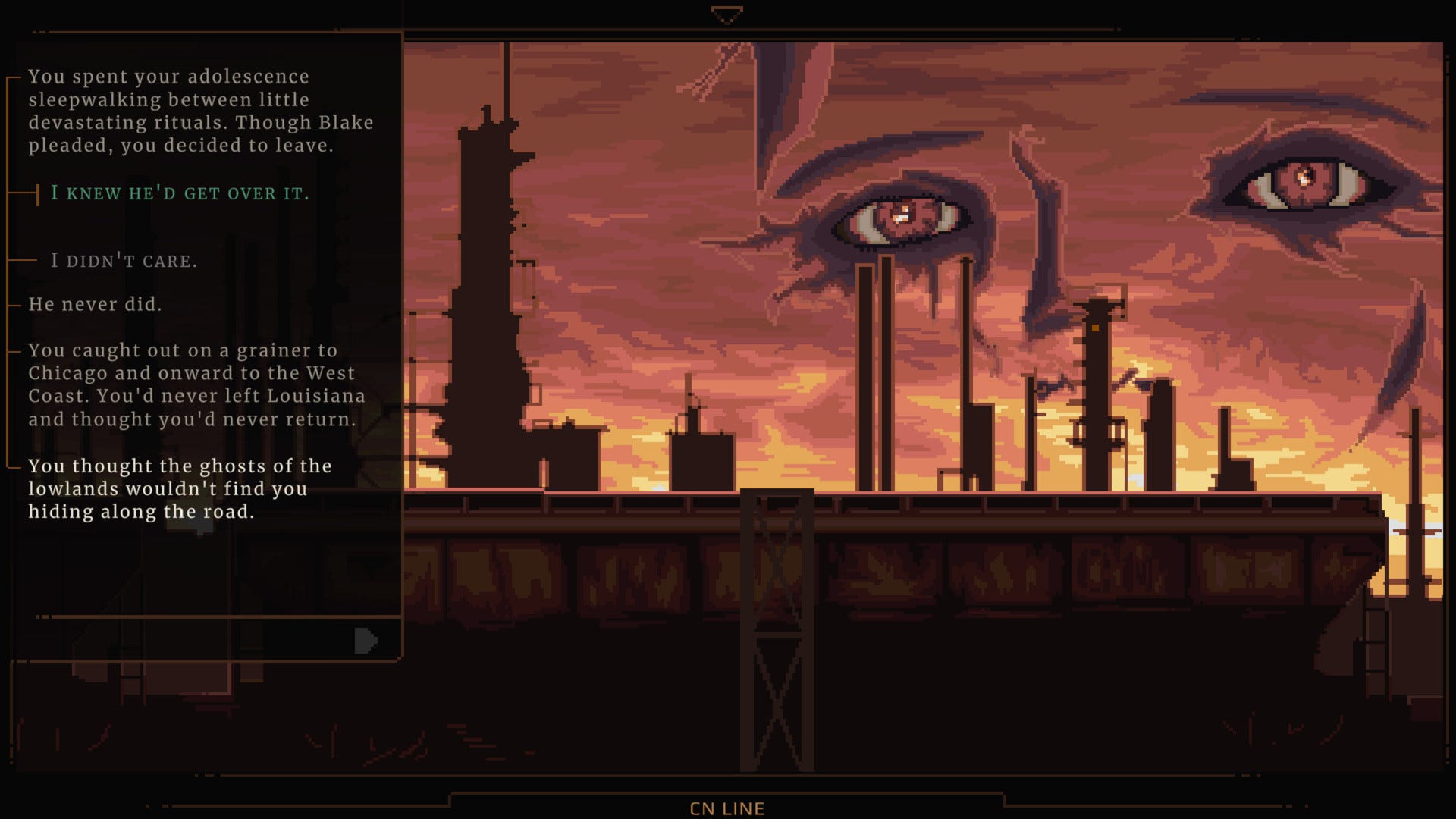
Norco understands this at the level of its design, not just its story. Kay comes home. In the negative liberty sense, the runway is clear: she leaves because she can and no one compels her return, but the game never lets you forget that her options, once home, are constrained in every direction by forces she didn’t choose and cannot individually dismantle. You make choices throughout, but they are not the choices of a power fantasy. You are not optimizing, just navigating. The distinction sounds small but the way it feels, much like when I was ten years old and playing those MUDs, is enormous.
I didn’t seek these games out but they feel very much connected to me. Norco and Kentucky Route Zero are a shared strand of game: southern gothic, text-centered or graphically spare, built around storytelling and moral imagination rather than mastery. KRZ puts you in the position of Conway, driving deliveries through a collapsing economy, accumulating obligations he cannot discharge. The game was developed in the wake of the 2008 financial crisis, and it shows: the theme is not debt as metaphor but debt as weather, as the atmosphere you breathe, as the thing that determines whether you stay or go or simply dissolve. You make choices in KRZ too, but the game is honest about what those choices cost and what they cannot change. There is no triumphant arc. To paraphrase myself: the should’ve, would’ve, could’ve, followed by the exhausted “oh well.” It is what it is.
Neither game is primarily about plot. They are about texture. They are about what it feels like to be a person in a particular place at a particular historical moment, where the forces shaping your life are enormous and faceless and, in some fundamental sense, not interested in you. Here is where the medium does something that other narrative forms cannot quite replicate: because you are the one making the choices, the constraints land differently; you feel the walls. When Conway cannot pay his debt, or Kay cannot protect the people she loves, it is not something that happened to a character you were watching. You were there, you tried, you failed. This is what Schmidtz and Brennan’s framework helps illuminate from the outside: real choice requires both options and the capacity to exercise them. These games put you inside the experience of having one without the other, and they don’t let you look away.
This is also, I think, why the text-forward form matters. A photorealistic game can show you poverty. For sure, it can render a dilapidated town in extraordinary detail, but rendering tends toward spectacle — the world is so complete, so fully realized, that your job is to move through it rather than to inhabit it. This is how Final Fantasy VII felt (and feels) to me: a world is being destroyed by a resource-hungry conglomerate, and the game tells me this all the time — reminds me in its renderings — but even though it is central to the conflict, it is hardly ever front of mine. I don’t feel, in my bones, the kind of existential dread of a dying planet.
In contrast, a text-forward game, like a MUD, asks you to meet it partway. The gap between what the words describe and what you feel is where your own life enters, and if your own life contains any memory of economic precarity, of watching systems grind people down without malice or accountability, of staying somewhere difficult because leaving was harder, that gap fills with something real. The game didn’t put it there so much as pull on your own lived experience, to take your stake and place it into the game.
I want to return to something I said earlier — that I didn’t seek these games out. I didn’t go looking for southern gothic dystopia or text-forward narratives about constrained choice. I found them the way you find certain books at certain moments: not because you went looking but because something in you was already looking, and the thing arrived at the right time.
Games are products of their time in an obvious sense. They’re made by people living in a specific historical moment, processing specific anxieties. KRZ is legible as a post-2008 artifact; Norco is legible as a climate-anxiety artifact. But I think they’re also received in time, meaning the same game lands differently depending on when you play it, what you’re carrying, what the world outside looks like when you put the controller down.
I opened with Tehran’s darkened skies not because they have a direct connection to either game — Cancer Alley at least shares geography and industry with Norco, but Iran is a different story entirely — but because they created the same atmospheric condition. The same low hum of systems failing people at a distance, of costs accruing in bodies and bank accounts and futures, of decisions made far away landing close. That’s the weather system these games live in but they are just mirroring what some people can see looking outside their window — that it is very much not a game, just their lives.
I was surprised to find MUD1 and MUD2 loosely available still. “Loosely” because there are only certain ways you can access and play. There is a whole other conversation to be had about preserving digital history, especially video games where the rights are … challenging.
I haven’t personally verified every item in the list below, but for readers interested in the surprisingly rich scholarly conversation around video game preservation and archiving (which turns out to implicate copyright law, digital heritage policy, and some genuinely hard questions about what we owe to cultural objects that exist only on degrading hardware) these are intended as starting points rather than endorsements.
Bodo Balázs, “Preservation of Video Games and Their Role as Cultural Heritage,” Journal of Intellectual Property Law & Practice 17(10), 2022. Examines games as complex digital cultural heritage objects and analyzes preservation exceptions under EU law. Available via Oxford Academic.
“Video Game Preservation and Its Challenges,” Przegląd Kulturoznawczy (Cultural Studies Review), 2025. Surveys institutional initiatives and the technical, legal, and curatorial obstacles to preserving games. Available via ejournals.eu.
Zach Vowell, “Preservation of the Video Game,” Provenance: The Journal of the Society of Georgia Archivists 29(1), 2011. Discusses archival approaches for interactive software, including media decay and hardware obsolescence. Available via Kennesaw State digital commons.
Jerome McDonough et al., “Collecting and Preserving Videogames and Their Related Materials: A Review of Current Practice,” Proceedings of the ASIS&T Annual Meeting, 2009. Reviews major methods and theories for preserving new media artifacts. Available via Wiley online library.
James Newman, “Rethinking Emulation for Preservation, Exhibition and Interpretation,” International Journal of Creative Media Research. Argues emulation is the only viable long-term strategy for playability and reframes it as interpretive rather than purely authenticity-oriented. Available via IJCMR.
Tessa Walsh et al., “Emulation Practices for Software Preservation in Libraries, Archives and Museums,” Journal of the Association for Information Science and Technology 72(11), 2021. Covers workflows, technical infrastructure, and legal constraints relevant to game preservation. Available via Wiley online library.
Séverine Dusollier, “Orphan Works, Abandonware and the Missing Market for Copyable Works,” International Journal of Law and Information Technology 15(1), 2007. Law-and-economics analysis of how the absence of a functioning licensing market affects preservation and access. Available via Oxford Academic; working paper version on SSRN.
Christoph Becker et al., An Overview of Emulation as a Preservation Method, Council on Library and Information Resources (CLIR pub. 194). Systematic overview of emulation as a digital preservation strategy. Available via CLIR.
For a broader survey of preservation and emulation scholarship, the University of Michigan Library maintains a curated research guide on game preservation at guides.lib.umich.edu.
There is also a plot (a) robots (of course); (b) corporate surveillance (naturally), and; (c) disaffected young men who really want a uniform. I don’t dive into these here.
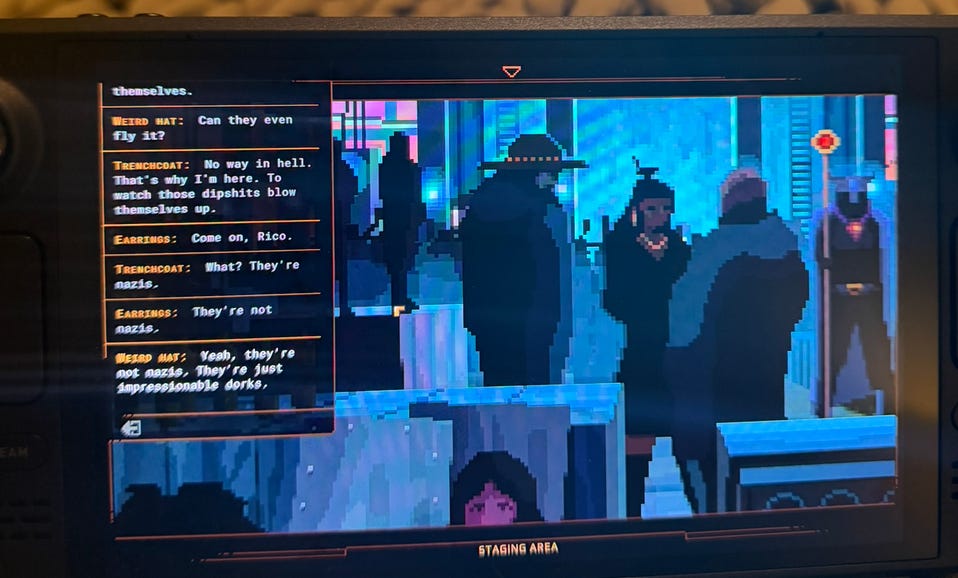
A detour within a detour: there is an obvious missing game here — This War of Mine. If you really want to step into the shoes of human beings managing and surviving through the more realistic dredges of war, play that game. I haven’t written about it because I haven’t fully played it, in some part (okay, large part) because I need to be in a certain frame of mind to do so. In contrast, Norco was ~5-7 hours long, playable on my Steam Deck, and I was traveling.
No posts
Comments
Nothing yet. Say the first thing.
Sign in to join the conversation.