
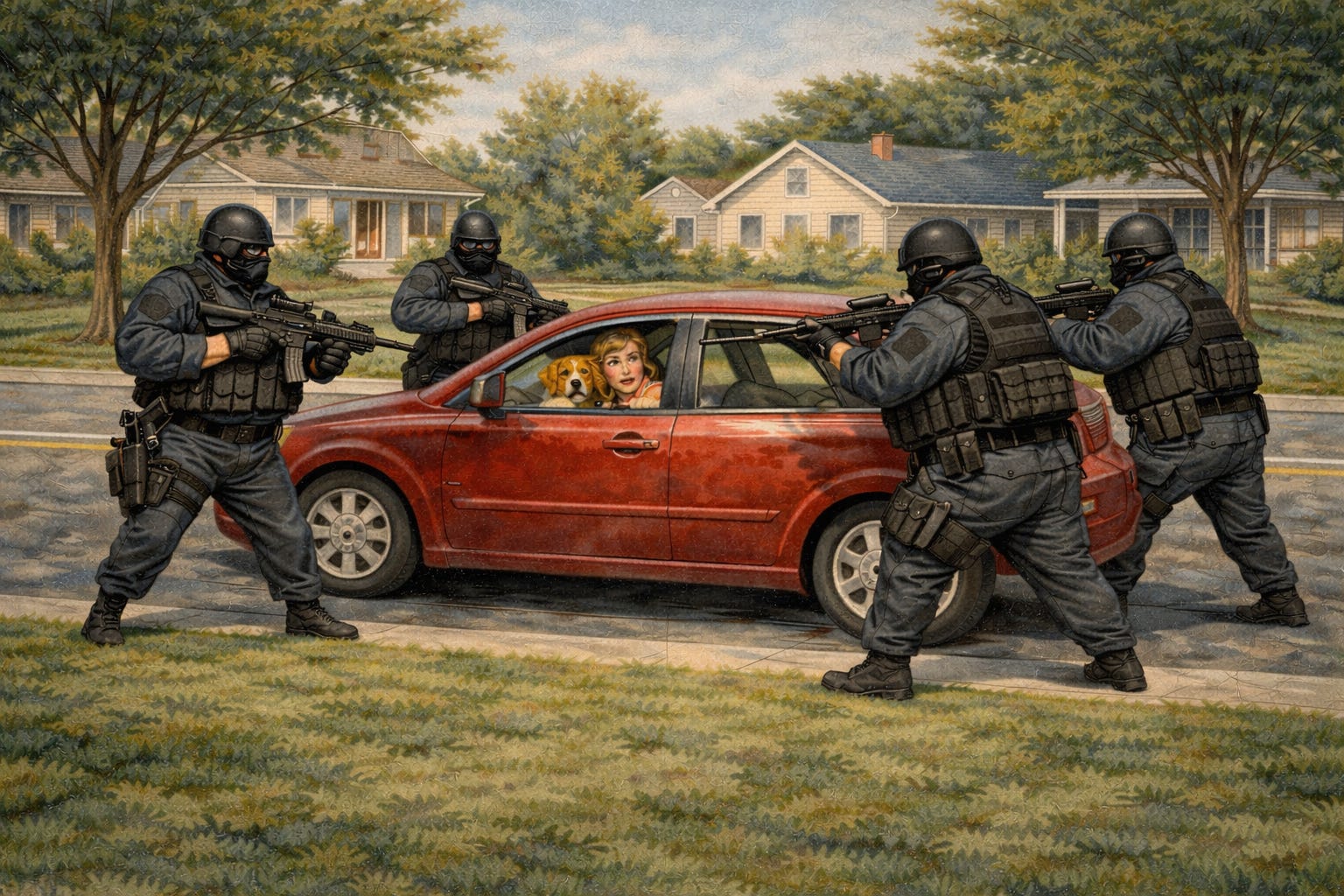
Writing from the hip on this one because it’s my lunch hour, but I recently saw this Department of Labor video which, on its face, isn’t so terrifying, but there was just something about the dystopic musical overlay that made me feel compelled to respond.
Here is what I remember about who we, as Americans, are:
We are in charge. The government has powers and people have rights. Whenever the government acts, it needs to justify itself by showing (a) where that power resides, and; (b) that it was justified in doing so.
We have inalienable rights to life and liberty. We do not beg and plead to keep our lives.
We have a right to our own beliefs and expressions of those beliefs. We do not require permission to publish or record goings-on in public. That includes recording law enforcement.
There has always been a tension between these liberties and safety. Law enforcement occupies a special place in this relationship because we delegate special permission to them to, under certain conditions, restrict liberty (arrest, detain, incarcerate) or take one’s life (in defense of self or others).
The trade-off has always been this: law enforcement is beholden to Americans, typically through courts and the justice system. If we systematically protect them from that accountability, then they, the government, are no longer subject to us.
This is not an indictment of any one law enforcement officer’s character. To the contrary, it has been and should remain a testament to the American project that we can have a professional peace officer corps that embodies honor and bravery, taking it upon themselves to run toward fire rather than away from it. It is a potentially dangerous and scary proposition under any circumstance, and we require that they do it with a thoughtfulness and deliberation worthy of our Constitution and philosophical heritage.
What heritage? This heritage.
John Locke’s Second Treatise of Government (1689) argued that government exists to protect natural rights: life, liberty, property. Authority that violates these rights is no authority at all, and the people retain the right to alter or abolish it. Montesquieu’s The Spirit of the Laws (1748) insisted that power must be divided because power corrupts, and that no single person or body should make the law, enforce the law, and judge under the law. The framers read this and built it into the architecture. Cato’s Letters in the 1720s warned that “only the checks put upon magistrates make nations free; and only the want of such checks makes them slaves.” These essays circulated widely in the colonies and taught Americans to be suspicious. Thomas Paine wrote in Common Sense (1776): “In America, the law is king. For as in absolute governments the King is law, so in free countries the law ought to be king; and there ought to be no other.”
And older still are the virtue traditions that shaped the founders’ understanding of what honor actually means. Aristotle taught that courage is not recklessness but right action in the face of fear, governed by reason and directed toward the good. The Stoics, beloved by educated colonists, taught that self-mastery is the highest form of strength, and that the person who can restrain their own power is more admirable than the person who merely exercises it. True honor, in these traditions, is not about dominance. It is about being worthy of the authority you hold.
These weren’t fringe ideas, and while I quibble with this Administration’s hard-on for their peculiar and revisionist version of the “Western Tradition,” they run through the entire tradition this administration claims to revere:
Cincinnatus, the Roman farmer who was given absolute power to save the republic, then gave it back and returned to his plow. Washington was explicitly modeled on him. Power is loaned, not owned.1
Bracton's 13th-century maxim, later quoted by Coke to King James I: “The king himself ought not to be subject to man, but subject to God and the law, because the law makes the king.”
Aquinas and the natural law tradition: an unjust law is no law at all (lex iniusta non est lex).
The Christian doctrine of imago Dei: human dignity isn’t granted by the state because it precedes the state.
The Magna Carta (1215) was about barons and King John, but it established a principle that echoed for centuries: even the sovereign operates under law. It declared that no free man shall be seized, imprisoned, or stripped of his rights except by the lawful judgment of his equals or by the law of the land. The English Bill of Rights (1689) declared after the Glorious Revolution that the Crown could not suspend laws, could not keep a standing army without consent, and could not impose cruel and unusual punishments. The Virginia Declaration of Rights (1776), drafted by George Mason weeks before the Declaration of Independence, stated that government is “instituted for the common benefit, protection, and security of the people” and that when it fails, the majority has “an indubitable, inalienable, and indefeasible right to reform, alter, or abolish it.”
The Declaration of Independence is not just a soaring preamble. Read the indictments:
“He has obstructed the Administration of Justice.”
“He has made Judges dependent on his Will alone.”
“He has erected a multitude of New Offices, and sent hither swarms of Officers to harass our people.”
“He has kept among us, in times of peace, Standing Armies without the Consent of our legislatures.”
“He has affected to render the Military independent of and superior to the Civil Power.”
This is a document about unaccountable [state] enforcement.
The Constitution’s structure tells you everything. Article I, Section 8 enumerates federal powers, meaning Congress can do these things and no more. The Tenth Amendment makes it explicit: powers not delegated are reserved to the states or to the people. The federal government must point to its authority; it doesn’t have inherent powers lurking in the shadows. Madison wrote in Federalist No. 51: “In framing a government which is to be administered by men over men, the great difficulty lies in this: you must first enable the government to control the governed; and in the next place oblige it to control itself.”2
The First Amendment is the amendment of challenge: freedom of speech means you can criticize, the right to assemble means you can organize, the right to petition means you can demand answers, and freedom of the press means you can publish, investigate, expose, and record. The Fourth Amendment’s demand for particularity, that the officer must say this person, this place, this thing, for this reason, is not procedural fussiness. It is the wall between a free society and a police state. The founders remembered writs of assistance, blanket authorizations that let customs officials search any home looking for whatever they pleased.3 James Otis argued against them in 1761, and John Adams, who watched, later wrote: “Then and there the child Independence was born.”
We remember the Federalists because they won, but the Anti-Federalists (Brutus, Federal Farmer, Centinel) were the ones who demanded the Bill of Rights as the price of ratification. They warned that distant government would become unaccountable government. They worried about standing armies and consolidated power. They were the skeptics, the pessimists, the people who said: write it down, because they will forget.
Fair enough.
Which brings us to this, said on national television by Representative Wesley Hunt:
“The bottom line is this: When a federal officer gives you instructions, you abide by them and you get to keep your life.”
This is the formulation of subjects before a crown. It is the logic of occupation. It inverts the entire constitutional order.
The American premise is not “obey and live.” The American premise is that the officer must justify the instruction, the detention, the use of force, and that we have courts, and rights, and recourse precisely because compliance is not the price of survival in a free society. If mere disobedience, or confusion, or fear, or disability, or the exercise of a constitutional right, can be met with death, and that death is justified by the disobedience itself, then we are not citizens; we are hostages.
There is another way to get people to comply besides killing them: make them afraid. Constitutional scholars call this a “chilling effect,” when government action, even without an explicit ban, deters people from exercising their rights. You don’t need a statute forbidding criticism if people believe criticism will get them killed. You don’t need to outlaw recording if people believe recording will get them labeled terrorists, especially if that label means you can be killed on the street without consequence.
In December 2025, the Foundation for Individual Rights and Expression (FIRE) warned that a DOJ memo from Attorney General Pam Bondi was laying the groundwork to treat “doxing,” including sharing information about the location of ICE agents, as “domestic terrorism.” As FIRE noted, this is protected speech: “The ability to share facts about public employees in the execution of their duties in public spaces is not a gray area under the First Amendment; it’s protected speech.” But the administration has explicitly targeted apps that track ICE activity, pressured platforms to remove them, and threatened their developers with prosecution.4
On January 8, 2026, Renee Good, a 37-year-old mother of three, a poet (scary!), an American citizen, was shot and killed by an ICE agent on a residential street in Minneapolis. She had dropped her six-year-old son at school that morning. She was unarmed. Her last words were “That’s fine, dude. I’m not mad at you.” Within hours, Homeland Security Secretary Kristi Noem called her actions “an act of domestic terrorism.” No investigation. No due process. No evidence presented. A citizen who was simply present, killed and posthumously designated a terrorist by the government that killed her.
And then, in the days that followed, ICE officers asked Minneapolis residents: “Haven’t you learned your lesson?”5
What is the lesson? Don’t watch. Don’t record. Don’t blow a whistle to warn your neighbors. Don’t be present and inconvenient. Or you may be shot, the government will call you a terrorist, and everyone will be asked if they’ve learned.
The First Amendment protects your right to record the police; courts have repeatedly held this. When you film an officer, you are exercising press freedoms, gathering evidence, performing the oldest American function of watching the watchers. When that function becomes grounds for being labeled a terrorist, when the “lesson” we are supposed to learn is to look away, we have forgotten who we are.
This formulation betrays good officers too, and I mean that sincerely rather than as the opening of a compliment sandwich. I like safety and I like liberty. There will always be tension between them, but professional police forces are one of the best structures we have to maximize both: providing the security people need to live free lives without infringement by their neighbors. Government abuse is a threat to liberty, but so is the person down the street. A constitutional peace officer, accountable to the law and to the people, is supposed to protect us from both.
Anyway, America has its own tradition of what law enforcement should be. The first constable in what would become America was appointed in Plymouth Colony in 1632, sheriffs followed in Virginia in 1634, and by 1651 Americans were electing their sheriffs by popular vote. The term itself matters: peace officer, not enforcement officer, not compliance officer. The constable and the sheriff were conservators of the peace, tasked with maintaining the conditions under which free people could live together, not with extracting obedience under threat of death. The International Association of Chiefs of Police Oath of Honor begins with honor, integrity, and public trust, and swears to uphold the Constitution. An officer who lives that oath is not demanding submission but serving a constitutional order that protects everyone, including themselves. ICE officers asking whether Minneapolis residents have “learned their lesson” are not speaking the language of that tradition. They are speaking the language of occupation.
What we want — and what we should remember — is what the Constitution envisions:
A government that acts within the law, that uses force only when necessary and proportionate, that respects rights, that submits to oversight, and that understands its power is delegated, conditional, and subject to review.
Citizens who respect lawful authority, who engage peacefully, who use courts and votes and speech to address grievances, and who nevertheless retain the unshakeable knowledge that they are citizens, not subjects.
That’s what I remember.
Constitutional law is rife with angsting over the technicalities of where these divides our, but for our purposes of Americans, the point is this: generally, if the Constitution doesn’t say the federal government can do it, it doesn’t have that power. I don’t claim that every thing ICE does is violative, but I do claim that we’ll never find out if Americans don’t challenge their unstated and unsubstantiated authority. They simply say “We were afraid” and “You are a terrorist.” My heroes.
I’m honestly a little surprised that even legal commentators don’t pause and go “Wait, what?” when Vice President JD Vance casually mentions ICE going door-to-door. The Fourth Amendment has many exceptions to the point of, well, being a problem (in my view), but it’s still on the government to show that they are conducting a lawful search, not just barging into peoples’ homes.
Calling all tech bros and free speech advocates who were big mad (justifiably!) at jaw-boning.
I couldn’t find a video of this that wasn’t embedded in a third party’s commentary, which is unfortunate, but I did find it on multiple channels effectively all showing the same thing but with different editorializing. Obviously I’m sympathetic to this interpretation.
No posts
Comments
Nothing yet. Say the first thing.
Sign in to join the conversation.