
First things first: rest in peace, Robert Mueller.
When Mueller appeared before Congress to testify about his report, he was criticized on all sides, with whispering in the background that he had lost more than a step. But, in seeking to have his report on the investigation speak for itself, he was trying to play it straight, which has become very hard to do in bent times. This approach could not win the day. Fast forward to today, to the strident, insult-laden, performative testimony that an attorney general of the United States believes it appropriate to deliver before Congress.
To mourn the loss of Mueller and what he represented in our public life is not to suggest that he cannot be criticized for any decision he made as special counsel. There was never any chance that, however his investigation concluded, he would have avoided harsh criticism in his “damned if you do, damned if you don’t” position. But what he discovered is that it is no longer possible for controversial decisions to be debated civilly and fairly while full credit is still given to good faith and professionalism under difficult conditions and in dealing with hard issues.
Robert Mueller was committed to a system that would work if those responsible for it, or called to navigate it through difficult times, served with skill, experience, and integrity. We will soon find out whether American politics have, for the foreseeable future, driven devoted public servants like Bob Mueller from the frontlines in an era when they can expect their work to be derided, their motives questioned, and, eventually, their deaths to be celebrated.
Separate but related, JVL at The Bulwark posed a question at their live show: should we root for America? The initial context was Iran but the conversation zoomed out to the “Are we the baddies?” meme. I took the question, therefore, to mean, should we root for America more broadly rather than should we root for America in Iran?1
I wanted to memorialize my answer here.
I find it so easy to root for the Americans, because to root for us isn’t synonymous with rooting for a particular, discrete outcome — endorsing Iran, for instance. To root for us is to insist on digging our heels in and saying “This isn’t our project.”
And I know the cynical response; I was 13 when 9/11 happened and forged in the fires of touching that stove — believing in my heart of hearts that we were doing the right thing because that’s what we were told. While it probably isn’t fair to blame a tween for being too credulous of her government, the lesson I learned was that American goodness had been falsified. That’s where I lived for a long time. Pride is for kids and suckers.
But now I realize there is a lot of space between administrative malfeasance and genuine evil or cruelty, and when I see that evil and cruelty being enacted ostensibly in my name, my first thought is “No” — no because it is wrong and no because, as an American, our project is fundamentally founded on a rational and enlightened order that we will always fail but nevertheless must strive for, because it’s precisely that momentum that makes us better. It’s not despite our failures but because of them — because people felt the incongruence between what this country claimed to be and what it actually was — that anything ever got better.
Sure, we don’t have a monopoly, but I’ll die on the hill that if we don’t root for the sort of esprit de corps amongst our countrymen, then we’re writing blank checks to the worst amongst us.
Totally unrelated, I spent the weekend playing Crimson Desert on both PC and PS5. I have some thoughts on — or initial impressions, anyway.
Top line: Crimson Desert is a fun game once you get past the 8-10 hours required to get through the tutorials and control mastery. I give it 7/10 now, with a realistic ceiling of 8/10 once patches address the roughest edges — the world is too good, and the “lost track of time” feeling too real, to score it lower, but the story and identity problems run deeper than any hotfix can reach.
For those of you not as hip as me, Crimson Desert is a long-awaited open world action RPG. You play as Kliff Macduff — yes, his real name — is a man with, presumably, internal thoughts and motivations, but ultimately he exists in this game solely as a vessel. His goal is to find his friends.2
I’m being facetious, of course. You can tell the game was intended originally as an MMO precisely because the characters and the story are fairly flat, existing primarily as rails for a player that would otherwise be motivated, in an MMO context, by getting various notches on their belt: acquiring gear, beating bosses, crafting, exploring, etc. etc.
From that perspective — the open world, “Wait, I can really do that?” point of view — the game is, frankly, incredible. All accolades deserved here. The image below is a screencap of the review that got me to purchase the game rather than wait (more on that later) and I think it still rings true:
It’s also graphically gorgeous. This is the first game I’ve had to set on “low” settings of my powerful PC rig. I’ve played on PS5 as well, and it is also beautiful, although the text on my screen appears teeny, tiny.
Having said all of this, the game is not an MMO and was marketed as a AAA mass market game, so I am going to measure it against expectations appropriate for that context.
First, the most divisive issue: the controls.
“Jank” is not a word you may have encountered unless you’ve spent any time on gaming forums or adjacent corners of the internet. Its etymology is, somewhat appropriately, a little rough around the edges. The OED traces “janky” to 1989, classifying it as “US slang (chiefly in African-American usage),” meaning something of poor quality or prone to malfunction. Think of a bicycle with a bent rim. You can ride it, but you know something isn’t right.
In gaming, jank arrived as a catchall for a particular texture of wrongness: the disconnect between what you tell the game to do and what the game actually does. Think of weird animations, unintuitive button mapping, a character who moves like they’ve just remembered they have knees. It often feels like the mechanical equivalent of your eyes being hungrier than your stomach: you want the character to do something but the controls are obtuse or dense and you can’t quite execute with the finesse that the situation requires.
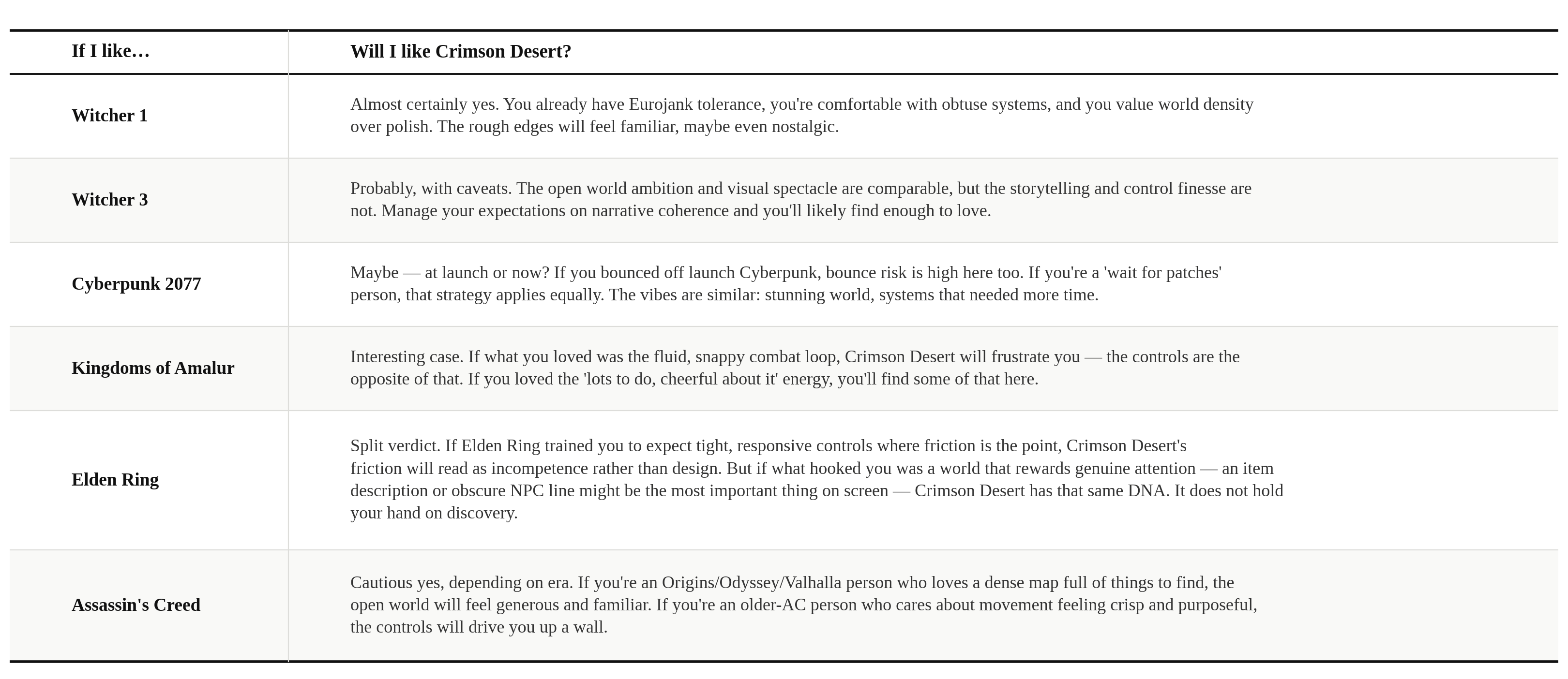
The term has since crystallized into something almost affectionate through a subgenre now called “Eurojank”, i.e., Eastern European RPGs like Gothic, S.T.A.L.K.E.R., and the first Witcher game, which were beloved precisely because of their rough edges. These were games with depth and ambition that outran their polish, and their communities understood the implicit bargain: you will feel like you’re fighting the controls sometimes, and you will love it anyway.3
This matters, because there is a legitimate school of thought — and it is not a stupid one despite my criticisms below — that jank can be a design choice. If the friction is intentional, if it serves the game’s identity or challenges the player in a meaningful way, then “jank” becomes texture rather than failure. Getting Over It with Bennett Foddy is the reductio ad absurdum of this philosophy.
This is the context in which some players have tried to situate Crimson Desert: that it belongs in this specific jank framework, but I personally don’t think it fits.
Here is the relevant distinction: jank-by-design requires intent, and intent requires evidence. It also, frankly, requires some coherence between the friction and what the game is actually trying to do. The beloved Eurojank titles had a specific quality to their awkwardness; it was inseparable from their systems, their world-building, their stubbornly particular vision of what a game should demand of you. The roughness had an author.
Crimson Desert’s controls, by contrast, have been described by reviewers across the spectrum — including people who love the game — as “shockingly bad,” “clunky,” and, in one memorable formulation, as though they “were designed by some creature that doesn’t have hands.” There is no meaningful faction arguing the controls are good; there are only people arguing the game is worth tolerating them for, which is a different argument entirely.
More telling: Pearl Abyss broke its silence shortly after launch to acknowledge that players had experienced “discomfort” with the controls, issue a specific apology to keyboard-and-mouse players, and announce a patch. A studio that designed controls intentionally does not respond to player criticism with an apology and a hotfix.
There is also a reported internal explanation, sourced from anonymous developer accounts: the control scheme emerged from leadership aggregating features from other popular games while suppressing internal criticism — and the story’s incoherence stems from similar dynamics, with the plot apparently not finalized until just before release. I want to be careful here; anonymous leaks are anonymous leaks, and I frankly take these with a major grain of salt. But the shape of what’s described is consistent with what the game feels like to play: not a bold, idiosyncratic vision, but a collection of parts that didn’t fully resolve into a whole, and that much feels credible to me insofar as we know from public reporting that the game genre pivoted.
Which brings me to the thing I keep coming back to in my head. Crimson Desert was marketed as a AAA mass-market single-player RPG, not as an MMO and not as an acquired taste. The audience Pearl Abyss was courting is not the Black Desert audience already fluent in that game’s particular demands. It’s “normie” consumers who were sold a gorgeous open-world action RPG and expected it to behave like one billing at $70 USD. Measuring a game against the expectations its marketing creates is pretty fair. The fact that it takes about 8-10 hours to “get past” or “get used” to the controls is also a bug, not a feature, in this context.
Moving on from controls is basic bloat. Specifically, bloat in UI and UX to the point where it spoils some immersion. I’m persuaded that Kliff needs to learn how to fish, or that he might not know how to mine and has to better understand special precious metals. However, somewhere along the line, the Greymane school system failed young Kliff in that he had to learn about cheese.
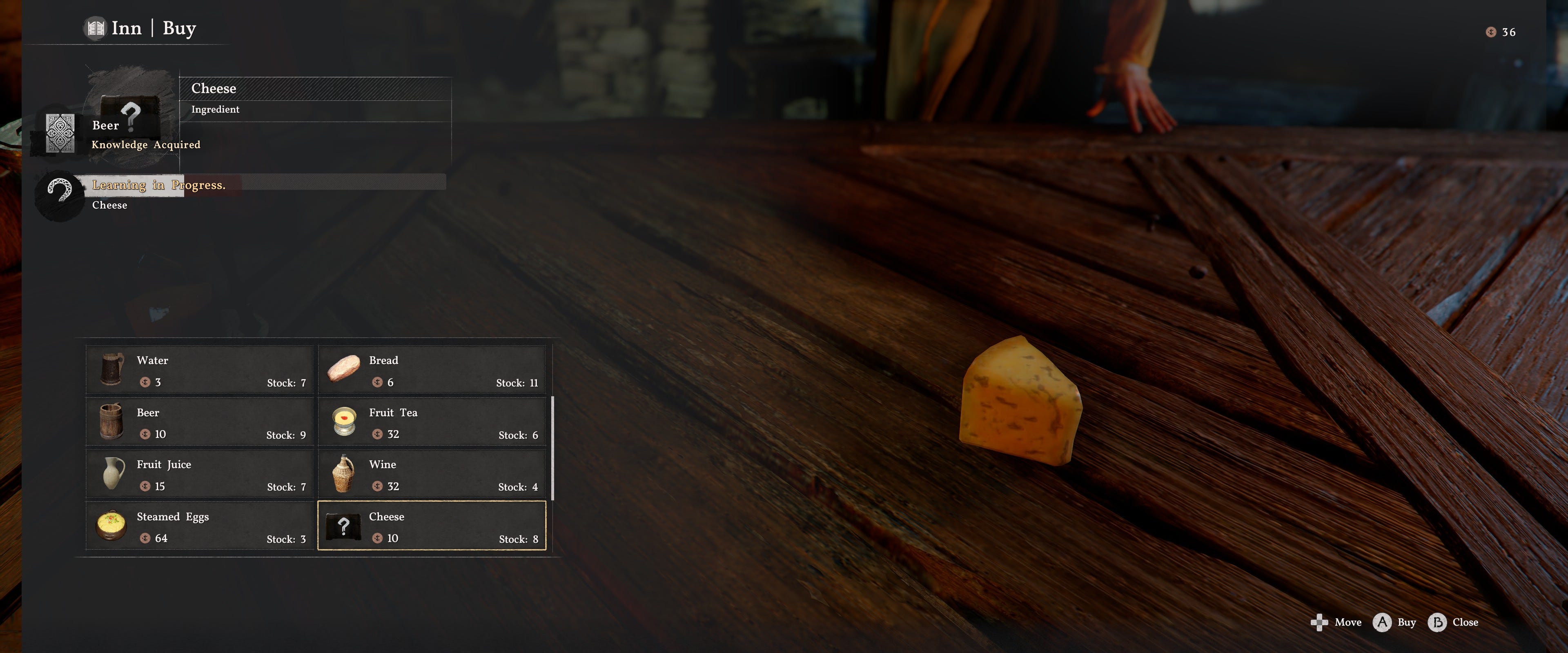
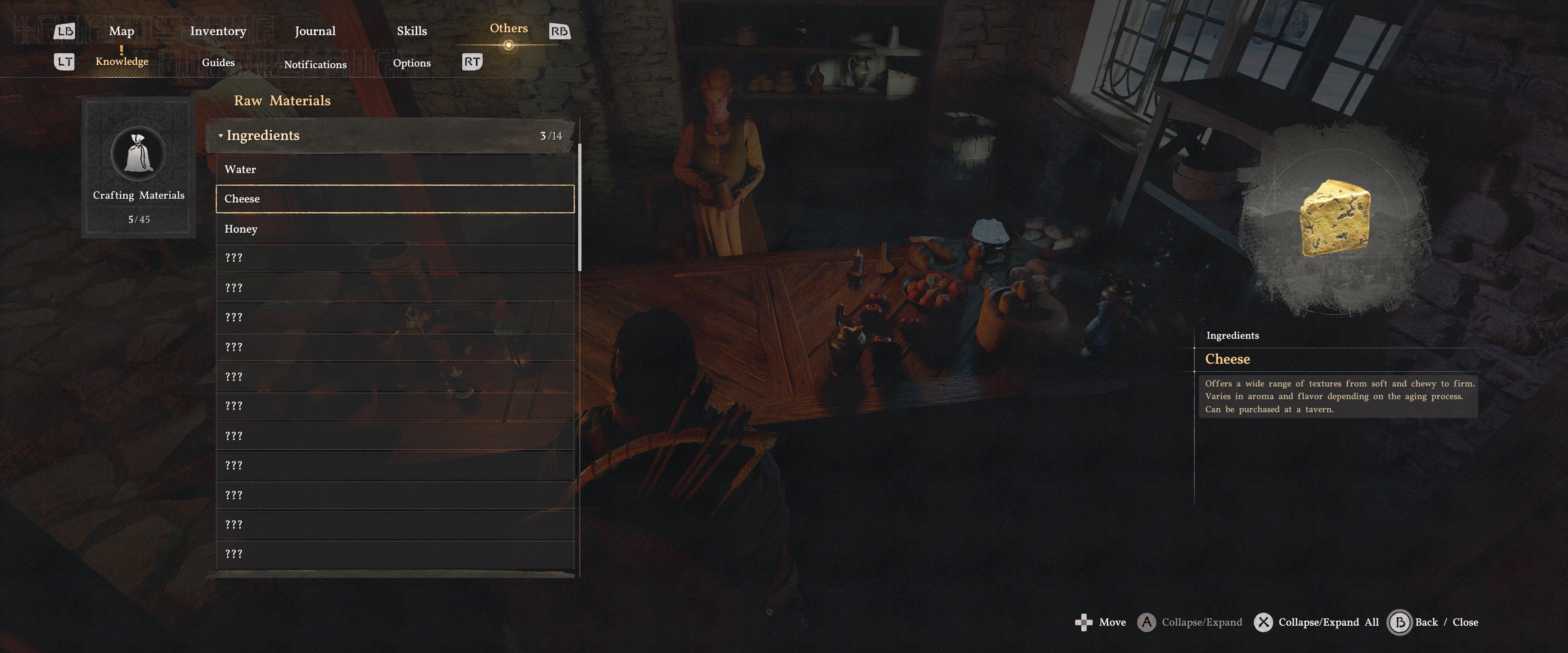
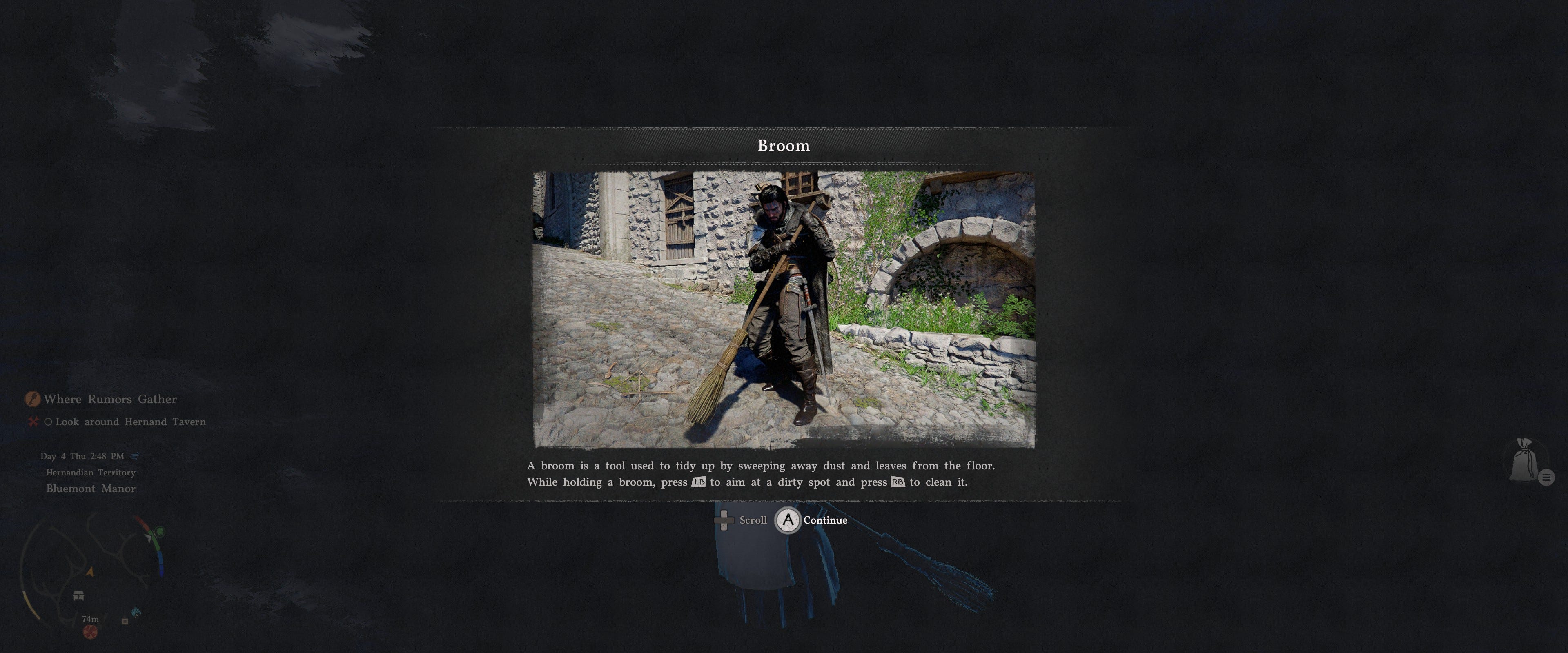
The game is needlessly complicated in ways that work against itself. Things that should take one step take three, and the cumulative effect isn’t depth so much as friction without payoff. Learning what cheese is doesn’t make the world feel richer; it makes the tutorial feel like it was designed by someone who had never considered what a player’s time is worth. The distinction I’d draw is this: complexity that illuminates the world earns its place. Complexity that exists because the system requires it does not.
The game also never quite settles on a thesis statement and it shows. It wants to be an immersive sim, an action RPG, a crafting game, a creature-hunting sandbox, and probably a few other things I haven’t unlocked yet. The ambition is real and I respect it — I’d rather play an ambitious mess than a polished nothing — but ambition without editorial discipline eventually becomes its own kind of bloat. The useful foil here is Kingdom Come: Deliverance. KCD1 was a surprise banger precisely because it had the correct bargain with its audience: this is janky, it is demanding, and it is absolutely worth it. KCD2 knew its positioning going in and was unapologetic. Crimson Desert doesn’t have that clarity, and the marketing — which sold this as a mass-market AAA action RPG — made the gap between promise and delivery harder to forgive.
Kliff himself is the one place where I’d argue the ambition actually undershoots. I’m fine with a settled protagonist, but he’s such a whatever of a guy that I found myself wishing they’d gone the Dragon’s Dogma route and let me build my own character, particularly given how genuinely excellent the armor and cosmetic customization is once you’re in the world. The bones for a great character expression system are there. Kliff is just sort of in the way of it.
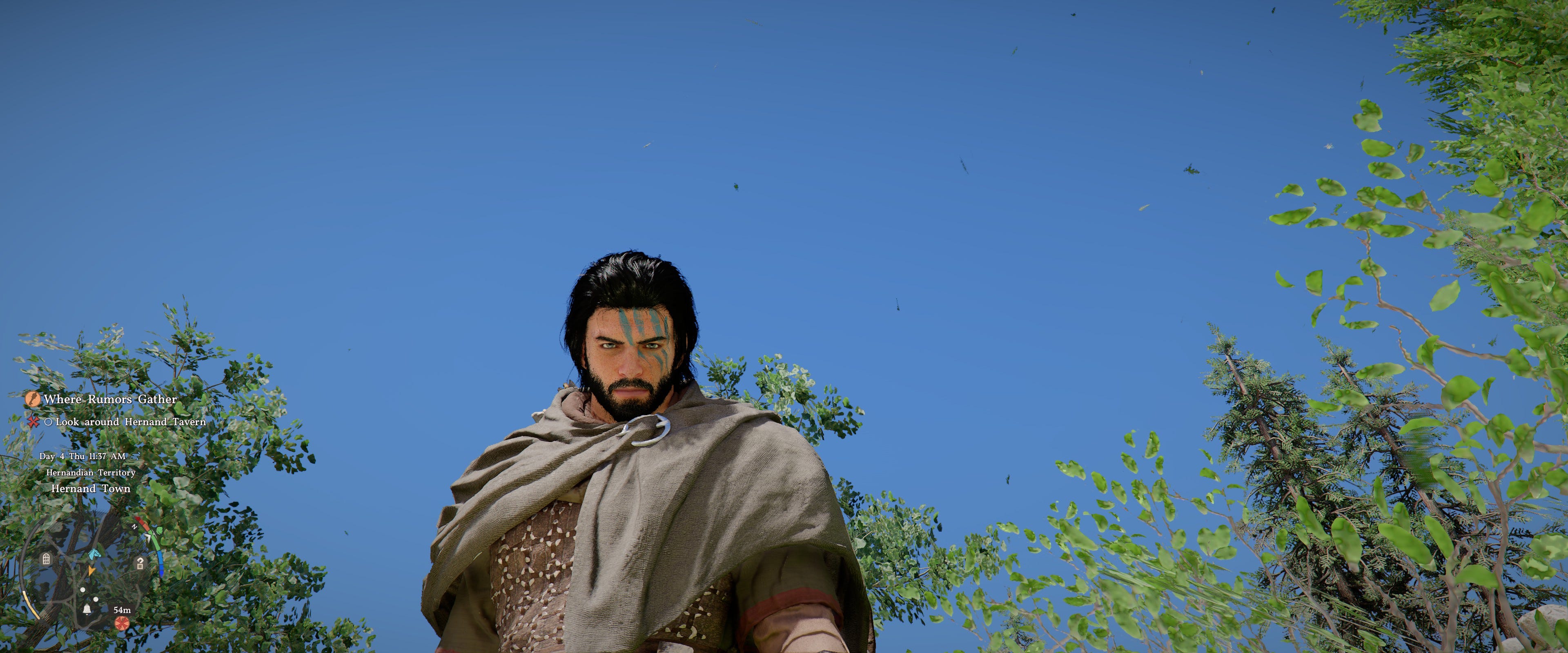
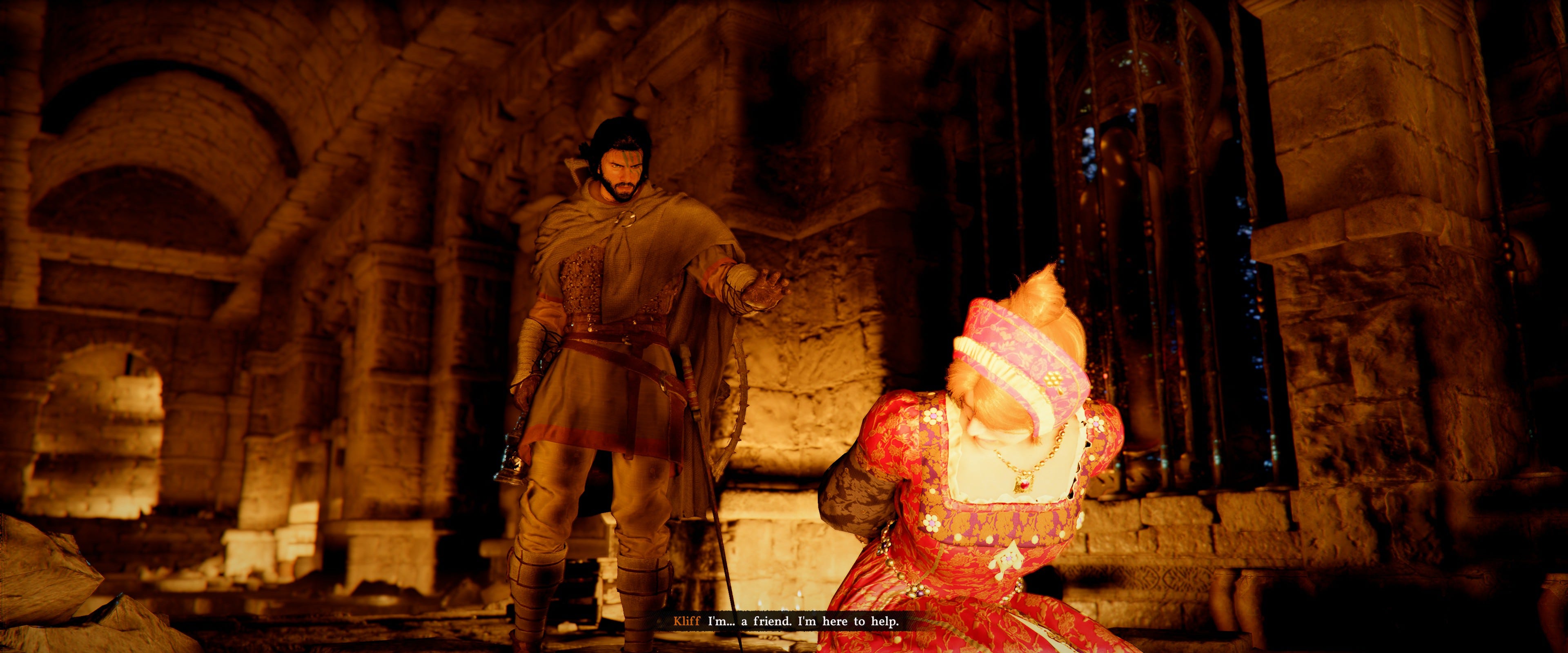
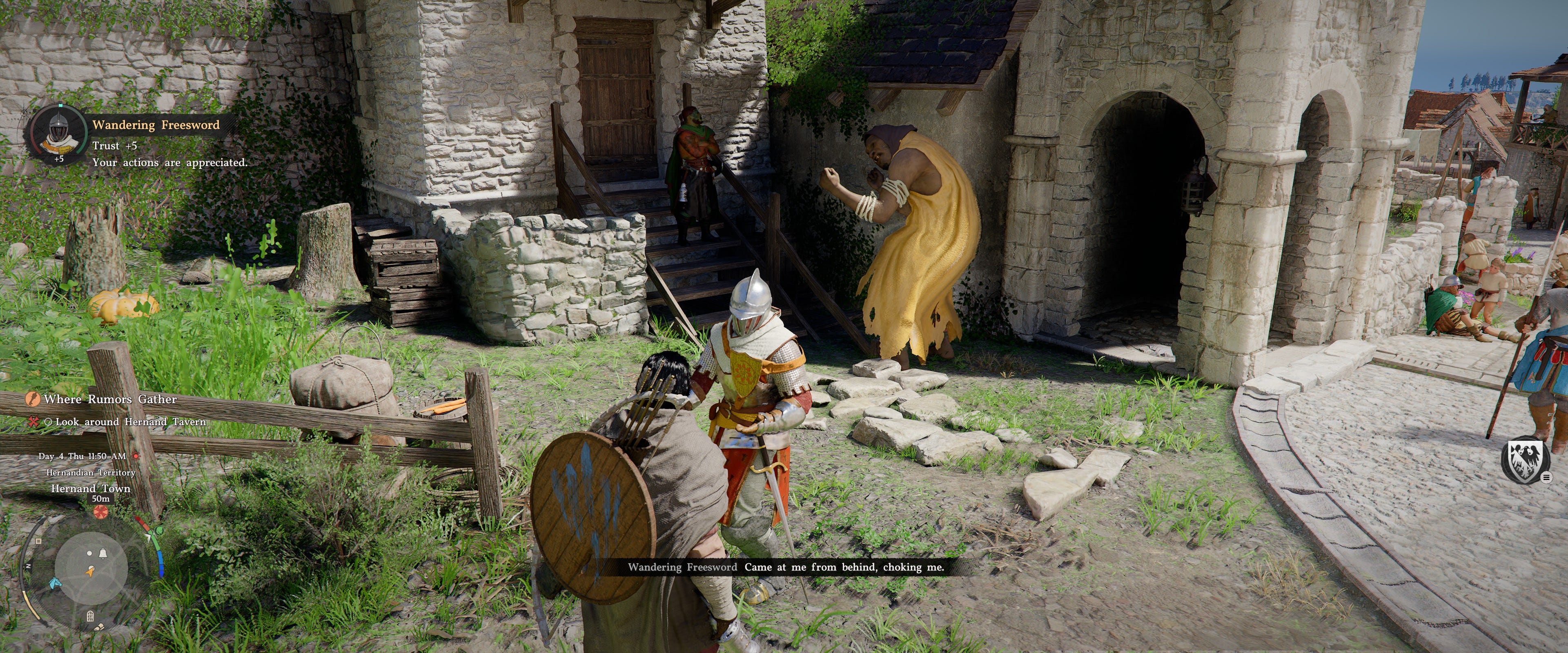
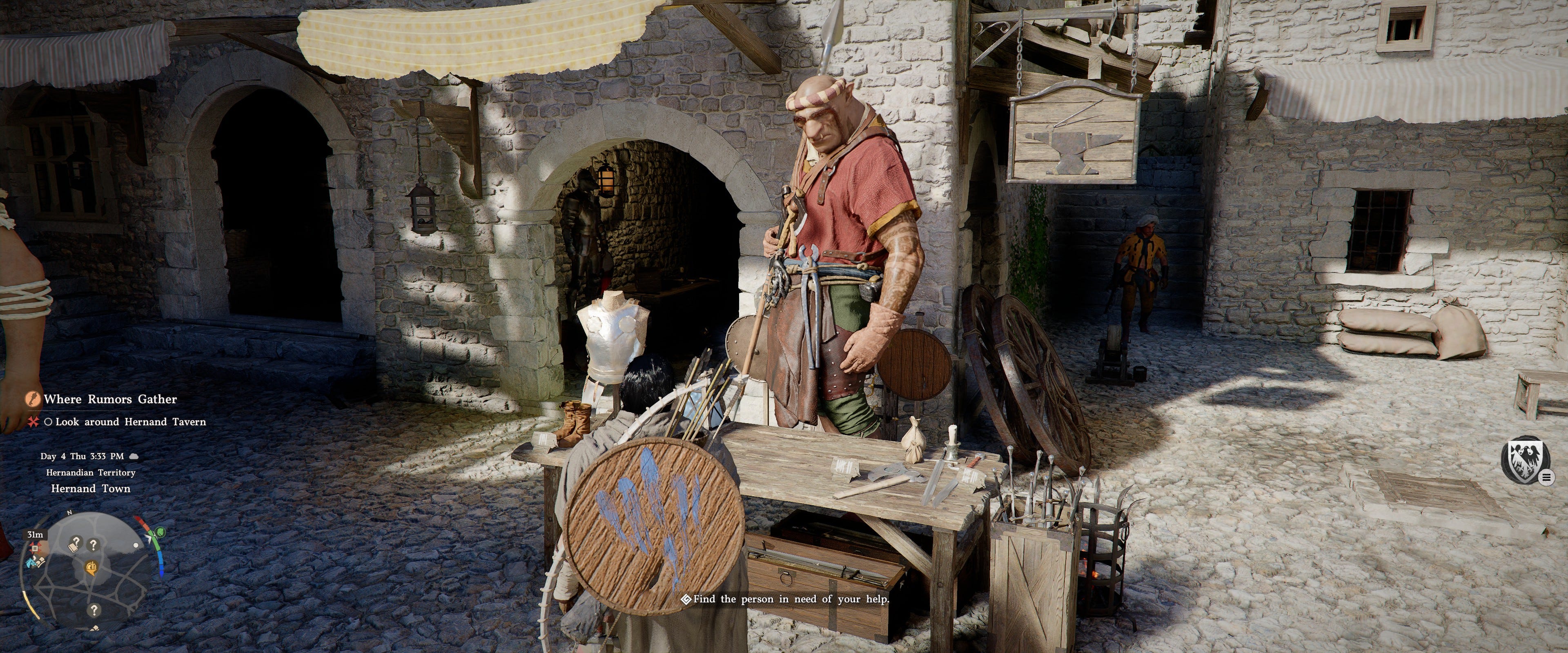
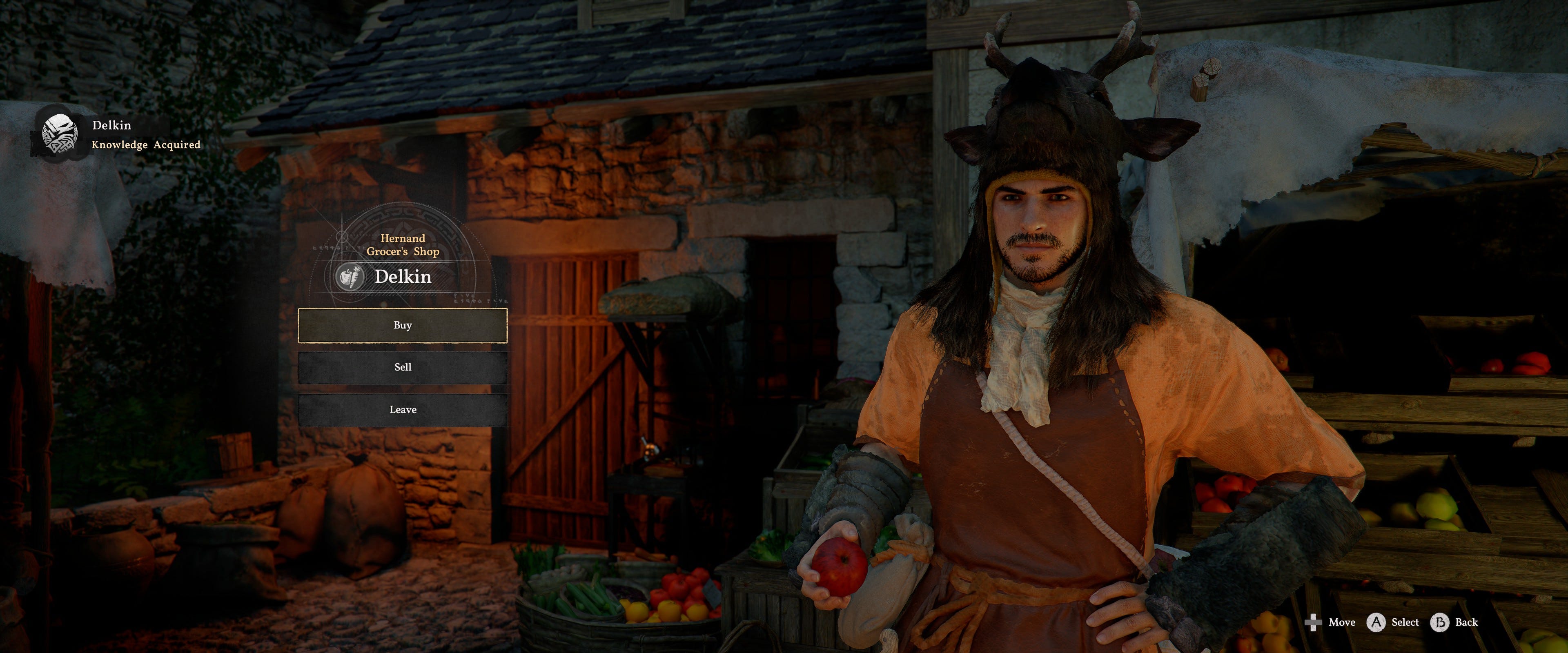
What the world gets right, though, it gets very right. The variety of creatures, characters, and species you encounter while wandering is legitimately impressive — my shopkeeper is sometimes an orc or an ogre (or the QAnon Shaman?), other mercenaries are drawn from every corner of the world, and it all feels inhabited rather than decorated. The environmental systems similarly earn their complexity: if it’s cold, dress for it. That’s immersion through consequence, which is exactly what the cheese tutorial is not.
The map is also one of the best I’ve used in any game. You can isolate sections and get a three-dimensional rendering of the terrain, which is both beautiful and genuinely useful. If you’re a map person — and I am very much a map person — it becomes one of the best tools for organic discovery in the game.
One specific control complaint I’ll single out before moving on, because it matters: do not make your interact button do double or triple duty in a game with fluid, overlapping gameplay states. Discrete mode games — horse controls versus on-foot, for example — can get away with context-sensitive inputs because the player knows which mode they’re in. Crimson Desert doesn’t always give you that clarity, which means trying to greet an NPC and instead pulling out your lantern, or attempting a precision jump and starting a conversation with a wall. That specific flavor of jank isn’t charming, just aggravating, and it’s meaningfully different from the navigable roughness I remember from the first Witcher.
Finally, and this is the thing I keep coming back to: I lost track of time. That’s not nothing. If you’re time-poor, wait for the patches — this game will be better in six months and you’re not missing anything that won’t still be there. But if you have the hours, or if your mode is to pick a game and live in it for a while, the payoff is genuine. Familiarity unlocks this game in a real way. The controls stop fighting you and the systems start to sing. The world, which is enormous and strange and full of things that surprise you, opens up in proportion to the patience you bring to it.
I do root for America in Iran insofar as Iran was a regime that brutalized its own people and I shed no tears for its loss. I also think rooting for America necessarily requires rooting for the Iranian people and taking their well-being into consideration because, ill-advised as this war of choice was, what makes it even more ill-advised is the fact that it probably, net on net, creates more problems for America than it solves. Anyway, this is too long for a footnote to address and not the primary purpose of this post.
I would love a game that riffs off of the book Kings of the Wyld — something of a true “Let’s get the band back together” story that is a play on literal metal bands, except bands of mercenaries. Unfortunately, the cast of characters here is pretty boring.
Further reading on jank: For a taxonomy of the term, Ryan Cooper’s 2018 definition remains the most useful starting point: jank as “a mixture of bugginess, minor glitches, strange animations, bizarre control schemes and any other number of possible occurrences or abnormalities,” and the Game Studies journal published a rigorous academic treatment in 2020 that frames janky controls specifically as a disconnect between input and expected output, drawing interestingly on Android developers’ technical use of the term. For the cultural history of Eurojank as a subgenre, Know Your Meme’s entry is surprisingly thorough. On jank as intentional design philosophy, Josh Bycer’s 2021 piece in Super Jump is the best short treatment.
No posts
Comments
Nothing yet. Say the first thing.
Sign in to join the conversation.