
I sometimes reflect on why it is I care so much about the climate crisis and why I’ve devoted a big chunk of my professional life to thinking and writing about it. Obviously, we should all care—it affects us all—but for most American voters, it barely cracks their top ten issues. In many ways, because of where I live and the resources I have access to, I’m actually more protected from the impacts than most people, so self-interest isn’t what’s guiding me. And judging by the speaking fees Jordan Peterson rakes in, it would have been a better career move to spend my days as a climate denier.
But when I really think about it, the reason climate has become such a big part of my life is probably my father. He was the person who took me on hikes and taught me how to camp and how to start a fire with birch bark. Growing up in the 1990s, my dad was a pescatarian and probably the only adult male in my life choosing a veggie burger over a Big Mac because he said meat was bad for the environment. He taught me how to cook tofu, but he was happy to buy me meatballs from the Italian shop around the corner. I suppose it was his version of “eco-masculinity” (if that’s a thing) that shaped my own.
As a younger man, my dad was involved in leftist politics, especially environmental activism. Occasionally, I’d hear a story about those days: a protest he’d helped organize, bailing friends out of jail. But by the time I came on the scene, this leftism was mostly theoretical. We lived in Brooklyn, with the radio of the family Volvo perpetually tuned to NPR. We were typical, upper-middle-class liberals.
As I got older and started thinking more seriously about my own political committments, I would ponder that gap between the version of my dad I heard about and the one I actually knew: the Deadhead who studied Marxist political economy and was president of the Buffalo Food Co-op—and the bald guy who worked for a law consulting firm and bought candied salmon at Whole Foods. Many children of boomers have probably felt the same way.
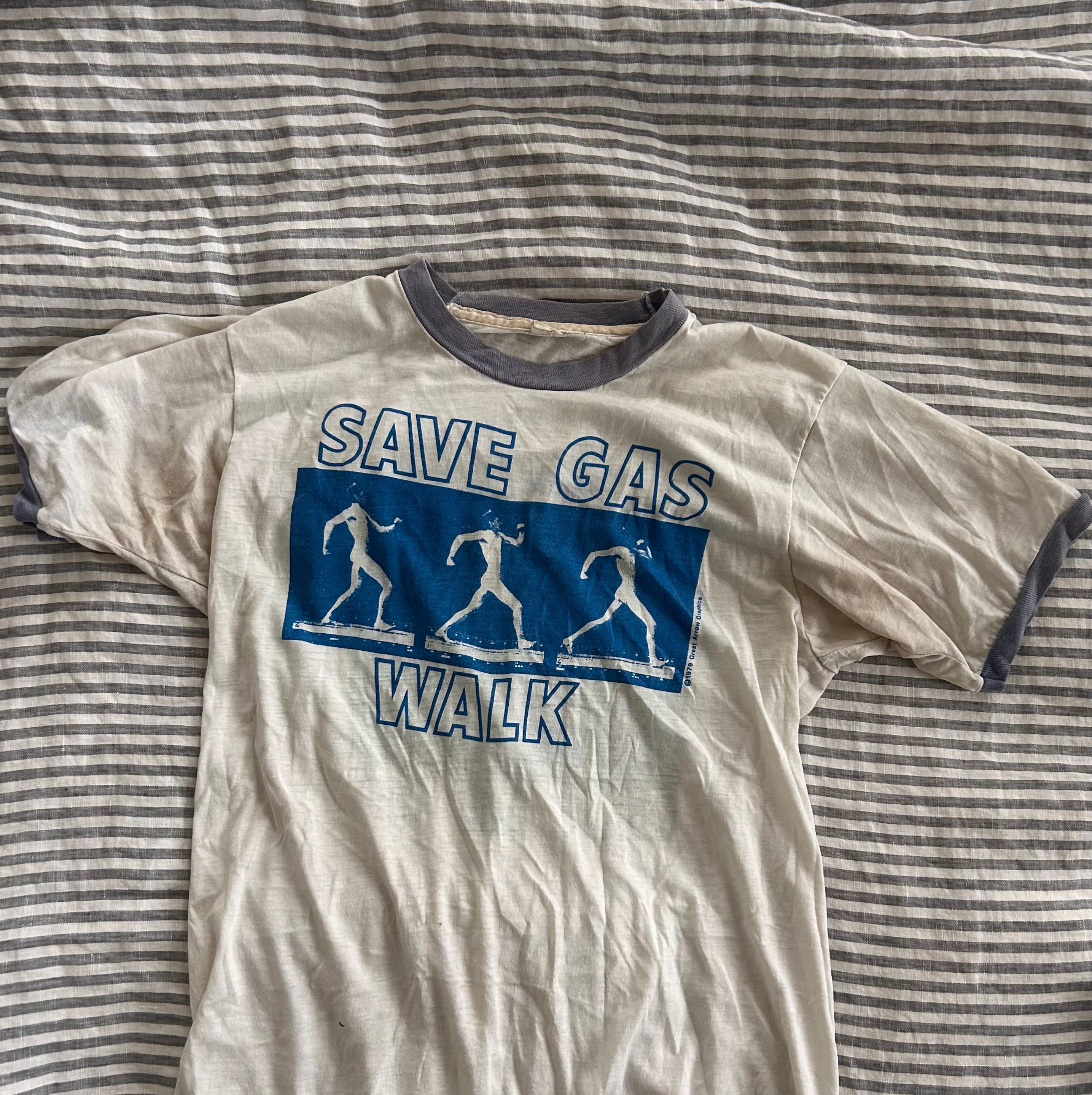
A few years ago, my dad passed away, and when my mom was clearing out some of his old clothes, she found an Earth Day T-shirt of his from 1980, when he was a student at SUNY Buffalo. A naked hippie strides across the chest, like a cross between Leonardo’s “Vitruvian Man” and the guy who has evolved from cavemen in the “March of Progress” illustration. Or perhaps he’s Adam, the first man, unencumbered by the world-changing technologies humanity would invent. Framing this image is the slogan: “Save Gas. Walk.”
This T-shirt is a 50/50 cotton/poly blend so threadbare that I only wear it occasionally. It’s really more of a relic from the era of acid rain, smog, and the OPEC oil embargo. By 1980, there’d been a solid decade of environmental activism in the US, along with years of high gas prices and economic stagflation. The vibe was not so different from today’s. It probably seemed like common sense that gas-powered cars were heading toward extinction. This was the future my father’s generation imagined, but not the one that came to pass. (For more on that subject, listen to my conversation with Nathaniel Rich.)
Today, many of the original concerns animating environmentalism in the US are resolved: acid rain and smog, burning rivers. But the Earth is also about 1°C hotter than it was 46 years ago, and heating up all the time. Plus, we’ve got new things to worry about, like PFAS and microplastics!
The T-shirt’s solution to the problem’s facing the Earth is simple, but maybe a little misleading. Just walk—just choose to reduce consumption. It’s a kind of proto-degrowth message that didn’t play well with the average American voter back then (just ask Jimmy Carter), and it’s getting mixed results today.
Personally, I guess I live up to this mantra, since I don’t own a car. And I’m lucky to live in an incredibly walkable, bikeable city. Still, I realize most people buy cars not because they don’t care about the environment or because they love their driving so much (though some freaks do), but because it’s just the world most Americans are forced to live in. They have to take their kids to school and get to work and pick up groceries somehow. It’s a world designed for drivers, not people, shaped by auto companies and NIMBY city planners, and ultimately paid for with campaign donations from fossil fuel companies.
But it doesn’t have to be that way. I want to live in a world of dense, spongy, walkable cities with lots of solar and abundant greespace. To build it, we’re going to need enormous political power, trillions in public investment, and lots of time. Just ask Malcolm Harris.
I suppose this is the difference between the path so many in my dad’s generation took and the more radical direction of my own. We don’t have the luxury of framing the climate crisis as a matter of personal choice. It’s a collective problem, one that requires political solutions. Which doesn’t mean we can’t take a walk in the woods or tend our own gardens and go to fermentation classes at the library. I love that shit. But I don’t mistake those pleasures for politics. Those are the things we’re fighting for.
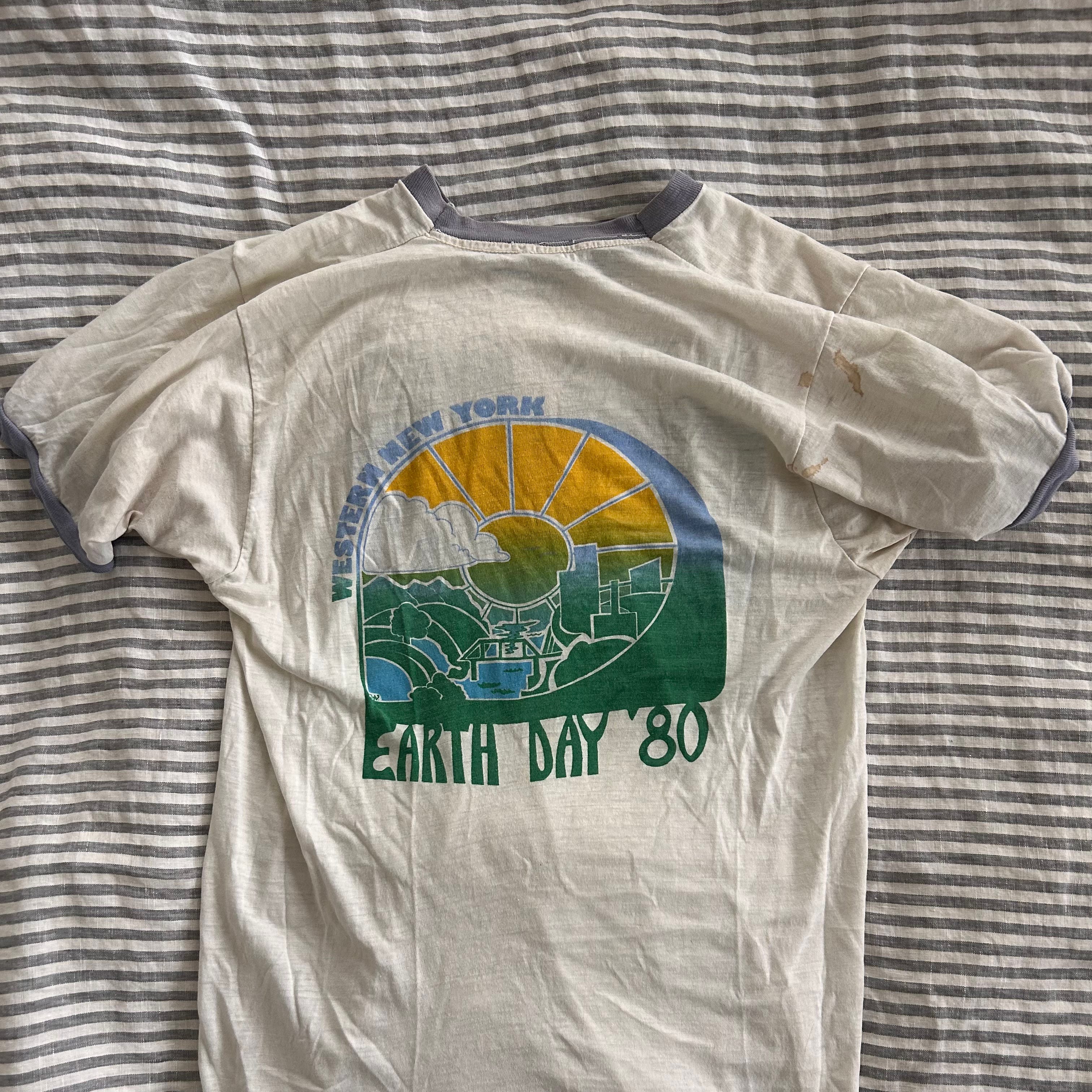
The scale of all of this is hard to wrap my head around sometimes. If we ever do manage to build a greener, more just world, it’s a transformation that will take decades. When I wear my dad’s old shirt, I think about how people in 2072 will look back on this time. Will we seem willfully stupid? Sadistic? Brave? Prescient? What artifacts of this fight will still exist then? It’s hard for me to say for certain, but hopefully I’ll still be around for Earth Day 2072, wearing my dad’s T-shirt from Western New York Earth Day 1980.
No posts
Comments
Nothing yet. Say the first thing.
Sign in to join the conversation.