
In January of this year, I found myself riding a late-night train from Tbilisi, Georgia, to Yerevan, Armenia. It was cold, snowy, and I wanted to become familiar with the inter-Caucasus railway between the two countries as an alternative to the minivan-empowered death-wish excursions that send people on daily suicide runs over the Lesser Caucasus mountains at full speed on mountain roads (see my prior dispatch, “Light Travels”[1]).
My American background has not given me the most robust train travel experience because we love the independence that 5 p.m. bumper-to-bumper traffic jams give us. So being in a sleeper cabin on an aging Soviet-era inter-Caucasus night train was absolutely a new experience for me. There was sparse ridership on this train on that particular night, and I had a sleeper cabin all to myself, which was really cool because I paid the base fare, which amounted to something around $40 to $50 to get back to Yerevan from Tbilisi.
There was still a lot of encrusted snow that I had to trudge through to get to the end of the train, where my railcar was. I boarded the train without any problems, save for the conductor gentleman who was surprised to see an American passport. He looked at my passport, then looked at me, and said, “Amerry-kan?” I didn’t know what else to say but “yes”, and then he motioned for me to get on. Once I went to my seat, I started to wonder who was going to be cramming into my cabin with me, but soon figured out that I was going to be all alone on this journey. I scanned my phone, listened to music for a bit, reconned where the water closet was, then took a trazodone and laid down on the lower rack and went to sleep for a while.
They all needed to gawk at my passport, understandably. But it was about to become way more interesting, at least to them.
Like when you suddenly lose white noise and awaken due to the auditory disruption, I awoke when the train came to a stop soon after midnight. The sleep-inducing hum and rhythm of the tracks subsided, along with the effects of the trazodone. I knew that crossing the border between Georgia and Armenia came with a border security check, so I awaited the moment when the security officers would come to ask for my passport and curiously ask “Amerry-kan?” again. They did not disappoint.
The four Georgian security officers that soon crowded my sleeper cabin curiously murmured “aahhhh, Amerry-kan?” while simultaneously pointing to my backpack with keen interest. They all needed to gawk at my passport, understandably. But it was about to become way more interesting, at least to them. I knew that this sensitive moment would come… the moment when I would unzip my backpack to reveal five brand-new boxes of trazodone, four new bottles of Sinemet, an opened bottle of trazodone, an opened bottle of Sinemet, an opened bottle of magnesium citrate, and a couple others. I was prepared.
Not one of the officers spoke a lick of English, so nothing I said seemed to register except for one word. As a matter of fact, I’m fairly certain that they heard and registered the following utterance from me: “...blah blah blah blah blah... Parkinson’s… blah blah blah blah...” because right after that, at least three of them echoed with absolute clarity, “Parkinson’s?!” Their eyes shifted between me (the Amerry-kan), and a backpack loaded with newly purchased, Russian manufactured pharmaceutical products. It might not have computed for them, as I still look fairly young for my age.
The eldest and seemingly highest-ranking officer reached into my backpack and removed one of the boxes of Sinemet. He opened the box to find an unopened bottle and the usage instructions that come in the box, printed in multiple languages. While he read, I brought out my list of medications signed by my doctor, my newest signed prescriptions, my purchase receipts, and a stamped note from the clinic I went to in Georgia which explained my prescription and was written in Georgian. I told you, I was prepared. Somewhere in the usage instructions, the senior-most officer saw the term “Parkinson’s,” at which point he nodded and repeated the term, then handed the packaging back to me in satisfaction. He looked at my other documents too, without excessively critical scrutiny. I was good.
Everyone had to get out of the train to go through passport control, then get back on again. The train progressed again for about 10 to 15 minutes, and then made a second stop as it crossed back into Armenia for their passport control officers to come aboard and scan and stamp passports. In its entirety, the security, passport, and border checks took over an hour, lasting past 1 a.m. and despite the comfort of my lone sleeper cabin and the lulling motion of the train, the process didn’t make for a restful night. I slept for a few more hours until the train stopped back in Yerevan at around 6 a.m.
You’re probably wondering what the hell any of this has to do with my medication management while living in the Caucasus. I went to Armenia with a six-month supply of Sinemet (carbidopa/levodopa 25 mg/100 mg) and even more of trazodone, the two primary medications that I need. I didn’t originally plan to stay any longer, but when it started to look like I could remain there a little bit longer, I started doing more homework on how I was going to resupply myself. This was actually pretty early on in my trip. I discovered that Armenia did not have Sinemet, but I booked an appointment with a neurologist in order to explore my options.
I went to a neurologist at the Nairi Medical Center in Yerevan. She saw me, didn’t do any clinical evaluation, and asked me what I wanted. I told her that I was staying for “several months” and that I simply needed to update my primary Parkinson’s medication. Many professionals in Armenia speak English, but not her. She became frustrated and called someone who could translate for us both over the phone. There we were, a cell-phone-bound trio, discussing my medication options. They confirmed that Sinemet was not available in Armenia, but its common European counterpart, Madopar, was. The desk/phone duo told me that this was going to have to work since Sinemet was not available anywhere in Armenia. What was I going to say, “no”? So, I somewhat reluctantly took the prescription and picked up my one-month supply at a local pharmacy in Yerevan. I was given NO titration schedule, and all the accompanying drug instructions were in Armenian, of course.
One of my fail-safe plans in this excursion was to start acquiring the new meds well before I ran out of my old reliable. I acquired the Madopar several months prior to running out of Sinemet. That way, I could make the attempt to titrate onto the Madopar and have enough Sinemet available if I needed to relocate or find a more reliably assured solution. This allowance that I made for myself turned out to be a critically important forethought.
Madopar is a widely used and well-established Parkinson’s medication throughout Europe. It is very similar to Sinemet, but instead of it being a mix of carbidopa+levodopa (C/L), Madopar is benserazide + levodopa. The benserazide, similar to the carbidopa of Sinemet, assists in the absorption process for the primary delivery item, levodopa, to get past the blood-brain barrier, just keeping it simple here. I read up on the differences between the two separate medications and learned enough to be comfortable with the prospect of being assigned a new equivalent medication. One excerpt I read even said that benserazide could often be more efficient at assisting the levodopa on its journey, so from the outset, it sounded like a plausible plan. Still, what I most wanted was Sinemet: fewer variables.
I kept looking for solutions to this medication riddle and found out that I could acquire Sinemet in the neighboring country of Georgia, with a local doctor’s prescription. Potentially, I could make an appointment in Georgia and purchase my meds the same day. We’re talking a two- or three-day round trip unless I wanted to stop and smell the roses in Tbilisi for a while. This sounded like it was going to be the solution I was looking for! It sounded like I was just an insane van trip away from my prescription sustainability in the region. I booked an inexpensive trip on the insane-clown bus over the mountains a couple weeks later.
The day came when I made it to the neurologist’s office. The Georgian neurologist actually did an examination! Already on a winning streak, I explained to my English-speaking Georgian neurologist that I had acquired Madopar, but what I really wanted was to stick with what I knew worked well for me with minimal side effects. She gave me good news and bad news: she could prescribe me Sinemet, which was not uncommon in Georgia, but only in a different ratio of carbidopa/levodopa: 25/250.
Skeptical, but relieved that I could find Sinemet, I thanked the doctor and acquired my new prescription at a pharmacy with minimal hassle. It was then that I discovered I could take the night train back to Yerevan and be part of the border officers’ entertainment as an Amerry-kan passenger.
My efforts to acquire a replacement for my most important medication were successful, but neither of the two that I had acquired were exactly the same as what I had been using. I needed to make a decision between Madopar and a variant of Sinemet that had a different C/L mix ratio. The problem with the new Sinemet variant (I’m about to drastically oversimplify here, ok?) is that it had the potential to give me higher dopamine “highs” and lower dopamine “lows”, in effect, higher peaks and lower valleys throughout the day, which isn’t an optimized or preferred “steady” dosage strategy. To clarify, the Georgian neurologist gave it to me not because it was the optimum overall dosing strategy, but because it was literally the only variant of Sinemet she had access to prescribe to me. The Armenian neurologist provided me the Madopar prescription under similar constraints. So, I had two different neurologists prescribing me different medications based purely on what they had access to.
Seeking to avoid the higher and lower dopamine swings, I opted to settle on the Madopar. But again, I hadn’t been given a titration schedule to properly transition from my old Sinemet to it. So, I made my own titration schedule. The original Madopar prescription called for one 50/200 mg tablet four times per day, the same daily dosage schedule as my old Sinemet. I followed a titration schedule that, over the course of four weeks, had me increasing by one 50/200mg tablet per day each subsequent week.
1) Week 1: 1 Madopar + 3 old Sinemet per day.
2) Week 2: 2 Madopar + 2 old Sinemet per day.
3) Week 3: 3 Madopar + 1 old Sinemet per day.
4) Week 4: 4 Madopar only per day.
This all seemed fairly benign to me. I was simply transitioning between two very widely used Parkinson’s medications, right? But then things got weird. For the first week, everything seemed okay, with the exception of just some barely noticeable heart palpitations. Midway through the second week, the heart palpitation events were definitely pronounced, to the point that I decided to not go to the gym one day and instead remained in my apartment to lay down. Madopar had been the only variable, so I stopped it immediately. …Ever heard of Occam’s Razor?
An ER physician, several years ago, told me that Occam’s Razor was “alive and well in medical diagnostics”. Occam’s razor is the rule of thumb that, when two explanations fit the facts equally well, the simpler one is usually the better starting point. For example, if you saw a horse hoof track on a dirt road in North America, Occam’s Razor would lead you to start with the idea that someone was simply riding a horse there previously, not that a zebra escaped a zoo. It had to be the Madopar.
My attempt at transitioning to a different medication so that I could consider remaining in the Caucasus failed in a very decisive and unmysterious way. But this wasn’t a personal failure. It was just a signal for my next course of action. The window of time that I had left for myself to readjust my nomadic plan was about to be clutch. My original tentative plan was to leave Armenia around January and relocate to France. By February, I had three weeks of my ol’ reliable Sinemet left. I left myself an “out,” and it was time to use it instead of introducing even more variables, namely medication changes, into my life. I knew from my prior planning that I could obtain Sinemet in France. My long-stay visa for France was just waiting to be used, so I methodically wrapped up my loose ends, said goodbye for now to my new friends, and dispatched this Amerry-kan to another new adventure.
In our endeavors to hold back the Leviathan, eliminating risk variables and flux typically leads one to stay safely and predictably in our most accommodating environment.
I keenly realize that to many of my fellow countrymen and Parkinson’s combatants, all of this sounds absolutely insane. In our endeavors to hold back the Leviathan, eliminating risk variables and flux typically leads one to stay safely and predictably in our most accommodating environment. I fully respect that, I get it, and I will be there soon enough as well. We all have to negotiate our own risk assessment matrix and accept the results. I like to imagine a simple X/Y graph that illustrates “Personal Boundary Expansion/Beginner’s Mind Iterations” running horizontally on the X axis, and “Risk of Wasting One’s Life” running vertically on the Y axis. It’s my Jonathan Livingston Seagull[2] graph. It looks like this…
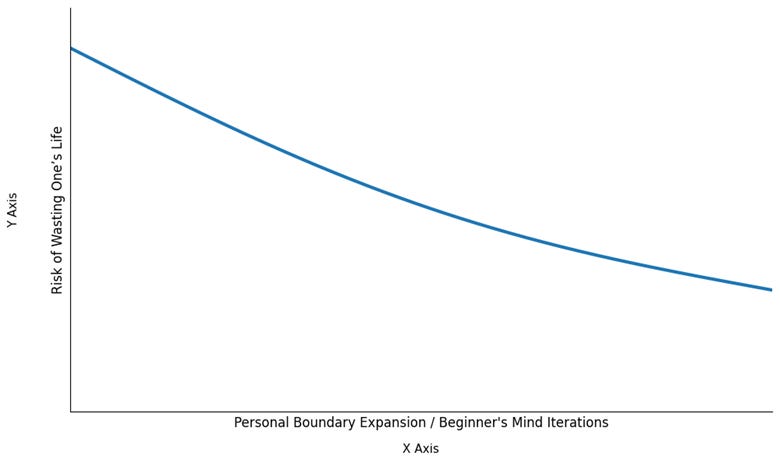
Instructions in a foreign language, having to consider a change in medication(s), taking a cross-border train with hopes of getting the right meds, getting two different prescriptions from two different neurologists in two different countries, making your own titration schedule, heart palpitations, changing course due to side effects ...all of these are add-on “risks” that come with a nomadic lifestyle, all of which would be avoided by simply staying at home. Life in the Western world’s medical system usually prevents self-induced perturbations such as this. You might say that all of this flux is ridiculously superfluous and more responsibly avoided by not exposing myself to these risks, and you would be absolutely correct. But for me, remaining in my safe place back in Amerry-ka absolutely came with a risk too, a quietly desperate one… and I can’t accept that risk right now.
This is the Nomadic Parkinson’s Dispatch.
[2] Bach, R. (1970). Jonathan Livingston Seagull. Macmillan.
No posts
Comments
Nothing yet. Say the first thing.
Sign in to join the conversation.