
First off, no amount of biometric tech does a bit of good amid breaking your hip or getting a traumatic brain injury. In this dispatch, we’re going to explore some of the “Healthspan” features of the particular brand of biometric tech I use, but before I open that door, I just want to show you a picture of what I would call a treacherous and potentially life-altering stairway. Please see Exhibit A…

I FELL DOWN THIS STAIRWAY. Not because of Parkinson’s, but because it had a river of ice flowing down it! See it accumulated down the very center? I didn’t even step on that part! The ice was sheeting much of the rest of it. Lucky for me, my ass bounced just once or twice before I was able to quickly grasp the handrail and recover… still to the apparent horror of the guy who was walking up the stairs simultaneously. You should have seen the look on this other guy’s face, though. Let me see if I can get AI to generate a believable recreation of the moment….

Joking aside, this is one of the principal ways for Parkinson’s people to end up on their deathbed. Falling accounts for 4–10% of PD deaths[1][2], with choking and aspiration being the leading cause. The only preventative measure I could have (and should have) taken was grasping the handrail prior to approaching the edge of the steps. In the aftermath, I was actually quite fine; I continued on to the gym and did my daily routine. This might have been a different story if I weren’t fit. But I still feel this encounter on the backside of my thigh …
Wear them for the general trends…
Biometric wrist straps and other tech have flooded the marketplace with many different platforms and levels of functionality, to the point that they have now become (for some) an obsessive distraction and source of stress in and of themselves. If you have OCD and seek perfection with biometric tech, you just may make yourself a biometric basket case. Don’t miss the point of the overall strategy with these devices and apps! Use them to learn about your glaringly obvious pitfalls, areas for improvement, and also to learn about what your lifestyle changes are doing for you. Wear them for the general trends, to find axes of improvement, and sure… to log workout and fitness efforts too. Unless you are using these devices in concert with a physical trainer and/or a physician don’t obsess over them! Again… generalities, major pitfalls, and trends.
Whoop doesn’t give me a dime- I’m paying for it, so this isn’t a veiled advertisement. I really like using a Whoop strap and the accompanying app to identify Parkinson’s-relevant general health trends, like I have already described in this prior essay here: Data Tools My Neurologist Never Talked About[3]. The data I glean from it has dramatically changed my perspective on multiple lifestyle factors, including sleep discipline, alcohol intake, and physical exertion goals.
A particular data-driven function that I like about the Whoop application is Healthspan. In my own layman’s terms, Healthspan aligns all of your fitness performance data, sleep performance data, and strain (exercise) data in order to give you two (algorithmically derived) measurements: Your Whoop Age and your Pace of Aging.
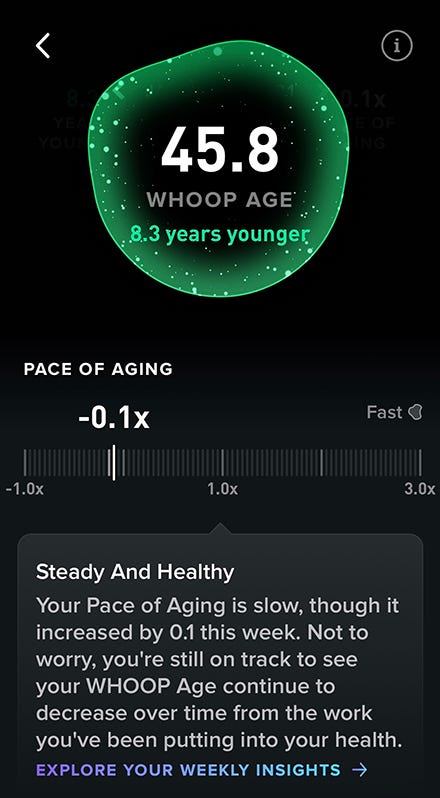
According to Whoop’s own description “Whoop Age gives you a quantitative measure of how your body is actually aging using your sleep, exercise, and fitness patterns over the last six months.” In other words, this is not a measurement where you can turn things around on a dime and get instant accomplishment gratification! This exactly corresponds to my previous statement of using biometrics to monitor overarching trends. Also, if you desire, you can identify which particular biometric drivers (sleep/exercise/fitness data) are influencing your Whoop Age positively or negatively with close granularity… which ones are pushing it up, and which ones are driving it down.
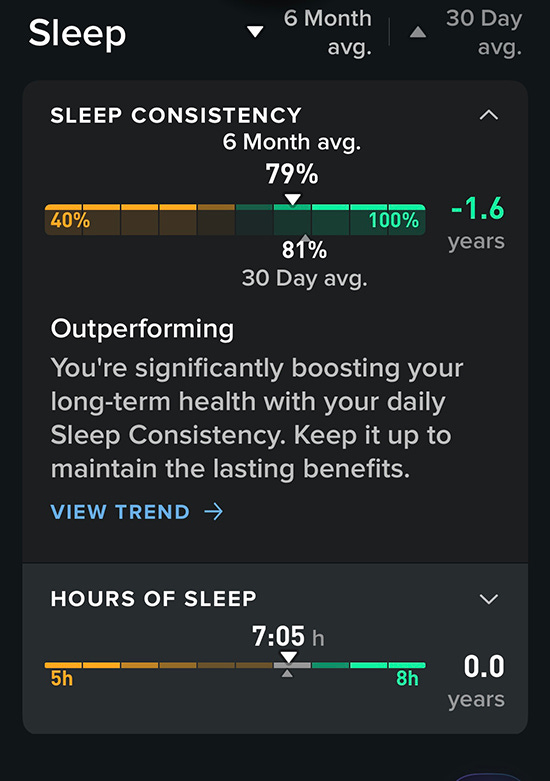
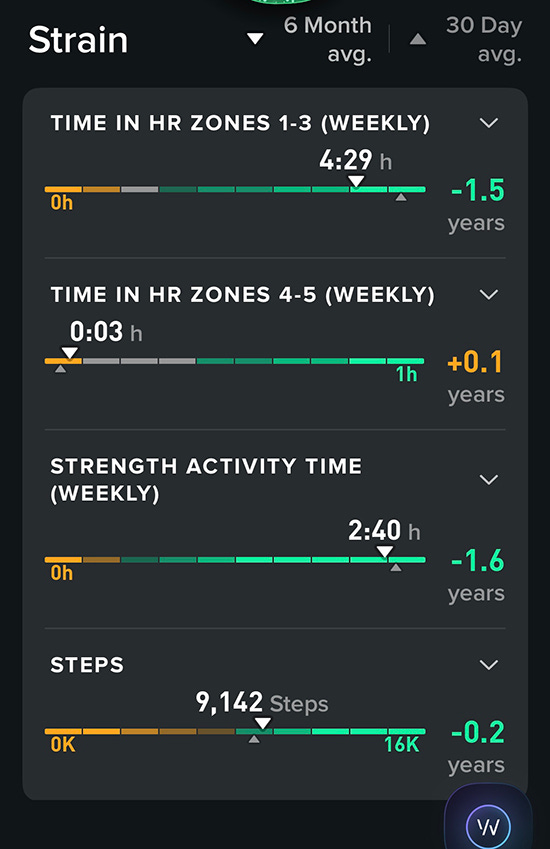
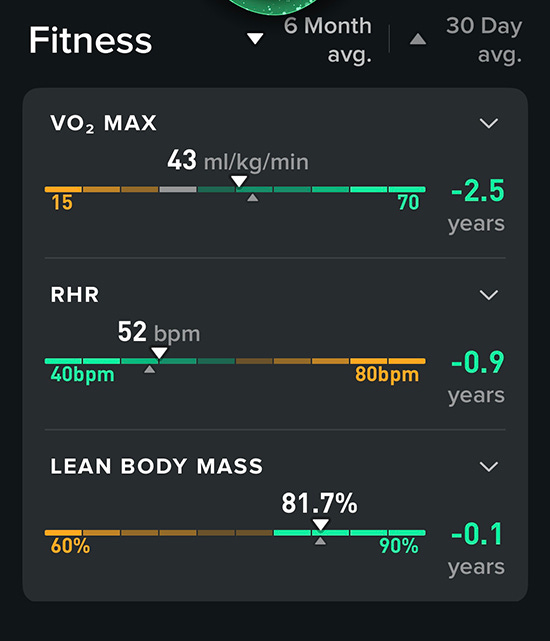
Two years ago, amidst my less disciplined workout schedule and sleep patterns, I was showing a Whoop Age that was higher than my actual age. I was a 52-year-old with something like a 55-year-old Whoop Age… not good. Now, due to discipline in exercise, sleep habits, weight loss, resultant lean mass, and several other data-driven factors… I am sporting a Whoop Age of 45.8. …I am actually 54. Here is a list of all of the data points Whoop collects in order to give you both your Whoop Age and Pace of Aging (including screen shots):
Sleep
1. Sleep Consistency
2. Hours of Sleep
Strain (Exercise)
1. Time in Heart Rate (HR) Zones 1-3 (Weekly)
2. Time in HR Zones 4-5 (Weekly)
3. Strength Activity Time (Weekly)
4. Steps (Daily average)
Fitness
1. VO2 Max
2. Resting Heart Rate
3. Lean Body Mass
Six months of these biometrically collected data points are amalgamated and compared to Whoop’s proprietary algorithm and drive your resultant Whoop Age to what you get. Another way I think about this is just a conceptual bell curve graph: if your Whoop Age is reflecting the same physical age that you actually are, then you are at the midpoint of the bell curve. If your result is younger, you are on the left (healthier than your age peers) of the bell curve. If your result is older, then you are on the right (less healthy than your age peers) of the assumed bell curve.
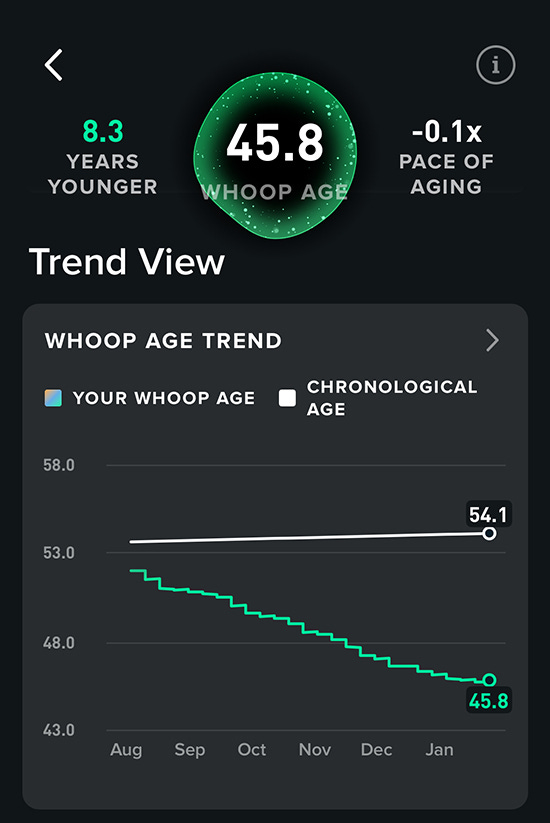
Secondarily, there is Pace of Aging, which is NOT based on the last six months of data but on your last 30 days of data. What Pace of Aging reflects is the rate-of-change to your Whoop Age. Initially, during my early (and most dramatically different) lifestyle changes, my Pace of Aging was far more dramatic, approaching a -0.8 at certain times, but that rate-of-change is not sustainable indefinitely, which is why I am currently around -0.1. Still, anything with a rate-of-change below zero is definitely sending your Whoop Age in the right direction… lower. Soon, I anticipate both of these numbers to level off at a reasonable level. Expecting an indefinite -x reading for your Pace-of-Aging would imply that you were continually applying ever-more exercise, more sleep, and ever-improving physical data measures and that would obviously not be perpetually sustainable. There are only so many hours in a day to do more, and your body eventually runs into the limits of what is physiologically possible and sustainable. As I said before, don’t obsess over these things; just use them as a positive, over-arching tool with which to identify your most glaring opportunities for improvement.
This is not tech-induced obsession with algorithmic perfection; this is disease management and trend awareness.
As a Parkinson’s combatant, I want to know what is happening to my sleep over time, since the disease progression attacks one’s sleep machinery. I want to see what’s happening with my cardiovascular health with regard to resting heart rate, VO2 Max (maximum aerobic capacity), and lean body mass, because these are prime contributing factors to my body’s health (the best defender of my brain). Further, as a Parkinson’s combatant, I want to monitor my quantity of physical exertion every week in order to correlate my exertion trends to these other critical health measurements. All of these things help mitigate the worsening pathology already at play in my brain.
These trend analysis advantages have helped me identify, before anything else, what I needed to do to protect my sleep, what my habitual workouts were doing for my cardiovascular health, and I have reason to believe… the slowing of my disease progression. This is not tech-induced obsession with algorithmic perfection; this is disease management and trend awareness. If you are already healthy and aging gracefully, exercising regularly, at a healthy weight, and getting a clean picture from your physician, then these biometrics would probably be superfluous to your already well-honed lifestyle. I, however, don’t have the extra-wide margins of physical (or neurological) forgiveness that I used to have. Therefore, I watch it a bit more closely.
Holding back the Leviathan that is ever peering over our shoulders and stalking us in our tracks is always subject to our own personal risk analysis, how much marrow we want to suck out of this life, and how much self-awareness and exertion we discipline ourselves with daily. Maybe biometric tools can take you to the next level?
Or maybe you’re doing well enough just to avoid the icy steps that come into your path, or at least hang onto the railing before you commit… you’ll be smarter than me if you do!
This is the Nomadic Parkinson’s Dispatch.
[1] Bloem, B. R., Hausdorff, J. M., Visser, J. E., & Giladi, N. (2004).
Falls and freezing of gait in Parkinson’s disease: A review of two interconnected, episodic phenomena. Movement Disorders, 19(8), 871–884.
https://doi.org/10.1002/mds.20115
[2] Pickering, R. M., et al. (2007).
A meta-analysis of six prospective studies of falling in Parkinson’s disease. Movement Disorders, 22(13), 1892–1900.
https://doi.org/10.1002/mds.21598
No posts
Comments
Nothing yet. Say the first thing.
Sign in to join the conversation.