
In March 1970, the holy ground of Thekchen Chöling in Dharamsala was transformed into a vast gathering place as approximately 30,000 Tibetans from India, Nepal, and Bhutan assembled for the first Kalachakra teachings conferred in India by His Holiness the 14th Dalai Lama. The Kalachakra, or “Wheel of Time,” initiation is one of the most significant and complex of all Tibetan Buddhist Tantric empowerments, traditionally extending over ten to twelve days of preparation, teaching, ritual and initiation.
My mother and I were among the many pilgrims who attended, having traveled from Chakrata, a military town located about 435 kilometers southeast of Dharamsala. I was not yet three. My mother, now 88 years old, is deeply religious, like most Tibetans of her generation, and holds a set of beliefs, a few of which, can verge on the superstitious.
Toward the end of the teachings, she encountered an incident that unsettled her. As we sat tightly packed among thousands on the teaching ground, a woman stepped over me while trying to pass through the crowd. My mother immediately grew anxious; she believed that stepping over a person seated on the ground was inauspicious and could bring misfortune.
Her fears seemed realized when I came down with a fever the following day, forcing us to return home before the conclusion of the teachings. Even more troubling – though my mother could never prove any connection to the Kalachakra incident beyond a mother’s strong hunch – was what followed. The fever gave way to febrile seizures, some mild, others terrifyingly severe, that came and went over the next three years, causing my parents immense distress.
The seizures dominated my life. Since my father was away most of the time for work, he rarely witnessed my convulsions – my limbs stiff as a rod, my body burning with fever. We sought help from every direction: doctors, healers, and lamas. My mother had respected teachers perform several rounds of mo (divination) and held shabten (prayer ceremonies) at home, praying for my recovery. My parents had me wear amulets and sacred threads around my neck to ward off harmful spirits. One high lama even gave me a new name and instructed my parents to dress me only in yellow.
One weekend morning, my father came home with a guest – the legendary Major General S.S. Urban, commanding officer of Establishment 22, where my father served. General Urban was a Sikh gentleman, and to borrow a Trumpian turn of phrase, he was “central casting.” I’m sure the General’s imposing presence and unexpected arrival had little to do with what happened next, but barely had he begun sipping his tea when I collapsed under the force of another convulsion.
After being briefed on my condition, the General recommended that I see his guru, Sri Sri Sitaramdas Omkarnath, whom he affectionately called “Baba”, who had an ashram in Rishikesh.
I had one darshan (audience) with Baba ji. He was a renowned spiritual figure who traveled widely across India and was constantly surrounded by devotees. After the initial consultation, he instructed that I visit his ashram every four to six weeks to meet with his staff. What I remember most vividly were the tiny pills he prescribed – small white pellets kept in slender glass vials. They resembled little pearls and had a sweet taste, which made taking them enjoyable. I was also placed on a strict vegetarian diet for the next two years.
My poor mother bore the brunt of my temper tantrums over the dietary restrictions. In a family that ate meat daily, she had to devise elaborate schemes to keep me compliant. She would feed me first, then send someone to take me out for a walk while the rest of the family sat down to eat. By the time we returned, she would have aired out the kitchen and dining room so that no trace of the meat’s aroma lingered. But I had a keen sense of smell for a three-year-old, and more often than not, I could still catch the faint whiff of momo or meat curry that my siblings and others must have so deliciously enjoyed while I was given vegetables and potatoes. I was quite a handful, and in managing me, my mother had to draw on a deep reservoir of patience she perhaps didn’t even know she possessed.
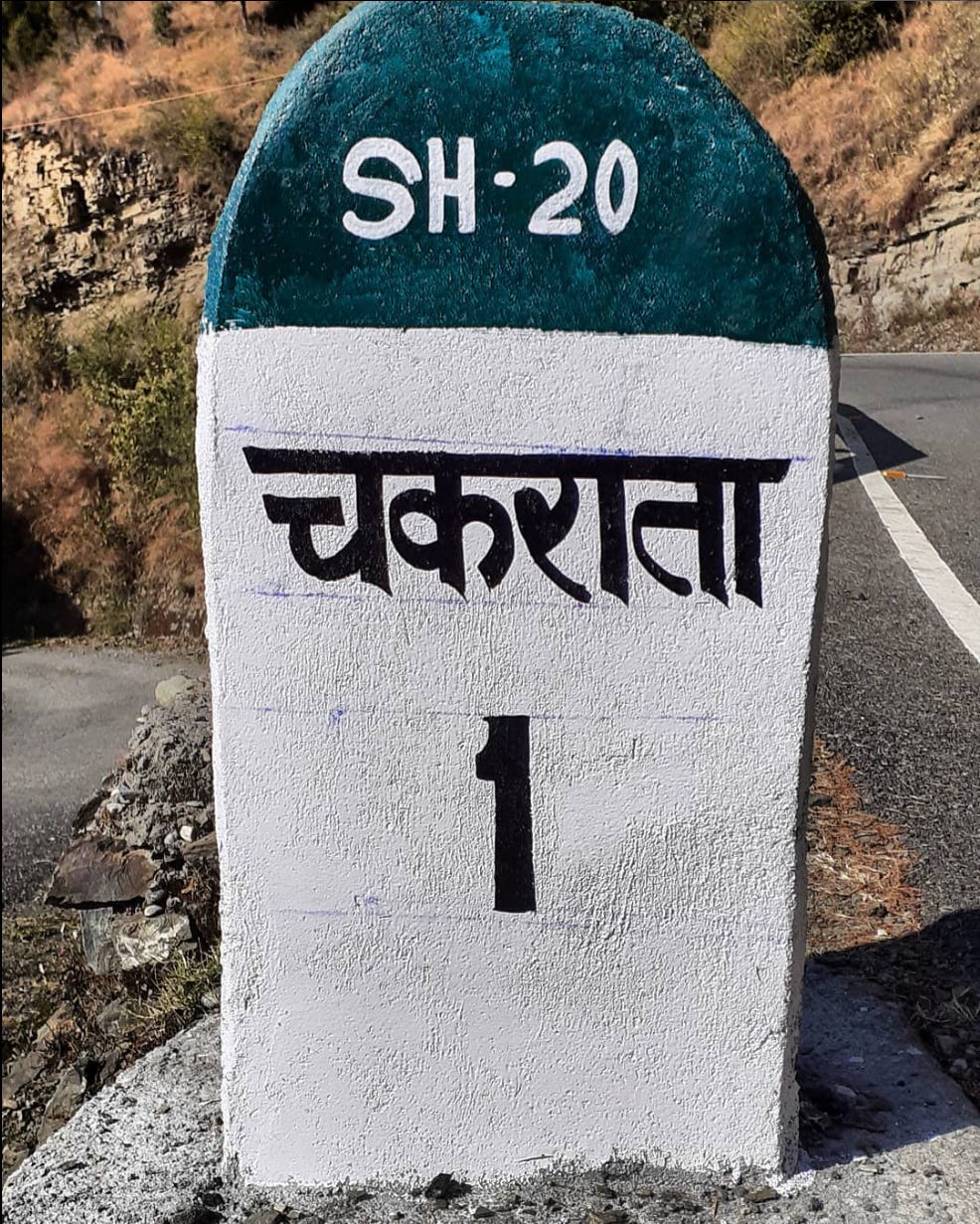
The cantonment town of Chakrata sits perched at about 7,000 feet, while Rishikesh, on the banks of the Ganges, lies roughly 130 kilometers away. The first stretch of road – about 44 kilometers from Chakrata to Kalsi, another cantonment town – wound through steep mountain terrain along a narrow, one-way route. Traffic from both ends moved in convoys at alternating intervals, which meant travelers had to plan their journeys carefully around the convoy schedule.
It was time for yet another visit to the ashram in Rishikesh. That morning, I waited for my father near the convoy departure point while he stopped by his office. We had planned to leave with the early morning convoy. The journey and the consultation typically consumed the entire day, allowing us to return just in time for supper.
As departure time approached, engines rumbled in the crisp mountain air. My father was, as usual, running late – but normally he would appear just as the military police at the gate began signaling for the convoy to move out. This time, however, there was no sign of him. The minutes ticked by. The gate opened, the vehicles rolled forward in formation, and the convoy departed – without us.
About an hour later, my father’s jeep finally pulled up. The military had recently issued him a brand-new vehicle: an earth-colored Willys CJ-3B, produced under license in India by Mahindra & Mahindra. Compact and sturdy, it had two open doors in the front and a narrow seat behind for two passengers. My father jumped out, offered a quick apology, lifted me onto his lap, and we sped off. Military vehicles were exempt from the convoy system and could use the road at any time.
I’m an uncle now to an adorable nephew and niece, ages three and one. Their father would probably have a heart attack if he ever saw how we traveled that morning. There were four of us in the jeep, and not a single seatbelt among us. The vehicle, though rugged, had none of the safety features that come standard in today’s cars – no airbags, no restraints, nothing but faith in the driver and a firm grip. My father had me seated on his lap in the front seat, my small hands clutching the metal hand bar in front. He placed his large hands over mine, and together we held on tightly as the jeep roared down the winding mountain road.
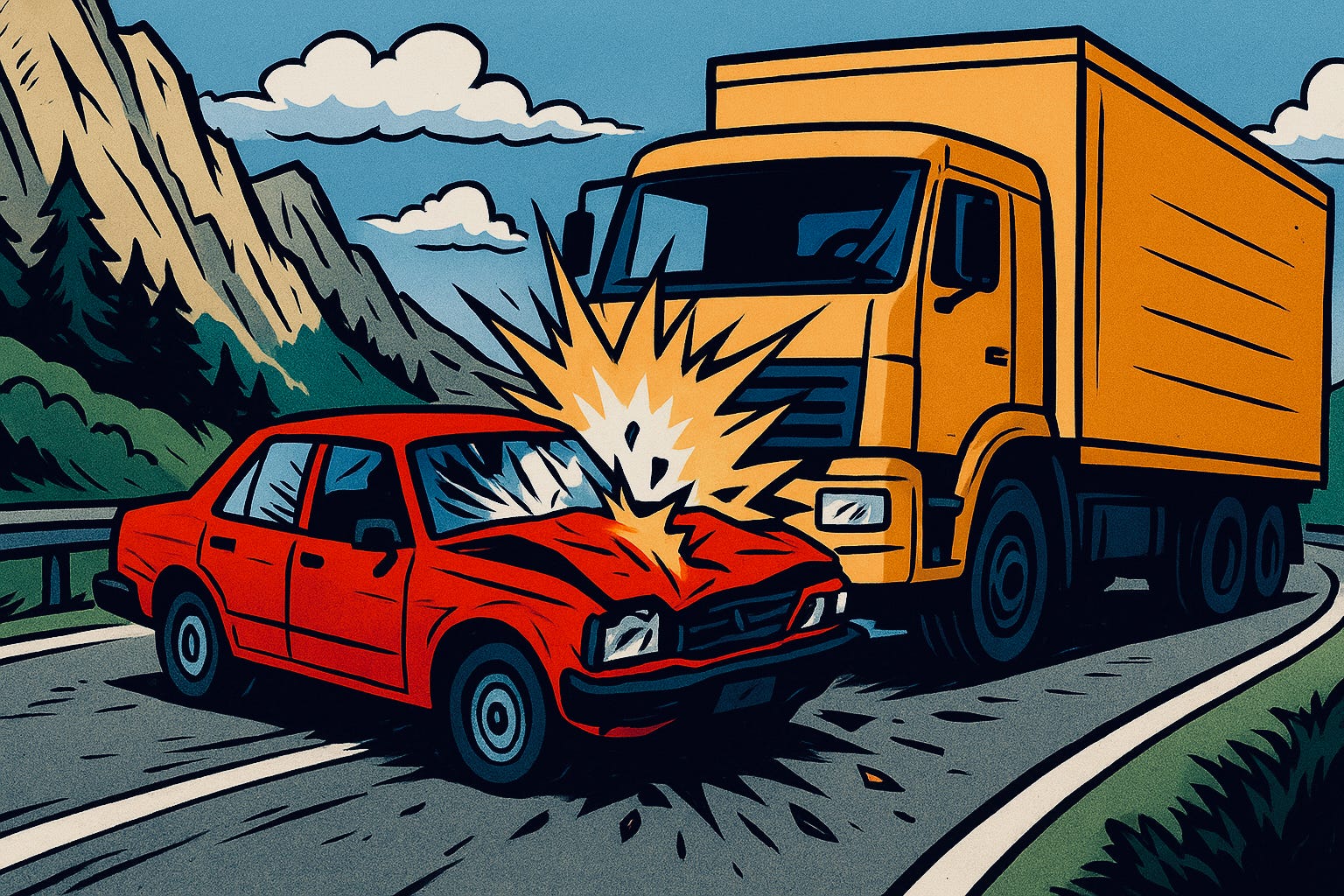
We were probably doing over 80 kilometers an hour. The driver, perhaps anxious to make up for lost time, pressed harder on the accelerator as the narrow road snaked downward. Then, around a sharp bend, everything changed. Out of nowhere, a utility truck – also exempt from the convoy system – appeared, climbing uphill in our lane. The driver, in a desperate act of self-preservation, jumped from the moving jeep, leaving the rest of us hurtling forward.
The mountains erupted with the screech of twisting metal and the explosive crack of shattering glass. The impact threw me forward. The windshield shattered, and tiny pieces of glass rained across my face. Tiny fragments embedded in my cheek; others cut across my father’s temple. I remember the metallic taste of blood and the ringing in my ears that drowned out every other sound.
When I turned, dazed and crying, the man seated behind us was slumped forward, his forehead split open from the force of the blow against the metal frame of our seat. I could see white bone beneath the blood. It felt unreal – like time itself had paused in that thin mountain air, holding us between life and death.
My father’s firm grip on me, and the fact that we were both holding on to the metal hand bar, saved us from being flung through the windshield. Other than the cut on my right cheek, I was miraculously intact. My father wasn’t as lucky: blood trickled down from a gash at his temple, and both his knees were damaged, injuries that never fully healed.
When we stumbled out of the wreckage, our driver was sprawled on the ground, clutching his legs and moaning in unbearable pain. It was a performance worthy of a Best Supporting Actor award. Beneath the theatrics, though, I could see the fear in his eyes, as he was probably thinking of what kind of punishment awaited him for abandoning the wheel.
We were extraordinarily fortunate. The jeep hadn’t flipped on impact, even though the crash site overlooked a steep valley that would have swallowed us whole. The rugged build of the Willys CJ-3B had likely saved our lives.
The jeep was so badly mangled that the front section, including the engine, had crumpled inward and twisted slightly to one side. The steering wheel jutted out grotesquely, bent at the edges. Later, the wreck was towed to Kalsi, where Establishment 22 maintained a major auto repair workshop, but the damage was beyond repair. The mechanics could do little except strip it for parts. In the end, the military had no choice but to consign the vehicle to scrap.
The utility truck we had collided with was a Tata lorry loaded with heavy telephone cables. Aside from a small dent on its front bumper and a few bent flag poles, it had sustained only minimal damage. Though the accident had clearly been our driver’s fault, the men in the lorry looked more frightened than angry when they realized they had collided with a military officer’s vehicle. They stepped out quickly, apologizing profusely, and began helping in whatever way they could.
We had no proper first aid supplies, but the lorry driver improvised a crude, if painfully effective, remedy to stop the bleeding. He dipped cotton balls in petrol, set them alight, and pressed the small flames onto our open wounds to cauterize them. The searing sting is something I still remember. A few hours later, word finally reached army headquarters, and a rescue vehicle was dispatched to take us to the military hospital for treatment.
That night, lying in a hospital bed with my face bandaged and my father resting nearby, I remember staring at the ceiling and feeling, not in words but in the vague awareness a child possesses, that something immense had brushed past us and moved on. It would be years before I understood it as the second time death had come close, looked me over, and turned away.
The wounds eventually healed, though even weeks later, my mother would still find tiny shards of glass in the cut that became a faint but permanent scar on my cheek. My father received a new jeep and a new driver (the old one escaped with nothing more than a stern reprimand). Later, when I asked him what kind of vehicle he had been given, he said it was the same model as the one destroyed in the crash. I told him, with all earnestness a child can muster, “Pala, you should get a Shaktiman instead.” The remark drew a quiet smile from him.
(Shaktiman trucks were widely used by the Indian armed forces but were finally phased out in the late 1990s.)
No posts
Comments
Nothing yet. Say the first thing.
Sign in to join the conversation.