
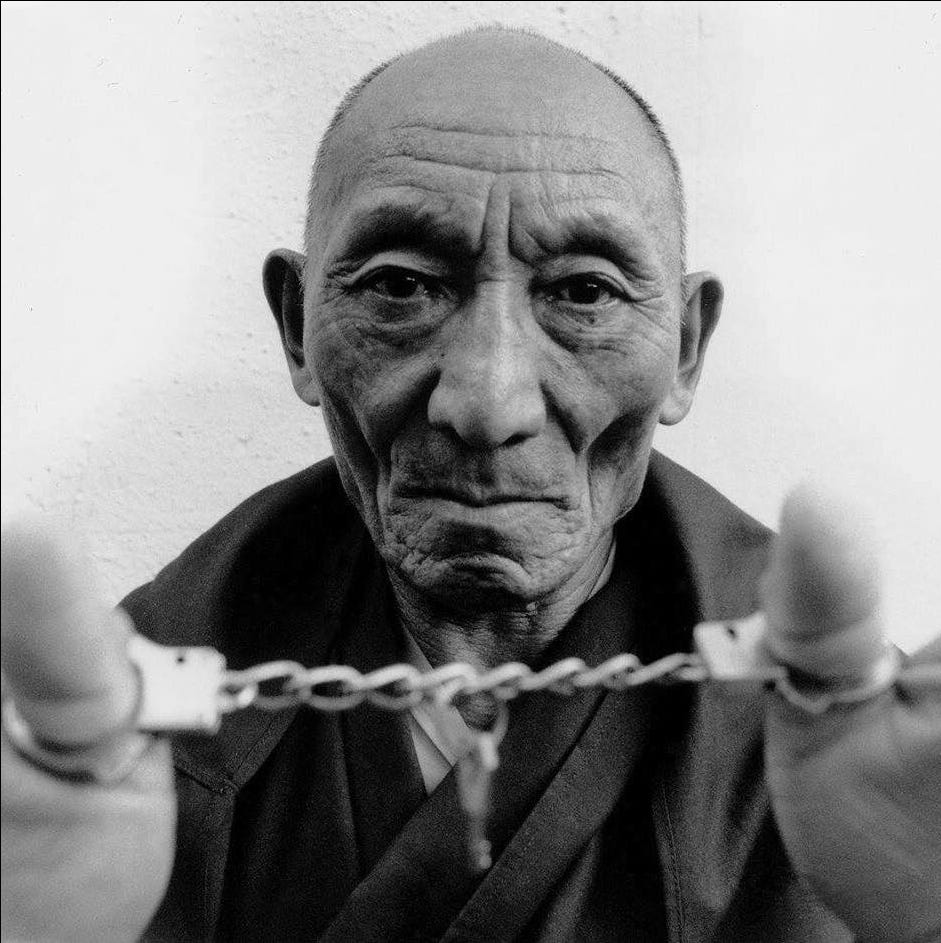
“Oppressors will always deny that they are oppressors. All I can do is bear witness and set down what I saw and heard and what the strange journey of my life has been. Suffering is written now in the valleys and mountains of Tibet. Every village and monastery in the Land of Snows has its own stories of the cruelty inflicted on our people. And that suffering will go on until the day Tibet is free.”
The above is the final passage from Kusho (Tibetan honorific equivalent of "Venerable") Palden Gyatso's autobiography, published in 1997. The story of Palden Gyatso, the Tibetan political prisoner who died in 2018, is well documented and widely known. While Tibet has produced many political prisoners, what set Palden Gyatso apart from others, including those who endured equal or even greater suffering, was his survival and his emergence as one of the most powerful Tibetan witnesses to Chinese atrocities in Tibet. His voice carried particular weight because it arrived just as Western interest in the Tibet issue - and the plight of the Tibetan people - was beginning to intensify.
I missed Kusho Palden Gyatso's arrival in Dharamsala in the fall of 1992 by only a few months, having relocated to the United States that April. When I landed at JFK airport after my first international flight, I witnessed from a distance the first group of New York-bound Tibetans disembarking under the Tibetan U.S. Resettlement Project, which had provided 1,000 visas for Tibetan refugees under the 1990 Immigration Act.
The early 1990s were an exhilarating period in the Tibetan freedom movement. The large-scale unrest that swept Tibet from 1987 to 1989 drew prominent international media coverage and renewed global attention to Tibet. The death of Hu Yaobang, the reformist former General Secretary of the Chinese Communist Party (CCP), served as the catalyst for the student-led protests in Tiananmen Square in April 1989. However, it is worth noting that the events in China - culminating in the massacre of thousands of protesters - were preceded by the largest demonstration for freedom and independence in Lhasa, held from March 5-7, 1989, which led to the imposition of martial law in the city. This confluence of unrest in both Tibet and China directly influenced the Norwegian Nobel Committee's decision to award the 1989 Nobel Peace Prize to His Holiness the 14th Dalai Lama.
These developments triggered an avalanche of interest and support for Tibet in the West. “Free Tibet” bumper stickers became ubiquitous, especially in cities and towns on the West Coast and the North East of America and Canada. Three massive Tibetan Freedom Concerts soon followed: June 1996 in San Francisco, June 1997 in New York City, and June 1998 in Washington, DC. These concerts featured the most popular and other well-known musicians and artists. Together, they drew over 270,000 attendees and reached millions through mass media. Palden Gyatso was a featured speaker at the San Francisco and D.C. concerts. I attended both the New York and D.C. concerts and remember the Tibetan political prisoner’s frail figure and the maroon robes lighting up the jumbotron at RFK Stadium.
In 1992, there were only a handful of Tibetans in the Washington, D.C. area. When I assumed the presidency of the Capital Area Tibetan Association (CATA) that year, the outgoing president and his team handed over the association’s entire balance - less than US$20, if memory serves.
The International Campaign for Tibet (ICT) office, where I worked, was then located at 1511 K Street NW in Washington, DC. My official role was compiling and editing the Tibet Press Watch, published six times annually, and functioning as the organization's "everything assistant."
Distributing the newsletter to ICT’s growing membership was a labor-intensive operation. To qualify for bulk mail rates, we meticulously sorted addresses by zip code and followed strict postal guidelines, printing mailing labels, affixing them to each newsletter, and bundling them by state and zip code. I coordinated volunteer teams, organized pizza and refreshments, and oversaw the entire operation - including the final trip to the post office.
Back then, ICT also hosted an annual Losar (Tibetan New Year) Guthuk (དགུ་ཐུག) dinner for friends and supporters. The traditional soup contains nine ingredients and dough balls, each hiding a playful surprise - a piece of paper, wool, pepper, charcoal, salt, a pea, etc. Each guest receives a dough ball, supposedly revealing something about their character or fortune.
During our February 1993 celebration, we welcomed about fifty guests, including a senior legislative aide to an influential congressman. When this aide bit into her dough ball and discovered charcoal. We explained that it symbolized a “cold-hearted person” and she became visibly upset. We quickly reassured her that it was playful symbolism - much like cracking a fortune cookie - not serious judgment. The incident became a lasting lesson in the importance of cultural context when sharing traditions across communities.
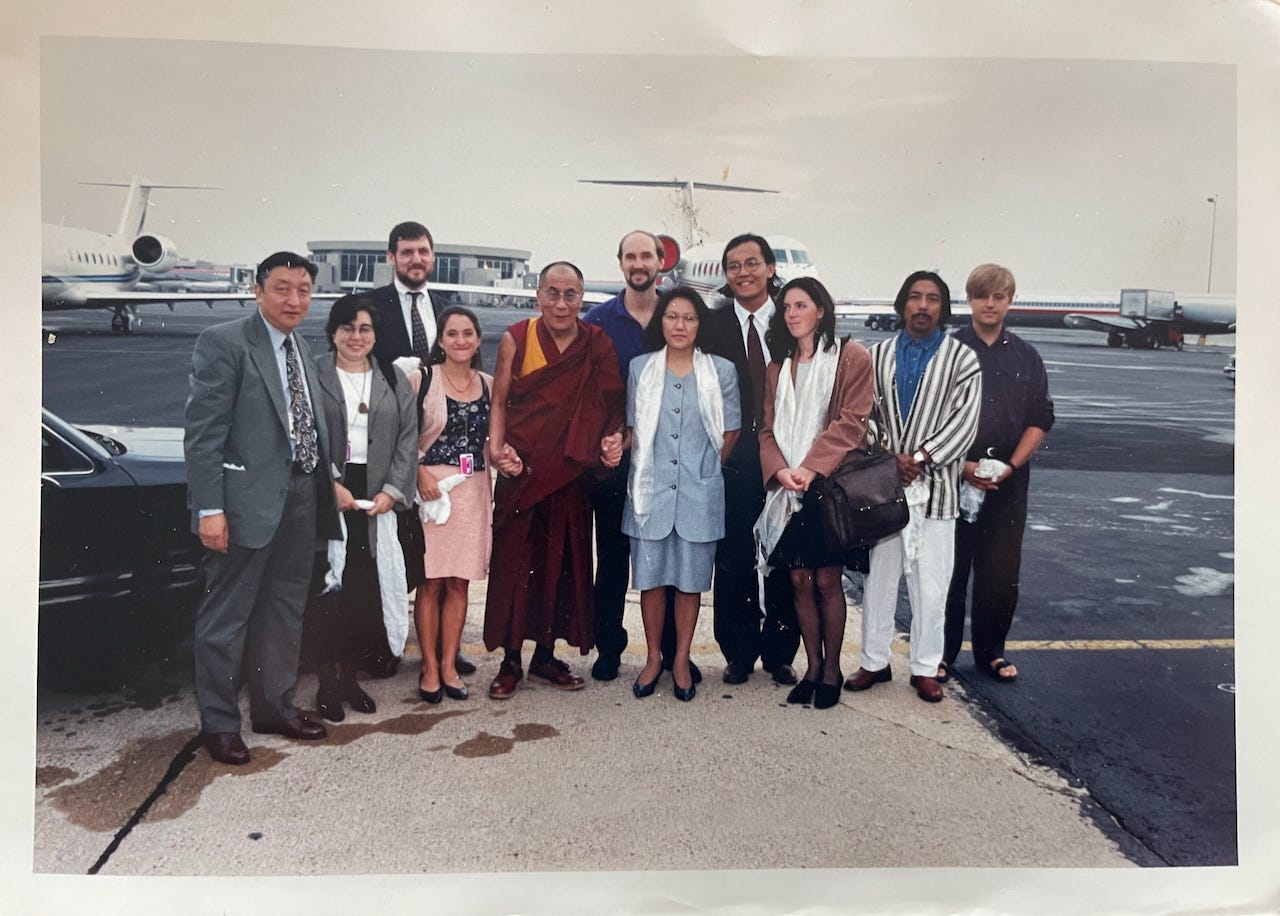
By early 1995, ICT had relocated to a larger office at 1735 Eye Street NW to accommodate the organization’s rapid growth. At a staff meeting that year, we were informed that Palden Gyatso would be making his first trip to the West in April/May and that ICT would host the Washington, D.C. portion of his visit.
We were all excited. I was assigned as the staff member to accompany him wherever needed and given an additional responsibility that left me both excited and nervous: to serve as Palden Gyatso’s interpreter during his testimony before the House Subcommittee on International Operations and Human Rights - his first appearance before the U.S. Congress.
During that visit, Palden Gyatso stayed at the home of Grace Spring, the Tibet peace activist best known for holding a weekly vigil outside the Chinese Embassy every Friday morning for 18 years. Grace, who passed away in 2018, was both an artist and Tibet’s angel. She was deeply involved in the Tibetan freedom movement and served on ICT’s board. I worked closely with her and cannot recall a single instance where she declined to help.
When I stepped off the Bethesda Metro station that morning of April 1, 1995 and walked toward Grace’s home in Chevy Chase, Maryland, there was an extra spring in my step - I was eager to finally meet Palden Gyatso. By then, Kusho had already spent five busy weeks in Europe, visiting Britain, Italy, and Portugal, and receiving extensive media coverage. In Geneva, he had testified before the United Nations Commission on Human Rights, becoming the first Tibetan political prisoner ever to do so. That appearance left a lasting impression on him, as he would later recall in his autobiography:
“Only when I finished did I look up and notice the Chinese delegation sitting in front of me, listening. They were listening! That gave me such a rousing sense of my freedom and I wished all my fellow prisoners had been there to witness it, for we had all dreamed of being able to confront our tormentors face to face and have them listen to our testimony. I was the first Tibetan prisoner to have had the opportunity to speak before the United Nations, so I knew that I was not just speaking for myself but for all Tibetans still in prison and for all Tibetans who had ever been in prison. The delegates heard only my voice, but behind my voice lay the suffering of the thousands of prisoners who had not survived to bear witness as I have.”
When Grace opened the door, I found myself face-to-face with someone whose appearance I will never forget. I already knew Palden Gyatso’s story — thirty-three years in Chinese prisons and labor camps, including the notorious Drapchi prison. I knew of the torture, beatings, starvation, and relentless hard labor he and other inmates had endured.
I offered my Khata but could not take my eyes off him. He looked as if he had just stepped out of Drapchi - frail beneath the maroon robes of a Tibetan monk, slightly bent, cheeks sunken, teeth knocked out by an electric cattle prod. Supporters in London had fitted him with false teeth, yet the years of torture remained starkly visible.
What struck me most were his eyes - large, set deep into his face, and carrying the weight of unspeakable violence endured and witnessed. And yet, behind the physical frailty, the lasting impression Palden Gyatso left with me, and with everyone he encountered, was his steely will, unbroken spirit, and unshakable faith.
While ICT had scheduled many meetings and events for Kusho during that first visit, the most important was his testimony before the U.S. Congress. I had already read his prepared statement - translated from Tibetan - several times. Preparing for the oral statement, particularly the Q&A portion, was critical. It was also my first time interpreting before Congress, which made me anxious.
We spent hours rehearsing that weekend. I wanted to ensure Kusho didn’t speak too quickly and gave me enough time to interpret accurately. We even agreed on a signal: if he spoke for too long, I would place my hand gently on his lap as a cue to pause.
On April 3, 1995, Palden Gyatso appeared as a witness before the House Subcommittee on International Operations and Human Rights. The hearing, chaired by Representative Chris Smith of New Jersey - one of the strongest voices for human rights in China and Tibet - focused on the Chinese Laogai (gulag) system. The Ranking Democrat was the late Tom Lantos of California, a Holocaust survivor, close friend of His Holiness the Dalai Lama, and a steadfast supporter of Tibet. Also present was Congressman Benjamin Gilman of New York, another close ally of the Tibetan cause.
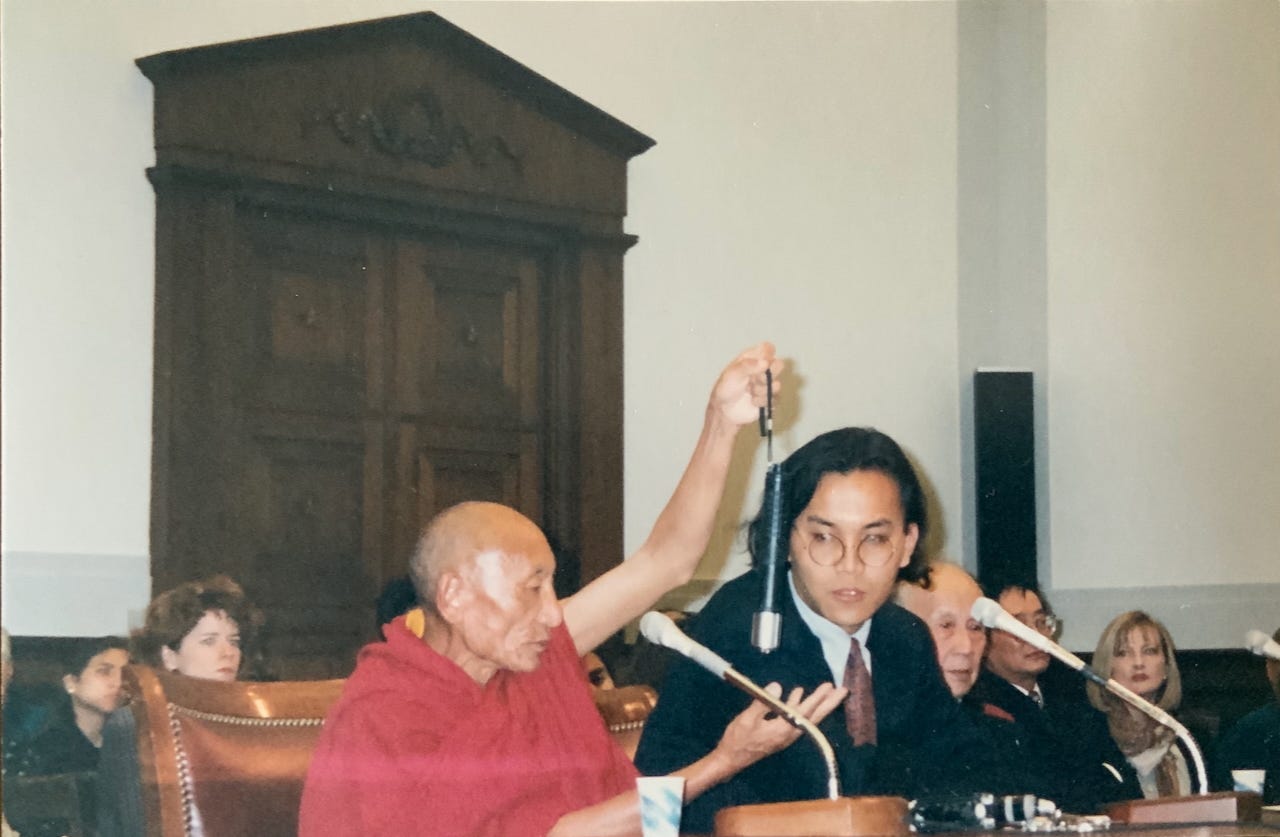
Palden Gyatso testified alongside fellow survivors of the Laogai system: Tang Boqiao, Catherine Ho, Father Cai Zhongxian, Liu Xinhu, and Harry Wu. Together, their testimonies offered a powerful collective indictment of China’s vast prison network.
We were the fourth witness to testify that morning. As planned, we began steadily, but Kusho grew visibly emotional and spoke for long stretches. I tried to signal him, but it became increasingly difficult to maintain the pauses I needed to interpret.
As he had done in Europe, Kusho brought the torture instruments Chinese officials had used on him: cattle prods, electric shock devices, and handcuffs — silent but damning evidence of the brutality he had endured.
The hearing room, 2172 of the Rayburn House Office Building, was not filled with the full Subcommittee - common unless a hearing features well-known figures or headline-making issues. Yet for those present that morning, Palden Gyatso left a profound and lasting impression through his presence and his testimony.
Chairman Smith thanked him for his “very moving testimony” noting that “by visually displaying the implements used to repress people and to torture them” Palden Gyatso had added “an additional dimension to our understanding, feeble as it is, to what it must be like to live under the horrors of this terrible Gulag system.”
Years later, upon learning of Palden Gyatso’s death, Congressman Smith reflected:
“With the passing of Palden Gyatso the world has lost a powerful voice for freedom and human rights. I once chaired a House Foreign Affairs Committee hearing where he delivered moving and unforgettable testimony about his 33 year imprisonment in China. He was horribly tortured, his body scarred and bent, but he forgave his captors then worked tirelessly to expose their misdeeds and the misdeeds committed by the Chinese Communist Party against the Tibetan people. We mourn this loss, but are comforted by the fact that Palden Gyatso left behind a legacy that will live on among Tibetan advocates for freedom and human rights.”
The rest of Kusho’s Washington visit passed in a blur. He met with many individuals and organizations, including a meeting with the late Ambassador James Lilly, who had served as U.S. Ambassador to China from 1989 to 1991. For those familiar with Palden Gyatso’s story, it is well known that Kusho and his fellow prisoners had attempted to deliver a petition to Ambassador Lilly during his visit to Drapchi prison in April 1991.
The visit received wide coverage in the U.S. media. A.M. Rosenthal, the renowned New York Times columnist, wrote an op-ed after Palden Gyatso visited him and the Times office, comparing the Tibetan freedom movement to the struggle for the abolition of slavery and observing that “sooner or later, abolition movements triumph.”
Those few fleeting moments with Kusho Palden Gyatso-la in Washington, D.C., in the late spring of 1995 remained etched in my memory. After his 1995 tours of Europe and the United States, Palden Gyatso’s stature grew as he tirelessly traveled the world, giving voice to Chinese oppression and repression in Tibet. He later testified and served as a co-plaintiff in the 2013 lawsuit filed against China by the Madrid-based Comité de Apoyo al Tíbet (CAT), which led the Spanish National Court to issue arrest warrants for five top Chinese leaders, including Jiang Zemin.
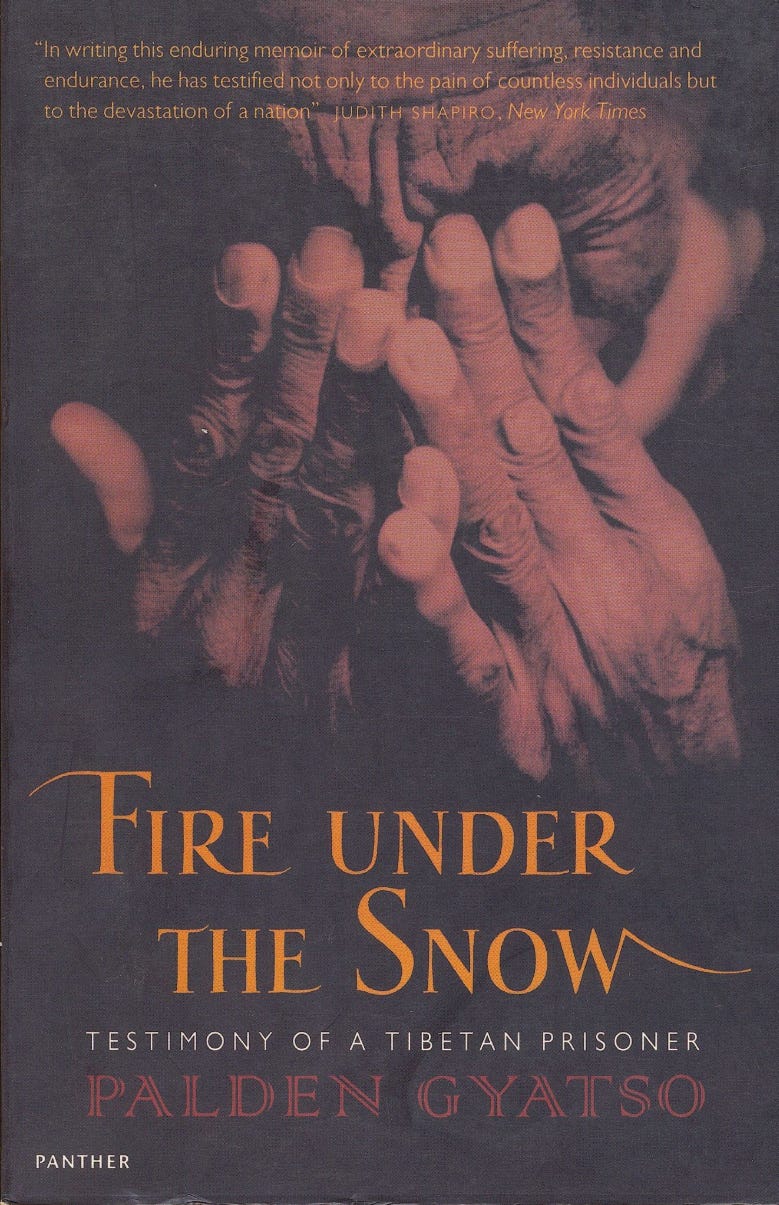
He achieved near rock-star status and arguably remains the Tibetan political prisoner who most powerfully educated the international community about Tibet’s human rights crisis. People, prominent and ordinary alike, flocked to hear him speak. His life and book were adapted into the film Fire Under the Snow, and he received numerous awards honoring his courage and advocacy. Palden Gyatso passed away at the age of 85, having lived all his exile years in Dharamsala, where he continued his activism for a free and independent Tibet until just weeks before his death.
He achieved near rock-star status and arguably remains the Tibetan political prisoner who most powerfully educated the international community about Tibet’s human rights crisis.
Palden Gyatso arrived at the perfect moment, just as the international spotlight was turning toward Tibet. The decades from 1990 to 2010 marked the peak of Western awareness and support for Tibet. Tibetans were fortunate to have someone like him - a witness, a truthteller, and a source of inspiration. For Tibetans born and raised in the relative comfort of exile, it would have been impossible to convey the legitimacy, authenticity, and living example of sacrifice that Palden Gyatso embodied.
For Tibetans born and raised in the relative comfort of exile, it would have been impossible to convey the legitimacy, authenticity, and living example of sacrifice that Palden Gyatso embodied.
I can still vividly recall the image of the frail Tibetan monk who commanded the full attention of everyone present on the morning of April 3, 1995, in Room 2172 of the Rayburn House Office Building. Though he spoke in Tibetan, it was clear that his words needed no translation — their meaning was immediate, and their impact profound.
There will never be another like Kusho Palden Gyatso la, but the truth he carried will continue to echo until Tibet is free.
No posts
Comments
Nothing yet. Say the first thing.
Sign in to join the conversation.