
By Vivify Mariposa 🦋 No Filter. Just Facts.
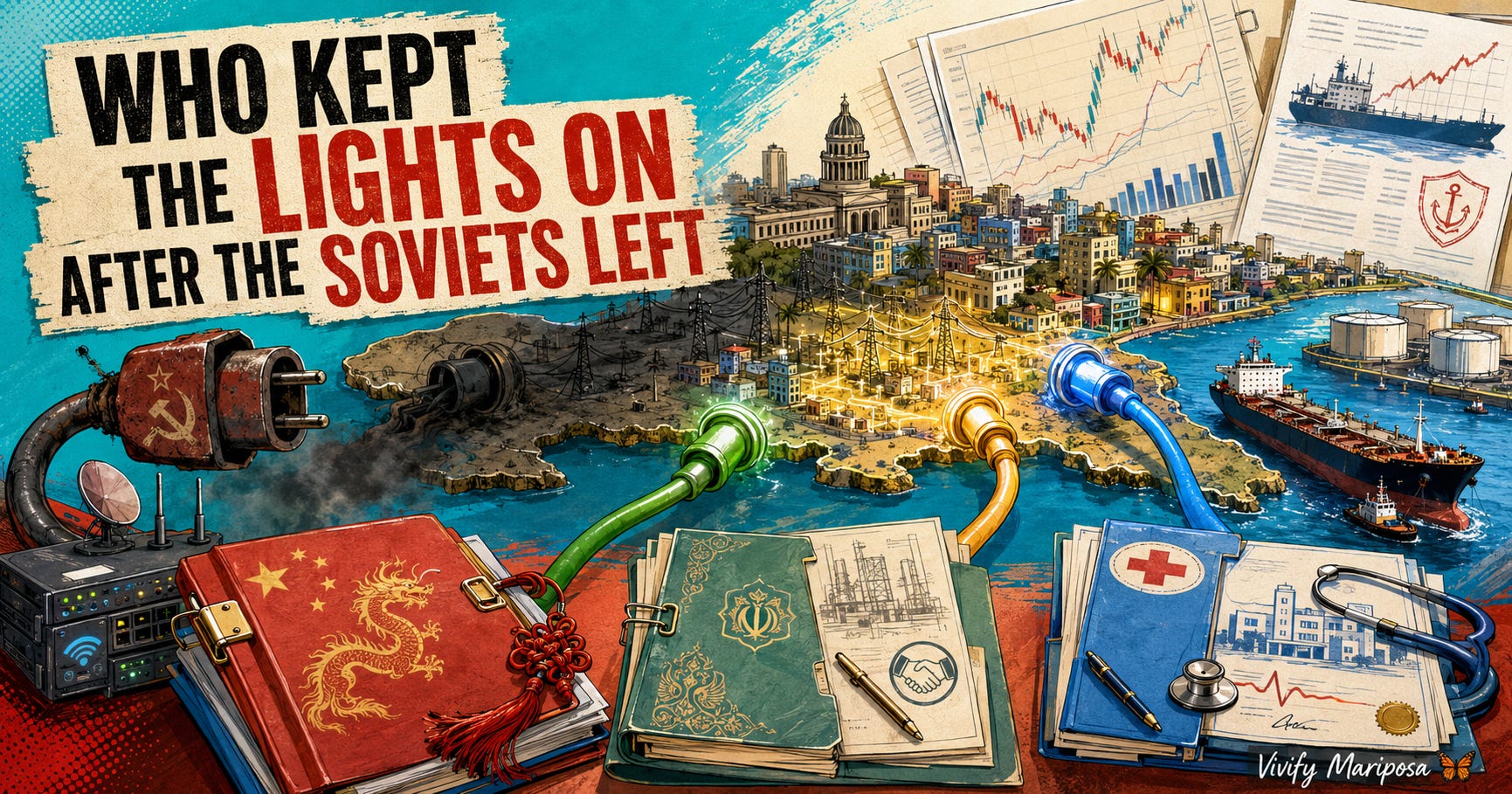
Part One ended with the door closing. The American market was gone. Dollar clearing was gone. Access to the London-anchored commodity, insurance, and settlement architecture was gone by extension. Cuba had been priced out of every market the West controlled. And Cuba was told the Soviet alignment was the escape from American capital, on terms written in London a century before Fidel Castro was born.
Now watch what actually happened inside the cage. And watch who was never inside it.
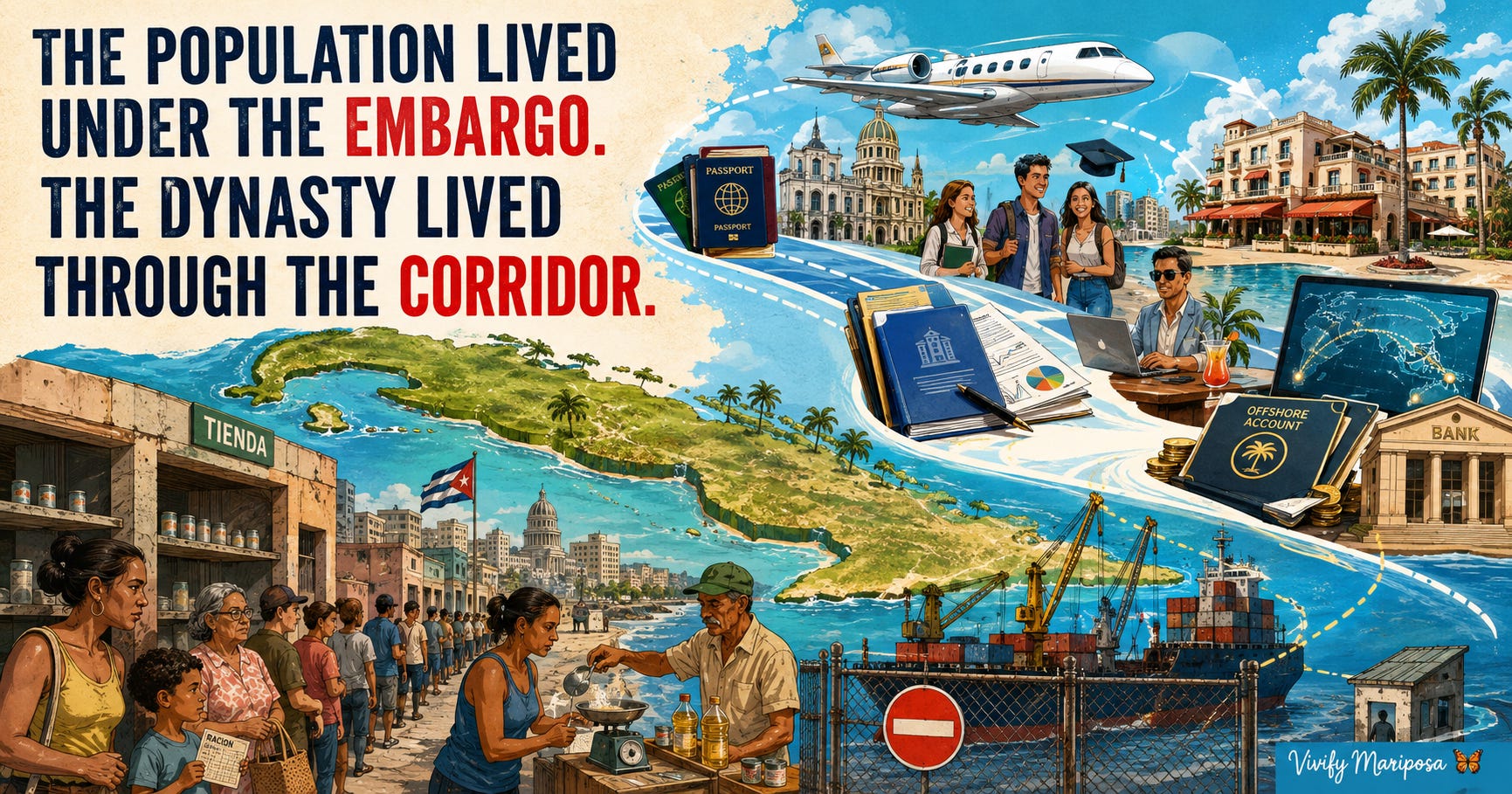
Because the story America was told for sixty-five years is that the embargo sealed Cuba off from the world. The truth on paper is different. The country was sealed off. The ruling family, the military conglomerate that runs the country, the commercial partners abroad, the exile sugar oligarchy, the hedge funds that bought the debt, and the foreign banks that laundered the money were all moving through the arrangement in every direction. Two Cubas were operating at once. One was a communist regime with a starving population and a rationing book. The other was a network of aircraft, universities, corporations, offshore structures, medical export contracts, foreign investment vehicles, and English commercial court filings that ran through the same jurisdictions the machine has always run through.
The population lived under the embargo. The dynasty lived through the corridor.
They sanctioned Cuba, but the Castro family stayed free to travel. Ordinary Cubans inherited the isolation while the ruling family inherited foreign education, private flights, European residency, companies, and access to offshore corridors. The population lived under communism. The dynasty moved through international finance.
Look at the timeline.
The Brothers to the Rescue shootdown happened February 24, 1996, and four men were killed over international waters. The United States did not unseal its criminal indictment against Raúl Castro over the attack until May 2026. Thirty years. Three decades between the killings and the criminal charge against the man federal prosecutors now accuse over the attack.
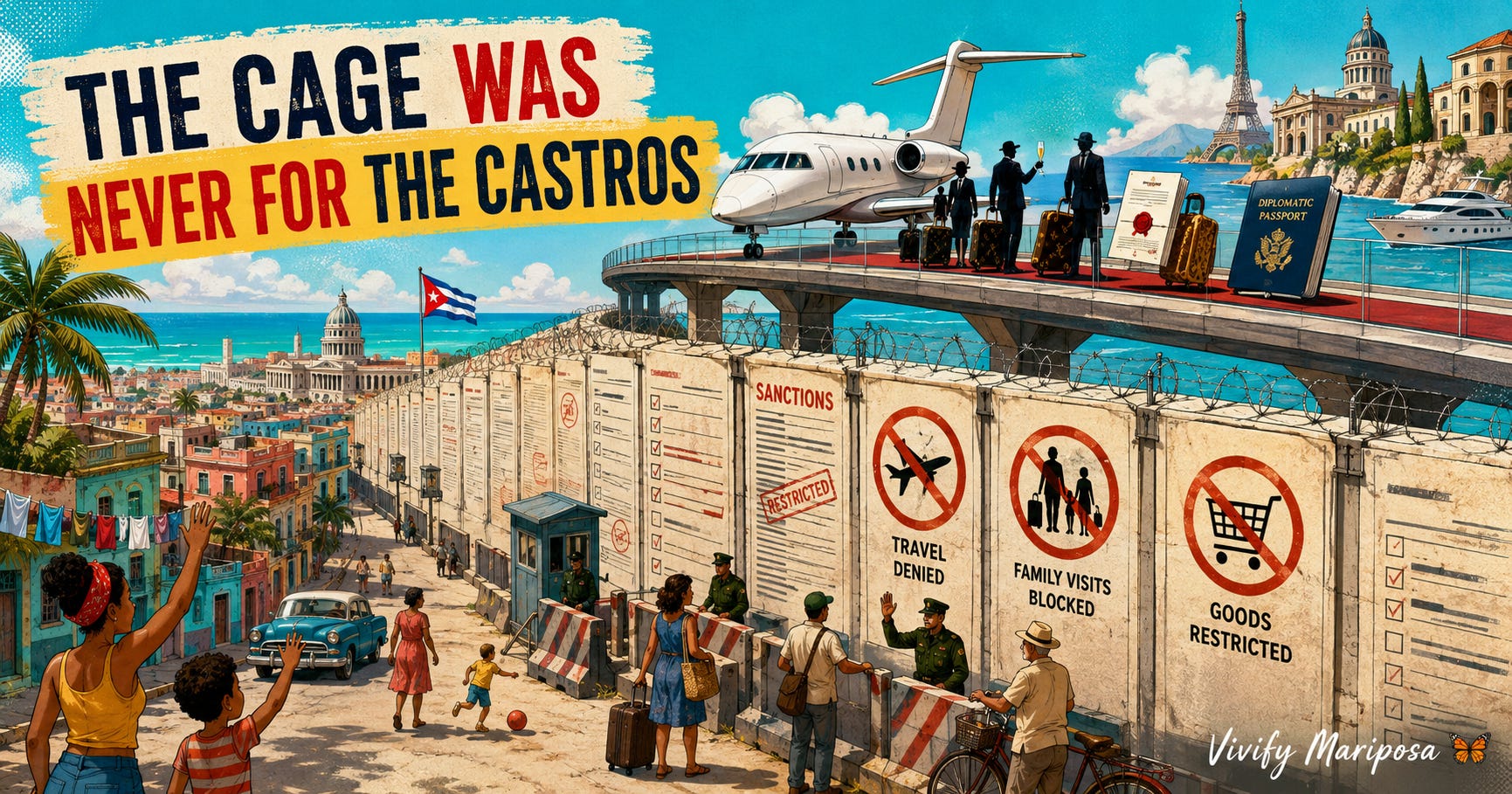
Raúl Castro and four of his children were designated by the U.S. State Department in 2019, and the consequence was that they became ineligible to enter the United States. That was not a worldwide travel ban. That was not an asset freeze. It did not touch Spain. It did not touch Panama. It did not touch Russia. It did not touch any of the British offshore jurisdictions. It closed one door and left every other door open.
The Office of Foreign Assets Control did not add Alejandro Castro Espín and other ruling-family members to the Specially Designated Nationals list until June 4, 2026. Sixty-six years after the embargo began. Eighteen years after Raúl formally succeeded Fidel as president. Seven years after the entry restriction. The country was sanctioned in 1960. The family was financially blocked in 2026.
Entry restrictions and financial blocking sanctions are not the same instrument. The public was told the family was locked inside the cage with the population. The paperwork tells a different story. And there is a third-country legal opening most people have never heard of. OFAC allows certain Cuban nationals living permanently outside Cuba to be treated as unblocked nationals, and financial institutions may maintain accounts for those Cuban nationals while they are outside Cuba, subject to restrictions. This is documented in OFAC FAQs 791 through 793.
Read who that provision covers.
An ordinary Cuban cannot leave the island to become an unblocked national. An ordinary Cuban does not have a private aircraft, diplomatic passports, foreign lawyers, corporate structures, or state money. The provision was drafted in neutral language, but in practice it was drafted for the passenger list of the private plane.
So who trained the family and where did the money go?
Russia trained the science. Fidel Castro Díaz-Balart, the oldest son of Fidel Castro, studied nuclear physics in the Soviet Union under an assumed name, worked inside the Soviet nuclear research system for years, married a Russian woman, and created a Cuban-Russian family branch that stayed embedded in the Russian scientific establishment across decades. The Joint Institute for Nuclear Research holds part of that record.
Spain trained the professors and issued the residency. Castro descendants studied at the Universities of Salamanca, Madrid, Seville, and Cantabria. Some received Spanish government scholarships. Some obtained academic employment. Some established civilian lives in Spain and stayed. Guido Jorge Castro Odio received a Spanish government scholarship, published in the Spanish official bulletin. Mirta Castro Smirnova became a professor at the University of Seville. José Raúl Castro Smirnov worked at IMDEA Nanoscience in Madrid, a research institution funded by the Community of Madrid and the Spanish government. Cuba was a socialist country. Spain was a NATO member and a European Union member. And the dynasty educated its children inside the institutions of the alliance that publicly sanctioned the country.
Panama moved the aircraft and hosted the companies. Raúl Guillermo Rodríguez Castro, Raúl Castro’s grandson, made thirteen private-aircraft trips to Panama in 2024, and at least ten additional journeys were logged during the first nine months of 2025. Some of the flights coincided with significant Panamanian political events, and the same aircraft transported business and political figures moving among Cuba, Venezuela, and Panama. La Prensa in Panama investigated and published the flight records. General Ania Guillermina Lastres Morera, associated with the leadership of GAESA, the Grupo de Administración Empresarial S.A., appeared in Panamanian corporate records including Anumex Corp. and Lukenwest Holding.
GAESA is the piece the American public was never told about. It is the military-economic conglomerate that runs the Cuban armed forces’ business empire, and it operates through a network of subsidiaries that each take a cut of every dollar flowing into the country.
FINCIMEX handles the remittances. Every Cuban abroad who sends money to a family member on the island sends it through FINCIMEX, which processes hundreds of millions of dollars a year and takes its percentage before the money reaches the family. The regime does not just tax Cubans abroad. The regime is the exchange.
Gaviota runs the military-owned tourism operation. Gaviota controls hotels, marinas, resorts, dive centers, tour operators, and the transportation infrastructure that moves Western visitors through the island and separates them from their foreign currency. The Canadian, European, and Latin American tourists who fly to Havana believing they are supporting the Cuban people are, in the accounting reality, supporting a hotel chain owned by the Cuban armed forces.
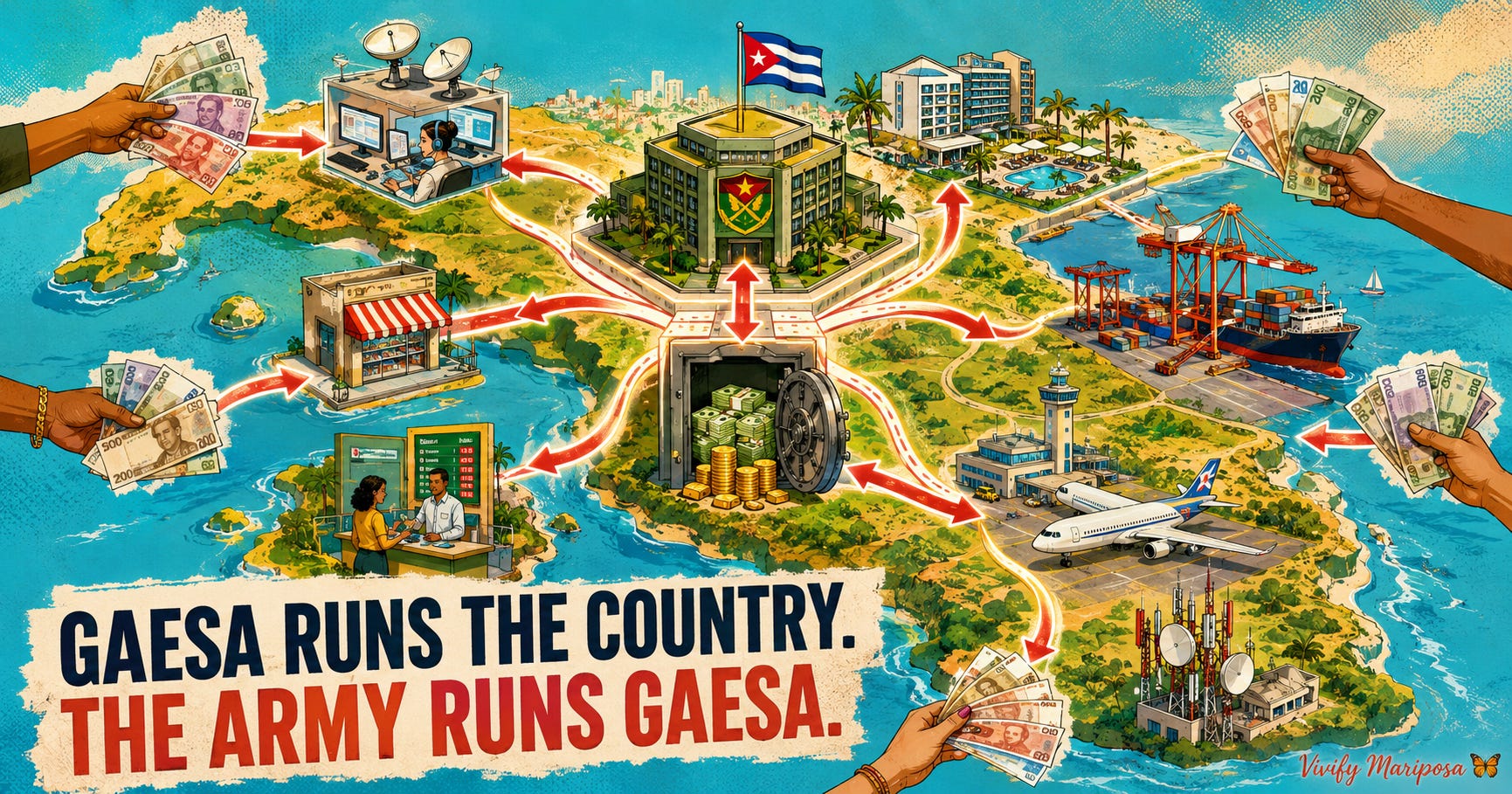
Other GAESA subsidiaries control the ports, the retail chains that sell to Cubans in dollars while ordinary Cubans earn pesos, and the wholesale trade that supplies both. Cimex, TRD, and their affiliates operate the hard-currency stores that separate Cubans from the remittances FINCIMEX has already taken a cut of.
The Cuban armed forces do not just run the security state. They run the economy. And the economy runs on foreign currency the ordinary Cuban worker will never touch.
Then there is the doctor export program.
The Cuban regime deploys tens of thousands of doctors, nurses, and other health-care workers to Venezuela, Bolivia, Brazil, Angola, Qatar, and other host countries. The host country pays the Cuban government per doctor. The government keeps the vast majority and pays the doctor a small fraction of what the host country is paying for the doctor’s labor. The doctors’ passports are held. The doctors cannot leave the assignment without government permission. The doctors’ families are held on the island as security. The United Nations Special Rapporteur on Contemporary Forms of Slavery has documented the conditions in reports and interviews. Testimony from doctors who defected describes the arrangement in the same terms international law reserves for forced labor.
Cuban medical export income has run in the multiple billions of dollars a year at peak, making it one of the largest sources of foreign currency for the Cuban state, at times larger than tourism and remittances combined.
The doctors do the work. The regime keeps the money. And the World Health Organization, the Pan American Health Organization, and every host government that receives the doctors buys the regime’s international humanitarian narrative at the same time it buys the labor.
The dynasty’s grandchildren study at Salamanca. The doctors send home a fraction. The remittances get skimmed by FINCIMEX. The tourists pay Gaviota. And the family sits above the whole operation, moving through the Panama corridor while the population moves nowhere.
Every one of those flows, the remittance fee, the tourism receipt, the doctor payment, the retail dollar, clears through the same New York correspondent banks Part One documented, is insured through the same Lloyd’s marketplace that has covered Cuban commercial cargo for two centuries, and settles through the same London commercial architecture that has priced Cuban sugar since the eighteen hundreds. The perimeter closes around the population. The corridor opens for the invoice.
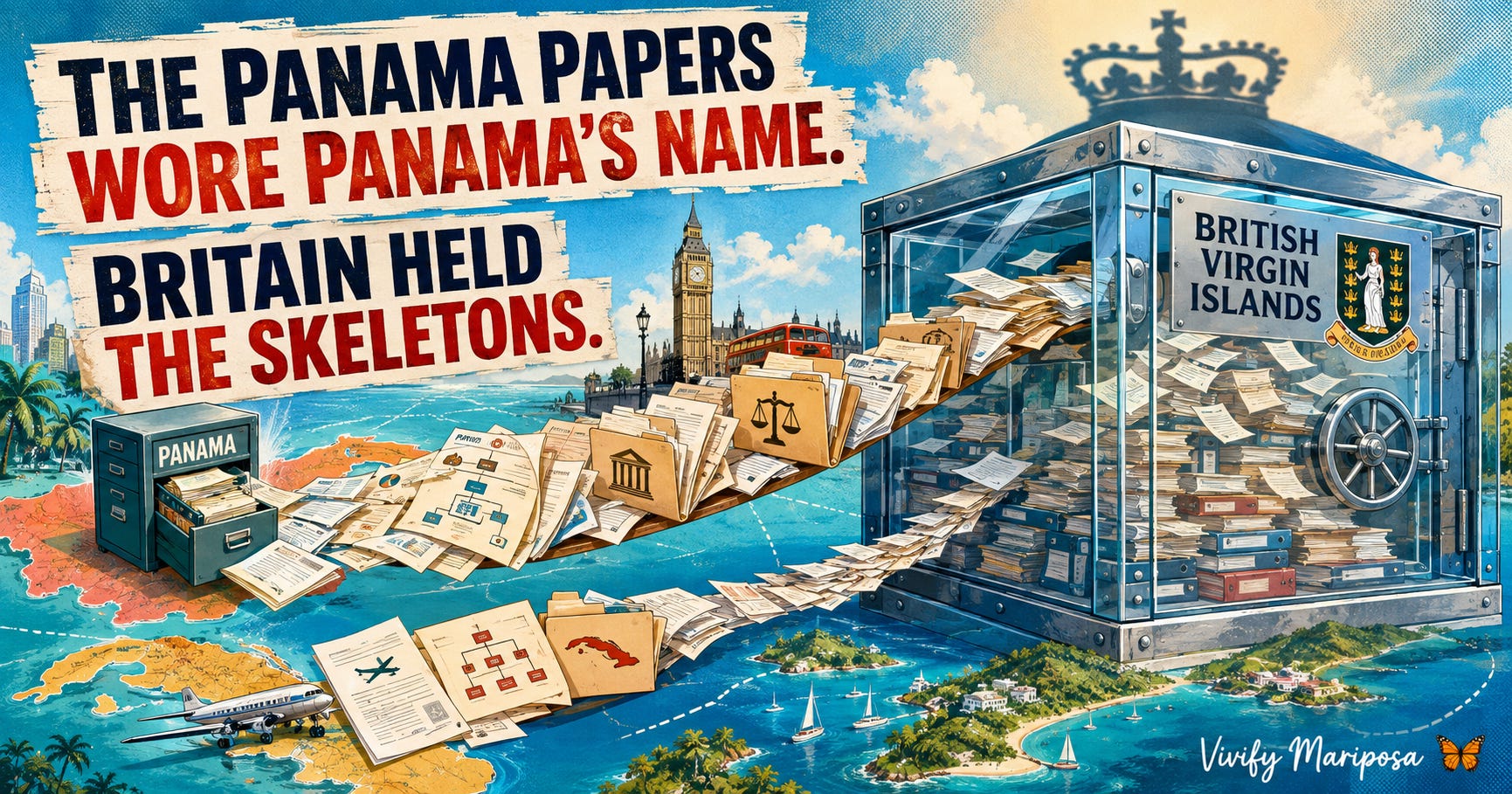
The Panama Papers leak of 2016 exposed the internal records of the law firm Mossack Fonseca, which had created or administered 214,488 offshore entities. More than 113,000 of them were incorporated in the British Virgin Islands, a British Overseas Territory. Roughly half of every entity exposed in the largest financial leak in history belonged to a British-controlled offshore jurisdiction, and a UK Parliament report identified almost two thousand British intermediaries in the same leak.
Panama gave the scandal its name. Britain held the corporate skeletons.
The Panama Papers did not automatically prove any specific Castro-family ownership of any specific British Virgin Islands entity. What the Panama Papers proved is the shape of the corridor. The BVI, Cayman, Bermuda, Jersey, Guernsey, Gibraltar, and Bahamas offshore system, all British-linked, is where regime money embargoed on paper stays fully liquid in practice. And the Cuban ruling family had lawyers, corporations, aircraft, and personal networks in every jurisdiction the corridor passes through.
Follow the chain. Cuba held the political power and controlled the foreign-currency intake. Russia provided the technical, military, and ideological training. Spain issued the residency, the education, the employment, and the European legitimacy. Panama moved the aircraft, the companies, and the intermediaries. The British Virgin Islands hid the corporate ownership. And London and Hong Kong provided the banks, the lawyers, the insurance, and the settlement.
The financial corridor had a diplomatic corridor beside it. London supplied direct access to the legal and banking center. Spain carried the family and its academic pipeline. Panama carried the aircraft and the companies. The British Virgin Islands hid the ownership. An embassy is not the hidden asset. It is the address that tells you where to look for the people, companies, property, and transactions.
The country was sanctioned as a country. The family was passed through the corridor as clients. Every stop on the chain is a jurisdiction the machine’s compliance regime tolerated for the right client list. Every stop took its service fee.
Two Cubas. One machine.
The invoice was in London.
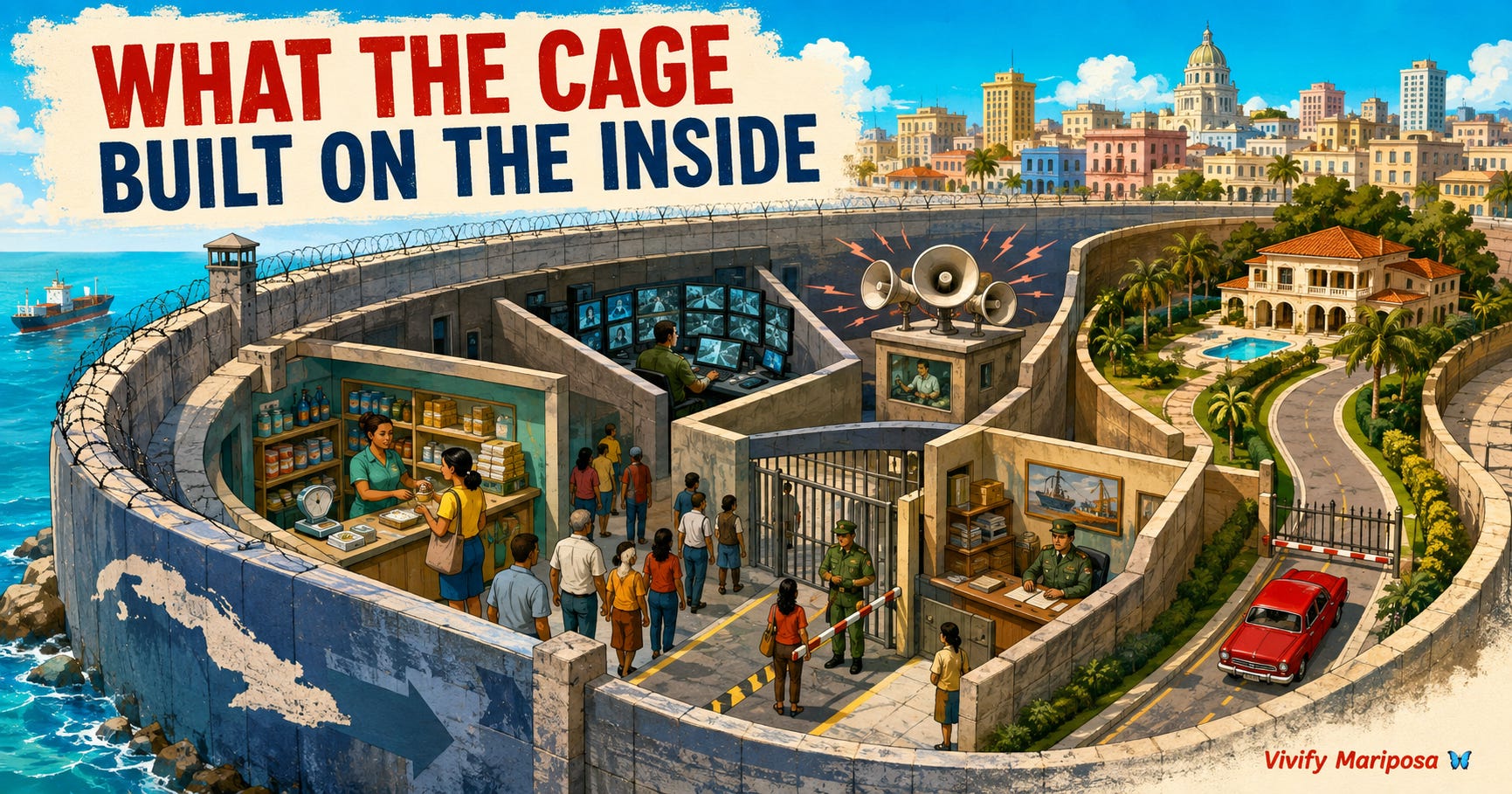
While the family moved through the corridor, the regime built something else inside the walls.
Castro used the hate for Americans first to win the population, and then to destroy the island from the inside. The embargo was real, but the regime made the embargo the answer to every question the people had a right to ask. Why is there no food? Embargo. Why can you not leave? Embargo. Why does the doctor make less than a bellhop? Embargo. Why does the son of the general study at a European university while your son cannot leave the province? That question does not have a permitted answer.
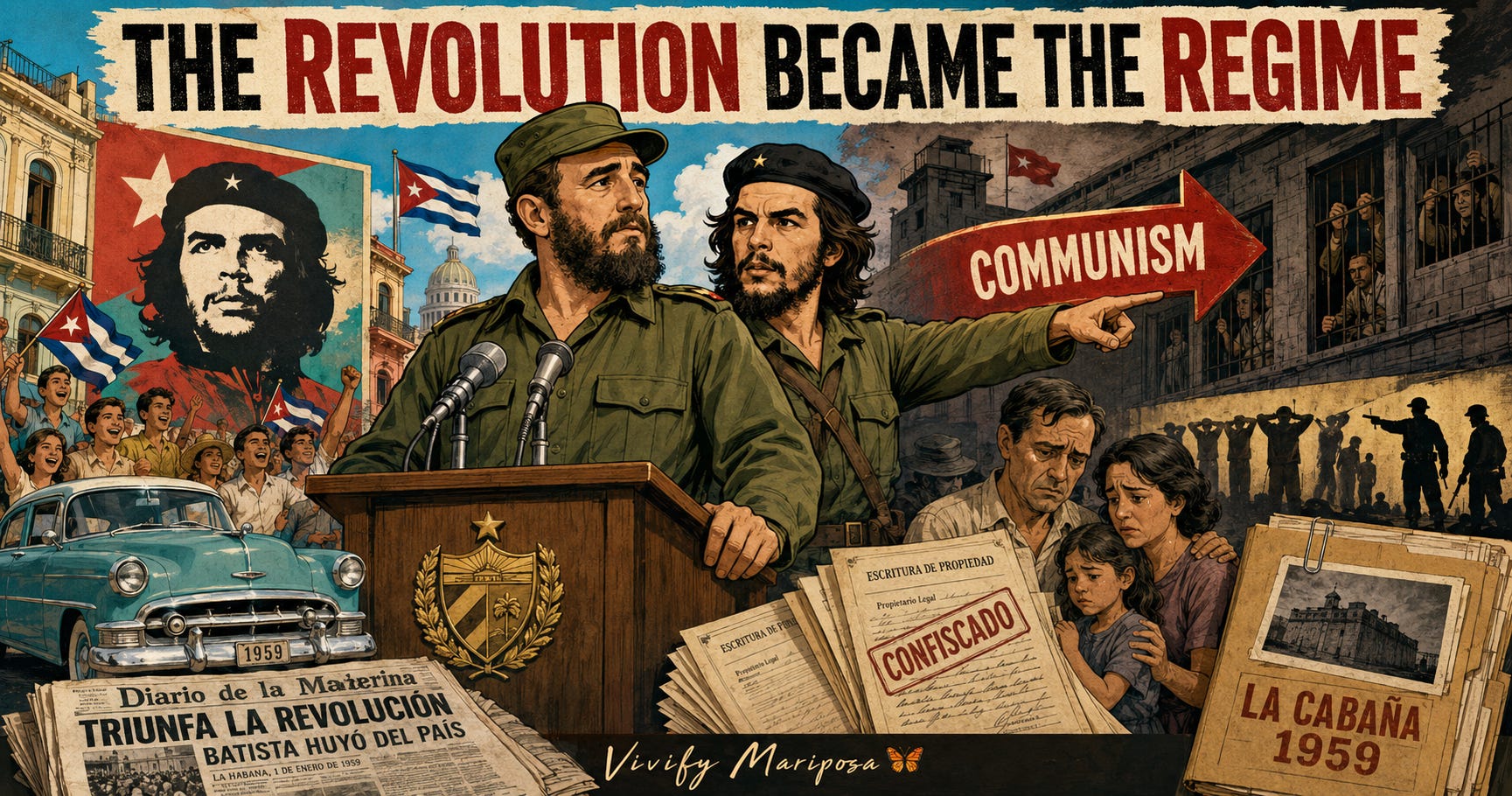
Trujillo was another puppet of the same system, removed when he was no longer necessary, and another puppet took his place. The same thing happened in Cuba. The regime the machine created to run the plantation and the regime the machine used to warn the plantation are both operators inside the same arrangement. One flag is red and one flag was Anglo-blue. The plantation is the same plantation.
The Dirección General de Inteligencia was established in late 1961 with Soviet KGB assistance, later renamed the Dirección de Inteligencia, and it penetrated the American government at a level that Christopher Simmons, James Olson, and other career U.S. counterintelligence officers have stated in public exceeded the reach of the KGB itself.
Look at the names. Victor Manuel Rocha pleaded guilty on April 12, 2024, in the U.S. District Court for the Southern District of Florida to acting as a Cuban agent over approximately fifty years while holding positions including U.S. Ambassador to Bolivia and adviser to U.S. Southern Command. Ana Belén Montes pleaded guilty in 2002 to conspiracy to commit espionage after serving as the senior Cuba analyst at the Defense Intelligence Agency. Walter Kendall Myers and his wife Gwendolyn Myers pleaded guilty in 2009 to conspiracy to gather and communicate national defense information, after Kendall Myers had held senior State Department positions. The Wasp Network was broken open by FBI arrests in September 1998, and the Miami trial of 2001 convicted Gerardo Hernández of conspiracy to commit murder for the February 24, 1996 shootdown of two Brothers to the Rescue civilian aircraft over international waters that killed four men.
Then came Tricontinental. The Havana conference met in January 1966 with more than five hundred delegates from eighty-two countries. OSPAAAL and OLAS were established with Havana headquarters, and Tricontinental magazine became the visual and ideological hub of what would soon be called Third WorldSIM. Between 1959 and 1979, Cuba supported or directly organized guerrilla movements in Venezuela, Colombia, Guatemala, Nicaragua, El Salvador, Argentina, Uruguay, Puerto Rico, and Peru. Cuba deployed approximately forty-nine thousand personnel to sub-Saharan Africa in the 1980s, with Operation Carlota in Angola beginning in 1975, Cuban forces fighting in Ethiopia, and Cuban forces training in Mozambique and Guinea-Bissau.
The cage did not excuse Castro. It gave him the perfect weapon. He chose what he built inside it. The embargo supplied the wall, the enemy, and the answer to every question the Cuban people had a right to ask. The mechanism produced the opportunity. Castro built the prison.
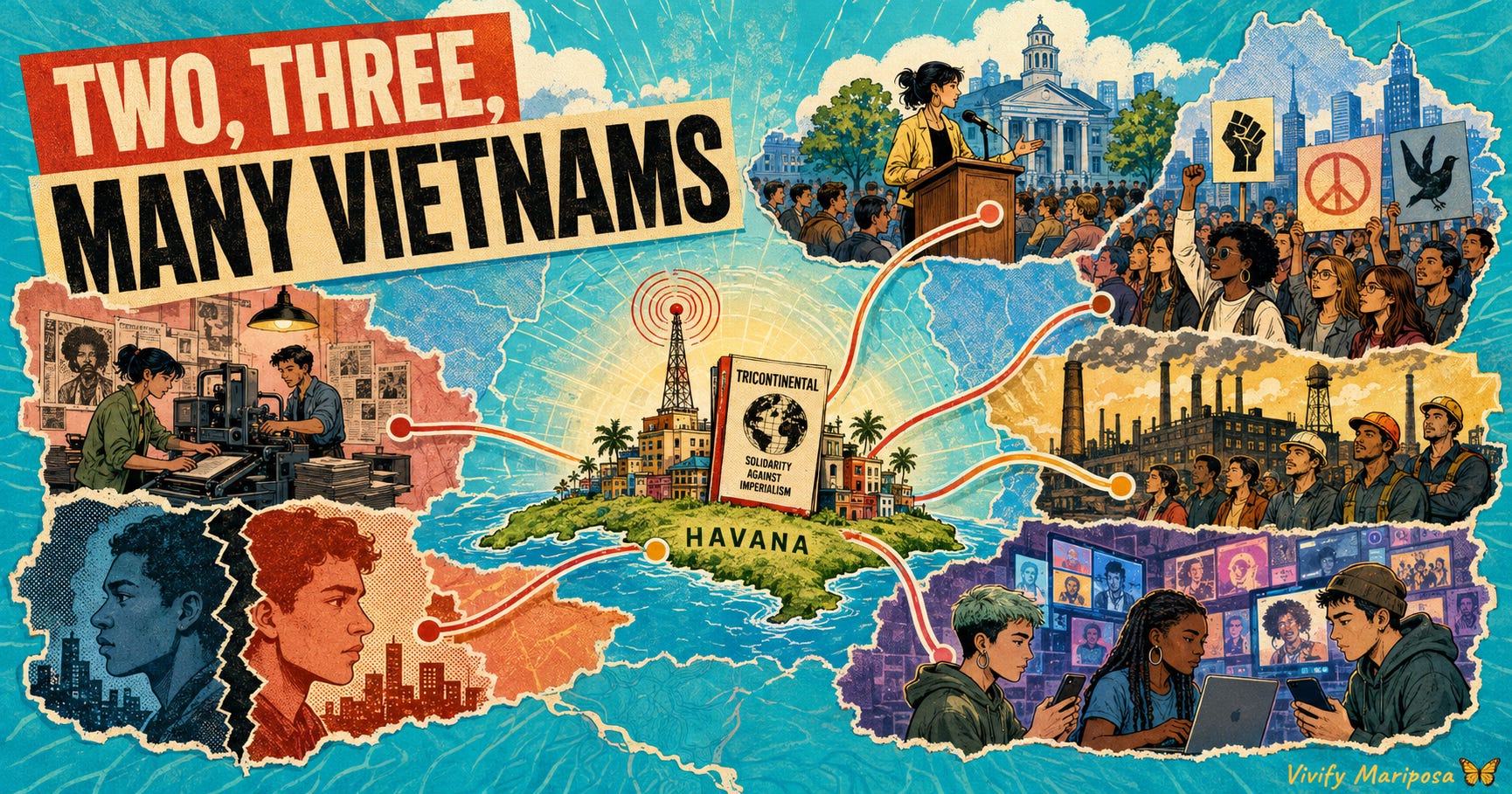
Cuba did not just build an intelligence state inside the cage. Cuba exported an operation into the United States, and that operation had a name. It was published in Havana on April 16, 1967, by the Organization of Solidarity with the Peoples of Africa, Asia and Latin America, known as OSPAAAL. The author was Ernesto Che Guevara. The title was Message to the Tricontinental. And the instruction was direct: create two, three, many Vietnams inside the imperial power itself.
The doctrine called for total war carried into the American homeland, for hatred as an instrument, for the transformation of the fighter into an effective, violent, selective, and cold killing machine, and for the exploitation of American racial contradictions, class contradictions, and generational contradictions as the fault lines the revolution should ignite.
Every word of the doctrine was published in Havana. Every word of the doctrine was written in the theoretical language London had underwritten Marx in for a century. The Havana printing press was the distribution point. The London tradition was the source. Together they produced a manual American radicals would execute for the next fifteen years.
The sequence tells the whole story. The Tricontinental Conference met in Havana in January 1966 and OSPAAAL was established. Guevara’s Message was published April 16, 1967. That same period, a delegation of American Students for a Democratic Society leaders traveled to Bratislava, to Phnom Penh, and met with Viet Cong representatives, and retired FBI revolutionary terrorism specialist Robert Glendon documented the delegation in a Chicago Tribune column of November 20, 1981. In July 1969, Bernardine Dohrn and other American radicals spent eight days in Havana meeting with Huynh Van Ba, a Viet Cong representative, who mapped the strategy for them: bring the war home, create violence in American cities, recruit violence-prone members. Three months later, from October 8 to 11, 1969, the Days of Rage exploded in Chicago. The Weather Underground executed the strategy Havana had transmitted.
By 1970 the Cuban Embassy in Ottawa had established a permanent communications channel with Weather Underground fugitives. Code name Delgado. Katherine Boudin used the channel. Bernardine Dohrn used the channel. The Royal Canadian Mounted Police were on the wire and had the code.
Now think about this. Ottawa is not Havana. Ottawa is the capital of a Commonwealth realm, and the head of state of Canada is still the British monarch in 2026. The tolerated presence of a Cuban embassy in a Commonwealth capital, running operations against the United States, is the exact fingerprint the article now names openly. Cuba could not clear a dollar, but Cuba could operate an embassy on Commonwealth soil coordinating armed operations against the country the enforcer said was under total sanction.
Between 1971 and 1972, the FBI counted twenty-five hundred bombings on American soil in eighteen months. Almost five a day. The Weather Underground. The New World Liberation Front. The Symbionese Liberation Army. The Fuerzas Armadas de Liberación Nacional. Los Macheteros. The Black Liberation Army. Every group was executing the doctrine Havana had published in 1967. On January 24, 1975, the FALN bombed Fraunces Tavern in Manhattan and killed four people. In 1976, an FBI spokesman called San Francisco the Belfast of North America. On October 20, 1981, at Nyack, Weather Underground and Black Liberation Army members robbed a Brink’s armored truck of one and a half million dollars and killed two Nyack police officers and a Brink’s guard. Kathy Boudin was arrested at the scene. On September 12, 1983, Los Macheteros robbed the Wells Fargo depot in West Hartford, Connecticut, of seven million two hundred thousand dollars and channeled the money through Cuba. Puerto Rico’s peaceful independence movement was discredited by the violence its operational wing produced.
The Black Panthers received the same treatment. Eldridge Cleaver went to Havana in 1968. William Lee Brent hijacked a jet to Cuba in June 1969 and lived in Havana until his death in 2006. Assata Shakur escaped Clinton Correctional in November 1979, arrived in Cuba by 1984, and died there in September 2025. Each of them was absorbed by the Cuban system as a propaganda asset. None of them liberated anyone.
The doctrine did not liberate Black Americans; it ran the Black liberation project into a Havana holding zone from which it never returned as a coherent political force. It did not liberate Puerto Ricans; Puerto Rico is still a territory of the United States in 2026, and the independence project achieved nothing except the security state expansion the violence justified. And it did not liberate American workers, who were divided against each other by every fault line the manual named. Race. Region. Ideology. Generation. Tactic. Whichever fault line the machine’s manual had identified as productive on that particular day.
Meanwhile, the American security apparatus that grew fatter fighting the division was the same security apparatus the machine’s compliance regime uses to enforce the arrangement across the hemisphere. Havana published the doctrine. Washington enforced the response. The American Left was destroyed by COINTELPRO. The American Right was destroyed by the culture war the fragments of the Left produced. The American working class was destroyed by both. And the invoice cleared in the Square Mile.
And the operation is still running today. Look at who gets to visit Cuba and how they get treated. When Code Pink goes to Havana, the regime receives them as honored guests. When Hasan Piker went to Cuba, GAESA rolled out the accommodations and Piker came back with content pieces reproducing the regime’s talking points to a Twitch audience of millions. The Nuestra América Convoy of March 2026 assembled 120 organizations from 33 countries in Havana, including Piker, Christian Smalls, Jeremy Corbyn, Pablo Iglesias, and Isra Hirsi, and every one of them left with the material the regime wanted them to publish. But when Nick, an independent American journalist who did not come to reproduce the regime’s script, tried to work in Cuba, he was treated as a criminal. Detained. Interrogated. Warned.
The instrument is called selective hospitality. GAESA identifies who reinforces the narrative and rolls out the carpet. The regime identifies who might document what it does to its own people and treats them like intruders. The visitor list is the narrative filter, and the narrative filter is the operation. Every visitor who comes back with content praising the Cuban model becomes a distribution point for the doctrine OSPAAAL published in 1967, except now the Havana printing press does not need to print anything anymore. The Havana printing press lives on Twitch, YouTube, X, Substack, and TikTok. The Cuban regime just decides who gets access, and the algorithm distributes the content.
Then something changed. The doctrine stopped working when the enforcer stopped enforcing.
Since 2016, the Anglo-American consensus that made the arrangement possible has been fracturing. The current administration has taken the United States out of every position the arrangement required the enforcer to hold. Venezuela lost to the machine. Iran under pressure the arrangement never permitted a previous administration to apply. China named openly as an economic adversary rather than the World Trade Organization partner the arrangement had contracted for. Russia negotiated with as a sovereign nuclear peer rather than the caricature enemy the arrangement required.
China is still an adversary of the United States, but China is also an adversary of the City of London, and the two adversarial relationships are not the same relationship. This administration is finally capable of naming that difference for the first time in seventy years. Russia is a sovereign nuclear peer. Russia is not aligned with the City. Russia is not aligned with Washington. Russia is aligned with Russia. And this administration is capable of negotiating with a sovereign counterparty on that basis for the first time in seventy years.
The Cuba Report of July 20, 2026, was signed by Secretary of State Marco Rubio. It catalogs what Cuba became, what Cuba exported, and what Cuba continues to run through Venezuela, Iran, China, and Russia in 2026. It is the first State Department product in seventy years that can name the Cuban intelligence architecture without protecting the London architecture that made the Cuban intelligence architecture necessary in the first place.
On July 28, 2026, eight days after signing the Report, Rubio went further on Fox News. He said out loud what no Secretary of State of the Cold War arrangement was ever permitted to say. There are plenty of people in American academia, and frankly in the American press, who sympathize with the Cuban regime, and have for a very long time. Part of it is motivated by their anti-Americanism, and part of it by ideological affinity. There are enough people in key nodes of our society, including professors, and in the past, people within our own government who sympathize with the Cuban regime. It is the way they get spies without paying them.
Read that last sentence one more time. It is the way they get spies without paying them.
That is a Secretary of State of the United States describing, on national television, the exact mechanism this article names. Ideological alignment does the work paid espionage would require. The regime does not have to recruit anymore because the academy delivers, the press delivers, and even the government has delivered. And every one of them is doing what OSPAAAL published in Havana in 1967 and what the London-underwritten Marx tradition trained American academics to reproduce for a century before that.
The Report was possible because the enforcer stopped enforcing. The Report is a symptom of the break. And the break is what makes this article legible in 2026.
Cuba could not defeat the United States militarily. Cuba could not sanction the United States. Cuba could not vote in American elections. What Cuba could do was train the cadre that would.
The Instituto Cubano de Amistad con los Pueblos, ICAP, was created in 1960. Its job was never friendship. Its job was ideological export. Foreign visitors arrived on politically curated tours. They met handpicked officials. They toured handpicked hospitals and schools. They returned home carrying the interpretation the state had prepared for them.
The Venceremos Brigade launched in 1969. American students traveled to Cuba to cut sugar cane and receive political education. The Brigade recruited on college campuses. It selected activists already inclined against their own country and sent them to a Marxist state that reinforced the inclination and gave it a program. The FBI investigated the Brigade repeatedly. Cuban intelligence recruited from inside it. That is on the declassified record.
The people who came back were not the people who left.
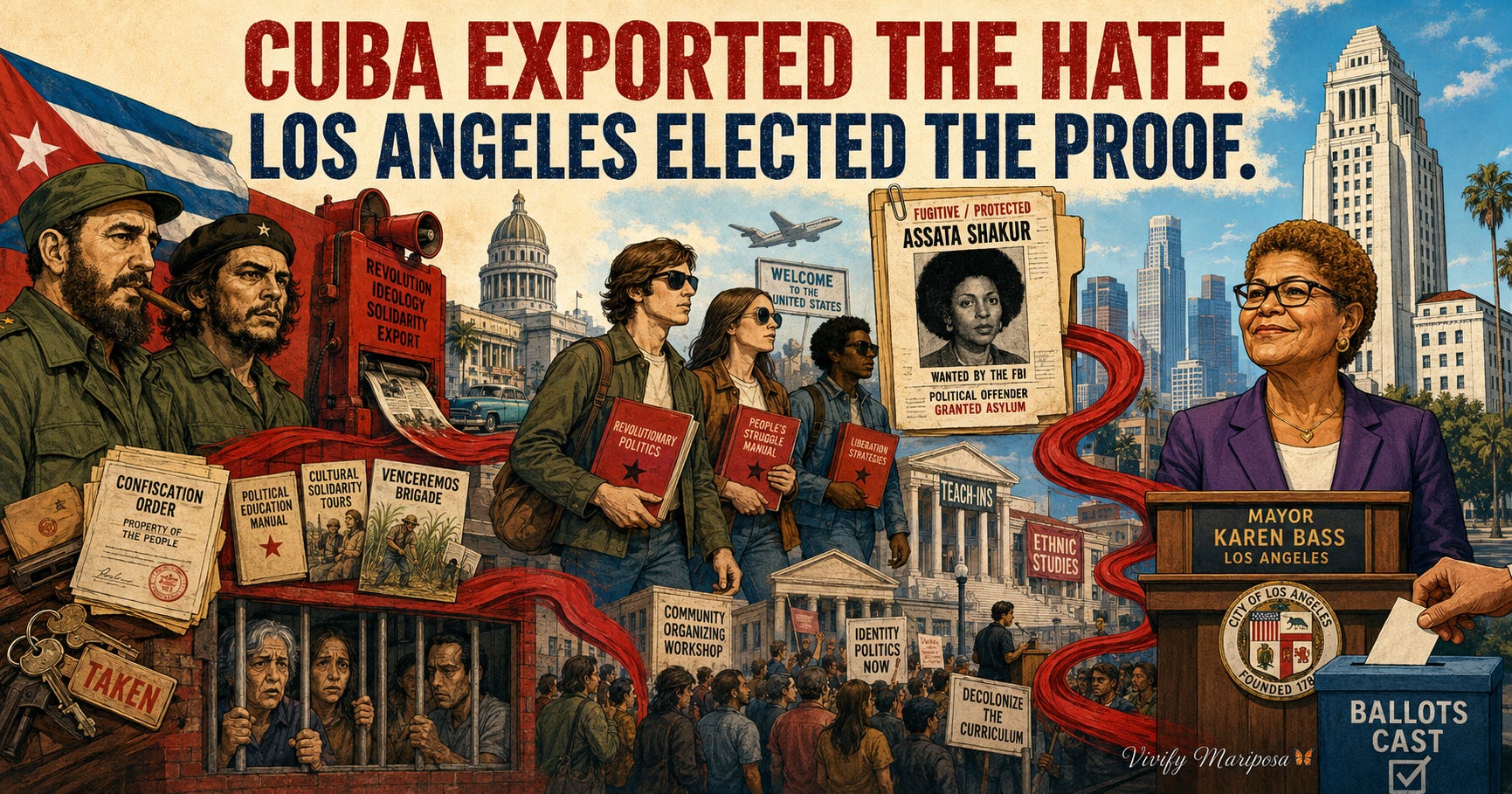
Assata Shakur is where the two eras connect. She was named earlier in this article as one of the American radicals Havana absorbed in the seventies. What was not named earlier is what she became after that. On May 2, 2013, the FBI added her to its Most Wanted Terrorists list, the first woman ever placed there. The reward on her head was two million dollars. She stayed under Cuban state protection for four decades. She died in Havana on September 25, 2025, without ever having been extradited. That was not sentiment. The fugitive was a symbol. The symbol was a distribution point. And by the time she died, the vehicle carrying her name into American electoral politics was already in place.
Black Lives Matter Global Network Foundation was founded in 2013, the same year the FBI put Assata Shakur on the terrorist list. Cofounder Patrisse Cullors said in a 2015 public interview that she and Alicia Garza were “trained Marxists.” That was her own phrasing. Not an accusation. A recruitment credential. Cullors had been trained for years at the Labor Community Strategy Center in Los Angeles by Eric Mann, a former Weather Underground member, one of the exact cells that had received the Havana doctrine in 1969 and executed the Days of Rage that same October. The BLM organization named Shakur its ideological grandmother. Her writing was placed on the organization’s materials. Chants from her autobiography were recited at rallies while American cities burned in 2020.
The 2026 State Department Cuba Report names Black Lives Matter Global Network Foundation directly inside its catalog of Havana’s American influence network. It sits alongside the National Network on Cuba, Pastors for Peace, the National Lawyers Guild, the People’s Forum, Code Pink, the Democratic Socialists of America, the Party for Socialism and Liberation, and the Black Alliance for Peace. That is not editorial commentary. That is the current United States State Department naming who Havana was moving through.
Then the ballot boxes moved.
Karen Bass is the Mayor of Los Angeles. She has held that office since December 12, 2022. She was elected by the residents of the second largest city in the United States. Before Los Angeles City Hall she served twelve years in the United States Congress, two years as Chair of the Congressional Black Caucus, two years as Speaker of the California State Assembly, and decades before that as a community organizer trained inside the exact movement infrastructure the Cuba Report catalogs.
She traveled to Cuba as a Venceremos Brigade member in 1973. She went to hear Fidel Castro speak on that trip. She returned to the island multiple times over the following decades. On November 28, 2016, three days after Fidel Castro’s death, she issued a public statement mourning him as Comandante en Jefe. Commander in Chief. The address a Cuban soldier gives his dictator. The address Cuba would not tolerate from a critic. She was not a critic. She was writing in the language Havana had taught her.
The statement called Castro’s passing “a great loss to the people of Cuba.” She hoped “our two nations will continue on the new path of support and collaboration with one another.” She was not condemning a regime that had jailed thousands of Cubans, executed thousands more, driven two million people off the island, and given permanent shelter to the fugitive who had been convicted of killing a New Jersey state trooper in 1973, the exact year Bass first traveled to Havana. She was memorializing the head of that regime in the title he used to identify himself.
When it became a problem for her national profile in 2020, during Joe Biden’s vice presidential vetting, she said she had not known the phrase’s political meaning and would not do it again. She was sixty-three years old when she wrote it. She had been going to Cuba since she was nineteen. Nobody who has spent five decades inside that network does not know what Comandante en Jefe carries. She knew. What she calculated was that Los Angeles would not care.
Los Angeles elected her mayor two years later. As of the June 2, 2026 primary, she is in a November runoff for a second term.
This is the mechanism the machine was built for. Cuba could not conquer America. Cuba did not need to. Cuba trained the cadre. The cadre organized the movements. The movements manufactured the labels. The labels sorted the population. The sorted population elected the officials. The officials ran the cities. The doctrine OSPAAAL published in Havana in 1967 traveled through half a century of American campuses, movements, non-profits, and city halls, and it arrived inside the mayor’s office of the second largest city in the country.
Cuba supplied the hate. American institutions ratified it. American voters, told for two generations that division was justice, cast the ballots that installed it.
Cuba was protected first by the KGB. When the Soviet Union disappeared in December 1991, that income disappeared with it, and Cuban GDP contracted by approximately thirty-five percent between 1989 and 1993. The rationing turned severe. The emigration surged. The Special Period began.
Then came China. Then Iran. Then Venezuela.
Hugo Chávez took office in Venezuela in February 1999, and between 1999 and 2013 Cuba supplied Venezuela with medical, educational, security, intelligence, and political personnel while Venezuela supplied Cuba with subsidized oil. The Cuban personnel restructured the Venezuelan internal security services on the Cuban model, and Venezuelan oil, priced against Brent crude on the London ICE Futures exchange, kept the Cuban energy system running. That whole arrangement was a joint venture between two regimes the machine had already isolated.
The latest host that tried to help Cuba was Mexico, and that arrangement was a joke. Not because the Mexican people are a joke. Because Mexico is not run by Mexico. Mexico is run by the cartels. And the cartels are not the outlaws standing outside the machine, they are the machine’s collection agency for the drug trade, the migration trade, the human trafficking trade, and increasingly the financial laundering trade that returns to the same offshore jurisdictions Cuba’s Batista-era casinos used seventy years ago. The banks that laundered the cartel money got fined by the U.S. Treasury and kept operating.
The City of London controls the cartel too.
Now name the bank. In 2012, HSBC admitted failures that allowed at least eight hundred and eighty-one million dollars in proceeds connected to the Sinaloa and Norte del Valle cartels to be laundered through HSBC Bank USA. The same case documented prohibited transactions involving Cuba and other sanctioned jurisdictions. One banking group appeared inside both ledgers, the cartel ledger and the Cuban sanctions ledger. The drug money was never outside the financial system. It moved through it.
Nothing that funds Cuba’s regime funds it without the machine’s clearance somewhere in the chain. The KGB was the machine’s Cold War hedge. China is the machine’s manufacturing hedge. Iran is the machine’s petroleum-and-sanction hedge. Venezuela was the machine’s socialist-alternative hedge. The cartel is the machine’s black-market hedge. Every host Cuba has been passed to has been an institution the machine has a working understanding with.
The regime was Cuban. The safety net was always the machine’s.
The invoice was in London.
The Fanjul family fled Cuba after the 1959 nationalization. They had owned some of the largest sugar and molasses interests on the island, and they settled in Palm Beach, West Palm Beach, and Miami.
When I first followed this transfer I thought I was reading the same date twice. July 6, 1960 removes Cuba from the American sugar quota. July 6, 1960 hands it to the Dominican Republic. One signature. Two effects. The exile family that lost Cuba would, twenty-four years later, acquire the Dominican assets built on the transferred quota.
Now ask the question you were told never to ask. How does a Cuban sugar family, expelled from Cuba by a revolution the American government spent sixty-five years punishing, end up controlling Central Romana in the Dominican Republic and setting the price of sugar in the world? How does the same family the revolution supposedly dispossessed end up receiving American federal subsidies that cost the American consumer more at the grocery store every week?
The answer is on paper.
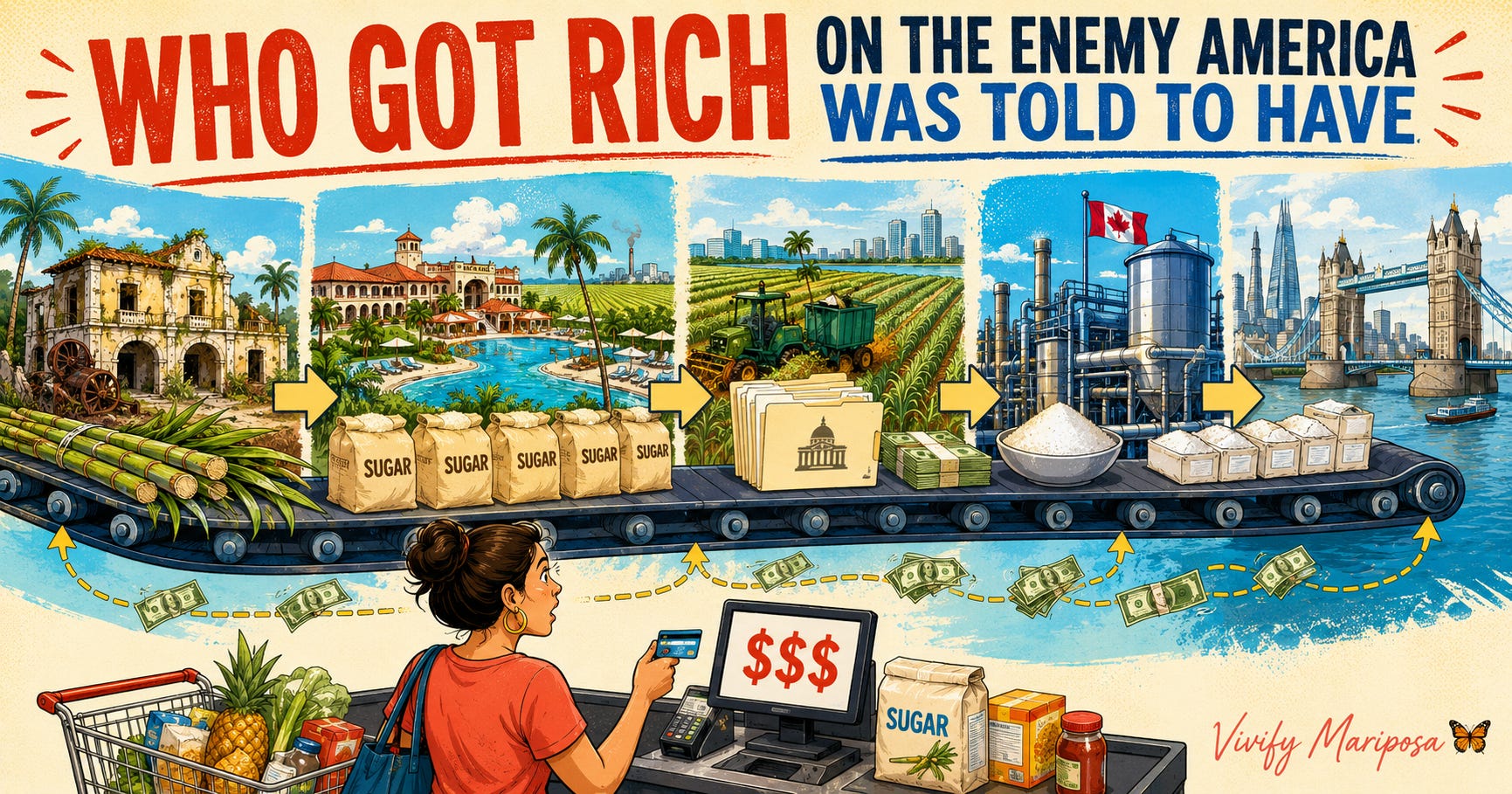
The July 6, 1960 proclamation that cut Cuba’s quota transferred it to the Dominican Republic on the same day. That transfer created the sugar quota that the Dominican industry would build itself around, and that industry included the assets that would become Central Romana under Gulf and Western ownership. In 1984, Alfonso Fanjul, José Fanjul, and Carlos Morales Troncoso purchased Gulf and Western’s Dominican sugar assets. The acquisition included Central Romana, now the largest sugar producer in the Dominican Republic. Central Romana anchors Casa de Campo, one of the most exclusive resorts in the hemisphere. Central Romana was placed on a U.S. Customs and Border Protection Withhold Release Order in November 2022 for evidence of forced labor. The order was lifted in 2025.
Then the country-level move came. On July 23, 2026, the Trump administration imposed a twelve and a half percent Section 301 tariff on Dominican Republic imports, citing the country’s failure to impose and effectively enforce a ban on goods produced with forced labor. The Dominican Republic was placed in the higher tariff tier alongside Brazil, Colombia, Peru, and Venezuela, above Mexico, Guatemala, Honduras, and El Salvador at ten percent. The forced-labor evidence CBP first named at Central Romana in 2022 is now named at the country level in 2026, and priced into every Dominican container crossing an American port. The instrument the previous administration had walked back on the corporation is the instrument the current administration reopened on the country. The commodity that takes the hit is sugar. It is the same Caribbean commodity London has priced, insured, and refined for two hundred fifty years.
The Fanjul family owns Florida Crystals. The Fanjul family owns Domino Sugar. The Fanjul family owns Redpath Sugar in Canada. The Fanjul companies receive federal sugar price supports and quota allocations that Cuba’s original quota was cut to make room for, and the estimated annual value of those supports to the family’s American operations runs in the range of one hundred and fifty million dollars a year.
The exile family that lost Cuba was made whole through the mechanism that punished Cuba. The Cuban revolution took their property. The Cuban embargo returned their market. Both moves benefited the same commercial family, and that is not opinion. That is the transfer sequence on paper, in the Federal Register, in SEC filings for Gulf and Western, in the Fanjul acquisition record, in the annual USDA sugar quota allocations, and in the November 2022 CBP forced-labor order.
The Cuban Democracy Act of 1992 expanded the embargo to foreign subsidiaries of American companies. The Helms-Burton Act of 1996 codified the embargo into statute so that no future president could lift it by executive order alone. The Fanjul family’s political donations to both American parties across the 1990s and 2000s are on the FEC record. The bill passed. The market held. And the invoice cleared.
The American public was told Cuba was the enemy. The American taxpayer subsidized the sugar producer that inherited Cuba’s market. The American consumer paid a higher domestic sugar price to protect the arrangement. The American voter had no vote on the arrangement. The enemy was manufactured, the subsidy was invoiced, and the taxpayer paid.
Now ask a harder question. Why is sugar not classified as a drug?
Sugar produces diabetes type two, obesity, metabolic syndrome, cardiovascular disease, non-alcoholic fatty liver disease, cognitive decline, and the exact addiction signature in functional MRI brain scans that cocaine produces. The medical evidence is not disputed and has not been disputed for thirty years. Sugar is not classified as a drug because sugar is an instrument of the machine.
Without sugar there is no transatlantic slave trade at the scale it operated. Without sugar there is no Cuba as a monoculture colony. Without sugar there is no Central Romana. Without sugar there is no Fanjul family. Without sugar there is no processed food industry dominating the American commercial system. Without sugar there is no diabetes epidemic. Without sugar there is no pharmaceutical industry built on metformin, insulin, and GLP-1 agonists. Without sugar making the population sick, there is no reason the American health expenditure runs at eighteen percent of GDP.
The food industry depends on cheap sugar. The pharmaceutical industry depends on the patients cheap sugar produces. The hospital system depends on the chronic treatments cheap sugar produces. The health insurance industry depends on the claim volume cheap sugar produces. Every one of these sectors bills billions, and every one of them runs its compliance regime on the same Basel standards the City of London wrote.
And the sugar remains subsidized. The Fanjul family receives the federal subsidy. The American consumer pays the inflated domestic price. The American patient pays the treatment for the diseases the sugar caused. The American taxpayer pays Medicare and Medicaid to cover those diseases. And the whole commercial circuit terminates in New York and London clearing infrastructure.
Sugar is the drug the machine legalized. Cocaine was made illegal because the machine did not fully control the market. Sugar was made legal because the machine controlled the market from the moment the first plantation was carved out of Cuba four hundred years ago. Different substance, same mechanism, different legal status, same biological damage. The law reflects who owns the commodity, not what the commodity does to the body.
In 2010, ASR Group acquired Tate & Lyle’s European cane-sugar operations, including the Thames refinery in London. Now follow the chain. Cuban sugar dynasty. Central Romana. American quotas. Domino Sugar. Redpath Sugar. Tate & Lyle Sugars. The Thames refinery in London. The invoice did not merely pass through London. The refinery was there.
The invoice was in London.
Nothing exposes the two-Cuba arrangement more cleanly than the litigation the American public was never told about.
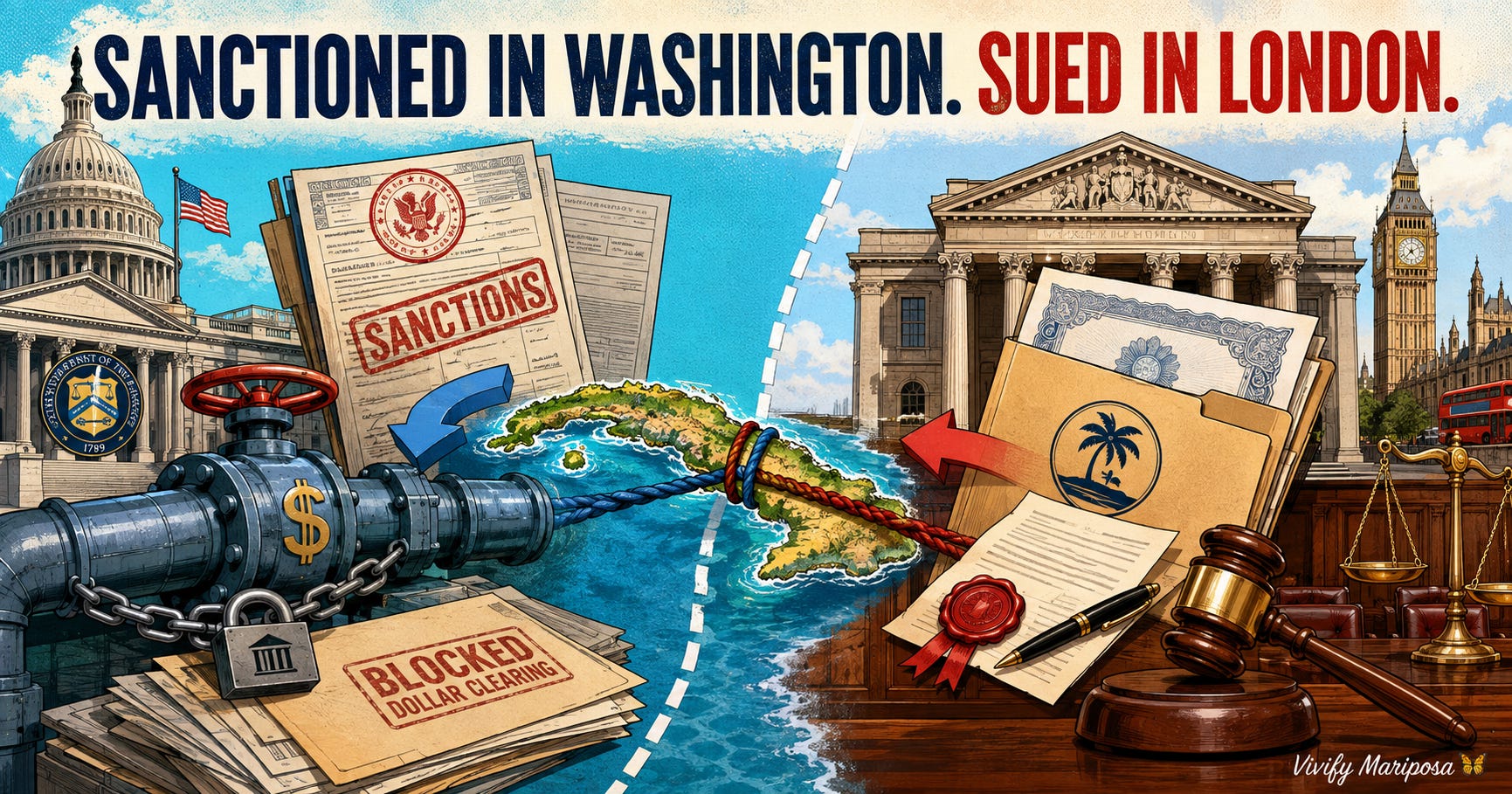
CRF I Limited is a Cayman Islands investment fund that acquired a portion of Cuba’s sovereign debt at discount on the London-linked secondary market. In 2020, CRF I sued Cuba in the English High Court of Justice in London under English-law loan documentation. The case was heard in London because the underlying loan contracts were governed by English law and the parties had submitted to the jurisdiction of the English courts when the debt was originally issued.
In 2023, Justice Sara Cockerill of the English commercial court ruled that Banco Nacional de Cuba had confirmed the debt and that the case could proceed against the bank on the merits. Cuba, the country that has been sanctioned by the United States for sixty-six years, has been sued for its sovereign debt in a British court under a British legal instrument by a Cayman Islands fund that acquired the debt through London-linked commercial markets.
Read the geography of this one more time. The country was sanctioned in Washington. The country is being sued in London. The country cannot access the American clearing system. The country is fully accessible to the British legal system. Cuba is excluded from the enforcer’s remaining tools. Cuba is fully inside the machine’s real jurisdiction.
And CRF I is not the only fund. The commercial debt Cuba took on across the Special Period and after was structured, priced, distributed, and traded on markets anchored in London and its offshore satellites. The paper says Cayman. The court says English High Court. The law says English law. The precedent is now on record. Any sovereign debt Cuba issued that was governed by English law can be litigated by any subsequent holder in an English court, and Cuba’s compliance with those judgments will determine Cuba’s access to any future international commercial financing.
Cuba is a sanctioned communist regime, and Cuba is also a defendant in the commercial courts of the City of London. Both are true at the same time. Neither cancels the other.
The population lived under the embargo. The regime was sanctioned by the enforcer. And the debt was collected by the machine’s own commercial courts, in the machine’s own capital, under the machine’s own law.
The invoice was in London.
The 2026 Cuba Report was released on July 20, 2026, under the signature of Secretary of State Marco Rubio, titled Cuba: The Capital of 21st Century Communism. It catalogs the Cuban intelligence and influence architecture in detail: the ICAP network, the Amistur travel operation, the SIGINT sites at Wajay and Calabazar and El Salao and Bejucal, the DGI espionage cases, the Tricontinental infrastructure, the Cuban role in Venezuela, the Cuban connections to Iran and China and Russia, the Cuban support to non-state actors including groups aligned with the PFLP and Hamas.
The Report is careful in some places and expansive in others. It treats documented convictions and decoded communications as its strongest evidence, then extends from that base into interpretive claims about the scale of Cuban influence over modern American political movements. Some of those expansive claims are supported by the underlying records. Some are the reading a policy document is written to produce. Both live in the same PDF.
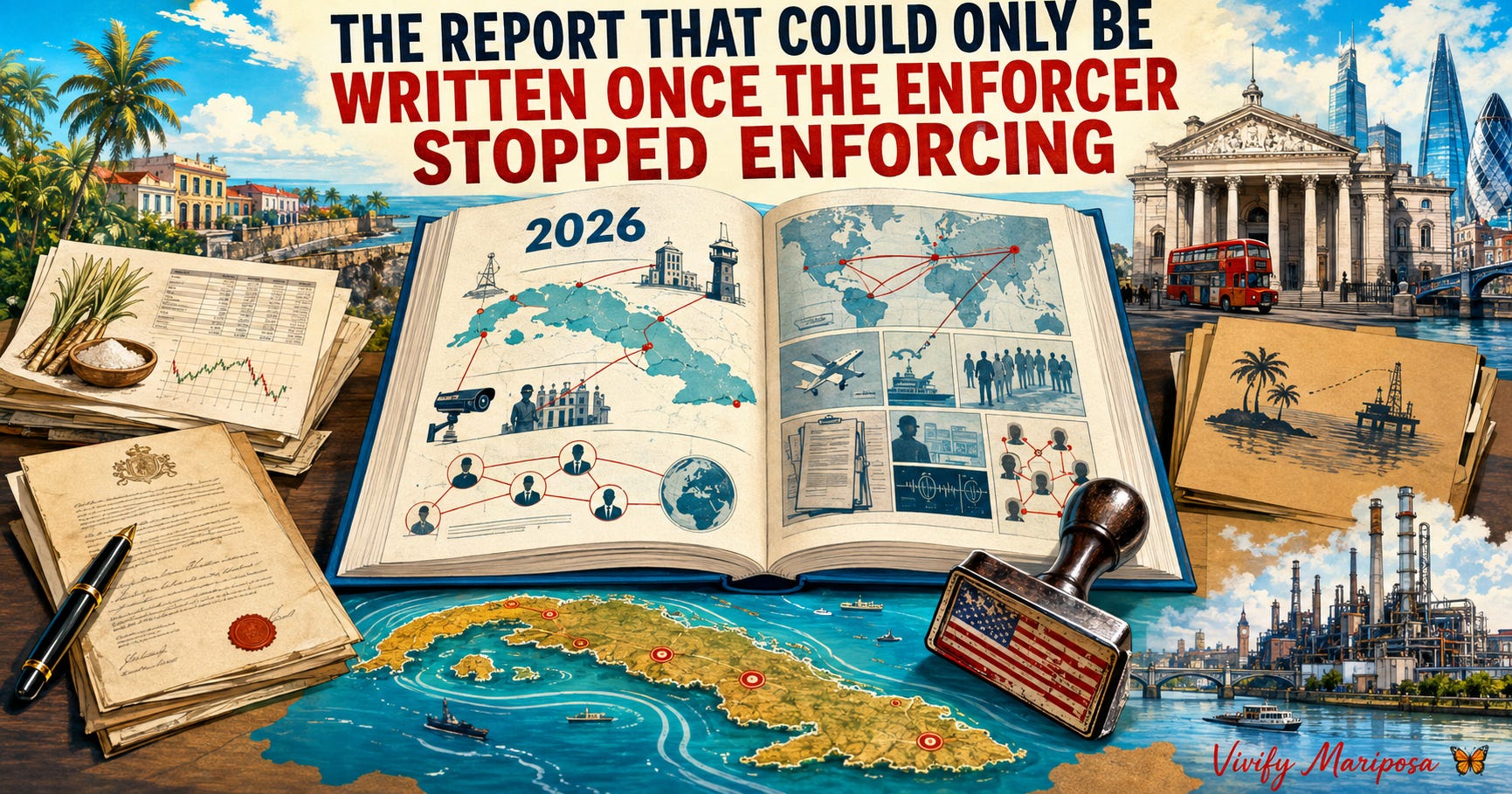
But what the Report does not do, ever, is ask who priced Cuban sugar, or who insured Cuban shipping, or who wrote the debt sustainability standard installed in the Cuban constitution in 1901, or who cleared the dollar transactions the Cuban peso was pegged to for six decades, or who ran the commodity markets Cuba was locked out of after 1960, or who holds the sovereign debt architecture Cuba could not access after 1961, or who is currently suing Cuba in the English commercial courts under English-law contracts, or who profited when the Cuban exile oligarchy inherited the sugar quota through the Dominican Republic, or who continues to profit today.
The Report does not ask because the answer would name the machine the previous seventy years of American foreign policy was enforcing. And American foreign policy under this administration is repositioning against that machine. The State Department under Rubio can catalog what the machine’s arrangement produced. The State Department cannot yet name what produced it.
This Report is what a repositioning power publishes on its way to naming the target of the repositioning. It is not a Cold War document. It is a post-enforcer document. The Cold War Cuba narrative was written to justify what America was doing on behalf of the arrangement. The 2026 Cuba narrative is being written to catalog what the arrangement produced, in preparation for a policy shift the arrangement will not survive.
The June 2026 Treasury sanctions on ICAP and Amistur cut Cuba further off from dollar transactions and tightened the perimeter, but they did not close the London real estate market where Cuban sovereign debt disputes are litigated, or the London Sugar Exchange contracts that price the sugar Cuba can no longer sell, or the ICE Brent contract in London that priced every Venezuelan barrel that fueled Cuba’s medical missions, or the Lloyd’s marketplace that insures every commercial cargo Cuba cannot access, or the English commercial courts where CRF I Limited sued Cuba in 2020 under an English-law loan agreement.
Cuba remains excluded from the American piece. Cuba remains subject to the London piece. The sanctions apply to the enforcer’s remaining tools. The machine continues.
But the enforcer has broken with the machine’s employer, and that break is what makes this article legible in 2026. It could not have been written this way in 2015. It could not have been written this way in 2005. It could not have been written this way in 1995, or 1985, or 1975. It can be written now because the American state is no longer enforcing on behalf of the arrangement.
The invoice was in London. The hand has stopped signing.
Cuba was destroyed by the machine, and Americans were told Cuba was the enemy.
American Marines died in 1898 to end Spanish colonial rule and hand Cuba to an American corporate rule that was, at the level of pricing, insurance, and settlement, always London’s underneath. American senators wrote a debt discipline provision into the Cuban constitution in 1901 that the Bank of England had installed in every colonial contract before them. American presidents signed the sugar quota and the embargo and the codification. American taxpayers subsidized the exile oligarchy that inherited the quota. American consumers paid the higher domestic sugar price for sixty-five years and counting. American families lost sons at the Bay of Pigs, lost sleep during the Missile Crisis, and lost fathers, daughters, and colleagues to the intelligence war that followed for six decades. American institutions were penetrated by Cuban agents whose reach the counterintelligence community has publicly said exceeded the KGB. And American service members are still stationed at Guantánamo Bay on a 1903 lease that even Cuba, for all it lost, signed only after the Platt Amendment had already conditioned its sovereignty.
The mother-in-law never left the house.
Everything Americans lost to the Cuban confrontation is real. The dead are dead. The penetrated agencies are penetrated. The stationed troops are stationed. The domestic sugar price is higher than the world price by the exact spread that funds the exile industry. The taxpayer bill is enormous.
And none of it was America’s fight.
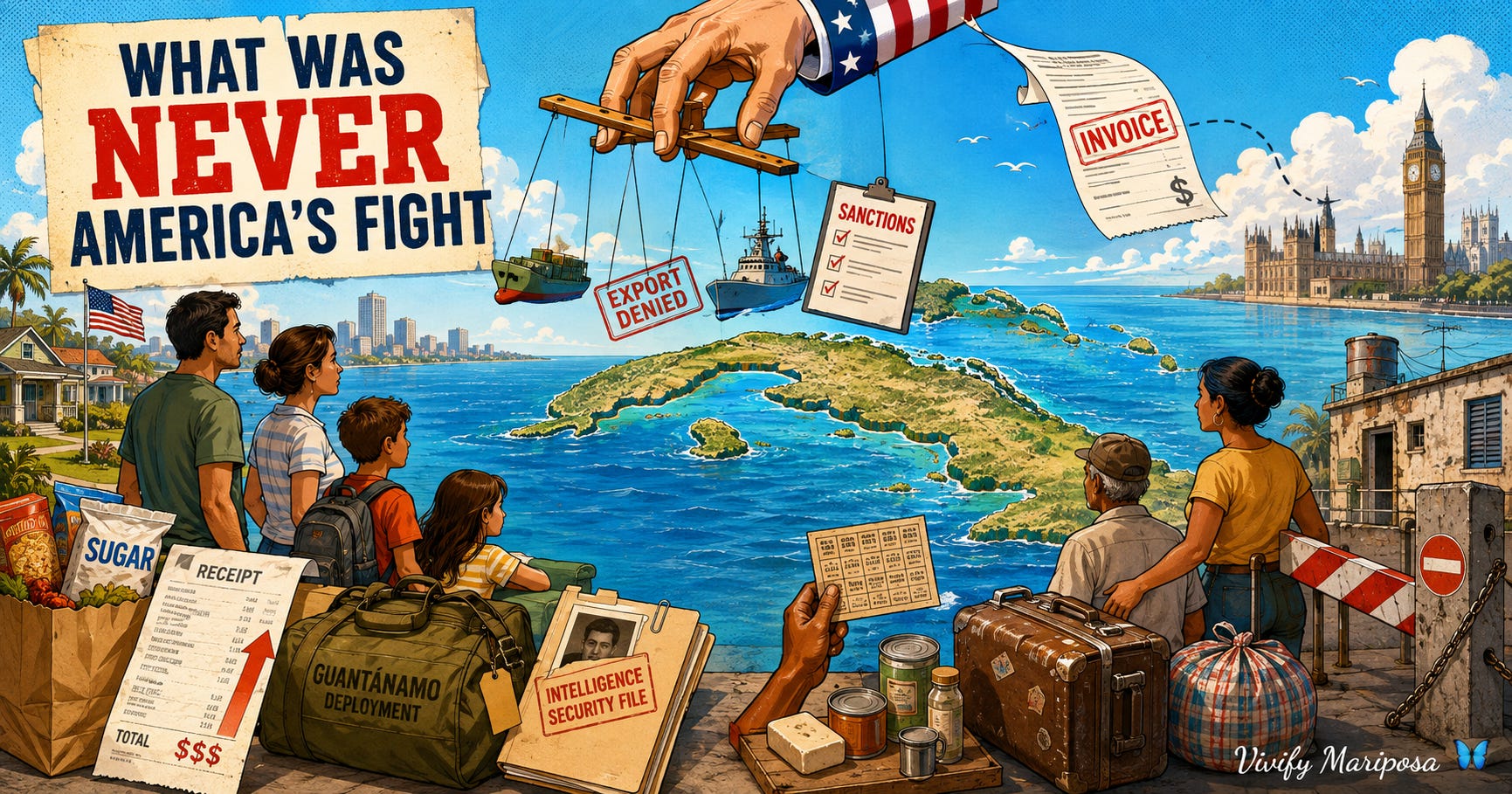
The fight was the machine’s. The invoice was the machine’s. The arrangement was written in the Square Mile. The enforcement flag was American. And the people who paid on both sides of the Florida Straits were the workers who never saw the ledger. Cubans paid with their country. Americans paid with their sons, their taxes, their institutional integrity, and the illusion that any of the ninety-mile war was ever theirs to fight.
The machine collected on both. The machine is still collecting. The Report catalogs what the arrangement produced. The arrangement is what needs to be named.
If you have read the Machine Series, you already know the arrangement’s name. If you are new here, welcome. The invoices are all written in the same handwriting.
As a child, I always dreamed of Cuba being free and of visiting all those places my mother’s friends loved to describe. I listened as they told us about the land they had lost to the regime.
I once blamed the United States for the embargo and for the suffering it caused the Cuban people. But I grew, and I learned. With time, I stopped blaming the United States and started blaming the regime.
Many of my friends continued pointing to the United States. Then Chávez came to power and applied the same method to Venezuela. Again, people pointed to the United States.
I was not studying intelligence operations at that time. I did not even know they existed. But I was watching the behavior, and the behavior kept repeating.
I still want Cuba free. I want the Cuban people to be free. But too many of them refuse to wake up. The regime controlled them for so long that it destroyed their desire to fight for freedom and their willingness to become leaders.
But oppression does not remove responsibility forever.
In order to become free, people have to fight for it. Cubans are suffering now, but they must wake up. No amount of foreign aid will do that for them. Aid is good for helping people survive, but it does not create the leaders required to recover a country.
Cuba needs leaders willing to fight for its freedom. Cuba also needs to learn from what happened to Haiti. When a country has no leaders capable of defending its sovereignty, everyone else arrives to control it.
That is why the enemy story mattered.
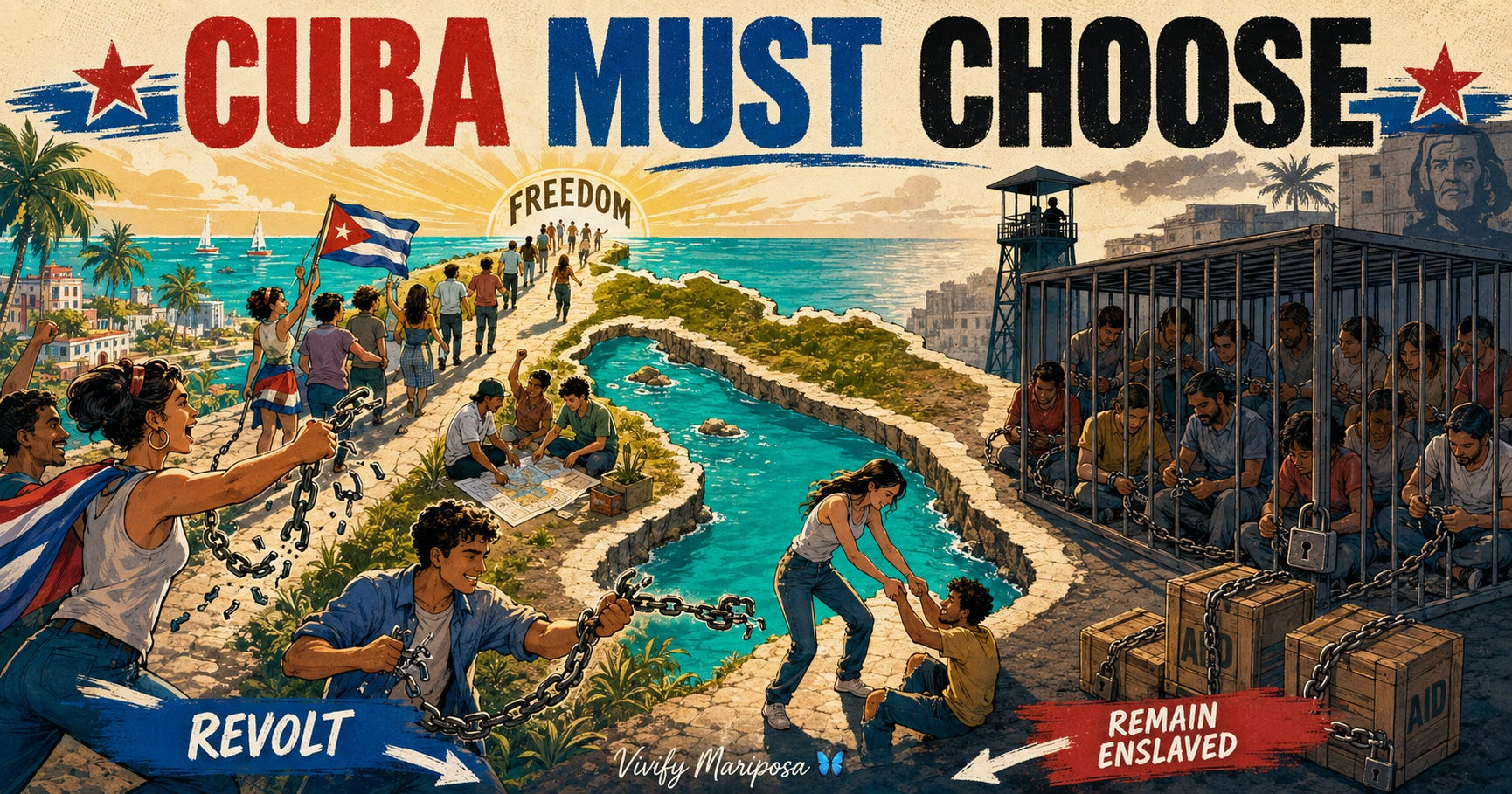
Cuba was sold America as the enemy. America was sold Cuba as the same enemy from the opposite side. Each population was taught to blame the other while the families, banks, corporations, and political institutions moved through the conflict.
The Cuban population lived inside the confrontation. The regime lived through it. American families paid for it. The shareholders profited from it.
The seven records of 1901 built this arrangement. The new records of 2026 are dismantling it. Cuba is where both years have to be read together.
The invoice was in London. The hand was American. The bill went to everyone who was not a shareholder.
If Part One and Part Two cut through the noise for you, share them with someone who is still being told Cuba is the story America was fighting.
Subscribe to receive every installment of the Machine Series, the Caribbean Machine Series, and the Square Mile / City of London series as they publish: nofilterjustfacts.substack.com
Support one-time at ko-fi.com/vivifymariposa. Every contribution funds the primary-source research, the archives access, and the time to write without a paycheck from any institution the record is investigating.
Follow on X at @interesante161 and on YouTube at @VivifyMariposa for daily receipts, thread breakdowns, and the Spanish version of each article.
The next installment in this thread will follow the same architecture into a country the Report never names.
Nothing is off the record.
Nothing gets buried.
Vivify Mariposa 🦋 No Filter. Just Facts.
No posts
Comments
Nothing yet. Say the first thing.
Sign in to join the conversation.