
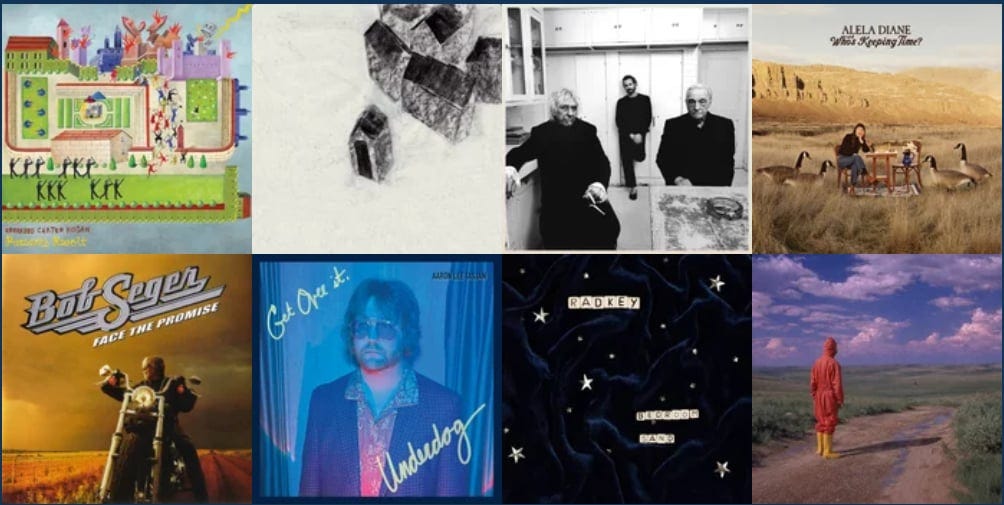
Alela Diane – “In My Own Time” (from Who’s Keeping Time?, 2026)
“In My Own Time,” from the Portland-based singer-songwriter Alela Diane’s seventh solo album, and her first since 2022, sounds at first like a seduction: “Are you around to catch a spark / to take my body in the dark?” she asks a lover over a humid, country-soul pulse. But she has more in mind here than caught sparks. Once seduced, we’re led then through verses about feeling the cold winter air knifing in our lungs, about working the garden and mending a wall and being there, for the long haul, for the ones we love. The song is about filling your life with all the life you can, right here. A fiddle curves a path, full of unexpected detours and fun and tears, through the middle of the arrangement, while the melody that Diane voices feels less composed than breathed to being. Diane’s music is routinely described by some synonym or other of delicate, but throughout her latest set, I think some better words would be rooted, determined, intentional. – David Cantwell
Aaron Lee Tasjan – “Science Friction” (from Get Over It, Underdog, 2026)
The singer-songwriter Aaron Lee Tasjan made the news recently when he posted on the socials about some people who walked out of one of his shows, presumably exercised about his song “I Love America Better than You,” a satiric jab at hyper patriotism. (“Happy Independence, I hope you’re not dependent/On ‘we’re all created equal’ to go live some kind of dream,” Tasjan sings in the song, originally released on his 2024 album, Stellar Evolution). I like the way the song mocks white Christian nationalism (and more—give it a listen) so unmistakably, you might even say so heavy handedly, the better not to mistake what side it’s on. I like most of Tasjan’s work: He’s a rock-and-roll singer-songwriter with a sense of humor, sometimes playful and silly, sometimes brutally acerbic, and he fits in Nashville not because he’s especially country or even rootsy but because songcraft and soundscapes are his things. If the cover of his latest, Get Over It, Underdog, has him appearing as if he’s hired Warren Zevon’s stylist, you’re on the right track. (If you also notice he co-wrote one new track, “The Real,” with Todd Snider, then you’re really zeroing in.) The social critique of plush-but-jittery album opener “Science Friction” is less broadly mocking and more cleverly, grimly ruminative: “Man-made machines putting man out of business,” for example, or “Time is gonna show we were quick to be too slow.” I’m not sure clever and grimly ruminative is quite what the political moment demands, but I’ll take every song we can get these days that’s on the side of human beings. Even ones this down on how all-too-human we are. – DC
Radkey – “Bedroom Sand” (from Bedroom Sand, 2026)
The Radke brothers—Dee, Isaiah and Solomon—were born and homeschooled in St. Joseph, MO, the rusty river town about thirty miles north of KC where Marshall Mathers was born. Radkey is a power trio that likes to bounce from pop-punk to heavy metal to grunge, often in the same song, investing it all with the sunny vibes its inspirations are mostly careful to avoid. RIYL: Metallica at their most radio-friendly, Green Day, the Ramones, Foo Fighters. I’ve enjoyed the band straight along, but I think I like this new album, only their third in ten years, the best yet. Partly that’s because it leans more to pop-punk than to metal, which plays to my preferences, and I like the title track best of all because its pop-punk bends all the way to New Wave: The Cars, if my ears don’t deceive me, but with more warmth. Lead singer Dee is going on about a best friend, who may actually be the guy looking back at him in the mirror, who plays Call of Duty and watches silent movies with him, but who’s also a big loser: “At least I’m still in your favorite rock band!” –DC
Owen Lake & the Tragic Loves – “Over You” (from Bury Deep My Heart, 2026)
When not dressed up like a midcentury country & western star, Owen Lake goes by the title Dr. Jeffrey Snyder, Director of Electronic Music in the Department of Music at Princeton University. These roles might suggest some seriously conflicting skill sets. But the wonder of Snyder’s work on Bury Deep My Heart, his third album in Tragic Loves mode over the last couple decades, is how warmly his drum programs, synth bass lines and bespoke gadgets such as the “Electrosteel” compliment his country melodies and themes, as well as the traditional color instruments like fiddle and pedal steel that he also uses. What I feared would be some sort of sneering art-project novelty is, in other words, a damn good country album. The more I listen, the more I like everything here, but a couple of standouts include the Outlaw-on-the-dancefloor title track and a country duet called “Let’s Go Back” (Not important, but… Its electronic pulse combined with its dinosaur-themed video gave me not unpleasant flashbacks to David Van Teighem’s These Things Happen!) I think my favorite cut here is “Over You,” which rolls along like Human League gone country. In a voice that’s not twangy in the least but still plenty lonesome, Owen Lake calls up his ex, Evaleen, to inform her he’s finally over her. Sounds suspicious to me. Evaleen will be forgiven if she thinks he still cares. – DC (Thanks to Phil Overeem for the heads up)
Bob Seger – “Little Jane” (from Face the Promise: Expanded Edition, 2026)
A twentieth-anniversary edition of Bob Seger’s 2006 album Face the Promise is on the way this fall, remastered and with three previously unreleased tracks. Perhaps you just thought to yourself, “Shouldn’t we be celebrating the fiftieth anniversary of Seger’s far superior, far more influential and career-defining sets Live Bullet and Night Moves instead?” Hey, get in line, sister! Then again, I’m here for most any sort of celebration of Bob Seger, a respected rock-and-soul singer-songwriter who never quite gets the respect he has coming. Then again, I’d rather listen to the Nashville-recorded Face the Promise than any twenty-first century album from, say the Rolling Stones or Tom Petty (maybe for the Patty Loveless duet alone). “Little Jane,” one of the new tracks, is about self-delusion coming home to roost: “We all get burned by the lies we live.” It’s hardly one of Seger’s finest songs, but it’s a solid stand-in for so many of Seger’s virtues: His smart, husky, and often unexpected phrasing, his comfortably worn and often just-plain-comforting gravitas, the whole loose, soulful, mid-tempo vibe. You know, that timeless rock and roll… – DC
Ken Pomeroy – “Deportee” (from Tonight’s News, 2026)
It has understandably been a big year for “Deportee,” the breathtaking and sadly still relevant song written by Woody Guthrie and Martin Hoffman back in 1948. We’ve already gotten two great collaborative versions in 2026: First came the elegiac, island-rooted take from Los Cenzontles, David Hidalgo, Taj Mahal, and Gary Haleamau, and then Margo Price joined with Joan Baez and Memphis Mariachi for their own urgent interpretation. But I think Ken Pomeroy’s spare, solo “Deportee” tops them all. From her upcoming covers EP, Pomeroy’s “Deportee” is mournful and intimate, with Pomeroy’s voice up close to the mic so that you don’t miss a single Guthrie word, or a single graceful turn of Hoffman’s melody. Here, the great young singer-songwriter calls back to her Oklahoma predecessor in the best way possible: by making one of his best songs into her own. – Charles Hughes
Chad Hugo (feat. Leikeli47 and Tierra Whack) – “Jumpupw!nya” (single, 2026)
Hugo’s partner in the Neptunes and N.E.R.D. has had a much more noteworthy solo career, but now Hugo belatedly steps into the spotlight with this careening delight. Paired with two of the best young MCs, each of whom dances along the stylistic edges of the mainstream in true Neptunian fashion, Hugo’s “Jumpupw!nya” has the bubbling space-jam atmosphere of all those great Neptunes tracks. But it’s never just a retro exercise, especially when Leikeli47 and Tierra Whack contribute distinctive verses that show the connective tissue between the artistic cohorts without fitting into one decade or another. And then it’s over before you realize, leaving no choice but to hit repeat and hope that this is the first of many happy returns from one of the sonic architects of the 21st century. Welcome back. – CH
Charli XCX – “Rock Music” (from Music, Fashion, Film, 2026)
Charli XCX’s return from BRAT’s ubiquity is a brash and uncompromising deconstruction of pop tropes both lyrical and sonic, with the brief opening blast of “Rock Music” a perfect encapsulation of the album’s swirling death-disco vibes. What starts as a relatively standard call to arms over a strutting riff quickly turns to face the strange, with Charli revealing the foreboding and fatalism behind the escapism: “I think the dance floor is dead,” her voice disappearing into processed disconnection, “so now we’re making rock music.” She bangs her head – “the nerve damage is real” – and stage-dives – “I hope they catch you today, but if they don’t, it’s okay” – before collapsing back into illusion as the track abruptly closes. This would all be fine, but it’s made great by the deliciously ironic fact that the track is a banger, an invocation of the album’s hazy late-night atmospheres. Listening to Music, Fashion, Film all the way through (as I’ve done multiple times since it came out last week), it’s hard not to hear Charli XCX as one of our moment’s keenest observers and innovators. – CH
Shania Twain (feat. Tanya Tucker) – “Little Miss Twain” (from Little Miss Twain, 2026)
Shania Twain’s new album is the best of her post-2017 comeback. Its highlight is its title track, where Twain recalls her mother’s encouragement in the early days of long drives to Nashville and – in the song’s most striking image – a guitar that’s bigger than Twain herself. Utilizing the frayed resonance of a voice deepened by age and a bout with Lyme disease, Twain recalls these days with love and wistfulness and a rising melody that reminds (as if we needed another reminder) that Twain is one of her era’s most gifted country melodists. (In many ways, from the gentle fingerpicking to the loving recollections, the song sounds like Twain’s response to Dolly Parton’s “Coat of Many Colors,” a song Twain loves and of which she does a fine version.) And then, of course, the song’s best trick is bringing in Tanya Tucker herself to sing along on the chorus, where – among other things – Twain’s mother assures her that she’ll be “the next Tanya Tucker.” The two singers sound great together, and I hope they collaborate more. (Lord knows they could have some fun.) As great as Ms. Tanya’s appearance is, though, it’s Shania’s solo resolution of “I’m gonna be a star” at the end of the chorus that gets me every time. You sure are. You still are. – CH
Creekbed Carter Hogan – “Burn” (from Peasants Revolt, 2026)
It makes sense that Minnesota-based singer-songwriter Creekbed Carter Hogan also identifies themselves as a fiction writer and educator. Their new album, Peasants Revolt, uses this literary precision and communicative power to what their bio calls “a medieval-Americana manuscript of apocalypse and everyday survival,” historically minded and grounded in the struggles and resistance of poor and working people across cultures and eras, with a commitment to revolutionary love at the center. On “Burn,” for example, the catastrophes of climate change and social injustice collide with the promise of true partnership. Hogan’s masterful fingerpicking, here a propulsive rumble underneath the song’s roil, adds crucial complement, and “Burn” – like Peasants Revolt more generally – suggests a new world of possibility even as the old one falls apart around us. A vibrant and exciting album from a young artist whose potential seems as limitless as their vision. – CH
Recommended reading:
-Our own Charles Hughes talks Roger Miller’s “You Don’t Want My Love” for the “Patsy Your Enthusiasm” series on HiLoBrow (David also contributed to the series)
-Kiana Mickles on Janet Jackson’s 2001 album All for You, for Pitchfork
-Joel Anderson on Jay-Z in 2026, for The Ringer
-Danny Katch on “corporate moral panic” and why stores lock up items, for his Revolution for Cowards
-Patricia Meschino talks to Linton Kwesi Johnson, for New York Times
-Mankaprr Conteh talks to Isiah Huron and asks “is this what R&B sounds like when you don’t respect women?,” for Hammer and Hope
-Natalie Weiner talks to Colson Whitehead, for Defector
-Kandia Crazy Horse talks to Tray Wellington, for Bluegrass Situation
-Emily Wilson reviews Christopher Nolan’s The Odyssey, for The London Review of Books
If you like what you’re reading here, please think of subscribing to No Fences Review! It’s free for now, although we will be adding a paid tier with exclusive content soon. Also, if you’d like to support our work now, you can hit the blue “Pledge” button on the top-right of your screen to pledge your support now, at either monthly, yearly, or founding-member rates. You’ll be billed when we add the paid option. Thanks!
No posts
Comments
Nothing yet. Say the first thing.
Sign in to join the conversation.