
I stood in Timber Hearth's museum, face to face with a Nomai stone etched in branching spirals—translation tool at the ready. The tablet's message flickered between clarity and mystery:
CASSAVA: We're nearly ready! Filix and I have finished construction, and she says calibrating the device won't take long.
FILIX: Fortunately, the Attlerock's lack of atmosphere will make calibration simple. After all this time, I'm thrilled to finally resume our search.
Each exhibit here—a rock that seems to react to conscious observation, a crystal that creates a local gravity distortion taken from one of their ruins, decorated pottery—felt like a clue half recovered, a civilisation glimpsed only in pieces. The more I read, the more those fragments hinted at something larger: hidden projects, vanished travelers, unanswered questions woven through every display.
So early on in the game, this was the moment Outer Wilds stopped being about space exploration for me and became more of an excavation simulator that happens to take place among planets and moons. I'd become an archaeologist without realising it, and the 22-minute time loop then isn't just a clever gameplay mechanic—it is field work methodology disguised as science fiction.
I've started thinking of this kind of gameplay as "archaeological"—that specific feeling certain games create where you're not just consuming a story but actively unearthing it. Where the process of understanding mirrors the actual work of archaeology: patience, cross-referencing, the sudden flash of comprehension when fragments align into meaning.
Not all games with ruins feel archaeological, though. Most don't. Tomb Raider has you raiding tombs, but you're plundering rather than understanding. Uncharted drops you into ancient temples, but Nathan Drake moves through them like a tourist with explosives rather than someone trying to piece together how people lived and died and thought.
The games that truly feel like archaeological sites recreate the epistemological process of archaeology itself. The way knowledge accumulates through careful observation, the way meaning emerges from fragments, the way understanding comes in layers rather than linear progression.
Real-life archaeology works in layers. You don't just dig straight down and find a complete Roman villa—you uncover fragments across different strata, each piece of pottery or corroded coin adding to an understanding that builds gradually, sometimes over decades. The most archaeologically authentic games understand this temporal structure and embed it into their core mechanics.
Outer Wilds achieves this through temporal stratigraphy—each 22-minute loop works like a different excavation season. You might spend one cycle exploring the Brittle Hollow, discovering fragments of Nomai text that mention something called the "Ash Twin Project." The next loop, you follow those clues to a different planet, where you find architectural evidence of massive excavation. Three loops later, you're floating inside Ash Twin itself, watching the sand cascade around massive Nomai machinery, finally understanding the whole picture.
The game never gives you a complete picture all at once. Instead, it teaches you to think archaeologically—to hold incomplete information in your mind while you search for corroborating evidence, to recognise that understanding comes through accumulation and reiteration rather than revelation.
This is the opposite of how most games handle worldbuilding. Standard practice loads you up with exposition through cutscenes, audio logs, or environmental text that explains everything you need to know. Archaeological games scatter fragments across space and time, trusting you to develop the patience and analytical thinking that real-life archaeology requires.
Return of the Obra Dinn takes this fragmentary approach to its logical extreme. You're investigating a merchant ship where every crew member died (or disappeared) under mysterious circumstances, armed with nothing but a magical pocket watch that shows you the moment of each person's death. But these glimpses are non-linear, context-free, often showing you effects before causes. You see a man being shot, but you don't know who shot him or why until you've witnessed dozens of other death-moments and started cross-referencing clothing, accents, facial tattoos, the contents of various ship compartments.
The game turns you into a forensic archaeologist, interpreting bodies as evidence, to understand that a torn sail tells a story about weather patterns, that the position of a corpse reveals the direction of attack. You learn to extract meaning from objects and their spatial relationships—the material world becomes a system of information, like a language, where every placement, every damage pattern, every missing piece carries significance. You become literate in material culture, so to say.
After a few hours with the Obra Dinn, you automatically start cataloguing details that initially seemed irrelevant. The way someone holds their hand suggests their profession. The quality of their clothing indicates their social status. The location of their body tells you where they were when violence erupted. You become someone who reconstructs the past from material evidence.
Archaeological games excel at pattern recognition puzzles—moments where scattered information suddenly coheres into understanding. Unlike traditional puzzle games, where the solution feels arbitrary—you might need to arrange colored blocks in a specific sequence that makes no logical sense beyond "this is what the designer decided"—, archaeological pattern recognition mimics how understanding actually develops in fieldwork.
In Heaven's Vault, you're literally an archaeologist deciphering an ancient language called "Ancient." The game presents you with fragments of inscriptions, and you must guess at meanings based on context, pictographic elements, and patterns you notice across different texts. For example, you might encounter the glyph for "person" combined with "law" and deduce it means "emperor / empress" (= person who makes the law) or see the glyph for "(liquid) water" appear repeatedly in contexts relating to rivers, speed, or value. As you accumulate more inscriptions, your interpretations become more accurate, revealing both literal and metaphorical layers of meaning
This is exactly how archaeological linguistics works—hypothesis, testing, revision, gradual refinement of understanding.
But Heaven's Vault goes further than just simulating archaeological methodology. It demonstrates how archaeological knowledge is always provisional, always subject to reinterpretation when new evidence emerges. The game allows you to revise your translations as your understanding deepens, showing how meaning shifts as context expands. An inscription you initially read as a simple historical record might later reveal itself as religious poetry, political propaganda, or even early science fiction.
This provisional quality of archaeological knowledge—the way interpretations shift as new evidence emerges—is something most games avoid because it creates narrative instability. Players expect stories to resolve into definitive meanings—or so game designers assume. Archaeological games embrace interpretive ambiguity as a feature. They recreate the very uncertainty that makes real-life archaeology so intellectually demanding and emotionally satisfying.
There's a specific emotional register that separates archaeological games from other forms of environmental storytelling, and it has everything to do with presence—the lingering presence of people who are definitively absent. Real-life archaeological sites carry this same quality: walking through Pompeii or Çatalhöyük, you're constantly aware that you're moving through spaces where people ate breakfast, argued with their children, fell asleep worried about harvests or taxes or whether their lover still cared about them.
Archaeological games recreate this sensation through intimate decay—environmental details that suggest personal lives interrupted rather than dramatic events concluded.
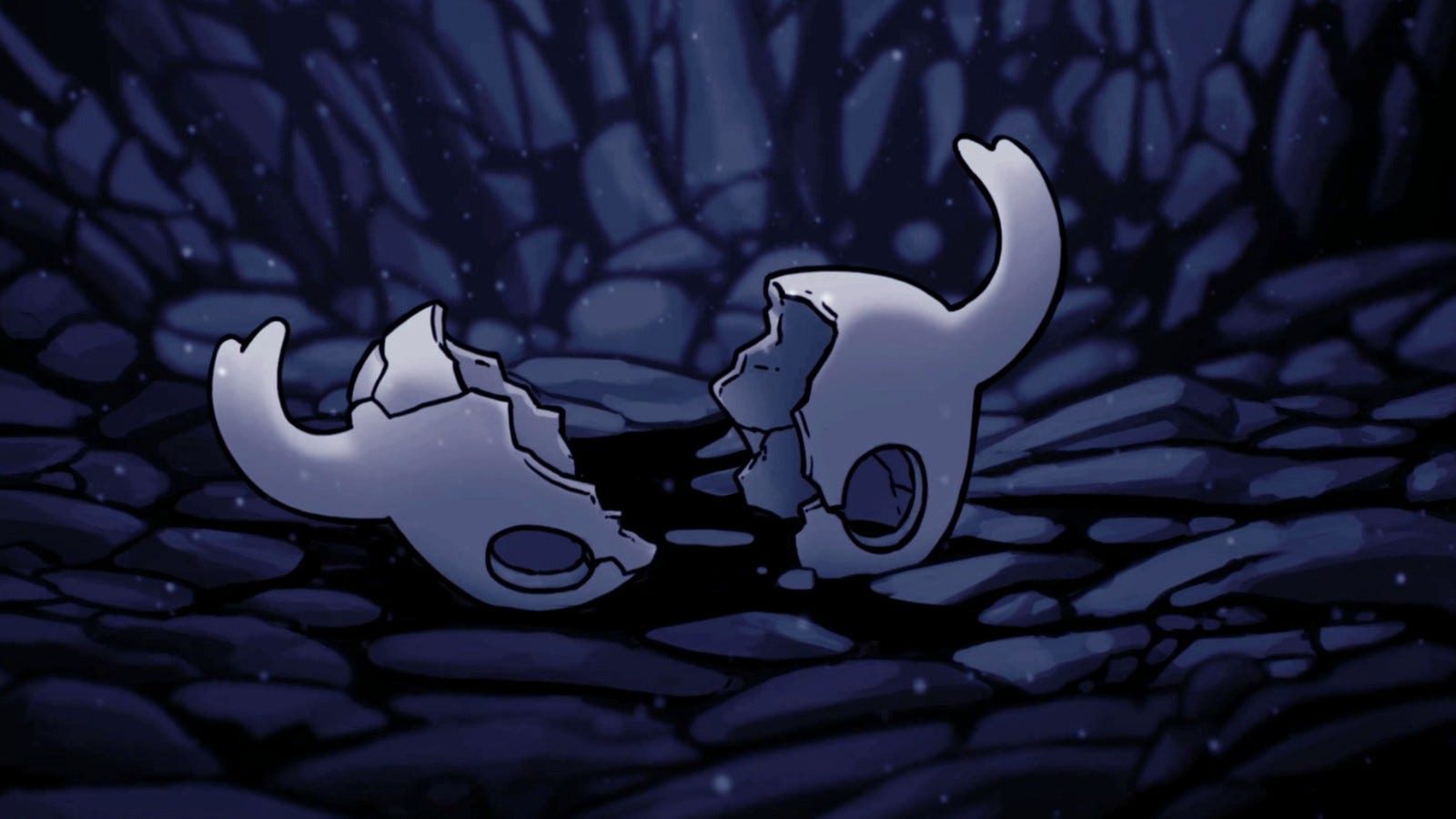
In Hollow Knight, you discover the remains of Hallownest through its ghosts. Literal spirits—like Marissa in the Pleasure House, the Great Knights found with Dream Nail dialogue—drift through the ruins, offering glimpses of what the kingdom once was before the infection swept through. But more haunting are the metaphorical ghosts—the infected creatures still wandering the tunnels, their minds stripped away by a plague that turned conscious beings into hollow shells. These walking corpses retain the forms of who they used to be but have lost everything that made them individuals. You're exploring a post-calamity kingdom where the dead outnumber the living, where the very air feels thick with interrupted existence.
The emotional impact comes from recognising that this was a gradual dissolution of consciousness itself rather than a dramatic apocalypse. The infection didn't just kill Hallownest's inhabitants—it erased their capacity for thought and feeling while leaving their bodies to shamble through familiar spaces. You're walking through a civilisation that experienced the most intimate possible violation: the theft of their minds.
Outer Wilds creates haunted presence through temporal displacement rather than spectral interruption. The Nomai are separated from you by geological time, yet their writing style is so immediate, so conversational, that reading their stone tablets feels like overhearing one side of a phone conversation:
CLARY: I have good news, Yarrow! The advanced warp core is ready to be installed in the central chamber of Ash Twin.
YARROW: I’m intrigued, love! Everyone here working on the Ash Twin Project is excited to see it (Pye is beside herself with joy!).
Their enthusiasm for discovery, their sincere affection (or dislike) for each other, their excitement about science—it all comes through with such clarity that you start to feel like you knew them personally.
This creates an almost unbearable intimacy with people who died before your species evolved. You find yourself caring deeply about whether Clary ever figured out the quantum mechanics problem she was working on, whether Solanum lived long enough to see the project completed, whether any of them had time to say goodbye before the supernova hit.
Journey perfects this emotional archaeology through pure environmental storytelling. You encounter cloth people and cloth creatures—flowing, ethereal beings that seem almost angelic in their movement. But as you progress through the world, the environmental clues reveal a darker story. The murals you discover show the history of this civilisation: they started as peaceful beings, but gradually became militarised, developing increasingly destructive technology. The landscape itself bears scars from ancient conflicts. You realise that these beautiful cloth creatures you've been encountering are the remnants of a species that destroyed itself through war and environmental collapse.
The deep sadness of Journey comes from understanding that these cloth beings were once people who were probably a lot like you—curious, creative, capable of great beauty and great destruction. The game makes you feel the weight of an entire species' worth of individual lives, each one as complex and meaningful as your own, all lost to cycles of violence that probably felt justified to the people perpetuating them.
What makes these emotional connections possible are specific empathy techniques—mechanical and narrative choices that let you inhabit the perspective of beings separated from you by vast stretches of time and circumstance.
Traditional game storytelling relies heavily on identification—making you feel like the protagonist, encouraging you to project yourself into their situation. Archaeological games reverse this relationship. They ask you to develop curiosity about beings who are fundamentally unlike you, whose concerns and cultural contexts may be completely alien to your experience.
In What Remains of Edith Finch, you're exploring your family's abandoned house, but each room unravels a different family member's story through interactive vignettes that simulate their psychological states. When you experience Lewis's story—his retreat into fantasy work routines to escape the depression of his actual job—you temporarily inhabit his mental state, understanding from the inside how repetitive work can become meditative, how imagination can become more compelling than reality, how someone might drift so far into internal worlds that they lose track of external dangers.
This is empathy as methodology. You reconstruct inner lives from external evidence—looking at a bedroom and understanding how someone felt while living there, what they were hoping for, what they were trying to escape.
The Witness creates empathy through spatial curation. The island is covered with audio logs, but they're not exposition dumps like original Half-Life's recorded scientist briefings that straightforwardly narrate plot developments—they're fragments of philosophical and scientific texts carefully placed in environments that reflect or complicate the ideas being discussed. You find meditations on perception next to puzzles solvable only by shifting your perspective, and thoughts about observation amid gardens where close looking reveals hidden patterns. In solving its puzzles, you learn to think like whoever designed this island, bringing together scientific curiosity and spiritual seeking.
Return of the Obra Dinn works through fragmentation and reconstruction. You witness isolated moments of death, but understanding who these people were requires cross-referencing dozens of frozen scenes. The bosun's mate who appears in multiple different death tableaux starts to feel familiar—you recognise his posture, his clothing, the way he holds himself. You develop genuine concern for crew members you've never heard speak, whose names you've pieced together through careful observation of how others react to them, where they sleep, what duties they perform.
These games turn archaeological methodology into forms of intellectual intimacy. Understanding the past means temporarily becoming someone else, seeing through their eyes, caring about their concerns. The empathy emerges not from being told to care, but from the patient work of reconstruction.
There's something almost anachronistic about archaeological games in our current digital landscape. We live in an age of instant information, where any factual question can be answered in seconds, where Wikipedia provides comprehensive overviews of complex topics, where YouTube videos promise to explain quantum physics or the fall of Rome in under ten minutes. The idea of spending hours carefully piecing together fragments to understand something that could be explained in a single paragraph seems almost perversely inefficient.
But that's exactly why these games feel so important, and why their archaeological approach seems more rather than less valuable. The instant availability of information has created a particular kind of intellectual poverty—we've become consumers of pre-digested knowledge rather than active participants in knowledge creation.
When you google "Nomai civilisation," you get detailed wikis that explain everything about Outer Wilds' lore in exhaustive detail. Reading these wikis is efficient, comprehensive, and completely different from the experience of actually discovering that lore through exploration and deduction. The difference isn't just emotional—it's epistemological. The wiki gives you information; the game makes you think archaeologically.
Archaeological thinking involves a particular relationship to uncertainty and incompleteness. Real-life archaeologists work with fragmentary evidence, provisional interpretations, theories that might be overturned by the next season's excavation. They operate with intellectual humility—the recognition that understanding complex systems requires patience, that premature closure often leads to false conclusions, that the most interesting discoveries usually emerge from questions rather than answers.
This intellectual orientation feels increasingly rare in contemporary culture. Social media rewards quick takes over careful analysis. News cycles demand immediate responses to complex problems. Academic publishing pressures researchers to present definitive findings rather than acknowledge uncertainties. We've created information systems that punish archaeological thinking—the slow, careful, iterative process of building understanding through accumulated observation.
Archaeological games, however, reward patience over speed, depth over breadth, interpretive sophistication over factual accumulation. You become comfortable with uncertainty, waiting for patterns to emerge naturally rather than forcing connections that aren't there yet. The process of discovery becomes as engaging as whatever you actually discover.
But there's also a self-indulgent quality to this archaeological romanticism. Most of the time, you actually do want the Wikipedia summary. When your car breaks down, you don't want to slowly piece together automotive theory from fragmentary evidence—you want the mechanic to tell you what's wrong and fix it. When you're trying to understand a news story, patient archaeological reconstruction might miss the immediate political consequences that affect real people's lives.
Archaeological games work because they're games. The stakes are low, the time is leisure time, and the complexity is designed to be eventually solvable. Real archaeological thinking often leads to permanent uncertainty, to questions that stay unanswered for decades, to careful work that turns out to be completely wrong.
Maybe these games work simply because they create a safe space for the kind of slow, uncertain exploration that real life rarely allows. They're archaeological tourism—all the intellectual pleasure of reconstruction without any of the professional responsibility of getting it right.
Spend enough time excavating virtual ruins and you start noticing the layered histories embedded in your own environment. The present becomes an archaeological site.
Walking through any city may turn into an exercise in reading temporal strata. The art deco building facade hiding a modern steel frame. The smartphone store occupying a space where a barbershop operated for sixty years. The parking lot built over a stream that still flows underneath in hidden tunnels. Urban landscapes get legible as palimpsests—texts written over other texts, with traces of earlier meanings still visible beneath the surface.
Even personal spaces reveal themselves as archaeological sites. Your living room contains artifacts from different periods of your life, each object carrying embedded stories about who you were when you acquired it, what you hoped it would help you become. You start reading these environmental texts, to understand how physical spaces encode temporal narratives.
Archaeological consciousness changes how you relate to everything from family dynamics to career decisions to creative projects. You notice patterns across time scales, see how present situations developed from layered histories, recognize that current problems often have roots in much older systemic issues.
With archaeological thinking, you see yourself as both investigator and artifact—someone whose current situation emerged from countless previous decisions and circumstances, many of which you can reconstruct through careful attention to evidence, but many of which may remain mysterious no matter how thoroughly you excavate.
This archaeological approach to the present makes me wonder about the opposite problem: what about the things that resist archaeological reading entirely? Digital interactions leave almost no material traces—no worn paths, no accumulated patina, no physical evidence of use. How do you reconstruct the emotional history of a relationship conducted primarily through WhatsApp messages that disappear? What kind of archaeology will future generations need to understand how we lived through screens?
Maybe that's a limitation of thinking archaeologically about everything. Some experiences are designed to be ephemeral, some knowledge is meant to be immediate rather than reconstructed. Not everything benefits from being treated like a ruin waiting to be excavated. Sometimes the surface is all there is, and that might be enough.
But then again, maybe you're already doing digital archaeology without realising it. What stories are embedded in your browser history, your photo timestamps, the apps you've stopped using? What would someone conclude about your life from the digital traces you leave behind?
Comments
Nothing yet. Say the first thing.
Sign in to join the conversation.