
If you can understand why I NEEDED the Power Rangers’ Megazord, it can help you write more believable characters. (And also may generate some story ideas as a free bonus.)
A character is not a person, insists Aaron Sorkin. Characters look like people, but they are not people. Characters are tools of the storyteller. Characters are there to do a thing that the author wants.
A person has brand loyalty, whether they want to or not.
Even a stalwart person.
A stalwart person might resist brand loyalty on most purchases, but pretty much everybody is caught in some consumer trap, buying exactly what someone wants them to buy.
So Matt Bird suggests:
(And I’m colorfully paraphrasing):
Make that shit happen to your characters.
Brand loyalty seems like it’s a choice we’re making.
Usually, brand loyalty is a result of countless hours of market research on people like us. Brand loyalty happens because someone had the care or at least the resources to figure out what we give a damn about.
Then they made the thing we wanted. And sold it to us for money. (Or for our vote. Or for social capital. Or for our attention.)
Someone wanted to be our choice. So they studied people like us until they stood out above the crowd like Powerline.
There are brands who want everyone to be their customer, like burger joints and soda companies. Most companies have a strategically narrowed view of who they want to do business with.
Have you heard comedians like Iliza Shlesinger talk about how in straight relationships the guy has an uninformed version of the story of how the couple met? Women position themselves to be chosen, but in selecting the guy they have agreed to be chosen by, Iliza says, “We scan you, like Predator….I checked your credit score….I gave you a pre-cancer mole check.”
We’re the oblivious guy, for most brand loyalty decisions. We think, “wow, I found this great thing, I have great taste,” not realizing that a part of the purchase price is covering the extensive research into people like us so that we’ll think this purchase is spontaneous, a little bit magical, and meant to be.
As I insinuated up top, I am terribly susceptible to advertising. I study this stuff, I know when it’s happening to me, and my only recourse is to yell in a mock angry tone, “Advertising works!” As I impulse purchase the thing I’m not sure I really wanted five seconds ago before I saw this ad, and my being was converted into person-desperately-in-NEED-of-this thing.
I’ve shouted “Advertising works!” as recently as this year, but when I was a kid, I obviously had even less impulse control than I have now as a man who is several centuries old.
When Power Rangers landed in the US, it was a big part of my world. I was not allowed video games, I was not allowed friends, and I was not allowed to watch Teenage Mutant Ninja Turtles, or Ren & Stimpy.
But my mom thought Power Rangers was great. She loved that it was very obviously part shot on an American sound stage, cut together with obviously dubbed lines from the villain, and combat scenes that were similarly imported.
So I was allowed to watch Power Rangers.
I repaid my mother’s kindness… by making her stand in line, for hours, to get me the Power Rangers’ Megazord toy for Christmas.
“Mother… This toy is all I want for Christmas…” -Noah Wizard, aged 6, a menace.
Now, when I learned drum rhythms, I started with bucket drumming because a drum kit has too many parts, and a bucket has two modes, the big low sound of hitting the top, and the higher sound of tapping the rim of the bucket— So, similarly, it’s going to be easier for you to understand how brand loyalty works when you see it used at the start of life when there are few characteristics that differentiate us yet.
To me, the Power Rangers’ Megazord was the perfect answer to my life. I still have it to this day (though it lives in another part of the country in storage).
But the fuckers who sell these toys, saw me and my mother coming not just from a mile away, but from another country away.
Someone realized they could take the fighting scenes from this Japanese television show, slap some Americans in-between them, and sell plastic for a high markup.
There weren’t a ton of toy options at the time. The toy revolution had begun, but we weren’t at Beanie Babies and Pokémon cards yet. There was still a shred of sanity left in the world.
So Power Rangers had some competition, but they were positioned to be exactly what my life needed in their TV show, which would act as an extended commercial for the products the show was promoting.
The number of Power Rangers merchandise things I made my family buy me was obscene.
We had magnets.
We had coloring books.
We had action figures of the Power Rangers themselves.
We had action figures of the monsters the Power Rangers defeat.
We had the hand-held device that turns you into a Power Ranger.
I went for Halloween as a Power Ranger, if I’m not mistaken. Blue Ranger I think.
We had the magically summoned weapons the Power Rangers use in the show.
These people saw us coming.
What did they know?
They knew the lineup of shows that boys had to choose from that year. (And remember this is before we chose when we watched things, or had home-video. We had to show up at a time and place. So they knew roughly when me and my peers were available to watch TV.)
They knew boys would watch a show about fighting shit.
They knew boys would want action figures, and prop weapons, and costumes of the characters.
They knew that parents were susceptible to caving, and pulling out their wallets to make their kids’ dreams come true. (My mother gets animated when she talks about how she’d pre-emptively sworn that she would not become one of those mothers standing outside in a line to get some toy for her kid. Then this fucker, Noah Wizard came along and busted that principle to smithereens.)
I saw Power Rangers and felt seen.
To me, obtaining Power Rangers merch was my right, because it was so perfect for me.
But it really wasn’t for me specifically, it was for any boy of this era with access to a TV and the will to guilt his parents into buying him stuff he didn’t need because he didn’t understand the connection between the extravagant Power Rangers gifts and “Mom stays late at work more. Where’s Mom? I miss her…”
Brand loyalty happens to a person.
Make brand loyalty happen to your characters.
When Matt Bird suggests figuring out which brands your characters are loyal to, it’s a paragraph or two away from another of his suggestions that you show your characters’ values through the compliments your characters give.
His example is Katniss in Hunger Games begrudgingly admiring her sister’s cat because the cat is a good mouser and Katniss is a good hunter.
Audiences enjoy characters having consistency in the things they value.
So the reason to know enough about your own brushes with brand loyalty takeovers of your psyche, is to understand WHICH brands can take over the minds of your characters.
Each character would fall into a different brand trap. The brand they love, tells you something about what this character values. If this character gives something up to get a preferred brand, that means the character is more invested in this exchange.
As a general rule of writing, we’re always on the lookout for the heightened times in a character’s life, and for characters worth zooming in on.
If we write about a normal person’s normal Tuesday, it’s tough to keep an audience engaged.
If we write about the confectioner whose discovery led to Napoleon Bonaparte’s increased naval capacity -’s normal Tuesday, it’s at least an interesting person to watch.
But we’re really here to watch shit like the day Nicolas Appert wins the bounty that Napoleon has placed for anyone who can develop a better method of food preservation that will let his armies conquer and pillage more effectively by sea.
And we wouldn’t care about things the confectioner did that everyone did. If everyone has a meal every day, it’s not news worthy. If a confectioner is going to figure out you can preserve food by putting it in wine bottles, corking them, and then boiling the bottle, then it might be intriguing to know what kind of shit that guy had in his fridge that nobody else had.
I don’t have that information about Nicolas Appert. I just have barely a grasp of the broadest strokes of his story and his impact on the Napoleonic wars and the unchecked spread of empires.
But if I were writing a biopic on Nicolas Appert, I’d employ some choices about his character that are based on what I know about him thus far.
Rantazmo calls characters, “A collection of choices an author makes.”
Or perhaps it’s like the old statistician’s adage, that: All statistical models are wrong. —They distort reality to make reality more readable.— But Some statistical models are useful despite that distortion.
If I were writing a biopic about this guy, it would be necessary to make up parts of his life to keep an audience interested, even if it’s just putting words in the character’s mouth.
One of the exercises I would do (even if it didn’t make it into the final draft) is to assign this character version of Nicolas Appert a clear worldview that impacts ALL of the choices he makes for at least the first few scenes.
We can always add depth and contradiction to characters later-on, but for the sake of the audience, in the scenes where we’re seeing characters for the first time, we make the characters consistent in how they respond to the world.
The trick I’m partial to, is assigning a few clear archetypes to my characters, to help differentiate them from one another.
In general, the easiest thing to write is some Odd Couple variant. One character wants order, the other character can’t be bothered.
But to keep things interesting, and to help populate the rest of the cast of characters, I use Gunnar Rohrbacher’s Comedy Code, and Sally Hogshead’s strengths chart. Sometimes some Meyers-Brigs. Sometimes some Love Languages. Sometimes Zodiac. Sometimes it’s cheaper and more “yeah like that one character,” which basically makes some of my work fan fiction that’s been worked until it wasn’t a litigious nightmare. (I’ve heard that 50 Shades of Grey started off as fan fiction of Twilight, but I have not confirmed that.)
So if I were picking an archetype for the guy who is going bottle food to help Napoleon kill people, there are a few ways I could go.
You could make the character a Buffoon, whose overconfidence brings about problems for others.
You could create someone who is contrarian and Rebels against all persons he meets, and does a sort of Challenge Accepted, God Complex thing that sustains him through his confectioning experiments.
You could decide he’s an Eccentric, who lives a rather otherworldly life on his own terms, and in so doing, was unaware that other people needed this technology, but in hearing the contest Napoleon has issued, goes to work and swiftly solves the problems of food preservation which are obvious to him how to solve.
If I wanted this guy to be a heroic character, I’d make him a Dreamer. Someone whose life is a mess because they overreach and fail to meet their targets most of the time. I’d have to make it the tragic story of a man who strove often to leave his mark on the confectionary world, and in a desperate attempt to keep his shop open, figures out how to solve Napoleon’s problem of food spoiling on long sea journeys, only to realize later the extra deaths that will cause in the world, I could show him sitting on an extra lux chair at the end, celebrated in the end of his life because Napoleon’s cash kept his business running, and he became a pillar of the community with that blood money, and now cannot enjoy any of his success.
I’m like one bottle of Southern Comfort away from writing this story…
BUT
It’s GAME JAM SEASON and I have a job to do!
Let’s wrap up this section by explaining how I’d apply brand loyalty to Napoleon’s food-bottle boiler, so that you get the mechanics of this technique, then I’ll stop stalling and actually apply it to my characters for this game jam that is due in 205 hours some of which I have to spend sleeping…
So I’ll say I’d go with the tragic Dreamer who regrets too late his decision.
What brands will trap this man?
There will be two distinct phases to his life.
Idealist.
Regret-ist.
During his Idealist years, the things that grab his attention will be rich deserts full of cream and fluff and wonder. He’ll be partial to candied violets and rose petals, and wax poetic about transforming the wonders of the natural world into something even more delectable for the human palette.
Once the regret sets in: Booze.
Alcohol brewers saw me coming from generations away.
Breweries knew that I’d be dissatisfied with how my life lined up with my dreams, and breweries would be a solid business to assume will exist generation after generation. Not because they’re genuinely good for us, but because they fill a gap we are only barely starting to deal with as a world.
So which alcohol would draw him in? Perhaps something syrupy and sickeningly sweet. Amaretto comes to mind. Or cinnamon’ed whiskey, could be.
If I were writing this story for real, I’d keep my eyes peeled as I went through life, trying to check, “Would my confectioner be trapped by this as I have?”
I’d be trying to learn what my instincts for him are.
This is a habit from Dungeons and Dragons (and other tabletop roleplaying games).
If you play Dungeons and Dragons style games for long enough, you may find that we all understand exactly who our character is during character creation, and we can make all of our decisions for the character’s stats and abilities to align with a greater purpose and theme…
But the minute the DM asks us to speak as our character, or take our first action, we are suddenly in the nightmare where we’re getting ready for a play that we’re in but no one has given us the lines yet and the curtain is going up in 3, 2, 1…
In order to counteract the blank-page mind that accompanies playing a character in an improvisation game like Dungeons and Dragons, it’s helpful to know how that character calculates risk.
In our story, the confectioner needed to keep his dreams alive, and was known to be bad at forethought. He was a dreamer. His task was to build foundations under his ‘castles in the sky.’ He didn’t realize the cost of taking money from an emperor. His focus was on the risk of his dreams dying before his life was through. The risk of having to no longer be a confectioner, and join another trade, —that risk was too high, in this story for him.
So whether it ended up in the published story or not, I’d take him on a shopping trip. I’d make the shopping trip an annual thing. (I want to show him in his idealist years and his regretful-ologist years.)
In the tradition of fan-fictioning shit, and because my mother got a book from the author of Chocolat, so I have that town from that movie in my head. So I would make him take a journey to this town with a chocolate shop that is imaginative like he wants his own confections to be.
There would have to be other stores in town, for this comparison to work. Or at least we’d need an easy way to show him in other locations with other dessert shops.
We want to see him choose the chocolatery, over the other choices. Seeing him go out of his way to obtain chocolate from this chocolatery, is how we understand what he values.
Then, when he’s old and successful, but remorseful, I’d take him back to this village he frequents. I’d make a big scene out of the light in his eyes as he is on his trip, anticipating the wonder he once felt in this chocolate shop. I’d have him make big speeches to his friends and loved ones.
—And you’d have to get a good actor, because this would be all face-acting, so you’d need someone who didn’t rely on dialog to convey the story.—
The look on his face, the twitch or the confusion— It wouldn’t be immediate disgust.
In fact, I’d have him perhaps mundanely move from one half-eaten chocolate to another, as if to routinely move from ‘a bad one’ to one that is ‘correct.’
I’d maybe swamp him in a conversation with the chocolatery owner, who are by this time old friends, and he wouldn’t notice right away that the chocolate brings no joy as it once did.
Trying to not break down in front of his old friend, the owner of his favorite chocolatery, he’d begin to lose patience, grill the owner that he’s changed the recipe somehow. When that isn’t true, the recipe is the same, he’ll have to resort to a litany about how the quality of milk in the region must have gone down in recent years. And the owner will rebuff this. “No, I know the owner of the dairy personally monsieur, the milk in the chocolate has, if anything, improved!”
Brand loyalty trapped him.
Brand loyalty played on his unmet needs.
And we could end the story there, in the chocolatery, if this were a real biopic, because losing the brand loyalty, helps us see how this man experiences the world.
The chocolate was never the product, in his case. The product he was purchasing was the wonder, the hope, the dream.
And his dream, though not dead, is hollow. And tastes wrong on the tongue.
So now let’s talk about spaceship fridges!
Fucking hell. -Do you know I almost did this post as a note. Freakin’ you know they mention Napoleon within the first chapters of Anna Karenina, which I have not finished because it is about a billion chapters long, and I’m just saying, holy heck is that fitting to remember just now because this is an even longer blog post.
BUT WE’LL GET THROUGH IT!
You wanted my process? I’ll give you my process dammit!
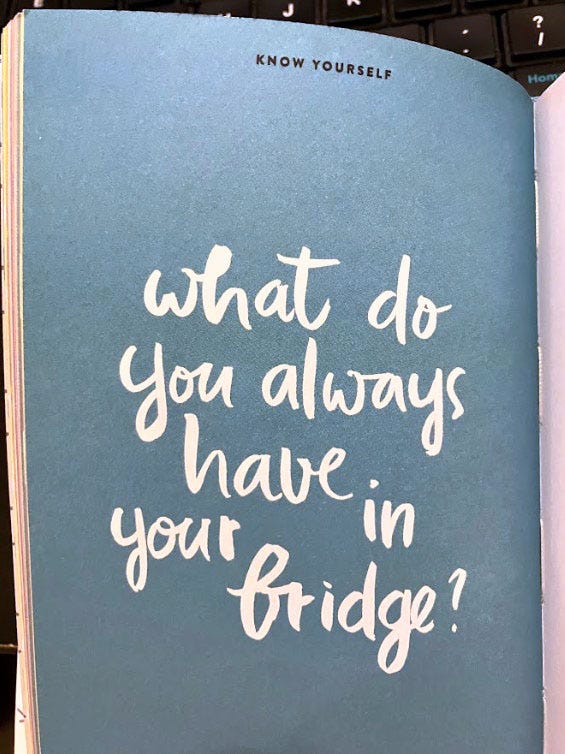
This is an impulse-check out (advertising works even if it’s just ‘which book should I get from the library’) from today’s visit to the library. We were there for a book sale, but they give you books for free, so long as you’re willing to bring them back.
This is one such book.
It’s called Know Yourself: A Book of Questions.
This is the kind of book I like for writing. I know the answers to a lot of these questions as they pertain to my own life, but knowing that it was game jam season, this was the perfect book to prompt me to differentiate my characters by what they would bring with them in the fridge, for the space flight, that is the setting for the video game that I am making in the next ten (now eight and change) days.
I know less about the characters for my story than I do about Nicolas Appert, Napoleon’s prizewinner.
But because I don’t feel the crushing weight of depicting real people who actually lived, there is some creative flow and freedom that comes from getting to make shit up as I go along, without fear of my historian cousin eying my work with a probationary squint.
What do I know?
Other than the total sum of what works and doesn’t work in a video game, I know:
They’re dudes in a relationship.
They’re in too-small of a space.
They’ve got time to kill on this journey.
Their names are or at least may be Mugs and Rowdy.
Mugs came from me playing a video game I checked out from the library on a whim (because advertising works, and I’ve wanted to play this game for a while, so when I saw it there, free of charge, I checked the hell out of it).
In this game, one of the characters you choose from to play, has the ability “Mug.”
But because of the unintuitive way they laid out the profile page, I thought the character was named Mug.
I was like, “That’s a great name! I want to play as a character named Mug!”
Then I realized my error.
Then I realized THIS GAME DOESN’T OWN THE NAME THEN!
I wasn’t even really thinking about how I could use that name for the game I’m making this week. It’s just a habit I have to future-proof my life, to jot down things that could be good names, for future use.
And this wasn’t the first time I’d misread or misheard something, felt embarrassed that I’d misunderstood, and then felt elation that I’d mistakenly invented a name for someone that I now could use for my own stories.
When I opened the document that holds all of the unused names, the top one on there (meaning the most recent) was Rowdy.
Mugs and Rowdy, I thought to myself, as I wrote Mug down on the list of names, and then Mugs, as that tweak came to me, then I explained in my notes where I got the name Mug from, so that I could remember that I was in the clear, and noticed I was attached to this idea of Mugs and Rowdy AND that I had two main characters to figure out for this game jam, so I declared them the names of the characters I’m about to make today.
I briefly cycled through archetypes from Comedy Code in my head, figuring that Mugs and Rowdy sounded like bruiser, enforcer types. And as I am making a video game, it felt like they would make sense as characters who can hold their own in a fight.
Mugs, I thought at first, might be a Rebel archetype, as Gunnar calls it, which is the archetype that picks a fight with everyone and everything they say. For both the fun of the fight, and because they believe that constant sparring will get them ahead in life (and it often does get them ahead).
But then Rowdy is literally how you would describe someone in a bar picking fights he doesn’t need to, so I shifted the Rebel over to Rowdy, and looked for another concept for Mugs.
Mugs, due to being monosyllabic, made me think of subservient characters who follow others around, and when they have their own agency, it’s maligned with lack of real understanding of the world they’re in, so their fervor gets them into trouble. This archetype is called the Buffoon.
That’s as much as I had figured out, and then I did what I almost always do, which is put the whole thing out of my mind, and hope to bump into some other stuff later.
But I don’t sit around waiting for inspiration to hit, my life is surrounded by stuff that is designed to ignite an idea if I have one brewing.
So now that I had this start-of-a-character going in the backgrounds of my head, hours later, when I picked up this Know Yourself book off of my shelf, I flipped through it, landed on the page above, which says, “What do you always have in your fridge?” and I realized, that Mugs and Rowdy sound like guys who would probably not fight too much over what they keep in their shared fridge, but when it’s a spaceship fridge, with limited availability for restocking, I could see them muscling one another out, to get more room for their coveted snacks.
But which snacks would those be for each of them?
I haven’t watched every episode of the American Office.
It didn’t grab me at the time it was airing.
It didn’t grab me when it came to streaming.
Finally, in ‘23, my sister who also did not like the show, lets me know that I should listen to The Office Ladies podcast, because it’s a wonderful friendship of two of the actors from the show, and it’s in-depth and organized enough that she said she felt satisfied that she could follow along the plot without watching the show.
I loved this podcast, and as someone who is promoting the idea that we need to study friendship more, and see better examples of what real friendship looks like: if I can get you to listen to the Office Ladies podcast (even just the 3 minute trailer) I will.
The American Office is referenced in Gunnar’s book the Comedy Code.
Michael Scott of the titular office, is a Buffoon.
Buffoons aren’t silly characters, so much as they are characters with a non-useful model for how reality works, and they take actions according to their own skewed (but consistent) logic.
Don’t write stupid characters, Gunnar says, write characters who are over-reaching and under-prepared.
So the first thing that pops into my head when I think “What does a Buffoon always have in his fridge?”
Michael Scott, when he quits his job, drinks openly at work.
He declares, “Scotch and Splenda! Tastes like Splenda, gets you drunk like scotch!”
When the hosts of The Office Ladies got to this episode, they fixed up scotches and Splenda for everyone, and they were shocked by how good it is.
Then I tried it. -Not with scotch, but adding sucralose to my booze. It was great!
I decided in an instant, because of this occurrence of a Buffoon being very right about something for once, that my Buffoon character Mugs, for my game, needs to have something amazing in the fridge he shares with his boyfriend Rowdy, on their shared, cramped spaceship.
It’s the old concept of “A broken clock is right twice a day too.” Meaning even useless people can be useful once in a while.
And I decided to make Mugs very useful when he’s useful in this case, so that while Rowdy will fight for his space in the fridge (because that’s what Rebels/Fighters) do, I can make him acquiesce to Mugs, reluctantly but heartwarmingly, when it becomes clear that Mugs used their fridge for something that they both love and can enjoy, because in this one instance, Mugs really is the best in the world at something.
Idk. I just know it’ll be something really good and smart and good for a long spaceflight.
I’m on the lookout for it.
What matters today, is that I opened a question about what these characters want to eat, and I figured out how to align the answer to that question with the unshakeable consistency that the characters need to have at the start of their story. (That’s why it’s the food characters MUST eat. If I bring up food in a story, it better not be pointless fluff, you’d better walk away with an imperceptible but solidly improved understanding of who this guy is and what he’s about. …I just don’t know what he’s about just yet… But I know now what I’m looking for, I can see how it’ll slot in once I find it.)
If you want pieces to come together faster, you gotta go consume completed media. This is real-time updates of behind-the-scenes stuff. I got this far today. Then I stopped to tell you all about it and I wrote like 90,000 words in this blog post. —I gotta sleep soon.
Sry.
EDIT: Congratulations to you the reader who is not checking this out on the day of publication, you get the free upgrade of actually hearing what the thing will be.
A buddy of mine was talking about how cheesecake is one of his favorite foods, and I was like, “oh, that can be the food thing.”
It’s as humble as that, once I’ve got the open question, something comes along and works for that slot, and it’s a quick, easy decision, and I lock it in and move on.
In order to finish the game jam, I made a prototype of the story I was working on, but I’m currently working to expand it into a full game.
Now: the main character will have excellent taste in cheesecake, and everyone will agree so… but then he will be terrible for just about every other choice of food, and his crewmates will loathe anything he makes in the kitchen besides his cheesecake.
SECOND EDIT: Mugs loves a dish he makes that he thinks is tiramisu, but he’s really gotten it mixed up with trifle. He puts everything in his tiramisu, jelly beans, graham crackers, banana slices —whatever was on-hand and sweet, he adds to his ‘tiramisu.’
People hate it.
No posts
Comments
Nothing yet. Say the first thing.
Sign in to join the conversation.