
My parents didn’t want me playing video games, because they didn’t want video games taking over my life.
My father was born in the 50’s, my mother was born in the 60’s. It’s more obvious now how foreign video games felt to them.
They didn’t just restrict me to no video games, but a lot of the shows my peers were watching, were forbidden as well.
They weren’t as strict as fundamentalists, so it’s admirable at least, that they weren’t outsourcing their judgement to someone else.
But what judgement they did, they did at arm’s length.
Video games were not a medium that they cared to engross themselves in, and let’s be fair: Video games were doing nothing to court them. A financial decision had been made that boys my age were the group to mass market games to, because all those games needed to be were competition-inducing, colorful time-sinks, in order to be profitable.
It’s my life’s mission to reverse and heal some of the fallout that resulted from the choice to make video games take the form of an automated pissing contest. -But not just because I wish my parents and more like them would play video games…
But because:
I can’t play most video games.
And it pisses me off.
When I was in my 30’s, I learned to wall jump.
More than learning to wall jump, I learned that wall jumping could be learned.
Wall jumping is a platforming technique in a bunch of games; you jump and cling onto a wall, and then jump off the wall, into the air, and land on another wall behind you, or sometimes back onto the same wall, but higher up.
It’s a way to get to new areas in the game.
And for most of my life, not only couldn’t I do it, but I ‘was sure’ that I had 100% missed the window to learn how to do it…
I did eventually get a few video game consoles in the house. Garage sale stuff that let me catch up on the games my peers had been playing for years.
But something had happened.
It’s not that I’d never played video games; I was allowed to play them when I went to my friends’ or cousins’ houses. But I found very quickly that I was bad at video games.
And it burned itself into my identity, that I was bad at video games.
We know now, that my friends simply had the gaming consoles at home, and plenty of free time, and the mono-focus of competitive little boys in the 90’s with nothing to distract from playing and failing and playing and failing and playing and learning and completing these video games.
Anyone who had a home gaming console was allowed to play and fail in private. When I’d go over to someone’s house and try their video games, I was always going to be at the playing and failing stage, for the entire visit.
And because our parents were older than the medium of video games as a whole, they didn’t have video games literacy.
They couldn’t sit us down and explain that, “Noah just needs some time to play this game and learn through mistakes and failure, and then he’ll catch up with you-all, but please be kind to him in the meantime, his parents (well-intentionedly) deprived him of the chance (that you-all had) to fail in private.”
So.
Instead of having someone who could diagnose my problem, I was left as a kid, to diagnose myself.
Prognosis: “Noah is bad at video games. Noah cannot play video games.”
Eventually, I’d graduate this to, “Noah missed the crucial window to develop his twitch reflexes, and thus cannot now play video games. (Though he probably could have had a promising aptitude for them if he had been given the opportunity.)”
So I knew eventually that it wasn’t that I was inherently bad at video games, it was just that I’d missed the window to become good at video games.
It was my identity that I was bad at video games.
That identity was, incorrect.
I carried around the identity that I had been unfairly forced to sit on the sidelines and watch others play video games, for two decades, before I accidentally ran into evidence, that my twitch reflexes could still be learned, and that I had not actually missed the window I’d needed to become good at video games.
In the olden days of video games, there were fairly strict genres.
A game was a shooter, or it was a platformer (jumping obstacle-course game), or it was a roleplaying game.
Roleplaying games (RPGs) saved my [gaming] life.
RPGs had a feature that other games did not:
RPGs would let you manually lower the difficulty of the game if you played them long enough.
Can’t beat this fight? Well go fight the easier fights, until you gain enough experience and are a higher level, and then come back and beat this fight with ease.
RPGs took the skill out of gaming for me; so long as I was willing to trade my time to grind these mindless level-ups, I could finish any RPG, by becoming max-level, and being stronger than anything the game had to throw at me.
Finally I was able to play games, so long as they were RPGs.
But decades on, the genres started borrowing elements from one another.
It wasn’t unusual to find a shooter game (which I was bad at the aiming and almost could not play) which added RPG level-up elements that let me manually lower the difficulty so that my bad aiming was no longer a factor. Mass Effect, the game that made me take game design seriously as a career, was a shooter game where I was bad at aiming, but I was able to play because I could level myself up.
But the game that cracked off my identity of, “Noah Wizard stinks at video games because he missed the critical window to become good at them,” was an obstacle course platforming game called Salt and Sanctuary, which had a very high difficulty of combat, but, if you traded your time in for level-ups, you could manually lower the difficulty of the game, and the combat became much more forgiving.
I was there for the atmosphere, and the fun of leveling my character up. It’s one of the few games I’ve beaten, but I still replay it for the satisfaction of leveling up a new character.
In fact leveling up characters is such a soothing balm to me (because it represented the relief of finally being able to play video games by lowering their difficulty) that I am about to pay money to World of Warcraft to let me spend a month of my life mindlessly leveling up characters for no other reason than that I can. I will listen to audiobooks, and rewatch TV shows, and level up characters, all because it helps soothe this ‘Enduring Vulnerability1’ that I have over video games being too hard for me to play.
One day, likely after I’d beaten the game, I was replaying an optional area of Salt and Sanctuary, that required this Wall Jump maneuver to get to a secret area.
Secret areas, are by their definition optional, and I’d had decades of skipping optional content, “because I’m just too reflexively impoverished to have any reason to hope that I should even bother…”
But (much like I do with my occasional vacations into World of Warcraft) I had an audiobook on.
So something happened which I did not expect.
Because I had the audiobook on, and because I cared so much more about learning from the content of the audiobook, I didn’t have enough attention to give to how bad I was at the wall jumping attempts.
The audiobook distracted me from my decades-long litany of, “Don’t bother; I can’t do it; I missed the window…”
And I tried, and failed… but listened to the book.
And tried some more, but mostly listened to the book, as I once again failed.
And trying and failing, were allowed to become ‘background tasks’ that ‘happened to be happening’ while I attended to my main focus, which was learning from this audiobook.
I’d try and fail, but not really think much of it, because I needed to focus on the book.
And this was an optional area, so it didn’t really matter that, “I had no real chance of getting up there but let’s just see how far I can get…”
‘How far I could get,’ it turned out, was the entire way to the top.
I got to the secret area…
And while the secret area had nothing that was worth the effort it would have taken me to get up there, if I’d felt the pains the entire way, instead of having the ‘anesthetic’ of being distracted by the audiobook, the real benefit of reaching this secret area, was that I actually managed to disprove this limiting thing I’d shouted about myself for years.
I hadn’t missed the window to learn how to reflex jump in a video game.
I just missed the window to do it without being self-conscious about it.
I could try and fail and try and fail and learn and complete the task, I just had to submit to the indignity and ego-pains of watching myself fail and fail and fail along the way.
If you’re familiar with Carol Dweck’s Fixed Mindset vs Growth Mindset, I’d been living my entire life with a relationship to video games (video games: my life’s work…) with my mindset that my skill level was ‘Fixed’ in place, and was an inherent quality about me now, and that, like anyone with a Fixed Mindset on a topic, if someone suggested to me that I could Grow and change and learn, I’d become wounded and offended because of the immutable quality about myself that I was sure I had.
“Noah Wizard can’t wall jump. He can’t even do a normal difficulty platform jumping puzzle! How’s he going to do the multi-twitch-reflex maneuver of multiple wall jumps in quick succession???”
But then, by accident, I disproved this screed I’d written about myself over and over for years.
I was not someone who was barred from becoming good at video games, I’d just have to deal with the hurt to my ego, and let myself fail a bunch, but then, I could acquire the missing skills that I needed, and I’d be able to play more video games than before.
This led me to an era in my life, both of testing my limits in which video games I could try and fail and learn, and in other arenas of my life where I could now see I might have a Fixed Mindset in need of a shift to a Growth Mindset.
After all, if there were things I was bad at, that I could improve at, those unlocked new skills that I’d been avoiding training, might actually open up my life a bit!
The biggest success of that era, was that I sought out a drawing group that was made up of a bunch of people who felt that though we could draw (technically speaking) we were not yet, “Good enough to call ourselves artists.”
Art collectives are tricky things to find. I’ve only ever found two in all my years of searching that were actually just about sharing in the joy of trying to draw (all other groups were basically galleries to show off how amazing your latest gallery-worthy finished piece was).
I started off with some ability to draw:

And gained enough strategy, and had enough practice, that I was able to shift my identity from, “Noah Wizard ‘can’ draw, but he shouldn’t really call himself ‘an artist.’” to, “Yeah, I know what I’m doing; I can draw; it takes me forever, but I’m no longer confused about how to improve a drawing, should I so choose.”
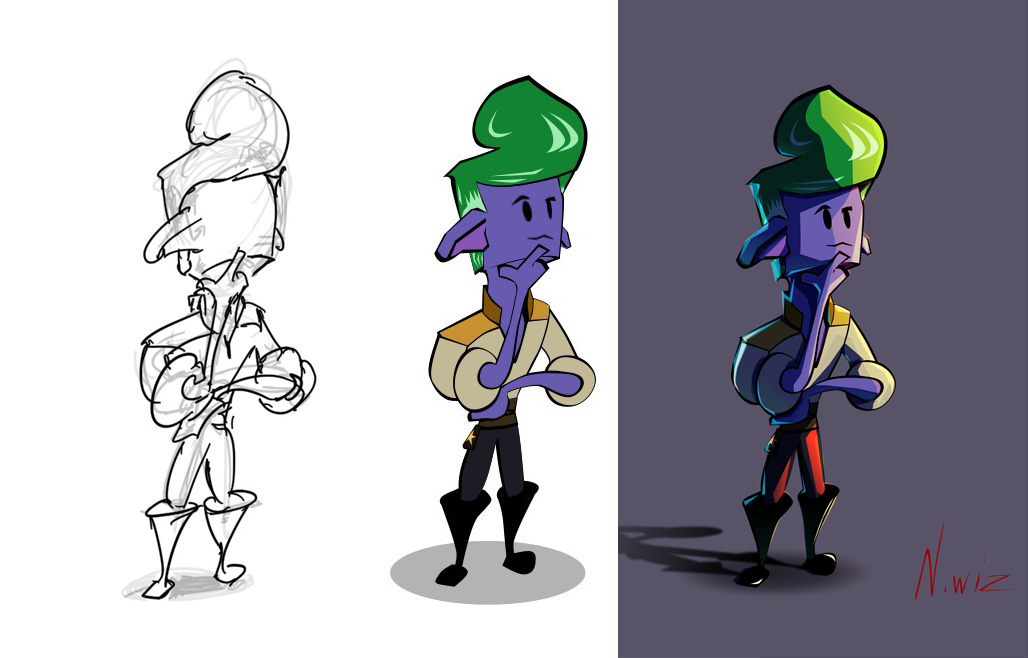
That being said, my identity never shifted into, “Wow I love to draw, I am a ‘drawing person’ now.”
Similarly, I’m still pissed at Mario…
Sometimes, I am a very bad friend.
Sometimes, I am hurt, and I use that as an excuse to suspend decorum, and put other people’s likes on trial, simply because I cannot understand them and I am tired of trying.
It’s a real shit character trait, and I don’t recommend it. (Putting my friends’ likes on trial, is something I will need to adopt more of a Growth Mindset on, going forward.)
One day, I was grilling a game designer friend of mine, who, like most nerd guys my age, likes platformer games, and doesn’t think about them as taunting exclusionary games that prevent someone like me from being able to enjoy them.
“Why are they good? Why is this fun??” I demanded.
He had no explanation other than that because the actual act of platforming didn’t cost him anything, he enjoyed getting to see the next level and the next.
For me, the cost is so high that almost no level in any game I’ve played would be worth it to go through the pains of trying to platform well enough to be able to access that area.
This is especially true for me, when there’s nothing to gain by going to the hard-to-reach area of a game, not even more story, just more game.
I hate it.
I hate it a lot.
And this guy is very wise, and he knew me well enough, that he was able to provide me this point of view:
“It makes sense that you don’t like platformer games. The way you’ve described it, the way these platforming games made you feel, in public, with your friends watching you fail: Mario was essentially your childhood bully.”
That helped.
That helped me to see that I’m not examining platforming games with the lens of someone neutral, trying to discern their benefits and value to the people who enjoy them; I was putting platformers on trial, as a victim who wanted to hear my perpetrator’s excuses for treating me this way…
So.
I can learn platforming, but the wounds surrounding my early humiliations about platforming, may take a lot of time for me to undo, and there’s a real question as to whether or not doing all of that work will be worth it.
I love my ability to draw. I don’t love the drawing [activity] part so much, but I love my drawings.
Overcoming the Fixed Mindset I had about drawing, had a benefit worth the trouble.
I had many such meltdowns on my way to being able to draw. But at the end of the journey, I gained the ability to illustrate my stories and change hearts and minds with what I can now create with my visuals.
At the end of being able to platform, all I’ll get is more platforming in many cases, and it’s not likely that I’ll ever see it as worth working through that hurt.
I wish my parents had played video games.
I’d have had a nicer childhood if they could have used their adult brains to work through the difficulty of learning a video game, and helped give me the psychological antibodies that would have allowed me to get over my own frustrations back then.
But I also just don’t like living in a world where so many have written this medium off entirely, as not worthy of their time.
For many people, if they haven’t checked in on video games in a decade or so, they might be blithely unaware that many games now are made by independent video game creators, and as such, there are thousands of games not sticking to the easily-marketable-pissing-contest segment of customers.
The way I sometimes pitch video games to someone who hasn’t played them yet, is that it’s understandable if they think the only genre of game is the shooter genre; if the only genre of movies that ever existed were the shoot-em-up genre of movies, there would be plenty of people who would have written off film-as-a-medium too!
In fact I think this has something to do with why opera has a narrow band of appeal; content and subject matter are important to viewers. We have so much choice, we want to select media that speaks to something in us.
“We read to know that we are not alone.” -C.S. Lewis
I think the vast majority of people who have never picked up a video game (or who haven’t tried the variety of games that are out now) assume that there is no video game out there that has any chance of speaking directly to their heart, making them feel seen. If there are books and movies and songs and television shows that are making a person feel seen, why would they bother with a medium that they are sure cannot deliver an experience of shared humanity the way all those other mediums surely will offer them what they need?
I want my games to be easy.
I want my games to have a low barrier to entry, because if you’re someone who is used to playing difficult video games, you can always stuff your pride and play a low-difficulty game, but someone who cannot play high difficulty games can’t just switch on some skill they don’t have and partake in a tough game.
I want games to be something that the majority of humans play.
I want, “I spent most of the weekend gaming,” to be looked at as nefariously as, “I spent most of the weekend reading.”
There are those who are suspicious of reading, but it’s an unchecked number of people who are willing to look down on the same number of hours spent gaming. And there are few people who would look on in admiration and say, “Wow, I really need to game more,” the way you will have people who say, “Wow, I really need to read more,” when confronted with someone who has read a lot recently.
I live a privileged life that I have been able to devote myself to trying to bridge this gap. I wouldn’t have been able to do it without support from friends and family.
I hope you’ll join me, at least in your heart, at least one step more than you had been, in honoring games as a way for humans to help other humans, same as any storytelling medium that we’ve had to lift ourselves up.
It’ll be some time before my games are complete enough that they can speak for themselves; in the meantime, if you are someone who felt a shift while reading all this, I hope you’ll stick around, or even go out and seek out more of an understanding of what games can be, and how games can be a tool for saving us from ourselves, and keeping us from the dark pit of isolation.
This is a term I heard from the Gottman Institute’s research in to the origins of fights with our loved ones. It refers to wounds that disproportionately hurt us, and if our partners and teammates and family members are unaware of them, we are likely to have an asymmetrical response to bad news, where we seem to be flying off the handle for small issues. They are termed enduring because though we can work through them, there is as yet little evidence that we can become truly neutral when certain events happen. And this is just my notion but I reckon this is the nature of why we’ll get haters in the comments for seemingly random things; likely that person has an enduring vulnerability towards something we said or how we said it, and their response is accurate to how much pain they’re in, but it isn’t likely an accurate reflection of how much carelessness they accuse us of.
No posts
Comments
Nothing yet. Say the first thing.
Sign in to join the conversation.