
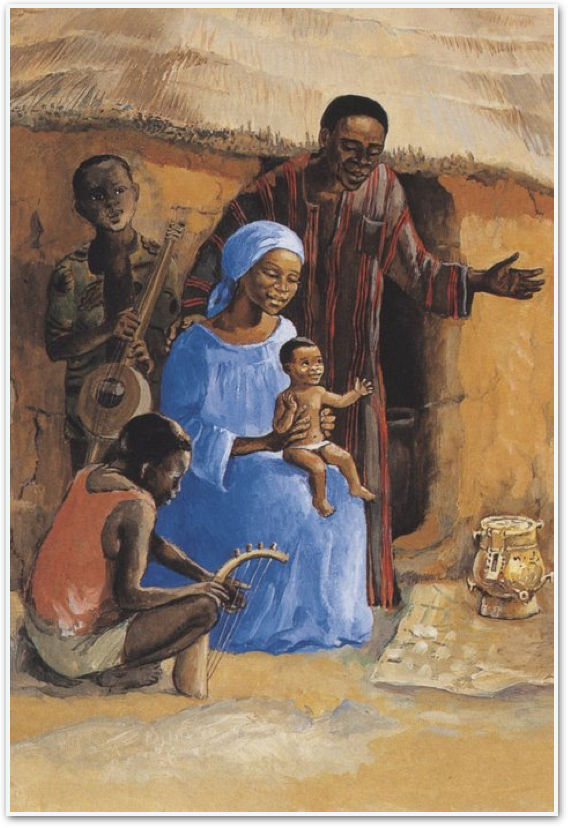
Holy Family1
The Word became flesh and made his dwelling among us. — John 1:14
“Everyday things, relationships with other people, daily work, love of our family—all these may breed saints. Jesus at Nazareth taught us to live every hour of the day as saints. Every hour of the day is useful and may lead to divine inspiration, the will of the Father, the prayer of contemplation—holiness. Every hour of the day is holy. What matters is to live it as Jesus taught us. And for this one does not have to shut oneself in a monastery or fix strange and inhumane regimes for one’s life. It is enough to accept the realities of life. Work is one of these realities; motherhood, the rearing of children, family life with all its obligations are others.” — Carlo Carretto
In a prayerful spirit, listen to the song* while meditating and reflecting upon the art, the Scripture, and the quote. As you meditate upon each, simply stay attentive to what the Holy Spirit is causing you to notice. Then, turn your noticing into a prayer: ask, “Lord, why are You having me notice this?” and listen for His voice.
“everyday things (may breed saints)” by Cura Anim
0:00
-8:12
There’s a great story Fr. Ronald Rolheiser tells in the beginning of his book “Domestic Monestary” (which is a MUST read for young parents).
He tells of Carlo Carretto’s journey into the Sahara desert to pursue a monastic life and to live as a hermit in an effort to deepen in his life with God and contemplation. He did this for over a dozen years. All the while, his mother was home — where for over thirty years, she lived the busy and noisy life of a mom, raising all of his siblings.
Upon Carretto’s return home, what we he was able to humbly notice is a profound lesson in our journey toward sainthood. He took note and was careful to observe that his mom, who lived the exact opposite life of a monastic hermit, was more selfless and contemplative than he was.
... what?!
Rolheiser points out that there wasn’t anything wrong with what Carretto did — but, that there was something incredibly right about what his mom did.2
I can relate to this on some level. I have two littles at home who have certainly upended prayer rhythms that I’ve been accustomed to for years. It turns out you can’t live like a monk while also being a husband and a dad — with a (loud, wild, and VERY energetic) dog.
But, herein lies the gift. If the whole point of the transformation journey is to die to self and to live a life of God-centered and others-centered love, then anything that can serve to remind you that time is not your own, other people exist, and that you don’t have to get your way, is a good thing. This is what Carretto’s mom was gifted to experience in full, and that anyone raising kids or living a life or working a job that calls you to serve and attend to others will experience.
Because Jesus took on flesh and made His dwelling among us, here in this ordinary, ‘everyday life’ kind of world, that means that this ordinary, ‘everyday life’ kind of world is not only deeply good, but sacred, holy, and full of opportunity to encounter God and be changed into persons of love.
It turns out that interruptions, inconveniences, and disruptions are an essential part to the transformation process. They teach us how to die to our selves, and can help teach us that God’s presence is everywhere — not merely in those “religious” spaces like prayer or church. I’ve observed in my own life that the very same “muscle” that’s being exercised and flexed in prayer is the same “muscle” that’s flexing when my daughter asks me for things, needs me to clean something up, etc. Just like prayer does, service calls us to live for something bigger than ourselves.
Jesus made His dwelling among us, and He’s continuing to make His dwelling among us each and everyday — while changing diapers, sending emails, taking out the trash, doing the dishes again, picking up toys (… AGAIN), running errands, doing the bills, getting the groceries.... you know, the ‘everyday life’ kind of stuff. He’s right there, beckoning us on into a deeper, richer, and more virtuous and attentive life.
Finally, it must be said that it’s here in the “everyday life” component of my model that I would place the role of suffering and affliction in our transformation process. There simply isn’t any real, significant level of transformation without affliction, hardship, trial, or suffering of any kind — and part of the ‘everyday,’ normal human experience is to suffer. It was the Spirit who drove Jesus to the wilderness to be “tempted” (which the Greek also renders as “tested”) and it’s through such testing that the Spirit forges character over time, as “the testing of your faith produces perseverance. Let perseverance finish its work so that you may be mature and complete, not lacking anything.” (James 1:3-4)
As the 17th-century Jesuit and spiritual director Jean Pierre de Caussade writes, “God teaches the soul by pains and obstacles…”3
Br. Lawrence, that 17th century monk, could easily be considered the patron saint of parents, or the patron saint of monotonous tasks, etc... You get the idea. He was the dish-washer at the monastery, and was very familiar with the kinds of tasks that make up our ‘everyday life.’ Yet, these were precisely the places and experiences by which and through which he met with God and cultivated an interactive, conversational intimacy with Him. It’s in this way, then, that these kinds of places and experiences have the potential to become places of holy ground for us. Therein lies their transforming power.
Br. Lawrence coined the phrase “the practice of the presence of God,” and it’s essentially the attainment of a posture by which one’s mind stays on God all throughout the day. How? By the constant directing and re-directing of the mind back to the reality of the presence of God, moment by moment. After years of practice, his mind and heart then had a kind of gravitational attraction to God — God was the default resting place of his thoughts and affections. Can you imagine?!
He once said:
The time of business does not with me differ from the time of prayer, and in the noise and clatter of my kitchen, while several persons are calling for different things, I possess God in as great tranquility as if I were upon my knees at the Blessed Sacrament.4
What a thing to say!
So, how might you go about your days this week with an intentional, conscious effort to keep your mind on God? It will drift — but that is where the act of re-directing comes into play, and thus sharpens the mind’s ability to stay on God. Try it out in the days ahead.
Then, over time, it will actually be possible for us to experience the transformative power of such a basic way of going about our everyday lives that we then can take into every task and demand.
As Dallas Willard once said (and these are precious words to me):
The first and most basic thing we can and must do is to keep God before our minds... This is the fundamental secret of caring for our souls. Our part in thus practicing the presence of God is to direct and redirect our minds constantly to Him. In the early time of our “practicing” we may well be challenged by our burdensome habits of dwelling on things less than God. But these are habits—not the law of gravity—and can be broken. A new, grace-filled habit will replace the former ones as we take intentional steps toward keeping God before us. Soon our minds will return to God as the needle of a compass constantly returns to the north. If God is the great longing of our souls, He will become the pole star of our inward beings.5
Lord Jesus, may we find You in our everyday lives, the lives we actually have — and there, open ourselves up to Your transforming presence. Remind us that time is not our own, and that when we are called beyond ourselves to tend to a task or serve another person, we are becoming holy. Amen.
*Song lyrics
Eyes wide open while I’m praying these days
Kitchen or the closet man it’s all the same
Everyday things they can make a saint
All you need is real life
Don’t gotta get insane
Eyes wide open while I’m praying these days
Kitchen or the closet man it’s all the same
I don’t need more information
I want a God-bathed imagination
This meditation is part of a series of meditations being released as a project called “Meditations on Change”. You’re invited to learn more and to follow along.
JESUS MAFA. Holy Family, from Art in the Christian Tradition, a project of the Vanderbilt Divinity Library, Nashville, TN. diglib.library.vanderbilt.edu/act-imagelink.pl?RC=47583 [retrieved December 14, 2024]. Original source: http://www.lib emmanuel.fr (contact page: https://www.librairie-emmanuel.fr/contact).
Ronald Rolheiser, Domestic Monastery (Brewster: Paraclete Press, 2019), 6.
De Caussade, Jean-Pierre, The Sacrament of the Present Moment.
Lawrence, Brother, The Practice of the Presence of God.
Dallas Willard, The Great Omission (New York: HarperOne, 2014), 125.
No posts
Comments
Nothing yet. Say the first thing.
Sign in to join the conversation.