As a perk for paid subscribers, I send out a call for questions each 20th of the month. This month things were pretty calm - in my mailbox at least. In the world everything revolved around USrael & Iran and their “Weekend War”. Which is also reflected in this mailbag because it was basically one question asked in a myriad of different ways: WTF is going on??
Usual rules: names and anything identifying get stripped, questions get trimmed to the bone, and a few I keep to myself because I’m fond of my privacy. Comments are open to everyone, so push back, correct me, add what I missed. I’m one keyboard warrior with a coffee and a deadline, and the people in the comments are routinely sharper than me. No ants on the desk this month, for those keeping score.
So, the July mailbag:

Why is Mr Market so complacent about the resumption of the war in the Middle East? Is the Strait open or closed? Who is winning? Can we really get out of the oil problem by emptying the SPRs? Does the market really think it’s all kabuki and that everything gets solved by the open, for the profit of the insiders?
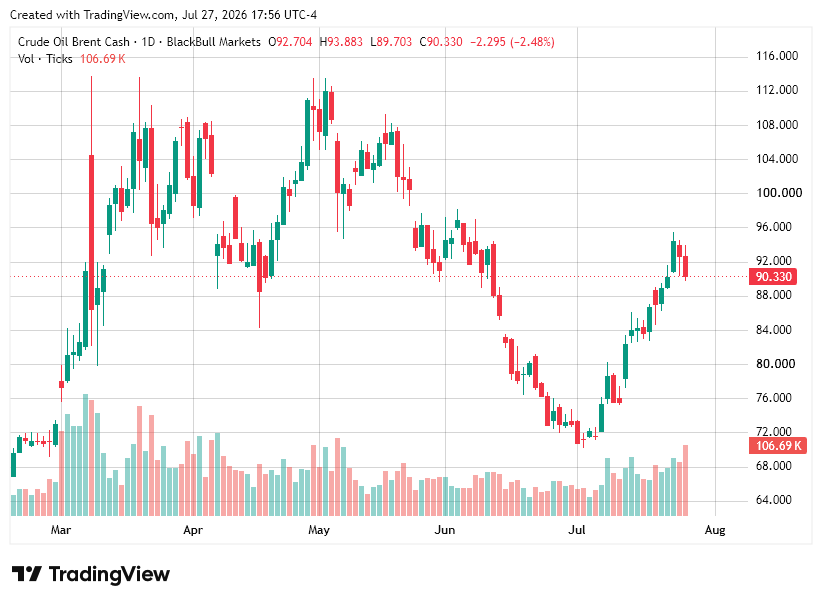
That $90 print looks like an opinion about the war.
The way I see it… It’s anything but.
The IEA agreed on 11 March to make 400 million barrels available and has since put around 290 million of it onto the water. The American share of that has taken the SPR down to ~311.4 million barrels, roughly 104 million lower than February, and the lowest since March 1983.
And on the other side of the ledger, China’s crude imports have fallen from more than 12 million barrels a day before the war to around 7.
So: a quarter of a billion barrels came out of the ground where they got buried for exactly this reason. Plus 5 million barrels a day of the world’s marginal buyer walked out.
THAT is what bought the quiet.
Which answers your SPR question directly, by the way.
It worked.
Once.
That drained reserve is what you’d spend to buy some time to fix the supply. No1 has fixed the supply by the way…
So what they’ve actually done is convert a strategic buffer into four months of a calm-looking screen.
Fatih Birol, who runs the IEA, said last week that there’s “no room for complacency”.
Kind of strange that he has to reiterate that… Especially when “nothing is going on” and “we have an oil glut”, you know? Remarkable…
The VIX spent the first half of July printing some of its lowest closes of the year and still sits under nineteen.
The S&P is above the record it set in January, on second-quarter earnings up something like 23% year over year, at a forward multiple north of twenty.
June CPI, meanwhile, came in at 3.5% against 4.2% in May, on a 5.7% monthly collapse in energy. (That was the ceasefire month.)
Oxford Economics looked at it on the 14th and said May was probably the inflation peak for the year.
Crude then went up forty percent.
Understatement of the year…
August 12 is the July reporting…
Now, your second question, which is the good one: is the Strait now open or closed?
Both, at the same time. Depends who’s asking and who’s answering…
Iran runs a permit desk. It has been baptised the Persian Gulf Strait Authority.
You submit your “Vessel Information Declaration” covering your ownership, insurance, crew manifest and cargo, you wait to be vetted and scheduled, and if they like the look of you, you pay.
Most reports put it at up to $2 million a transit, settled in yuan, crypto, informal swaps or charitable donations to for example the Iranian Red Crescent.
So by Iran’s definition… the Strait is open.
By everyone else’s: one vessel crossed in the twenty-four hours to Saturday, and it wasn’t a tanker. IMF PortWatch’s last published day counted 15 transits against a pre-crisis baseline of 88.
War-risk cover runs about eight times pre-crisis where there’s cover at all, and six P&I clubs have withdrawn.
17% of normal. But “open”. At 2 mil a pop.
Now on to your “Who’s winning”?
Sequere pecuniam…
1: The refiners. The 3-2-1 crack spread hit $70 a barrel this month, an all-time record.
Marathon and Valero have roughly doubled on the year, Phillips 66 is up two thirds with a third of that in the last month.
Crude went up, but diesel went up (much) more…
2: Tanker owners with the nerve to sail, obviously. Two million of war-risk premium plus two million of toll, on freight rates that have gone somewhere silly.
3: China, which bought discounted Iranian barrels the whole way through, filled its reserves, banned refined-product exports to keep the fuel at home, and is now the country quietly sponsoring the peace track through Pakistan.
Some of that import collapse is preparation.
Some of it is an economy that chose to take the damage early rather than late.
And some of that is genuine demand destruction due to the popping real estate bubble.
4: And Iran. Tehran moved roughly 50 million barrels through the shadow fleet in June, 10 million of it in a single day, into a price 40 dollars above pre-war.
Less volume yes, but more money, plus a toll booth which is worth $70-90 billion a year if it’s ever allowed to stand.
They’re doing just fine. Financially.
But Iran’s health ministry counted 3,468 dead in the first forty days, aged between eight months and eighty-eight years, including seven infants and 376 children, with more than 26,500 injured.
The Red Crescent puts 82,000 civilian structures damaged or destroyed.
Lebanon’s health ministry is past 4,300.
Between thirteen and twenty American service members are dead - depending on your definition of dead I guess, and the Pentagon confirmed that nearly a hundred more troops were hurt in strikes on regional bases since the ceasefire fell apart.
And if you believe those numbers… I’ve got a Big Beautiful Bridge for you on a prime location!
No1 there is winning anything.
The Houthis claim they hit Aramco-linked facilities at Jizan and Yanbu on Saturday. Riyadh didn’t confirm it. Aramco didn’t confirm it. I guess it’s just another laundry fire… Visible from satellites…
Jizan alone refines about 400,000 barrels a day. And when they’re burning like that for 2 days, I think it’ll be a while before it comes back online.
Then we have Central Command which spent a fortnight saying the waterway remains open with American support, over a stretch where the daily transit count was in single digits.
Which brings me to your last question, and the honest answer is worse than kabuki.
I doubt it’s scripted. Ten thousand dead is a disaster. Not choreography. NEVER forget the human cost in this!
But just like the Strait being open and closed at the same time, so is the negotiation theatre both scripted and real…
In the middle of this month Washington floated a twenty percent Hormuz transit fee of its own, then dropped it in favour of Gulf investment deals. Trump had already called Iran’s toll a beautiful thing and floated a joint venture to run the Strait together.
So Washington doesn’t object to a toll booth, as long as it can profit from it.
And yes, the volatility gets monetised, systematically, institutionally.
That doesn’t need a script. It just needs inside information. And a market that has learned - correctly, for a hundred and forty-eight days running - that the headline mean-reverts by Monday.
It will keep working right up until one of these headlines doesn’t stick. I wouldn’t want to be short at that time…
How high can Brent go before it crashes the world economy and everything goes kaput, including oil itself? I’m trying to work out what $147 in 2008 is equivalent to today.
You want a number, so here are three, and then the reason the number isn’t the answer.
Straight CPI first. The 2008 peak was $147 and change, on 11 July. That’s somewhere around $225 today. Official index, mind - you know how I feel about that particular series, so treat it as a floor.
Second: oil spend as a share of output.
The classic line is 4%.
The world uses roughly 104 million barrels a day against something like $120 trillion of GDP, which puts 4% at about $125 a barrel.
Reproducing the ~7% of world output that the July 2008 spike represented takes Brent somewhere near $220.
Two unrelated methods, same neighbourhood. Call it $220-225 as the nominal 2008 equivalent.
But note what the 4% line just did. It sits at $125, and we crossed it in March and stayed above it for weeks. Dubai printed $166 at the panic peak.
Which brings me to why the number is the wrong thing to be watching.
Nobody buys crude. Refineries buy crude. What an economy buys is diesel, jet and gasoline, and the gap between those two prices is at an all-time record.
That’s the $70 crack spread I mentioned above.
In July 2008 the same measure was running around 12 dollars.
So $90 crude plus a $70 crack lands on the buyer at roughly where a $147 crude plus a $12 crack landed in 2008.
You already have your $147. You’ve had it since mid-July. It just isn’t printing on the line you’re looking at.
In March, Singapore fuel oil hit $140 against $93 crude, and it has only gotten worse since. US distillate stocks are about 12% under their five-year average, Russia has halted diesel exports, and Saudi Arabia’s holding giant BBQs.
That refining constraint takes years to fix, and no barrel released from anyone’s strategic reserve can solve it, precisely because the SPR holds crude. And crude isn’t really the bottleneck.
Now two things: duration beats magnitude. 1990 was a sharper spike than 2008 - Kuwait took 4.3 million barrels a day off the market and oil went from $15 to $42 in two months - and it produced a mild recession, because it was over in months.
The 2008 climb took five years. A simple price doesn’t break the economy. It just depends on how long it has to keep paying it.
And 2008 was a credit event with an oil trigger.
Which is actually a question I’ve been asking myself: not how high crude will go, but what will it break when it gets there?
The world economy doesn’t wait for any specific number and then crash.
It just adjusts by not buying. And those tiny adjustments look exactly like that there ain’t a problem.
So the honest answer to “how high before it all goes kaput” is that it’s not really a single price by itself. Remember: “collapse is a process, not an event”.
The point where it all goes to hell is where somebody has to stop bidding for the diesel that grows and moves our food.
But nobody publishes that one.
What is it that gives fiat value? I’ve never found a believable explanation. Yes, I pay taxes in it. But as far as I can tell the only thing giving it value is the belief that it has value - which puts fiat in a similar, if slightly less waterlogged, boat as crypto.
You’ve done most of the work already, but I’ll give you (besides the article above), my undiluted answer.
Belief is what you already surmised. But underneath there are the taxes. They’re the seed, not the structure - a tax bill creates a demand for the currency that can’t be argued with, but it’s a demand for a slice of output, once a year.
Your mortgage is a short position in fiat. So is every corporate bond, every car loan, every lease, every supply contract, every pension promise, every sovereign bond on the planet. Hundreds of trillions of obligations that can only be extinguished with the one instrument the issuer prints. That demand isn’t discretionary and doesn’t care what you believe, because the alternative to acquiring fiat is the bailiff.
Which is also the whole answer to your crypto comparison: nobody owes bitcoin.
Nobody wakes up on the first of the month having to source it or lose the house. Fiat has a captive bid, manufactured by the debt stack sitting on top of it and enforced by people with the legal authority to take your things. Crypto has an audience.
So fiat is backed. Just not by anything in a vault. It’s collateralised on the state’s lien over everything you own and everything everyone else owns.
That’s more collateral than gold ever had behind it.
It’s just collateral you can’t audit and can’t refuse.
Your last observation about No1 believing that fiat would be worth more tomorrow is the sharpest thing in your question…
Because it’s actually not a defect!
Money that appreciates gets hoarded and stops circulating, which Gresham worked out in the sixteenth century and every monetary authority since has designed around deliberately.
That slow leak is a feature. The trouble with it, is that “slow” is a policy knob, and it just so happens that the people holding these dials are also the largest debtors in the system.
Now where it all goes wrong is when that debt stack compounds faster than the thing pledged against it. So then the issuer has to make a choice between defending the bond price or defending the currency’s value. You can’t do both. Japan has been doing that for a while now... I’ll leave it at that.
Now one thing I want you to take away from all that is that the UST’s and gold’s has crossed somewhere around now. (dollar aggregated share is still around 40% vs ~30% for gold)
It started in earnest in ‘22 when the US showed that owning dollars is not a reserve asset, but something that can be weaponised.
The biggest reserve managers in the world (CBs) have quietly been adjusting their strategies since then.
89% of surveyed central banks expect official gold holdings to rise over the next 12 months. A record 45% intend to add themselves.
THEY print the fiat.
THEY are buying the metal.
“Sequere pecuniam”
That’s where I’ll leave it for July. The floor is yours.
My other publications:
[Daily Digest] → The news in 5 minutes, without the forty open tabs.
[Portfolio] → What I do with my own money
No posts
Comments
Nothing yet. Say the first thing.
Sign in to join the conversation.