
What can you do with a 100+ pound, 10-month old Rottweiler that is technically still a puppy, but is also an active and yet surprisingly cute slob monster?
Oh, and he destroys things.

Recently, my dad announced that Ramses, my sister’s “puppy,” had turned the pooper-scooper into his latest toy and destroyed it in the process. Given the amount of–shall we say–presents Ramses leaves in the yard, going without a scooper was not an option.
My first instinct was to click on my Amazon app. Order a new scooper. Maybe add a couple more things to the cart to qualify for free same-day delivery. My dad had another idea. He said he would go to the store and pick one up.
Over the course of the day, I heard the sounds of sawing and nailing, but I didn’t think much of it. My dad is a world-class tinkerer, and he is always building something to pass the time. Later that evening, he came into the kitchen and proudly exclaimed, “That dog won’t be destroying this scooper!”
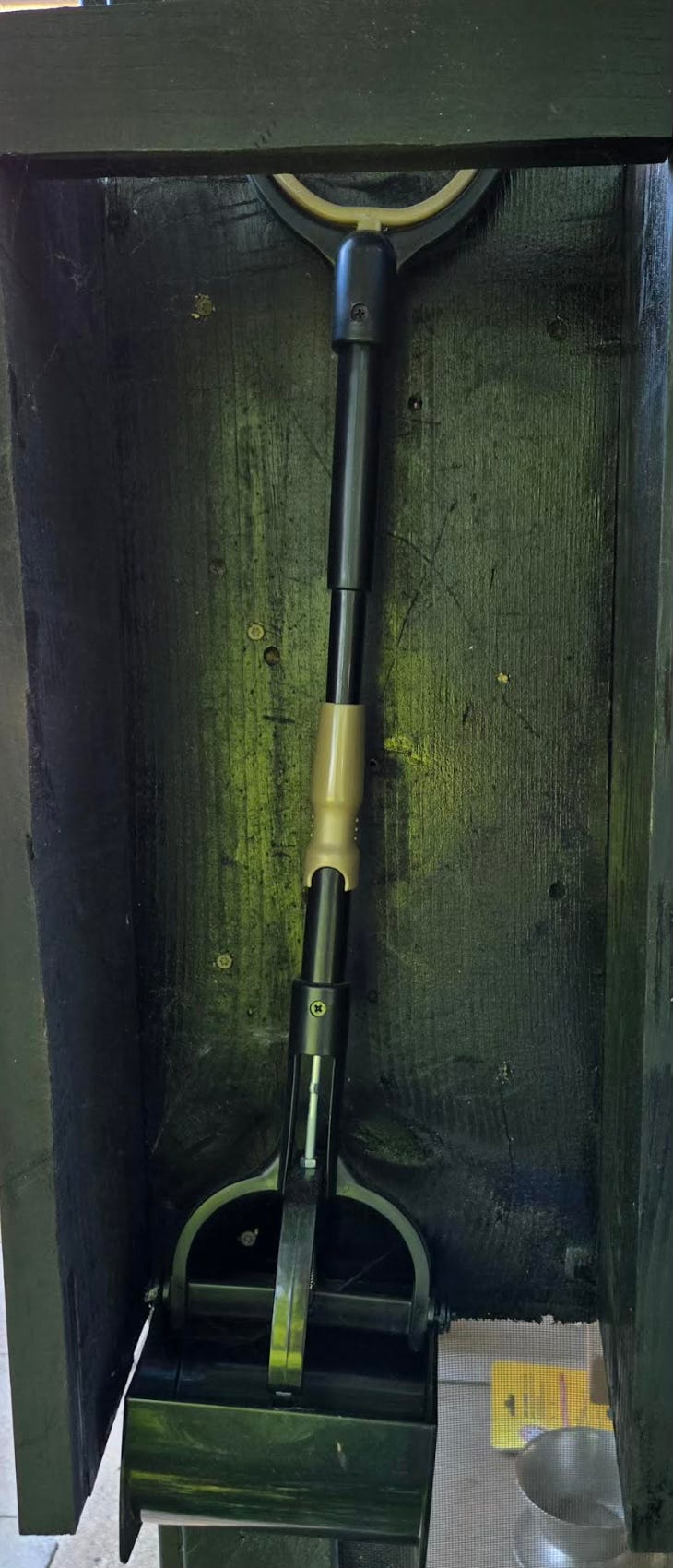
Not only did my dad purchase a new scooper, but he also used some old pieces of wood to build a hanging container for it. He even took the time to paint it!
It was a small household moment, but it made me think of the AI era.
When I consider my creative, technical background and my dad’s logical, mathematical background, it doesn’t surprise me that our solutions-thinking was different. I was focused on the efficient fix. The dog destroyed the scooper. Replace the scooper. Move on. Looking back, I had not really solved the problem. I had only offloaded the next step.
My brain treated the broken scooper as a replacement task. I had to find the scooper, order the scooper, and wait for delivery. The order was efficient, but it also narrowed my thinking. I stopped at the first available solution instead of asking why the problem happened and whether it would happen again.
My dad, on the other hand, was not about to enter a never-ending loop of buying pooper-scoopers. His thinking was more than, “Let’s replace this.” It was, “This won’t happen again.” In design-thinking terms, he did three things my quick-fix approach skipped:
He reframed the problem. The issue was not just a broken pooper-scooper. It was an accessible pooper-scooper.
He considered the user and the environment. The “user” in this case was a 100-pound puppy with time, teeth, and poor boundaries.
He designed for recurrence. My dad did not just replace the tool. He changed the conditions that allowed the problem to happen.
The obvious lesson is that we don’t need AI for everything. Not every problem requires a prompt. Sometimes we just need someone to notice what is happening and fix it. AI is powerful, but its usefulness still depends on context.
This is where cognitive offloading can become tricky. Offloading is not inherently bad. We all use tools to reduce mental load, such as GPS to help us navigate (because if you’ve never had to rely on Rand-McNally, you wouldn’t understand). The challenge comes when offloading the task keeps us from understanding the problem.
In my case, ordering a new scooper would have been convenient. It also would have ignored the pattern. Ramses does not need a better online shopping experience. He needs a scooper he cannot reach. Replacing the tool solved the immediate issue. Building a place for it solved the pattern.
That’s the kind of thinking we need in the AI era. Sometimes the best solution isn’t always the most advanced one. Sometimes it’s the most situated one.
When I’m working with educators, I tell them that the first question to ask is: Is it necessary? Sometimes the answer is yes. AI can extend our thinking and open possibilities that would have taken much longer to reach on our own. And sometimes the smartest thing we can do in the AI era is pause long enough to ask whether we are addressing the immediate problem or redesigning the conditions that caused it to occur.
Note: No humans or dogs were harmed when drafting this post. One pooper-scooper, however, was damaged beyond repair.
ACFI: NA
No posts
Comments
Nothing yet. Say the first thing.
Sign in to join the conversation.