
Thank you, as always, for reading the Devils’ Advocates Substack! If you enjoy the quasi-daily content, please consider subscribing and sharing with your friends, family, and any Devils fan you know. It is completely free of charge and helps out quite a bit!
Consider checking out the Devils’ Advocates Podcast, which features weekly episodes chock-full of in-depth content and exciting guest appearances. They’ll be available on this Substack, but you can also listen on your favorite platforms at the following links:
In the last couple of days, on both Pucks & Pitchforks and Infernal Access, I mentioned Pittsburgh Penguins prospect Chaz Lucius as a potentially interesting target for the Devils. Lucius let the Penguins know that he would not be signing a contract with them at the 2026 NHL Trade Deadline for reasons unknown to the public, according to Pittsburgh GM Kyle Dubas. Given that he spent four years in college and seemingly wants a shot at an NHL lineup as soon as possible, Lucius will become an unrestricted free agent when his rights expire on August 15th.
Today, I wanted to dig a little bit deeper and explain why I’m high on the 22-year-old forward.
Lucius, a 2022 fourth-round pick by the Carolina Hurricanes, has spent the last four seasons in the NCAA — two with the University of Wisconsin and two with Arizona State University. His first two seasons, spent mostly in a middle-six capacity, were point-per-game campaigns, a jarring jump in development given his pedigree as a 124th overall selection. He transferred to Arizona in his junior campaign, but never settled into the new system and dealt with a couple of injury setbacks, resulting in just 10 points in 19 games.
In 2025-26, though, his senior season, Lucius stayed healthy, settled into a top-six role, and produced with the best of them. His 46 points in 36 college games were good for 11th-best in the entire NCAA. His 1.28 points per game were ninth-best, above first-round names like Charlie Stramel, Dean Letourneau, William Horcoff, and Lucius’s own teammate, Cullen Potter. Sure, Lucius is older than the names on that list, but the point stands that he has far outproduced and outperformed his fourth-round pedigree.
Production aside, the underlying numbers should be of interest to a New Jersey Devils front office that is keen on prospects sporting strong numbers:
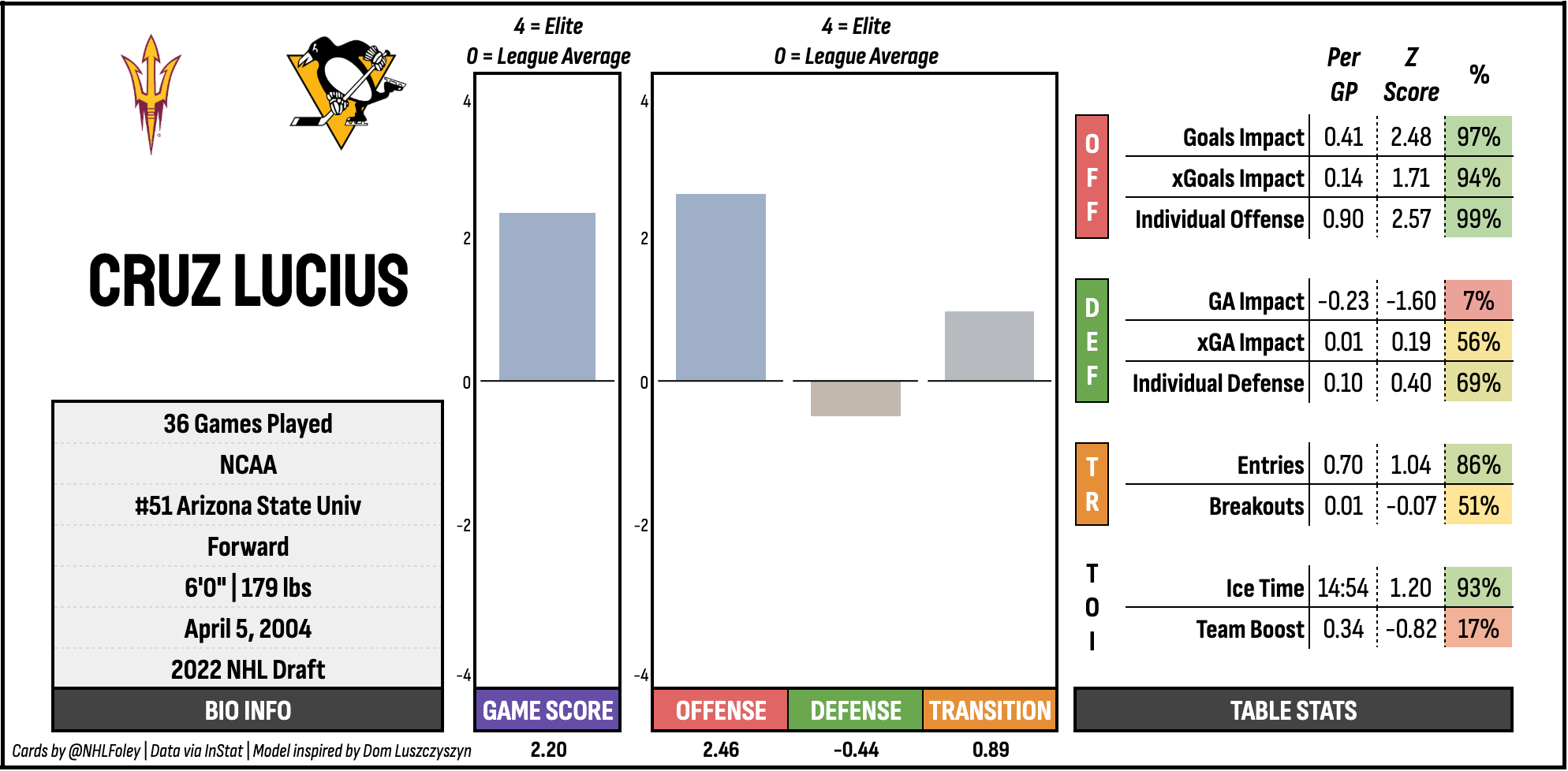
The above card, via Gabriel Foley, uses InStat data to create a Game Score model for prospects at most levels. His work is excellent, and I highly recommend giving his page a look for prospect insights.
For Lucius, the bulk of his value comes on the offensive side of the puck. He ranked in the 97th percentile for his impact on actual goals, the 94th percentile for his offensive impact on expected goals (xG), and in the 99th percentile for individual offensive creation. Though he was just barely above average in defensive zone breakouts (51st percentile), he was a stellar zone enterer, placing in the 86th percentile for that metric. Entries are inherently more valuable for forwards than breakouts are, especially given the archetype of player Lucius is (which we will get into momentarily).
Even defensively, I think Lucius gets sold a little short metrically, by virtue of his 7th percentile finish in impact on actual goals against. Given that he ranked in the 56th percentile for his impact on xG against, it stands to reason that his puck luck was a bit lacking on the defensive front for 2025-26. A near-50-point disparity between his xGA impact and his actual GA impact seems anomalous.
Statistically, then, Lucius looks like a player who excels on the offensive side of things — particularly from within a cyclical setting — and who is still working on his defensive game. I’ve spent some time watching him over the course of 2025-26, mostly as a byproduct of watching Samu Salminen (whose rights also expire on August 15th), and I have to come to that very same conclusion.
Within the offensive zone, Lucius is a dynamic playmaker. He scans the ice incredibly well, almost seeing the game in slow-motion at times as he threads passes through sticks and legs en route to creating a high-danger look. He lets the play develop in front of him while calculating the best path forward, be it drawing in defenders, firing off a pass, or rifling a shot himself. He is an expert in drawing attention from the defense, using head and body fakes to open up space, and punishing the opposition with a tape-to-tape pass to the slot.
Lucius’s shot is better than his production would make it seem — his 15 goals in 36 college games in 2025-26 are nothing to scoff at, to be clear, but it certainly took a backseat to his playmaking game. As such, it flew a bit under the radar. His release is deceptive, though, despite being a bit drawn out. He can toe drag mid-release to change the angle of his attack, and he has a one-timer that is a threat from odd angles and distance alike.
There’s an interesting dynamic between Lucius’ skating ability and his motor, in the sense that his top-end speed and acceleration aren’t anything to write home about but he is constantly playing with pace and has strong explosiveness within his game. It’s part of the reason why the young forward is more effective from within a cycle than off the rush, or at least is far more reliant on give-and-goes, one-touch passes, and being the F3 shooter in transition. Lucius is a true workhorse in battles, winning a good proportion of them through willpower and burst acceleration despite not being a particularly physical player.
At times, when he does have the puck in the neutral zone, he finds seams to deliver a perfect pass to streaking linemates:
I’m not wholly convinced that Lucius is an NHL-caliber player quite yet — I felt through watching him that he’s a bit too reliant on staying to the perimeter of the ice himself, even if he is an effective facilitator at the college level from that spot. There were also stretches in games where he wasn’t noticeable, blending into the background by virtue of being more effective on-puck than off it. If he improves his willingness to cut to the middle of the ice and improves his off-puck habits, there’s a bottom-six winger here at the NHL level.
Moving up to the AHL is paramount, though he was seemingly unwilling to do so with Pittsburgh after his NCAA season ended. Lucius is not an NHLer right now, but he has the playmaking skeleton to be one. His deception and manipulation of space is a legitimately appealing quality, and his lacking top-end speed is counteracted by his burst skating, a much more important skill given the role he’ll likely cap out at in the big leagues.
It’ll be interesting to see which team Lucius signs with next week — I can’t imagine it will be a very long wait to see where he ends up. The Devils have put a concentration on improving their pipeline and the Utica Comets, and adding talent like this in a year where there are very few genuinely palatable players who become available through this path would be a smart move. Lucius needs work, but is a low-risk gamble worth taking.
Comments
Nothing yet. Say the first thing.
Sign in to join the conversation.