
Energy is the foundation of sovereignty. A nation’s economy, its security, and its ability to innovate all sit downstream of energy policy. Get energy wrong, and every other sector of national power will eventually fail.
Britain got it wrong. For decades, successive governments built energy policy on a fragile assumption of a perpetual “End of History”: that markets would stay open, the world would stay stable, and American power would forever underwrite British security.
They paired this with a Net Zero ideology pursued without a credible industrial strategy: decarbonization as a moral performance rather than a plan for national resilience. The war in Iran is now exposing the hollow reality of that failure.
But there is a risk of a deeper crisis that has not been widely acknowledged. Britain has made electricity so expensive and scarce that it cannot compete in the defining race of this century: the deployment of AI at scale.
Supply Shock
The Iran war sent British wholesale gas prices surging — up nearly 90% in a month. This hits Britain with unique force because the nation remains 75% dependent on fossil fuels for its primary energy needs. As gas sets the marginal price for all electricity, a spike in the Middle East becomes an immediate, unavoidable tax on every British business and household.
The reality is crushing. Analysts warn of household bills hitting £2,500 if the Strait of Hormuz remains closed for more than six weeks. As energy-driven inflation surges, hopes for interest rate cuts have vanished.
Britain is now servicing a £2.9 trillion debt mountain with £114 billion of interest expected to be paid this year. That’s nearly double the nation’s entire core defense budget.
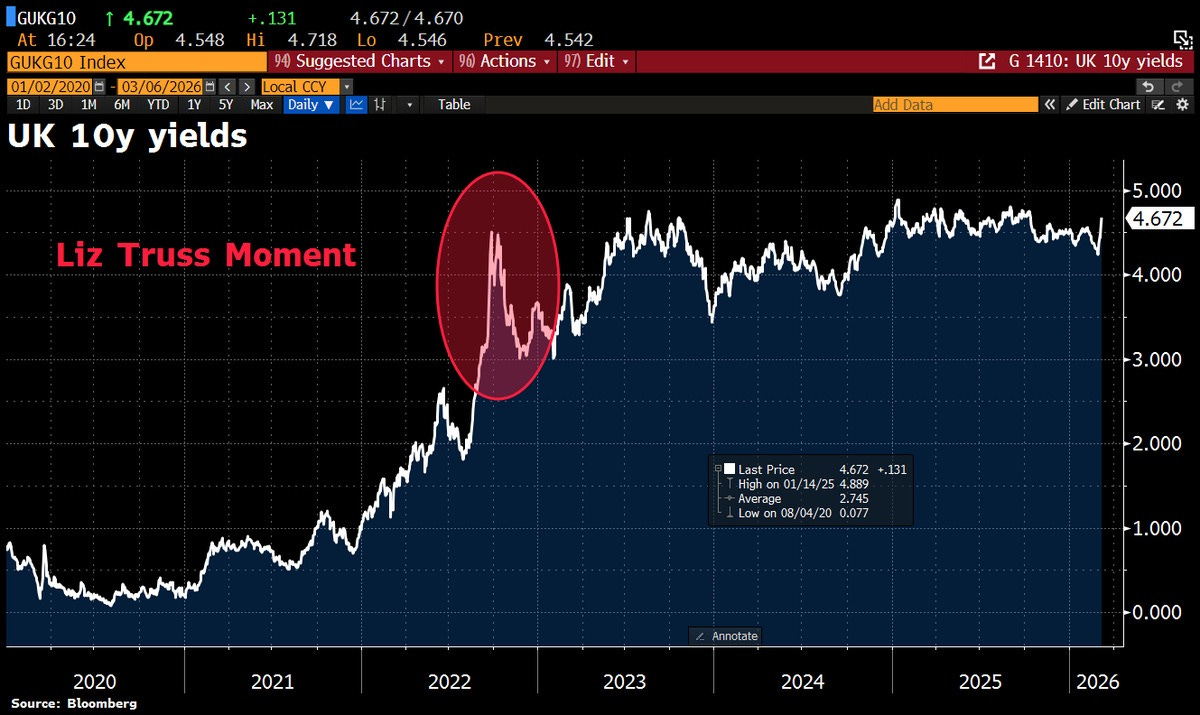
To make matters worse, Britain has no supply buffer. Westminster based its storage needs on optimistic assumptions of frictionless global markets. It has a maximum gas storage capacity of just twelve days. Compare that to Germany’s 89 days, France’s 103, or the Netherlands’ 123.
Unable to stockpile, Britain is forced to buy gas at the worst possible moment. European gas futures have already surged above €60 per megawatt-hour, roughly six times the US price.
Britain’s main gas provider, Norway, is at maximum capacity, and Qatar (the UK’s swing supplier) has declared force majeure, halting shipping after the unprecedented shutdown at Ras Laffan.
“Energy Dominance” may be an explicit aim of the Trump administration, but American suppliers say they cannot scale production further.
Vladimir Putin is playing his characteristic game: threatening to terminate the remaining 13% of gas Russia supplies to Europe, while simultaneously offering more gas if Europe accepts “long-term cooperation, free from political pressures.”
The Great Divergence
This vulnerability was a choice. Britain and Norway were dealt the same hand when they struck oil in the North Sea. The UK treated its reserves as a fleeting windfall to be consumed. Oslo leveraged them for long-term security and prosperity: a “sliding doors” moment for British sovereignty.
Despite the basin’s maturity, Norway never stopped drilling, averaging forty-five exploration wells annually. In 2025, Norwegian production surged to its highest level since 2009 — the lucrative result of a record $24.68 billion investment that returned roughly $90 billion in exports. Today, the sector serves as the bedrock for 20% of Norway’s GDP and sustains 200,000 people.
Norway runs 98 percent of its domestic grid on renewables, capitalizing on the geographic windfall of hydroelectric power. But Oslo paired this with a rational calculation on its sovereignty: decarbonize at home while extracting maximum value from its resources to endow its future.
Norway’s sovereign wealth fund is now worth over $2.2 trillion — the biggest in the world. Propelled by heavy exposure to US tech and AI, it posted historic returns of 15% last year. Every Norwegian has roughly $385,000 invested in their name; every British citizen carries roughly $55,000 in national debt.
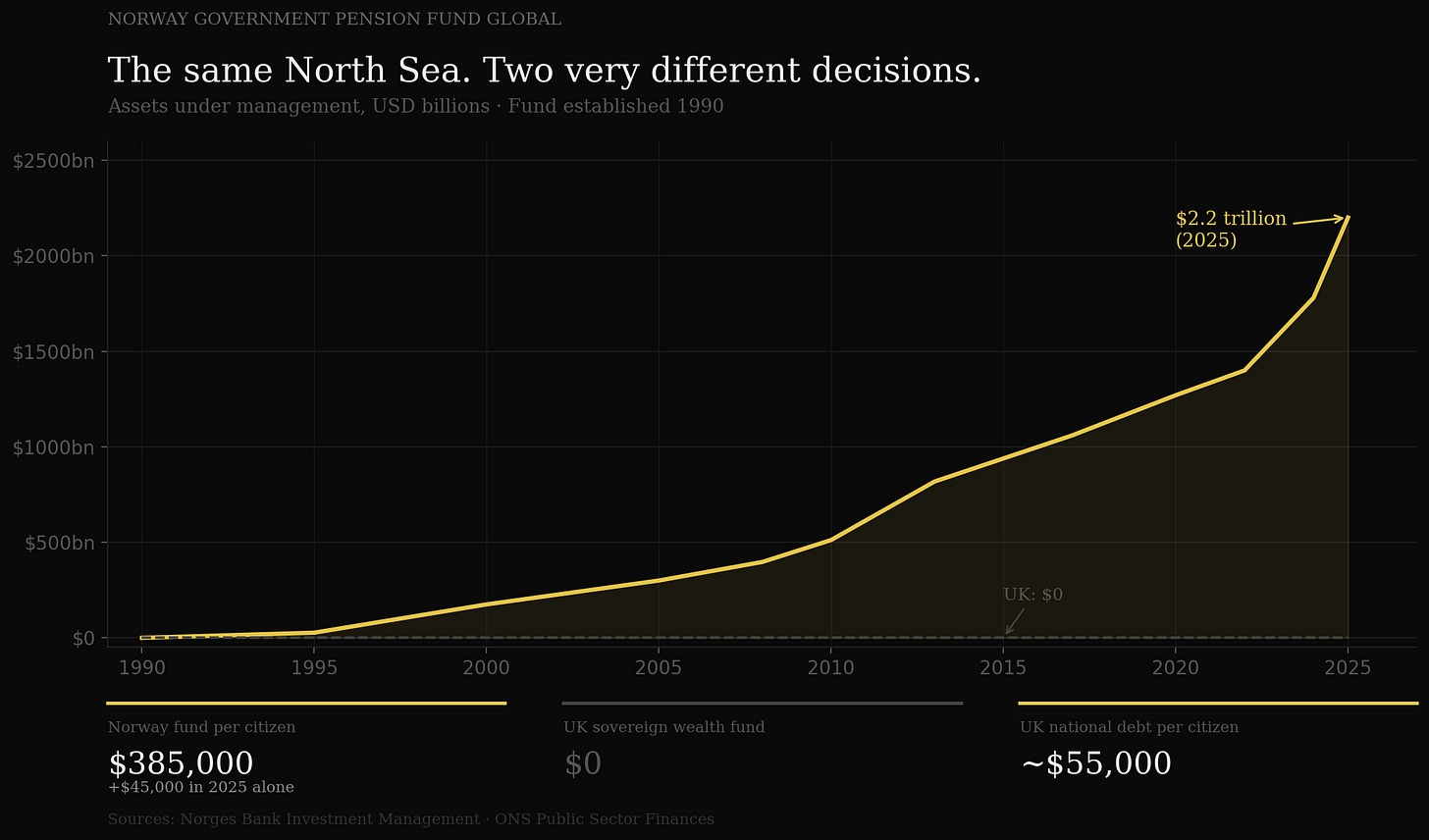
The payoff for Oslo is as much geopolitical as it is financial. When the invasion of Ukraine shattered European gas supplies, Norway stepped into the breach. It now provides 30% of the Continent’s gas imports. Britain is a captive customer, sourcing 76% of its gas from Norway — up from 58% just two years ago.
Britain still has its own reserves. The collapse of British exploration is a policy-driven crisis, not a geological one. By suffocating North Sea producers with a 78% effective tax rate via the Energy Profits Levy, Britain rendered long-term capital investment impossible.
The result is a historic standstill. In 2025, for the first time in sixty years, not a single new exploration well was drilled in British waters.
Nuclear Sunset
If energy is the foundation of sovereignty, then Britain’s nuclear history is another study in the demolition of that foundation.
On 17 October 1956, Queen Elizabeth II switched on Calder Hall in Cumbria: the world’s first commercial nuclear power station. Britain didn’t just participate in the nuclear age; it led it.
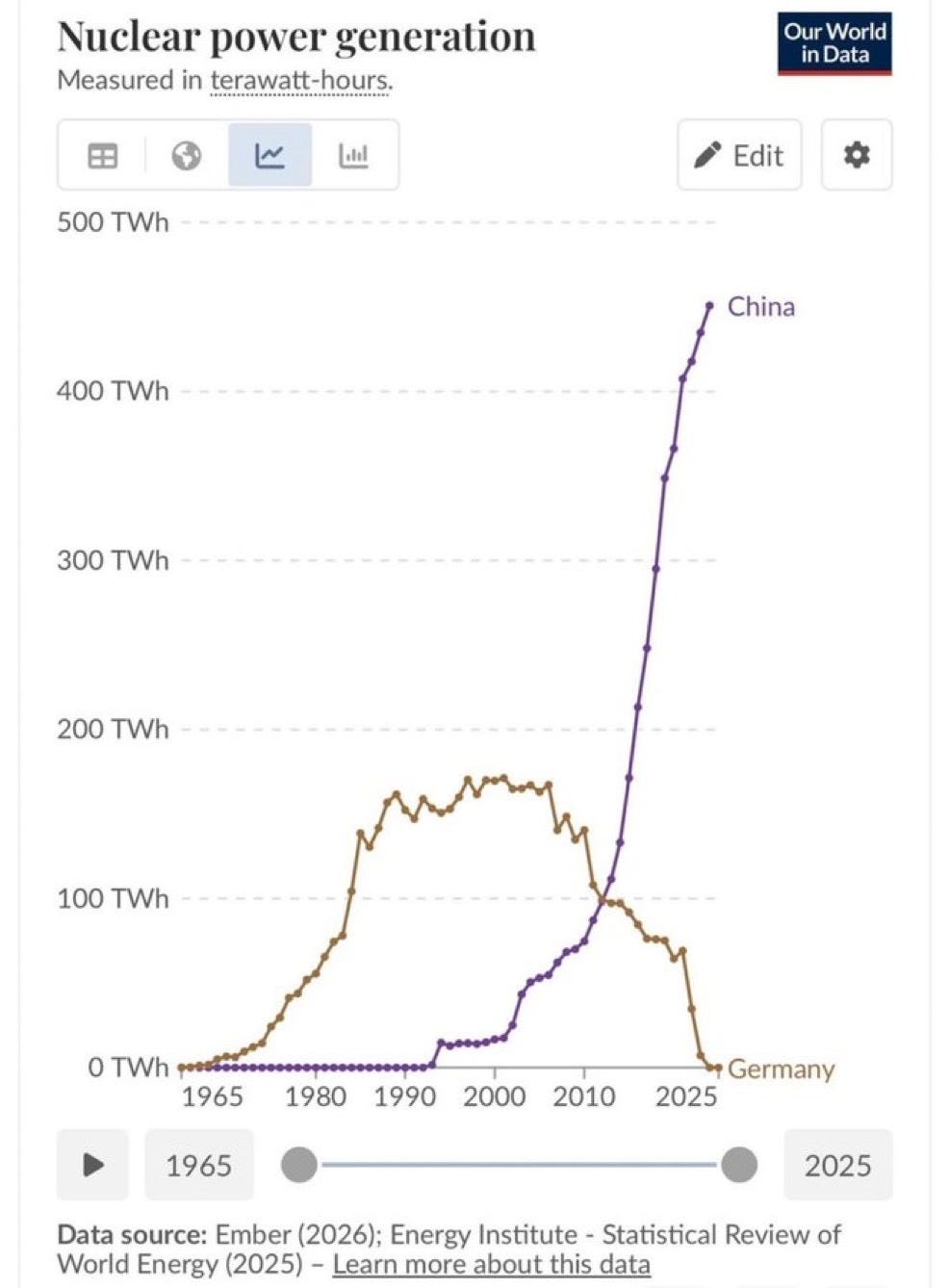
While Germany’s Energiewende is now recognized as a monumental strategic error—an admission made just this week by Ursula von der Leyen, the European Commission President who served in the Merkel government that initiated it—the British failure is more subtle but equally devastating.
The UK’s nuclear fleet is aging and shrinking; it still operates nine reactors across five sites, but no new large-scale station will come online before Hinkley Point C. The story of Hinkley is a masterclass in what happens when a nation loses its industrial and sovereign edge.
While European regulators were still mired in planning committees, Chinese engineers had already finished the first EPR — the Franco-German design used at Hinkley — in Taishan, China. The country that gave the world commercial nuclear power now cannot build a reactor without foreign intervention.
Hinkley itself is under construction by the French and Chinese. Delayed until at least 2030, costs have exploded from £18 billion to a staggering £48 billion. Worse, the project is part-funded — and owned — by the Chinese Communist Party via CGN—a firm on Washington’s export blacklist.
Today, China has 38 reactors under construction — more than any country in history — building them in an average of 6.3 years compared to the global average of 10. Their target is 400 gigawatts of nuclear capacity by 2060, a figure that exceeds the entire cumulative nuclear capacity of the world today.
The pattern is now familiar: the West invents the technology; China builds it; China scales it.
Supply-Chain Trap
The problem with a 100 percent renewable target isn’t the ambition of a zero-carbon goal; it is the structural reality of the supply chain. While Net Zero advocates claim this transition will make Britain “energy sovereign,” the opposite is true. Britain is effectively trading one dependency for another: moving away from Norwegian gas only to walk into a systemic dependency on China.
China currently controls more than 86 percent of global solar module production. In the battery sector, Chinese giants CATL and BYD now account for 59 percent of the global EV battery market. In 2025, Chinese firms seized the top six global positions in wind power, effectively shutting Western pioneers out for the first time.
China also refines more than 80 percent of the critical minerals — lithium, cobalt, and graphite — that underpin the entire Green transition.
The belief that Britain could dismantle its own energy and industrial base while allowing a strategic rival to monopolize the infrastructure, hardware, and supply chains of the future — all in the pursuit of ‘sovereignty’ — is laughable.
The scale of Beijing’s lead is staggering. In 2025, China’s total power capacity reached nearly 4,000 GW, with solar and wind capacity eclipsing coal for the first time in its history. In 2024 alone, China installed 277 gigawatts of solar — more than twice the entire installed base of the United States.
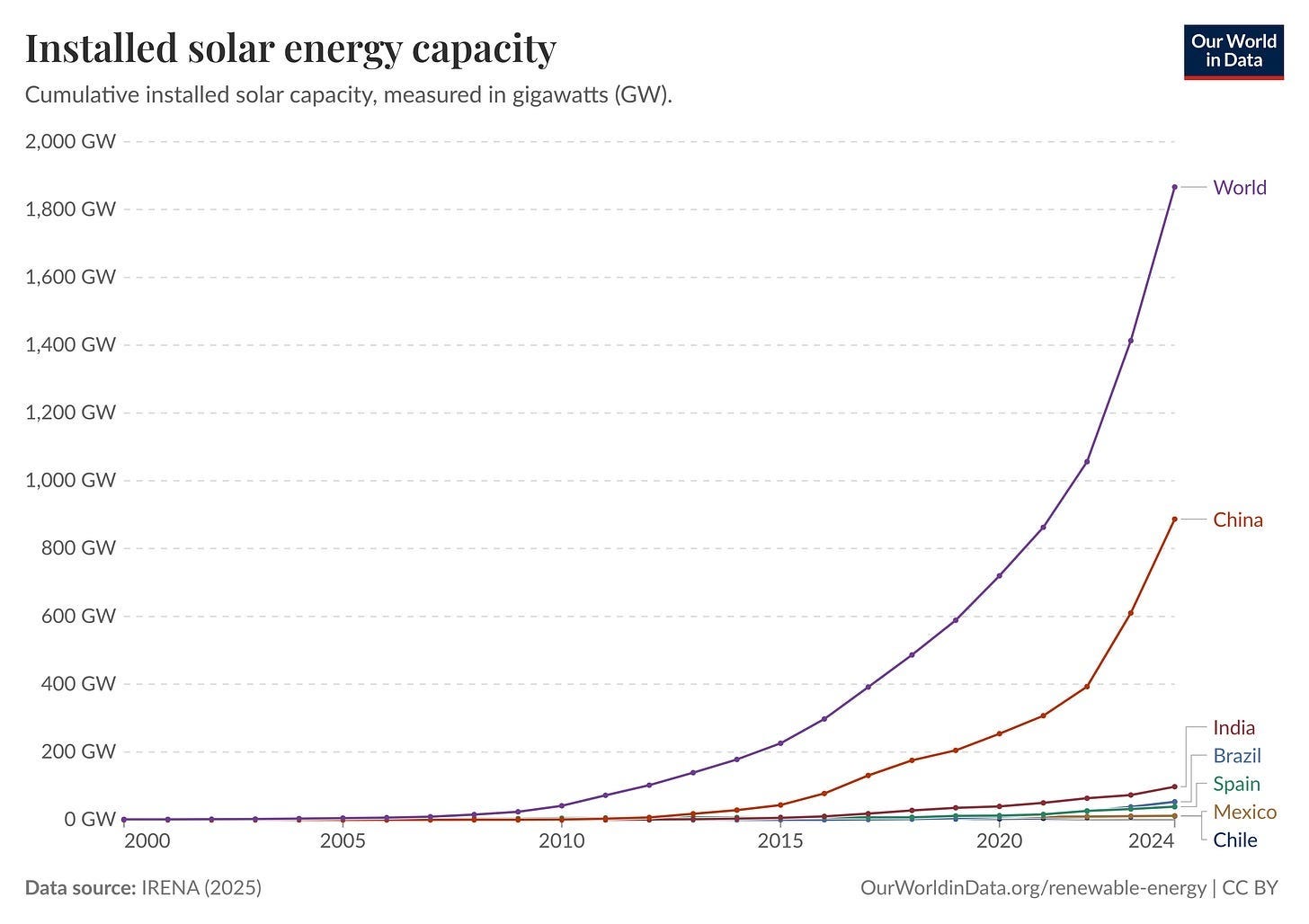
As a net importer of oil and gas, Beijing understands that energy dependency is a strategic vulnerability. Unlike Britain, however, it is solving for that vulnerability by ensuring the rest of the world becomes dependent on Chinese hardware.
That is an industrial strategy for national resilience. Britain’s approach, by contrast, is not.
Britain now has the highest industrial electricity prices in the developed world. At 25p per kilowatt-hour, its power costs stand at double the EU average and quadruple those of the US (6p) and China (7p).
The results are visible: energy-intensive output has collapsed by 33% since 2021. In 1970, manufacturing accounted for 30% of UK GDP; today, it is just 8% — a lower share than Thailand (26%).
But this isn’t just about the death of old industry. Just as cheap electricity determined the industrial powers of the past, it will now determine the AI superpowers of the future.
The real competition is not about who builds the best AI models, but who can afford to run them. Sovereignty in this century isn’t found in “green ledgers” or offshore wind farms; it is found in the physical ability to process Intelligence at an industrial scale.
Britain’s current path is a dead end. There are 140 data centers in the UK’s grid connection queue, representing 50 GW of demand — more than the entire country’s current peak usage (45 GW). For many, the quoted connection date is 2040.
As Intelligence proliferates, productivity will no longer be measured in man-hours, but in Tokens-per-Watt: how many units of ‘Intelligence’ a kilowatt-hour of electricity can buy. With its 25p rate, it is already 400% more expensive to buy Intelligence in Britain than in China or the US.
This is a direct hit to the UK services sector, which accounts for 82% of the economy. As AI automates knowledge work, British firms must 'rent' intelligence from foreign clouds at predatory rates just to stay competitive.
Even if Britain builds domestic AI infrastructure, the 25p barrier means it would be structurally uncompetitive from day one. This leaves only the path of outsourcing national productivity to foreign clouds, a permanent transfer of British wealth.
True sovereignty requires a radical shift to dedicated, low-cost power for compute. Without cheap energy, Britain won’t just lose its factories — it may lose its offices, too.
The Compute-Energy Nexus
By contrast, Washington sees AI as foundational to American sovereignty. Its flagship policy, “America’s AI Action Plan” (July 2025), reclassified AI as a mission-critical national asset on par with the Manhattan Project.
This has triggered a rapid pivot from “regulation-first” to “build-first.” U.S. hyperscalers are projected to invest over $700 billion into Intelligence Factories this year alone.
To put this in perspective: Meta has signed deals for 6.6GW of nuclear energy (double Hinkley’s output of 3.2GW) just to power its ‘Prometheus’ supercluster in Ohio.
Energy is the primary constraint.
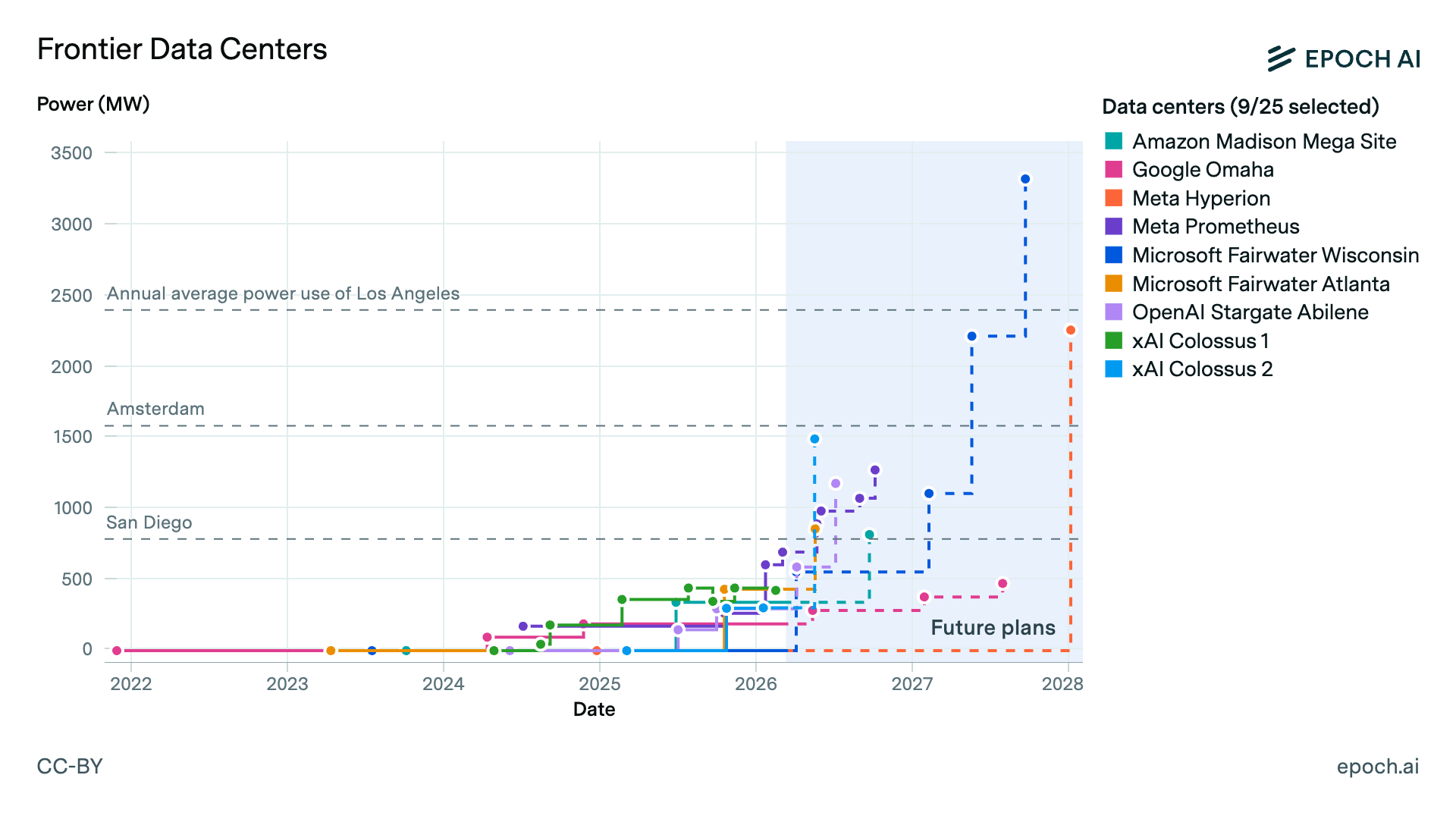
This is also why the White House just formalized a historic deal with the nation’s leading hyperscalers. Under the Ratepayer Protection Pledge, the government provides a regulatory “fast track” to build AI infrastructure in exchange for a simple commitment: Big Tech must provide its own energy.
By taking full liability for their own power— and innovating to meet it — Big Tech is also ensuring that AI demand doesn’t spike utility bills for ordinary Americans. Instead, this surge in private investment is expected to expand the national grid, eventually lowering long-term energy costs for everyone.
President Trump is calling on the leading United States hyperscalers and AI companies to build, bring, or buy all of the energy… paying the full cost… no matter what.
In this environment, tech giants are no longer mere customers of the grid; they are treating electricity generation as a proprietary layer of their technology stack.
Microsoft is restarting the Three Mile Island nuclear plant; Amazon is plugging directly into the Susquehanna nuclear station; Google and Meta are financing a new generation of SMRs.
Meanwhile, Elon Musk is using gas turbines backed by Tesla Megapacks to power Colossus, where xAI is targeting 2GW of energy by 2026.
The race is even moving off-planet.
Musk’s merged xAI/SpaceX entity is eyeing a $1.75 trillion IPO this summer to launch a “Global Compute Fabric.” These are orbital, solar-powered Intelligence Factories designed to circumvent the terrestrial limits of energy and cooling altogether.

Nina Schick@NinaDSchick
Elon Musk is attempting something extraordinary. Not just building another company. He is building the largest AI training cluster in the world. A million GPUs wired together. A brute-force attempt to scale intelligence itself. The capital required to do this is staggering.
2:15 PM · Nov 7, 2025 · 517K Views
276 Replies · 711 Reposts · 5.78K Likes
New Quality Productive Force
China is moving with equal aggression. Under its 15th Five-Year Plan, Beijing elevated AI to a “New Quality Productive Force.” This is Party-speak for turning Intelligence into a state-funded public utility.
This vision is backed by a staggering surge in energy infrastructure. By the end of 2026, China’s total installed capacity is forecast to hit 4.3 TW, nearly quadruple that of the U.S. (1.2 TW) and Europe (1.0 TW).
China has created a strategic buffer so immense that even if AI demand triples overnight, the power is already there to serve it. While Western electricity generation remains stagnant, China’s has rocketed past 10,000 TWh.
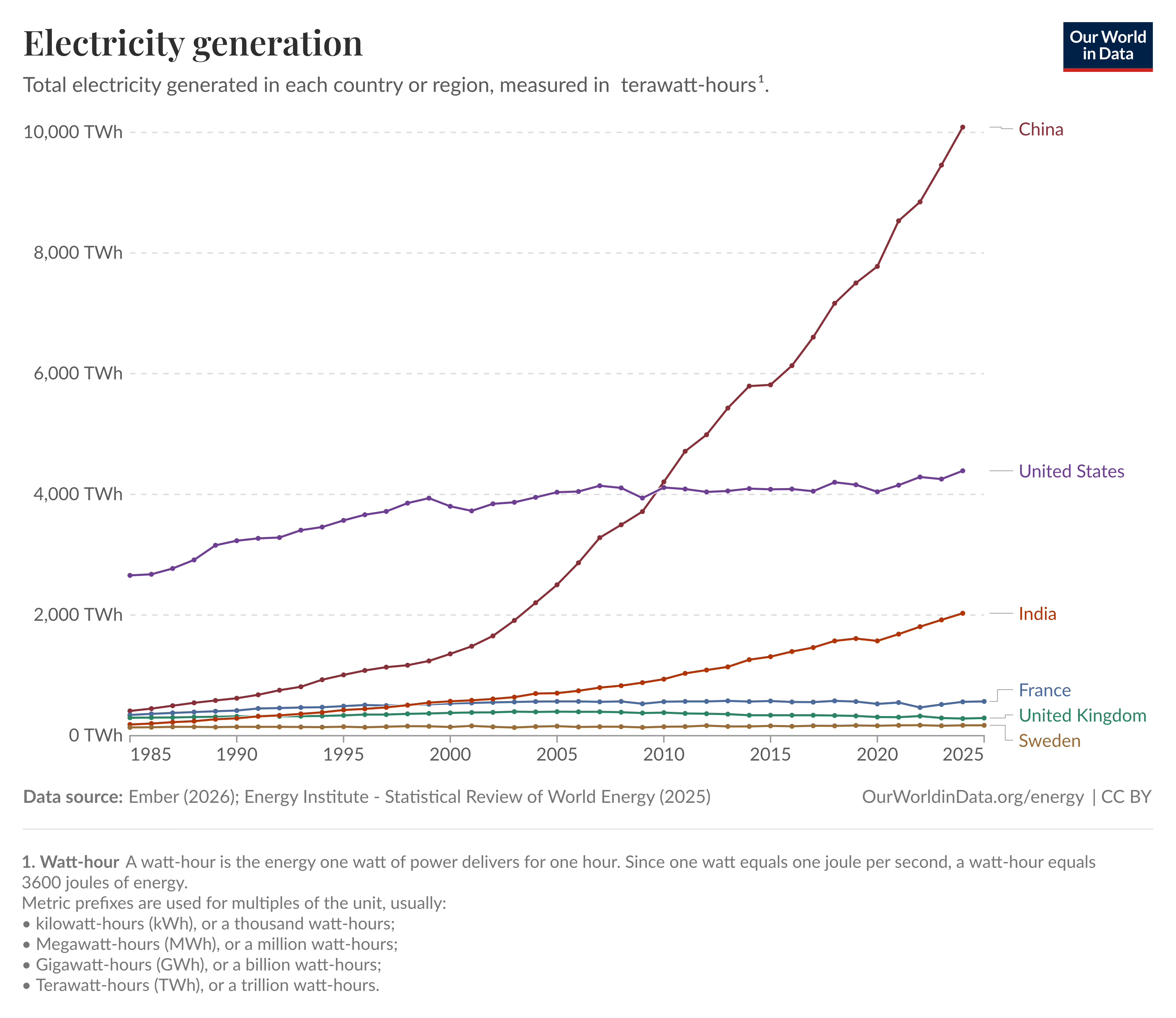
Beijing is also positioning itself to win the race for Embodied AI.
Its “AI+ Action Plan” mandates that AI-powered robots reach 70% penetration in key industrial sectors by 2027, rising to 90% by 2030. This is a mandatory state-directive, not a corporate choice.
Through the “East Data, West Computing” project, China is linking Gobi Desert energy bases to coastal factories via 15 new ultra-high-voltage “super canals.”
These transport both electricity and compute directly to the industrial heartland. The goal is the world’s first “intelligized” industrial economy.
This is China Shock 2.0. If China infuses AI into physical applications first, it gains an asymmetric advantage that solves its demographic crisis and cements its industrial dominance, overturning its Century of Humiliation.
Both China and the US are in an existential battle to “intelligize” their economies — and their militaries. British leaders, meanwhile, are still focusing on carbon credits.
The Ratchet
The situation in Britain is not improving. This week, Energy Secretary Ed Miliband cited a Climate Change Committee report, arguing that reaching Net Zero by 2050 is “cheaper” than another fossil fuel crisis.
This is a delusion. It ignores a fundamental reality: being sovereign in a world reshaped by AI requires massive, high-density energy, not just intermittent green generation.
By adhering to Net Zero without an industrial base, British leaders are not reclaiming independence. They are trading a reliance on foreign fuels for a terminal dependence on foreign supply chains — from critical minerals to the very hardware and compute that will run the Intelligent economy.
This also prevents Britain — which claims to be an AI leader — from competing in the most important race of the century.
Even if the government wanted to pivot, the window is slamming shut.
Recent YouGov polling puts the Green Party at 21%. Among voters under 25, they are the outright majority at 49%. The Greens want Britain to scrap its nuclear deterrent. And their leader, Zack Polanski, characterizes nuclear power as a “fax machine.” In reality, it is the only viable baseload for a sovereign AI future.
Across the Atlantic, a “People vs. AI” movement is rising too. Bernie Sanders is calling for a moratorium on data centers. In Britain, the Green worldview fits this emerging politics perfectly. They see fossil fuels as evil, nuclear as reckless, and tech billionaires as the enemy.
The ratchet only turns one way.
Fleeting Sovereignty
Sovereignty requires defense. Defense requires industry. Industry requires affordable energy. In 2026, all four are tethered to AI.
When an Iranian drone struck RAF Akrotiri, HMS Dragon — Britain’s premier air defense asset — sat idle in Portsmouth for ten days. (French and Greek warships deployed immediately.)
The reaction from Washington was withering. Keir Starmer is “no Winston Churchill,” said the President. It was a damning indictment, signaling a state capability and political seriousness that are rapidly evaporating.
This rot now reaches the very core of British national security: its nuclear deterrent. Vanguard — the fleet of four submarines that carry Britain’s nuclear warheads — is now past its intended retirement.
The facilities meant to build the reactor cores for its replacement, Dreadnought, are currently rated “Red” by the government’s own Infrastructure and Projects Authority. This means that successful delivery is officially considered “unachievable.”
The same hollowing out that shuttered the blast furnaces of Port Talbot is leaving the UK’s nuclear shield held together by a prayer.
Modern warfare is being reshaped in Ukraine and Iran.
To defend itself, a nation must now deploy AI across its entire defense architecture. This requires the one thing British politics has made impossible to provide: cheap, abundant, and reliable energy.
Britain birthed the Industrial Revolution because it solved for cheap energy to power new machines, igniting the most significant period of human prosperity in history.
Today, Britain is failing that same test. It is about to re-learn the lesson it once taught the world: Energy sovereignty is national sovereignty.
Comments
Nothing yet. Say the first thing.
Sign in to join the conversation.