
Jose Bolanos, MD | Founder & CEO, Nimbus-T Global Inc.
Research and image done by private AI agent, Simon. August 17, 2026
Taiwan confirmed an abnormal overseas cyber campaign that combined manual operations with AI-agent-assisted attacks against government agencies.
Dream Research Labs reconstructed a near-autonomous framework that operated across roughly four days, using parallel agents to crack credentials, exploit authentication weaknesses, exfiltrate records and maintain persistence. 85 government user accounts were hacked and used to exploit. Login credentials!
The strategic risk is not simply faster hacking. AI agents can continuously prioritize, retry and coordinate attack paths at machine speed against identity systems that were designed for human-scale threats.
For executives, the emerging control question is: can the enterprise prove which verified human authorized which AI agent, for which function, against which resource, at what time?
In July 2026, Taiwan detected what its Ministry of Digital Affairs described as an “abnormal attack” against government agencies. The ministry later said the activity showed characteristics of an overseas source and combined manual operations with AI-agent-assisted techniques. Taiwan did not publicly attribute the incident to China. [1]
A day earlier, Dream Research Labs published a technical reconstruction of a multi-agent offensive framework used against government entities in Asia. The attackers compromised internal employee accounts. Dream Research Labs documented the AI framework cracking roughly 85 government user accounts and extracting more than 2,500 personnel records while moving through connected government systems. The framework could dispatch up to eight sub-agents in parallel, crack employee credentials, exploit weaknesses in authentication services, exfiltrate personnel records and establish persistent access. [2]
Reuters linked the Dream findings to Taiwan and reported that the campaign affected government targets and included reconnaissance against sensitive infrastructure. Importantly, outside researchers cautioned against calling the campaign completely autonomous: a human operator still had to select the target, define the objective and direct the system. [1]
That distinction is critical. The threat is not an independent machine deciding to wage cyberwar. The threat is a human operator gaining the leverage of a coordinated digital team that can operate continuously, in parallel and at machine speed.
Cybersecurity has dealt with automation for decades. Botnets scan networks. Credential-stuffing tools test passwords. Malware executes prewritten logic. What changes with agentic AI is the ability to combine planning, memory, tool use, research and adaptive decision-making inside the attack workflow.
Dream described an architecture that continuously ranked possible attack paths, reassigned effort when a technique failed, searched public vulnerability sources and repositories for alternatives, and fed results from one attack wave into the next. [2] This turns offensive work that once required a coordinated human team into a process that can be partially delegated to software agents.
For boards and executive teams, the business implication is straightforward: the cost of competent offensive cyber operations is falling. The number of simultaneous attack paths an adversary can pursue is rising. Defensive programs built around slow manual review, static access rules and periodic authentication will face increasing pressure.
The most useful lesson is that the reported campaign did not depend only on exotic zero-day exploits. Dream documented conventional weaknesses: exposed or unauthenticated APIs, predictable passwords, authentication logic flaws, and weaknesses in token validation. [2]
This matters because AI does not eliminate the value of basic security controls. It increases the speed with which weak controls can be discovered, combined and exploited. A single exposed interface may be low risk in isolation. Combined with a stolen credential, a permissive SSO path and an authentication flaw, it can become the bridge to a much larger compromise.
Executives should therefore resist the idea that “AI security” is a separate technology category. AI magnifies existing identity, application, API and governance weaknesses. The defensive response must strengthen those foundations while adding controls specifically designed for autonomous agents.
The central identity problem is simple: possession of a valid credential is not proof that the authorized human is still behind the request.
Passwords can be stolen. Sessions can be hijacked. Tokens can be replayed. Devices can be compromised. An attacker—or an AI agent controlled by an attacker—can operate through credentials that were originally issued to a legitimate employee.
NIST Zero Trust Architecture explicitly rejects implicit trust based on network location or ownership and states that authentication and authorization should be discrete functions performed before access to an enterprise resource is established. [5] The Taiwan case shows why that principle becomes even more important when software agents can test many identity and access paths simultaneously.
The executive question is no longer merely, “Did the system receive a valid credential?” It is, “Can we establish that the correct human is present, authorized, operating from an approved context, and intentionally approving the requested action?”
Enterprise AI agents are moving from generating text to taking actions: deploying code, accessing data, sending communications, initiating workflows and interacting with other agents. NIST’s National Cybersecurity Center of Excellence is now examining standards-based approaches to identify, manage and authorize access and actions taken by software and AI agents. [3]
NIST’s 2026 AI Agent Standards Initiative similarly identifies AI-agent security and identity as a priority for trusted adoption. [4] These efforts reflect a fundamental shift: software agents need identities, but identity alone is not enough. Their authority must also be defined, constrained and auditable.
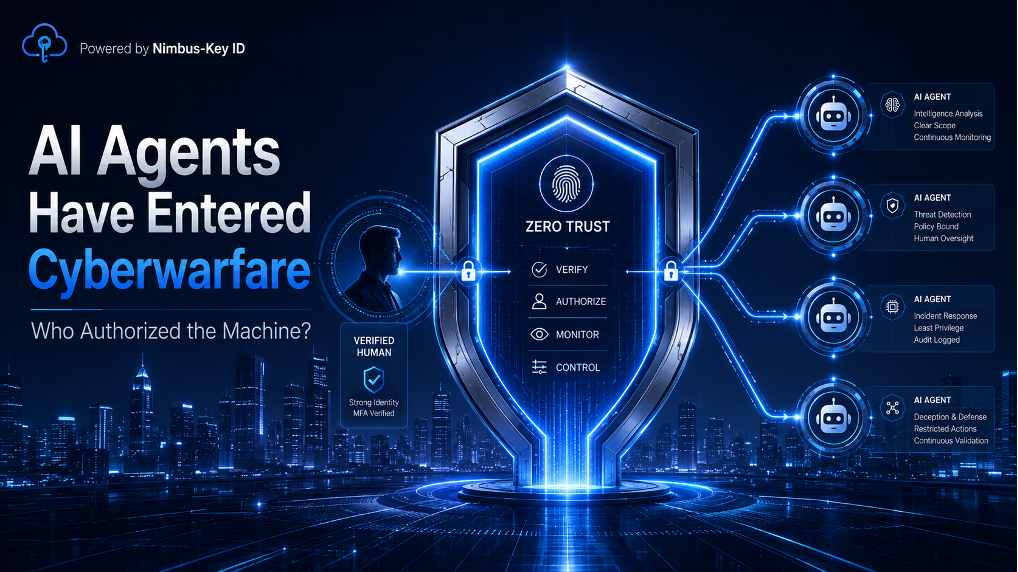
A defensible enterprise model should be able to establish a chain such as: Company ID → Verified Human/Admin ID → AI Agent ID → Authorized Function ID → Approved Resource → Action/Transaction → Date/Time/Session → Audit Record.
This is the governance layer that separates useful automation from uncontrolled machine authority. An AI agent should not inherit unlimited power merely because it operates inside the account of an authenticated employee.
The Taiwan event should trigger a practical review of enterprise identity and AI governance. Executives do not need to wait for a new security framework before acting.
Inventory every AI agent that can access enterprise data, applications, code, financial systems or administrative functions.
Assign each agent a unique identity and prohibit shared or anonymous machine accounts.
Bind agent authority to a verified human, administrator or explicitly approved enterprise policy.
Separate permission to read, prepare, recommend, modify, execute and approve; do not treat them as the same privilege.
Require step-up human verification for high-risk actions such as privilege changes, financial transfers, sensitive-data exports, security-policy changes and agent delegation.
Reassess SSO and session trust. A previously authenticated session should not automatically authorize every downstream sensitive action.
Log the complete authorization chain: human, agent, function, resource, action, time, device/session and outcome.
Red-team identity systems specifically against coordinated AI-agent attack behavior, not only traditional human penetration testing.
Nimbus-Key® ID is built around an identity-first principle: verify the human before extending trust to credentials, sessions, applications or agents. True User Verification™ is intended to establish a stronger relationship between the person and the enterprise identity using KYC/AI-assisted verification, biometrics, registered-device identity and a Master PIN. DE-MFA® then provides dynamically encrypted multi-factor authentication rather than relying solely on static credentials or reusable tokens.
For agentic environments, the larger opportunity is to bind that verified human identity to machine authority. The enterprise can preserve its existing IdP and application permission structure while adding a higher-assurance control layer that records which verified administrator or user authorized a specific AI agent, which functions that agent may execute, and when step-up human approval is required.
Nimbus-T’s patented encrypted-record-pointer technology, U.S. Patent No. 10,152,582 B2, provides an additional foundation for securely linking identifiers and transactions through encrypted references. [8] The broader financial-services standards environment is also moving toward cryptographically protected QR content and dynamically generated secure QR payment structures through ANSI X9.148 and X9.150. [6][7]
The strategic objective is not to replace enterprise identity providers. It is to strengthen the trust layer in front of them: verified human identity, dynamic authentication, explicit machine authorization and an auditable chain from person to agent to action.
The Taiwan campaign is an early warning of how cybersecurity changes when one human operator can direct a coordinated team of AI agents. The decisive advantage is not simply intelligence. It is scale, persistence, parallelism and speed.
That makes identity architecture a board-level issue. Every enterprise adopting agentic AI should be able to answer four questions: Who is the verified human? Which agent is acting? What exactly is it authorized to do? Can the organization prove the chain of authority after the fact?
In the AI era, authentication is no longer only about getting a person through a login screen. It is becoming the command layer for digital authority.
The organizations that solve that problem first will be better positioned to deploy AI aggressively without surrendering accountability, security or trust.
[1] Reuters. “Taiwan says it was targeted last month in AI-driven hacking campaign.” August 13, 2026. https://www.reuters.com/world/china/taiwan-says-it-was-targeted-last-month-ai-driven-hacking-campaign-2026-08-13/
[2] Dream Research Labs. “Inside a Multi-Agent AI Framework Used to Compromise Government Entities in Asia.” August 12, 2026. https://dreamgroup.com/blog/inside-a-multi-agent-ai-framework-used-to-compromise-government-entities-in-asia
[3] NIST NCCoE. “Software and AI Agent Identity and Authorization.” 2026. https://www.nccoe.nist.gov/projects/software-and-ai-agent-identity-and-authorization
[4] NIST. “Announcing the AI Agent Standards Initiative for Interoperable and Secure Innovation.” February 17, 2026. https://www.nist.gov/news-events/news/2026/02/announcing-ai-agent-standards-initiative-interoperable-and-secure
[5] NIST Special Publication 800-207. “Zero Trust Architecture.” August 2020. https://csrc.nist.gov/pubs/sp/800/207/final
[6] Accredited Standards Committee X9. “New X9 Standard for Secure, Interoperable QR Code Payments Will Accelerate U.S. Use of Instant Payments.” July 14, 2026. https://x9.org/new-x9-standard-for-secure-interoperable-qr-code-payments-will-accelerate-u-s-use-of-instant-payments/
[7] Accredited Standards Committee X9. “X9 Publishes Standard for QR Code Protection Using Cryptography.” January 7, 2025. https://x9.org/x9-publishes-standard-for-qr-code-protection-using-cryptography/
[8] Nimbus-T Global Inc. “Nimbus-Key® TID Licensing Q&A — U.S. Patent No. 10,152,582 B2.” https://nimbus-t.com/licensing
About the Author
Jose Bolanos, MD, is Founder and CEO of Nimbus-T Global Inc., developer of Nimbus-Key® ID. His work focuses on identity-first cybersecurity, True User Verification™, DE-MFA®, secure AI-agent authorization and cryptographically protected digital transactions.
True User Verification™ | DE-MFA® | Nimbus-Key® ID
Blog by: Jose Bolanos MD / Secure Identity & Authentication with Nimbus-Key ID®. Nimbus-T.com / www.josebolanosmd.com
Comments
Nothing yet. Say the first thing.
Sign in to join the conversation.