
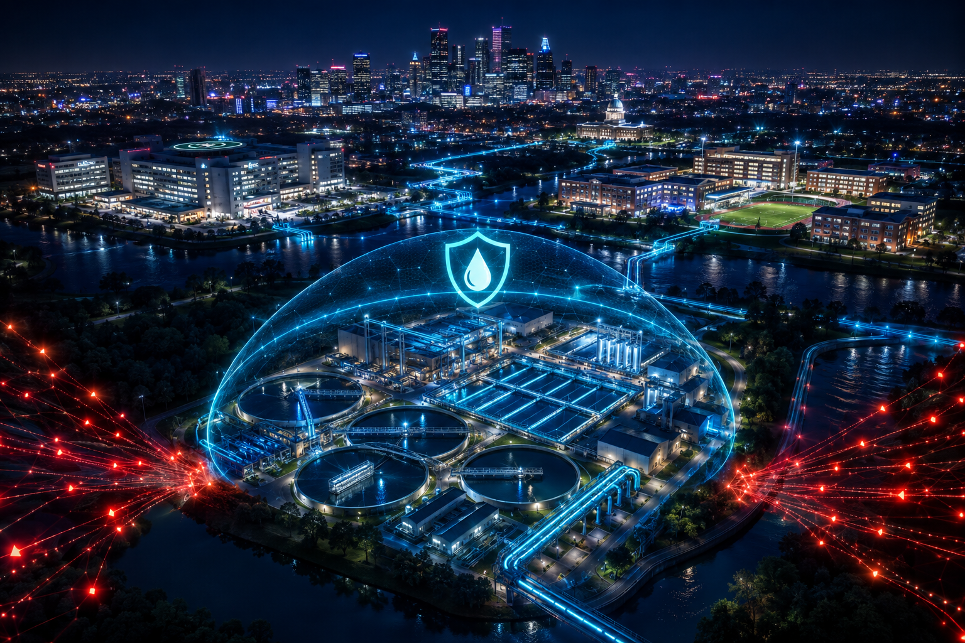
AI-generated conceptual illustration: Conceptual protected water network serving cities, hospitals, schools, and essential facilities.
Authors: Jose Bolanos MD & Arvin Verma CISSP | August 5, 2026
Introduction: Water is one of the few services whose failure is felt almost immediately in every part of a community. Homes need it for drinking and sanitation. Hospitals need it for patient care, sterilization and cooling. Fire departments need pressure in hydrants. Schools, nursing homes, restaurants, factories, power facilities and data centers cannot operate normally without a dependable supply. That dependence makes water infrastructure an unusually powerful target: an attacker does not have to contaminate an entire city to create disruption, fear and economic damage. Interrupting visibility, pressure, pumping or wastewater treatment can be enough.
The coordinated attacks of July 2026 demonstrated the scale of the threat. Minnesota confirmed that operational technology at more than 30 community water systems was targeted on July 26 and 27. Federal authorities separately reported incidents across at least seven states, including loss of pressure and flooding. These events were not merely attacks on office computers or billing records. They reached equipment used to monitor and control physical water operations, showing how weaknesses inside local utility systems can be converted into consequences outside the computer network.
Water utilities combine enormous social importance with uneven cybersecurity resources. The United States has nearly 170,000 drinking-water and wastewater systems. Many serve small communities with limited budgets, small staffs and aging equipment. An adversary therefore sees a target that can affect thousands of people but may be defended by only a handful of employees who must prioritize water quality, repairs, regulatory testing and uninterrupted service.
The target also offers psychological leverage. People can tolerate a temporary website failure; they react very differently when they are unsure whether tap water is safe. Even when an attack does not contaminate water, uncertainty can trigger bottled-water purchases, school closures, emergency announcements and distrust of local government. Publicity from an intrusion may be strategically valuable to a foreign adversary or ideologically motivated group because it demonstrates reach into ordinary American life.
Water systems are also useful for reconnaissance. A nation-state can quietly study how utilities are connected, which vendors they use, how quickly operators respond and whether manual controls still work. Access obtained during peacetime can be preserved for possible use during a diplomatic or military crisis. Criminal groups have a different motive: ransomware, extortion, theft of customer data or pressure on a utility that cannot afford prolonged downtime. Hacktivists may seek visibility, political influence or retaliation rather than money.
Minnesota IT Services confirmed that a coordinated cyberattack targeted operational technology at more than 30 community water systems on July 26 and 27, 2026. The Federal Bureau of Investigation (FBI) and Environmental Protection Agency (EPA) subsequently reported related activity affecting utilities in at least seven states. Some systems lost monitoring or control functions; reported effects included loss of water pressure and flooding.
The attackers focused on internet-connected programmable logic controllers (PLCs), small industrial computers that automatically operate pumps, valves and other equipment. Federal investigators reported that attackers changed network addresses and passwords, locking operators out of parts of their own systems. At least one organization found that controller project files—the instructions telling the equipment how to behave—had been modified.
The campaign demonstrated how one weakness can be repeated. Utilities in different communities may use the same controller models, cellular connections, outside service companies or standard network layouts. Once an attacker learns how one configuration works, the same method can be tested against many similar facilities. This turns the fragmentation of the American water sector into an advantage for the attacker: thousands of local systems may unknowingly share the same exposure.
A modern water utility has two connected worlds. The first is the business network used for email, billing, payroll, documents and ordinary administration. The second is the operational network that monitors and controls physical equipment. Inside the operational network, sensors measure water level, pressure, flow and chemical conditions. PLCs receive those measurements and automatically turn pumps on or off, open valves or maintain a process within safe limits.
Operators watch the system through a human-machine interface (HMI), the screens that display tanks, alarms, pump status and treatment conditions. A supervisory control and data acquisition (SCADA) platform collects information from multiple sites so a small team can oversee wells, towers, lift stations and treatment facilities spread across a wide area. Engineering workstations are used to change the controller instructions when equipment or operating needs change. Remote connections allow employees, contractors and equipment vendors to diagnose problems without traveling to every location.
This arrangement improves reliability and reduces costs, but it creates paths into the physical process. An attacker who steals a remote-access login, discovers a controller exposed directly to the internet or compromises a vendor account may move from viewing information to changing it. If the attacker can alter a password, suppress an alarm, change a pump schedule or replace a controller file, the computer intrusion can become a physical operating event.
Updating a water-control system is not like installing a routine update on a personal computer. A water plant cannot simply stop providing service while every device is restarted. Pumps and treatment processes must continue, and any interruption must be carefully planned around storage capacity, public demand, backup equipment and emergency needs.
Many controllers were installed years before constant internet connectivity was expected. They were designed to perform one industrial task reliably for decades. Some use old operating software, default credentials or communication methods that assume anyone reaching the device is trusted. The manufacturer may no longer support the product. In other cases, a security update exists but cannot be installed immediately because the utility must confirm that it will not interfere with pumps, sensors, safety interlocks or other certified equipment.
A software change may also require vendor approval, laboratory testing, backup of the controller program and a maintenance window with trained staff present. Smaller utilities may depend on one contractor who serves many towns. If an update causes a controller to fail, the result is not merely a frozen screen—it may stop a pump or remove visibility into a reservoir. Utilities therefore postpone changes to avoid an immediate operational risk, while the delay creates a growing cybersecurity risk.
This is why compensating protections are essential. Older equipment that cannot yet be replaced should be isolated from the public internet, placed behind controlled gateways, restricted to approved communications and continuously monitored. Utilities also need an accurate inventory of every controller, modem, workstation and remote account; otherwise, an exposed device may remain online simply because no one realizes it is there.
Artificial intelligence (AI) does not need to operate a water plant autonomously to make attacks more dangerous. Generative AI can help an adversary search the internet for exposed equipment, translate technical manuals, analyze configuration files, prepare convincing messages to employees and adapt malicious code. Tasks that once required a larger expert team can be performed faster, in more languages and across more targets.
AI is especially useful for scaling attacks. An attacker can compare information from many utilities, identify repeated equipment and vendor patterns, and prioritize systems that appear poorly protected. AI-generated voice, email or video impersonation can make a fraudulent request appear to come from a supervisor, contractor or emergency official. Once access is gained, automated tools can rapidly test passwords, locate connected devices and search for paths from the office network into operational controls.
There is also a defensive opportunity. AI can help utilities detect unusual logins, recognize abnormal pump behavior and correlate alarms across distant sites. But an AI system should not be allowed to change treatment settings or controller logic on its own. Any automated recommendation that could affect water quality, pressure or public safety should remain subject to defined safety limits and approval by a verified, authorized human.
The most immediate consequence is loss of operational awareness. If operators cannot see accurate tank levels, pump status or alarms, they may have to switch to manual operation and send employees to distant facilities. A prolonged loss of visibility increases the chance of overflowing tanks, empty reservoirs, equipment damage or delayed response to a genuine mechanical failure.
Loss of pressure creates a public-health concern because pressure normally helps keep contamination outside drinking-water pipes. When pressure falls, groundwater or other material may enter through cracks and joints. A utility may issue a boil-water advisory even when contamination has not been confirmed, because testing takes time and protecting the public requires caution. Manipulation of chemical feeding or disinfection could create an even more serious hazard, although physical safety mechanisms and operator intervention may limit the effect.
Wastewater systems create a different set of consequences. Disabled pumps or altered controls can cause sewage backups, overflows or releases into rivers and neighborhoods. Cleanup costs, environmental penalties and equipment repairs can continue long after computer access is restored. Flooding can damage electrical systems and make a cyber incident more difficult and dangerous to recover from.
The cascading effects can spread quickly. Hospitals may postpone procedures or struggle with sterilization and sanitation. Firefighters may lose dependable hydrant pressure. Schools, childcare centers, nursing homes, restaurants and food processors may close. Manufacturers and data centers may reduce operations. Residents may overwhelm stores for bottled water, while local government must communicate under conditions of uncertainty. The economic damage can therefore be much larger than the cost of repairing the original controller.
Not every attacker needs to produce catastrophic damage to succeed. A short disruption can prove that access is possible, generate national attention and force federal, state and local agencies to mobilize. It can also reveal how long detection takes, which backup procedures work and which communities are least prepared. That information has intelligence value.
For a foreign government, access to water infrastructure can become leverage during conflict. The threat of simultaneous disruptions across many small systems could force officials to divide personnel and attention while the country is responding to another crisis. For a criminal group, the same urgency creates pressure to pay an extortion demand. For hacktivists, a visible interruption can amplify a political message far beyond the technical sophistication of the attack.
The danger is magnified by public confidence. If residents believe their water may have been manipulated, official reassurance must be supported by reliable sensor data, independent testing and a clear record of who accessed the system. Restoring trust can take longer than restoring a network. Water cybersecurity is therefore not only about protecting equipment; it is about preserving confidence in the institutions responsible for an essential public service.
No single product can secure a water utility. The first priorities are to remove controllers from direct internet exposure, separate business systems from operational controls, secure cellular and vendor connections, eliminate shared and default passwords, disable former employee accounts, maintain tested backups and preserve the ability to operate essential processes manually. Utilities must also validate controller files after an incident so that a hidden malicious change is not restored from an infected backup.
The remaining vulnerability is the human authorization point: the moment a person logs into a remote gateway, opens an engineering workstation or approves a consequential command. Traditional credentials can be phished, copied, shared or reused. A valid username, password or static authentication token may prove that the correct credential was presented, but it does not necessarily prove that the authorized human is the person presenting it.
Nimbus-Key® ID can be applied directly at this boundary as an identity-first control layer in front of the utility’s existing login and authorization systems. Before access is granted, True User Verification™can establish the real operator through identity proofing, liveness-tested biometrics, the registered mobile device’s unique identifier and a private Master PIN. DE-MFA®—Dynamically Encrypted Multi-Factor Authentication—can then issue a short-lived encrypted login QRcode & PIN, rather than relying on a reusable password or static token.
The verified identity can be required when an employee or vendor enters the secure remote-access gateway, launches the SCADA or engineering application, changes a controller program, modifies pressure or chemical settings, disables an alarm, or requests an emergency override. Routine monitoring can continue without unnecessary delay, while higher-risk actions trigger renewed verification and, where policy requires, approval by a second verified operator.
Nimbus-Key® ID would not replace the utility’s existing roles, network segmentation, safety interlocks or manual controls; it would ensure that those existing permissions are exercised by the true authorized human. Nimbus-Key® TID can link each approved high-risk action to an encrypted transaction identifier recording who acted, what was authorized, when it occurred and which system received the instruction, giving investigators and utility leaders a defensible audit trail after an incident.
1. Minnesota IT Services — MNIT Activates Statewide Cybersecurity Response to Support Minnesota Community Water Systems (July 28, 2026)
https://mn.gov/mnit/media/blog/?id=38-761869
2. Federal Bureau of Investigation and Environmental Protection Agency — Malicious Cyber Actors Targeting Water and Wastewater Sector Internet-Facing Programmable Logic Controllers, Causing Operational Disruptions (July 30, 2026)
https://www.fbi.gov/investigate/cyber/alerts/2026/malicious-cyber-actors-targeting-water-and-wastewater-sector-internet--facing-programmable-logic-controllers-causing-operational-disruptions
3. Cybersecurity and Infrastructure Security Agency — Iranian-Affiliated Cyber Actors Exploit Programmable Logic Controllers Across U.S. Critical Infrastructure (July 22, 2026)
https://www.cisa.gov/news-events/cybersecurity-advisories/aa26-097a
4. U.S. Environmental Protection Agency — EPA, FBI, CISA and NSA Issue Joint Cybersecurity Advisory Regarding Iranian-Affiliated Threats (April 7, 2026)
https://www.epa.gov/newsreleases/epa-fbi-cisa-nsa-issue-joint-cybersecurity-advisory-water-system-regarding-iranian
5. U.S. Government Accountability Office — Critical Infrastructure Protection: EPA Urgently Needs a Strategy to Address Cybersecurity Risks to Water and Wastewater Systems (GAO-24-106744)
https://www.gao.gov/products/gao-24-106744
6. U.S. Environmental Protection Agency — Enforcement Alert: Drinking Water Systems to Address Cybersecurity Vulnerabilities
https://www.epa.gov/enforcement/enforcement-alert-drinking-water-systems-address-cybersecurity-vulnerabilities
7. National Institute of Standards and Technology — Artificial Intelligence Risk Management Framework: Generative Artificial Intelligence Profile (NIST AI 600-1)
https://nvlpubs.nist.gov/nistpubs/ai/NIST.AI.600-1.pdf
8. National Institute of Standards and Technology — Guide to Operational Technology Security (NIST SP 800-82 Rev. 3)
https://csrc.nist.gov/pubs/sp/800/82/r3/final
9. Office of the Director of National Intelligence — 2026 Annual Threat Assessment of the U.S. Intelligence Community
https://www.odni.gov/files/ODNI/documents/assessments/ATA-2026-Unclassified-Report.pdf
Blog by: Jose Bolanos MD / Secure Identity & Authentication with Nimbus-Key ID®. Nimbus-T.com / www.josebolanosmd.com
Comments
Nothing yet. Say the first thing.
Sign in to join the conversation.