
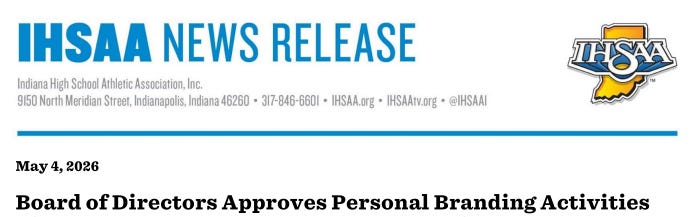
This week, the Indiana High School Athletic Association (IHSAA) officially approved new bylaw language permitting Personal Branding Activities (PBA) for student-athletes across Indiana.
With a 13-5 vote by the Board of Directors on May 4, 2026, Indiana became the 46th state association — plus the District of Columbia — to permit some form of NIL activity at the high school level, effective with the 2026-27 school year.
You can read the entire news release from the IHSAA here: https://www.ihsaa.org/sites/default/files/documents/050426.Board_.pdf
And while the headlines will continue to focus on “high school athletes can now profit from NIL,” the bigger story is this:
Education, safety, compliance, and clarity will now matter more than ever.
Because once NIL activity becomes permitted, schools, families, coaches, and student-athletes immediately enter a new environment filled with opportunities, risks, gray areas, and long-term eligibility implications that most families are simply not prepared to navigate alone.
That’s why this moment cannot simply be viewed as “allowing NIL.”
It must be viewed as the beginning of a statewide educational responsibility.
Indiana’s approved language specifically uses the term Personal Branding Activity (PBA) — defined as the use of a student’s name, image, or likeness for promotional, endorsement, or commercial purposes through appearances, licensing, social media, endorsements, branding, and similar activities.
The terminology matters, and to be honest, has been the basis for the most recent policy approvals (Michigan, Ohio, and now Indiana…)
By framing this around “personal branding,” the IHSAA deliberately created separation from the collegiate NIL landscape, particularly the school-involvement model that has become deeply controversial at the college level.
Additionally, as I’ve said thousands of times, (yes, thousands), the entire goal of a state association policy is to separate NIL activity from interscholastic athletic participation.
Does just changing the wording to PBA do that? No, but, it’s a step.
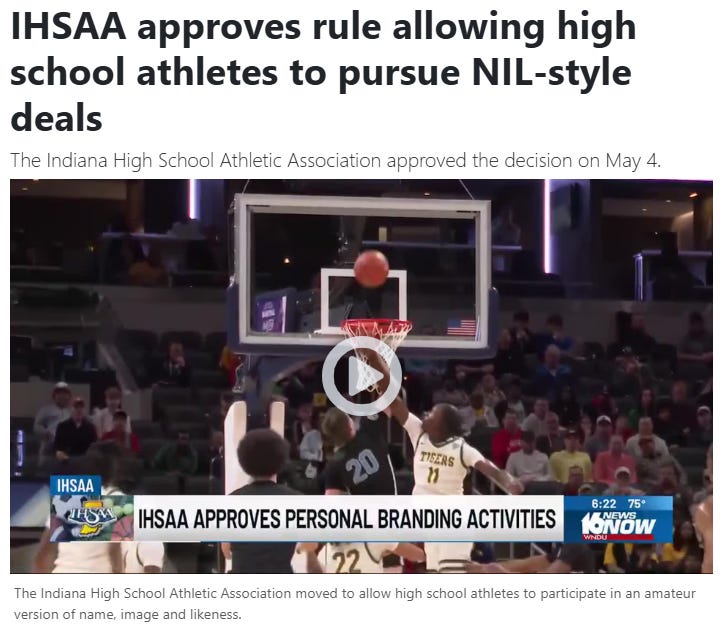
IHSAA Commissioner Paul Neidig was direct in his interviews stating
“Unlike the current college system, where schools often play a direct role in NIL compensation, the new rule keeps high schools out of arranging or funding deals for student-athletes. Instead it allows students to benefit independently from their school, without using school branding or representing school-sponsored endorsements. it creates a clear distinction between the college model and the educational mission of high school athletics.”
Whatever a student-athlete does to monetize their personal brand, they do it as an individual — not as a representative of their school, their team, or their sport.
That foundational principle shapes every single element of what follows.
Operationally, however, this is NIL activity. Students may now:
Engage in PBA activities provided they do not represent the Member school and do not perform athletic services.
Monetize personal brands through social media, personal appearances, and endorsements UNRELATED to their school athletic participation.
Provide non-athlete services such as tutoring, personal training instruction, or coaching youth sports for reasonable compensation.
And with those permissions come very real guardrails that families and schools must understand completely.
The new PBA framework prohibits student-athletes from:
School Representation.
Any use of school logos, mascots, nicknames, uniforms, traditions, achievements, or any reference to school affiliation in a compensated activity is prohibited. This prohibition is broad — a jersey in the background of a social media post, a school tag in a caption, or even a strong implication of school affiliation in sponsored content can constitute a violation.
Prohibited Product Categories.
Deals involving gambling or gaming, alcohol, tobacco, cannabis, illegal or banned substances (including performance-enhancing drugs), sexually explicit material, or firearms and weapons are expressly off limits. Businesses operating in adjacent spaces should think carefully before approaching a high school athlete.
PBA Collectives.
The IHSAA expressly prohibits participation in or acceptance of benefits from any collective working on behalf of, in conjunction with, or for the benefit of any member school.
Recruitment-Related Arrangements.
Any PBA activity offered to induce a student to attend a particular high school for athletic purposes is prohibited. This specifically focuses on preventing schools from using brand deal opportunities as an indirect recruiting tool.
School-Affiliated Athletic Services.
Student-athletes cannot participate in athletic contests, demonstrations, or events organized, sponsored by, or affiliated with a member school as part of a PBA arrangement. The line between a permissible independent clinic and a prohibited school-affiliated event is one that requires careful, case-by-case analysis.
Just remember —> SEPARATE FROM THE MEMBER SCHOOL & INTERSCHOLASTIC ATHLETIC PARTICIPATION!
Buried within the procedural requirements is arguably the most critical component of the entire policy in 5-7.4 (5).
“Member schools must provide annual education to student-athletes regarding PBA rules, compliance requirements, and potential consequences of violations.”
That line matters. A lot.
Because NIL policies without educational infrastructure create confusion, inconsistency, and compliance risk.
Most families do not automatically understand:
NCAA, NAIA, and NJCAA eligibility implications
Contract language and what they’re actually signing
IRS tax responsibilities when a minor earns income
Intellectual property rights and what’s being licensed
Social media risk and long-term digital footprint implications
The difference between a compliant deal and one that costs their student a season
And many Indiana schools are about to discover very quickly that “allowing NIL” and “being prepared for NIL” are two completely different things.
Cue the “NIL Education Experts” showing up at every one’s door who have been around for about a year, saying “we’ll help.”
Do your research, and follow the money. If they’re trying to get to your student-athletes to help them monetize, and providing guides on “how to monetize your NIL”… run, run fast.
And no, that’s not what I do.
The policy requires student-athletes to notify their athletic director in writing within 48 hours of entering into any PBA agreement.
Schools may review agreements for IHSAA compliance but may not prohibit compliant activities.
That may sound straightforward. In reality, schools now need systems in place to:
Track disclosures consistently
Store documentation securely
Review agreements for compliance red flags
Communicate concerns to students and families
Maintain consistency across all sports and student groups
Bylaw 5-7.4 (6) states:
Data Security and Integrity: Member Schools shall maintain reasonable security measures to safeguard personal data related to PBA agreements against loss, interference, misuse, unauthorized access, disclosure, alteration, or destruction, and shall maintain reasonable procedures to help ensure data reliability for its intended use.
The policy also places responsibility squarely on students and parents, not schools, to determine NCAA, NAIA, and NJCAA eligibility implications, manage tax obligations, and understand all applicable legal responsibilities.
That makes educational leadership from schools absolutely critical.
Because if families don’t understand what they’re responsible for, they can’t fulfill that responsibility.
The penalty for getting this wrong? Up to 365 days of ineligibility in the sport concerned.
One overlooked detail.
One social media post with a school logo in the background.
That’s the margin.
And I can show you how often that happens, because it’s actually more than you think.
The schools that handle this best will not be the schools that panic.
They will be the schools that educate early, communicate clearly, and build internal procedures before problems arise.
That means:
Establishing written reporting and notification procedures
Developing internal review systems for PBA agreements
Training coaches and staff on what they can and cannot do
Creating stakeholder education opportunities for families
Helping student-athletes understand eligibility implications across all levels
Clarifying precisely what is and isn’t permissible under Indiana’s specific framework
Building proactive compliance structures, not reactive ones
This cannot simply become “good luck everybody,” or - here watch this video, or take this NIL Education course developed by this expert who doesn’t really know our state policy.
Because once eligibility is lost, reinstatement becomes difficult, public, and deeply stressful for families, schools, and the student-athletes themselves.
The schools that approach this as a pure athletics issue will miss the larger picture entirely.
At its core, Indiana’s new PBA framework is also about:
Digital citizenship and online responsibility
Personal branding and long-term reputation management
Financial literacy for young athletes and their families
Social media safety and risk awareness
Contract literacy and intellectual property basics
Compliance culture within athletic departments
And Indiana schools now have a genuine opportunity to lead proactively instead of reactively, and model the kind of education-first approach that protects students, supports families, and strengthens communities.
I can help you get there…
Over the past several years, I’ve had the privilege of working with hundreds of public and private high schools, districts, athletic departments, and state associations across the country delivering high school NIL education presentations tailored specifically to each state’s policy, focused on what student-athletes and families actually need to understand to stay safe, compliant, and protected.
As Indiana begins this new chapter, the time to educate is now…. before confusion and misinformation fill the vacuum. Ultimately you have until the 2026-2027 school year.
The schools who will LEAD in this environment are the ones who:
Educate early and often
Communicate clearly
Focus on Compliance and Safety, not fear
If you need help making sense of this shift, educating stakeholders, or simply understanding what this looks like in your specific school’s world, that’s exactly why I do this work, and focus solely on high school NIL policy.
So if your school, district, or conference is looking for:
Policy-aligned resources focused on compliance and protection
A School Stakeholder NIL & PBA Education Night
Coach & Administrator NIL Education Compliance Training
Parent & Family NIL & PBA Education Sessions
Student-Athlete Personal Branding & Safety Workshops
State-Specific PBA Compliance & Eligibility Presentations
And at the end of the day, education has to remain the priority.
Please don’t hesitate to reach out. The schedule is filling up, but I’ll do whatever I can to support you.
I’m always here to help schools navigate this space the right way…. with EDUCATIONAL based athletics at the center and integrity leading the way.
— Doc G
© nil-education.com | The information provided in this post is for educational purposes only and does not constitute legal advice. Consult qualified legal counsel before entering into any PBA agreement.
No posts
Comments
Nothing yet. Say the first thing.
Sign in to join the conversation.