
While it’s been a few weeks since the last update regarding HB 661, there has been a political curveball during that time.
The Ohio General Assembly now has two House bills on the table dealing with Name, Image, and Likeness (NIL) rights for high school student-athletes. Some might say on the surface that could be considered progress.
In practice, it’s starting to look like the opposite.
House Bill 661 has been working its way through the House Education Committee for months as it just had its sixth hearing this past week, and the bill’s sponsor has made clear he intends to move it forward as written.
Then, what felt like almost out of nowhere, House Bill 745 appeared.
Titled the Student-Athlete Publicity Rights and Fair Compensation Act, HB 745 is sponsored by Tex Fischer from District 59 (Boardman / Youngstown area) and Phil Plummer from District 39 (Dayton) who is also a High School Wrestling Coach at Vandalia Butler High School.
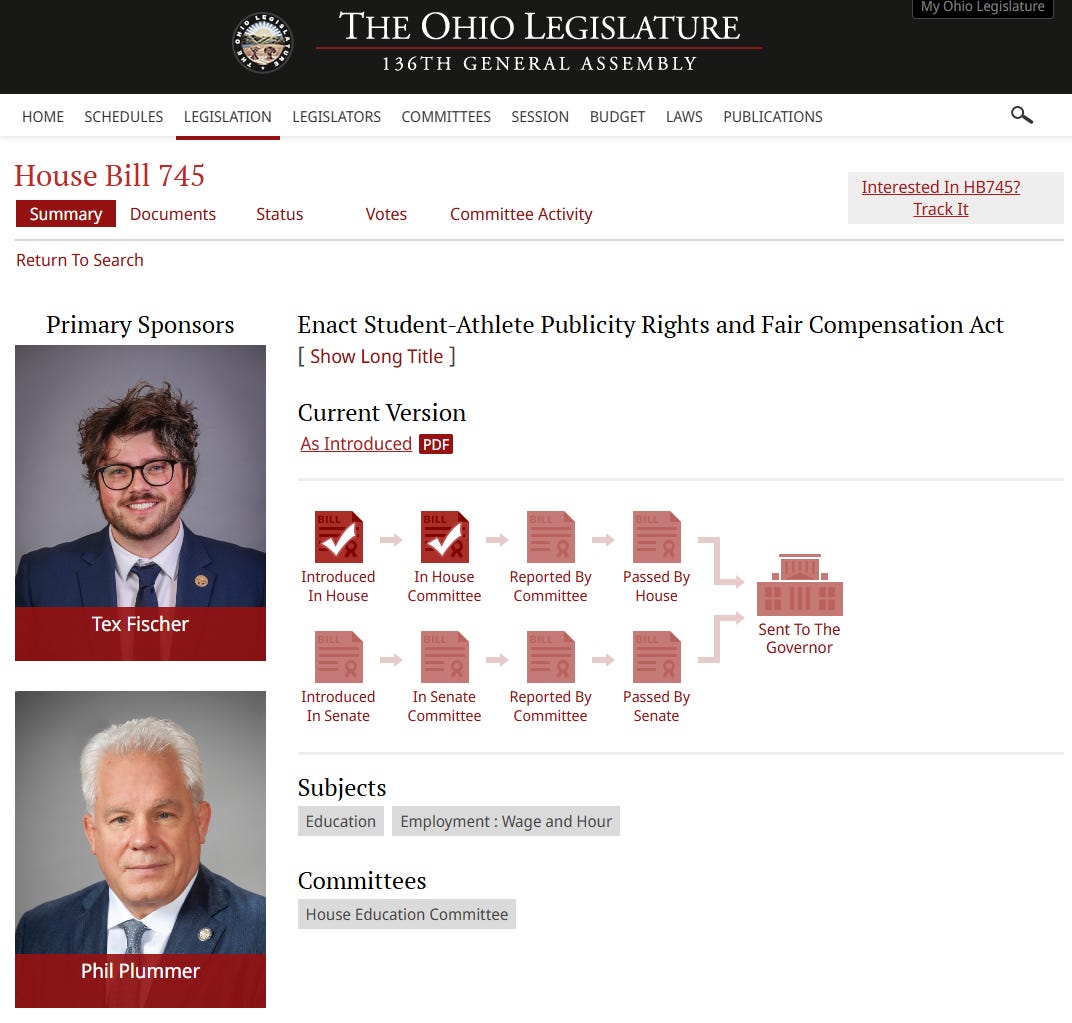
You can visit the Ohio Legislature House Bill 745 page here: https://www.legislature.ohio.gov/legislation/136/hb745
HB 745 is being framed as a competing alternative and the two bills don’t just differ in detail, they move in completely opposite directions.
This is no longer a conversation about whether NIL should exist for Ohio’s high school athletes.
It’s a conversation about what kind of system Ohio wants to build, and right now, two very different answers are on the table.
Below are some recent articles about the two competing bills if you’re interested in diving into the media coverage:
At its heart, the difference between these two bills comes down to one concept: separation.
HB 661 draws a clear line.
NIL activity cannot be tied to athletic participation or roster position. It reinforces structural separation between commercial activity and interscholastic athletics. The focus is on eligibility and enforcement — keeping schools and governing bodies out of the middle.
HB 745 takes a different path.
It builds a regulated marketplace — NIL is allowed, structured, reviewed, and monitored within the school environment, or as it says - “by the school governing authority” - which in it’s definition within the bill can mean a lot of things. It almost sounds like the Schools become active participants in the process. Administrators become reviewers. Governing bodies become gatekeepers.
One bill prioritizes separation. The other attempts integration with oversight.
And when you look at the details of HB 745, the integration runs deeper than what I think most people realize, including the bill sponsors.
HB 745 explicitly prevents schools or governing bodies from prohibiting student-athletes from obtaining representation from an athlete agent or attorney.
Here’s why that matters: doing so currently violates OHSAA’s amateur bylaws.
This isn’t a minor NIL adjustment. This is a fundamental redefinition of amateur status in Ohio high school athletics. That deserves its own serious conversation — not a footnote buried in an NIL bill.
With written permission from a school governing authority, a student-athlete could use school logos, uniforms, and facilities as part of a commercial NIL arrangement.
The intent may be to expand opportunities. The effect is the opposite of what sound NIL policy should accomplish.
The entire point of a high school NIL framework is to separate NIL activity from interscholastic athletic participation.
This provision ties them together more tightly than ever and immediately raises questions:
Which athletes get approval?
Which deals align with school values?
Who evaluates that?
What happens when schools say yes to some athletes and no to others?
Is that even a thing?
This doesn’t separate NIL from athletics. It embeds the school (school governing authority) directly inside the NIL process.
HB 745 requires that all NIL compensation align with “fair market value.”
Conceptually, that makes sense. Operationally, it’s nearly impossible to enforce at the high school level (or to be honest, at any level).
We’ve watched this concept get applied at the college level and collapse into chaos.
Fair market value is, by definition, what someone is willing to pay.
For a junior wide receiver NIL activity in suburban Columbus… what’s that number? Who decides? Who enforces it?
People will say - “Well we know a kid shouldn’t make $50,000 for one social media post.”
And while that may be true, is the “school governing body” going to decide whether that’s allowed or not. I wouldn’t want to be part of that disaster in waiting.
Again, sensible in theory, difficult in application.
Many high school NIL arrangements will be informal and local.
A handshake deal with a car dealership.
A social media post for a local pizza shop.
Requiring a written contract for every transaction creates a compliance gap most families won’t have the resources to navigate.
Requiring contracts doesn’t eliminate informal activity. It just pushes it underground.
HB 745 prohibits contracts involving “any individual affiliated with the school.”
There is some definition of the following: “collective, booster club, foundattion, high school, school governing authority, or any agent, coach, administrator…”
…. but then it goes to “or other individual affiliated with the school is a party to the contract”.
But what does “affiliated” mean? A parent? A volunteer coach? A person on the booster club? A person or company that has been a donor? A local business owner who sponsors the entire athletic program, or a specific one, that now wants to add NIL activity to their marketing portfolio?
Some states try to specifically define this, and it can get super detailed down to “people who have given $10,000 in aggregate over the last 4 years.”
I’m not saying go there, but, without a clear definition, enforcement becomes subjective… and subjective enforcement creates inconsistency across 800+ schools statewide.
The bill prohibits contracts used as inducements for a student-athlete to attend a particular school.
Everyone agrees with the principle.
The enforcement problem is obvious: no one writes that into a contract.
It’s always informal. It’s always a handshake. A provision like this is essentially unenforceable as written.
And this is what people are often most worried about because let’s face it… recruiting, inducements, etc. have been around for a long, long time. Don’t kid yourself with that one.
HB 745 allows NIL contracts to be denied if they conflict with a school’s educational mission, code of conduct, or “public values.”
This is one of the most problematic provisions in the entire bill.
It places building principals, athletic directors, or whatever they want to call administrators of “school governing authorities” directly in the middle of commercial decision-making and value judgments about student-athletes’ outside business activities.
That is not a role schools should occupy, and it’s not a role most administrators want.
HB 745 requires student-athletes to submit contracts to a designated school administrator seven days before signing. That administrator has five days to review.
It’s a tight window, and it places real legal and compliance responsibility at the school level regarding a student’s NIL activity that SHOULD have nothing to do with their participation in interscholastic athletic activity, or the school in general.
The bigger question the bill never clearly answers: who is actually running this system? Schools? The OHSAA? Both?
Right now, that answer seems a bit murky and inconsistent. Is HB 745 going to make that better? If anything, it’ll need more oversight than what’s in place now.
HB 745 attempts to solve the NIL challenge by adding structure. But in doing so, it creates:
More definitions
More oversight
More school involvement
and More enforcement questions than it resolves.
The Principle THAT CANNOT BE LOST IS THAT every effective high school NIL policy requires at its core the separation between NIL activity and interscholastic participation.
HB 661 leans into that.
HB 745 moves away from it.
And when that line blurs, three things follow:
Increased enforcement difficulty
Increased liability exposure for schools, and
Increased pressure on administrators who were never meant to be commercial arbiters in the first place.
Ohio is at a genuine crossroads. Not between NIL and no NIL, that debate is effectively over. The crossroads is between:
Separation vs. integration
Clarity vs. complexity
Structure vs. reaction
HB 661 provides a structural reset with a clear philosophical anchor.
HB 745 builds a regulated system that, despite good intentions, repeatedly places schools in roles they shouldn’t occupy and creates enforcement challenges that will compound over time.
Ohio and the OHSAA Membership has an opportunity to get this right.
But getting it right requires clarity of purpose, a timeline that isn’t rushed, and that starts with a simple question the legislature should demand an answer to before any bill moves to a floor vote:
Does this framework actually separate NIL activity from interscholastic athletic participation? Or does it just make the entanglement look more organized?
Because organized complexity is still complexity.
And Ohio’s schools, school employees, student-athletes, their families, and educational based athletic as a whole deserve something better than that.
Regardless of which direction this goes, one thing remains true:
Schools are operating under the current framework today.
That means:
Continue educating stakeholders
Review NIL disclosure processes
Understand current OHSAA bylaws
Evaluate potential exposure points
Prepare for multiple policy outcomes
Because policy uncertainty does not reduce risk, only preparation does.
The conversation must shift to:
Whether the system built around it can actually function.
Clarity matters.
Enforcement matters more.
Structure matters most.
Ohio can lead in this, but leadership requires alignment.
And right now, alignment is still missing.
I’ll continue to keep you updated as things progress, and as always, here to help in any way.
— Doc G
Dr. Scott Grant, EdD, MBA, CAA
Founder & CEO, Triple Threat Leadership | NIL-Education.com
📧 scott@triplethreatleadership.com | 📞 419-306-3002
🌐 www.NIL-Education.com
No posts
Comments
Nothing yet. Say the first thing.
Sign in to join the conversation.