
As we crossed the threshold of the Spring Equinox, I found myself in reflection. Not just about the changing seasons, but about this first quarter of 2025 and the weight of it. I’ve been sitting with the profound impact of the federal funding freezes—watching my clients, my community, and the food system practitioners I love and trust navigate a level of struggle that feels both personal and systemic. This post is a real-time offering from that reflection. It’s an attempt to speak life into the folks who professionally raised me, to name what I’m seeing, to listen to what’s needed, and to ask: how can I best be of service now?
Before I knew that food system practitioners would shape my life, I was a climate kid. I was in the early waves—studying environmental science at UCLA, organizing with the California Student Sustainability Coalition, learning the contours of climate change while the language of global warming was still taking root in public consciousness. It was important work. Urgent work. But even then, there was a quiet tug in my spirit, a longing for something more sensual, more relational. Food was where I got my juice. Even as I showed up in climate spaces, the place where my heart filled back up—where I felt most connected to people and the land—was with food system practitioners.
Early in my career, I served as the executive director of People’s Grocery in West Oakland. It was a formative time. I was learning how to lead and how to listen. I was steeped in a community that had been organizing around food justice long before it had a name. I was surrounded by people who believed that nourishment—true nourishment—is a right. There are so many memories from those years that live in my body. I remember the team throwing events at the California Hotel—welcoming families with a DJ on the turntables, kids running around, free lentils and kale salads passed out with joy, while neighbors walked through the greenhouse and garden nestled in the heart of West Oakland (shoutout to Max Cadji and Phat Beets Produce). I remember supporting local food entrepreneurs through the Growing Justice Initiative—watching folks light up as they shared their recipes, their stories, their vision for community-rooted economies (shoutout to Saqib Keval and The People’s Kitchen). One of my favorite moments was a retreat with the Social Justice Learning Institute (shoutout to DArtagnan Scorza) and the Detroit Black Community Food Security Network (shoutout to Malik Yakini). We gathered in Detroit, our three organizations dreaming together about how we might collaborate nationally. That gathering still stands out as a high point in my career, for the depth of kinship we cultivated.
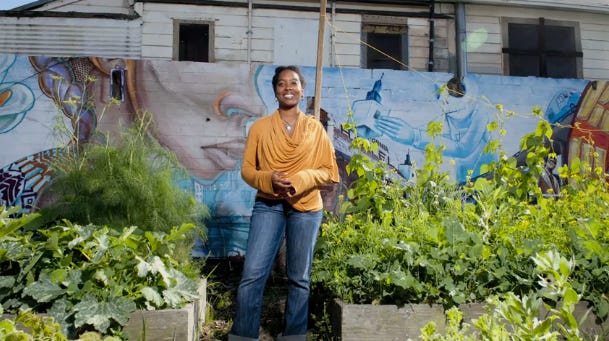
I don’t only serve food system practitioners in my work today, but my heart is with those of us who work in the food sector in a way that is unique. And I wrote this to speak life into all of us—especially now.
What I’m seeing right now among food system practitioners is pain. And I feel it in my own body. There’s grief for decades of slow, intentional work being undone. Not by disinterest, but by abrupt decisions. By funding freezes. By leaders that fail to see the deep care, skill, and vision that food system practitioners have always carried. For those of us attuned to living systems, this pain hits differently. We know how fragile ecosystems are. We know how quickly the work of years—sometimes generations—can be unraveled. And at the same time, we also know that living systems which have been well cared for are more resilient than any other kind.
But that resilience? It doesn’t run on a human timeline. It’s slow. It might take hundreds of years for the fruits of our care to fully reveal themselves. And still—we’re human. We want to know our kids will be okay. We want our elders to live with dignity. We want the soil and the pollinators and the communities we’ve poured ourselves into to thrive in real time—on human timelines.
The field of food systems is humble, rooted, and relational. So to see this work, these livelihoods, these relationships to land and to each other, threatened like this—it’s not just financial. It’s spiritual.
And still, I want to be clear: this isn’t only happening to food system practitioners. So many people across so many movements are in pain right now. Naming my heartbreak here doesn’t take away from anyone else’s struggle. I just know this one most intimately right now. I know the farmers losing access to critical supports. I know the staff at local food orgs trying to keep their teams afloat. I know what it feels like to love the land and to love your people and to not know how you’re going to keep showing up for either.
So how am I being called to show up right now? Honestly, what’s alive in me is a deep call to give.
Over the past few weeks, I’ve been really present with the weight my clients are carrying. So many food system leaders are being asked to hold more with less—less funding, less support, less time. And here’s what I know about my work at Soil and Shadow: so much of it is rooted in presence. In helping people come home to themselves. To experience more joy in their bodies, more peace in their teams, and more alignment in their purpose. To lead with clarity, even in the midst of collapse.
I’ve come to see that so much of this work can be given. Not all of it—transformation takes time and relationship. But the frameworks, the step-by-step processes, the tools? Those can be shared more freely.
And what I’m stepping into now isn’t a new idea—it’s something local, resilient communities have always known: radical generosity in times of struggle is not just beautiful; it’s necessary. It might feel counterintuitive in a society that teaches us to hoard and preserve when we feel we don’t have enough. But what I’ve witnessed—and what food system practitioners have shown me time and again—is that when we are in a moment of deep scarcity, one of the most powerful ways through is to give more. To pour into the vortex of reciprocal generosity. To keep the fire going by feeding each other.
This practice of generosity in crisis is what I see food system practitioners doing right now. They’re showing up. Still offering their time, their tables, their tools. I’ve been inspired by that, and I want to do my part to contribute to it.
So I’m making it a priority this season to package up much of Soil and Shadow’s work—simple, accessible guides about feedback, conflict, management, etc—and offer them to food system practitioners (and others, if you don’t identify as a food system practitioner but you could use this information).
I’d love to hear from you.
What do you need right now?
Do you need leadership practices that support your nervous system?
Is your team in conflict and you don’t have the funds to bring someone in?
Are your managers struggling?
Whatever it is—if I have it, I want to give it.
Drop me a note. Tell me what would feel most supportive.
—
From the very beginning of my work in climate, I was taught that local, resilient communities would be how we survive systemic collapse. And no one has taught me more about local resilience than food system practitioners. These are the people I trust, because they’ve been playing the long game for decades. They know how to move slowly, with care. They know how to keep one foot in modern systems and one foot in soil. They carry the split consciousness we need for this moment—the ability to hold grief and possibility, loss and love, in the same breath.
They remind us that we won’t survive this era because of scale—we’ll survive it because of relationship. Because of our deep, unshakeable ties to land, to each other, to seed, to story. Because we’ve been tending the lambs and the river and the trees long before it was in fashion to do so.
This past year, I’ve felt that even more through my work at Paicines Ranch. I’ve taken people to the river. I’ve stood with them under trees. I’ve watched my children witness lambing season. I’ve been in community with folks from all over the country who are holding fast to wisdom in their bodies—investing in local, resilient communities in ways both ancient and urgent.
And I just want to say this: I believe in us. I believe that being more of who we are—not performing, not contorting—is the path to not only survive this season, but to create the conditions to thrive again, to grieve and scream and cry and laugh and bond through this. We need to let our visceral experience move through us, unfiltered. We need to run it all the way through until it returns us to our beauty, to our strength, to our rooted wisdom.
So when I talk about giving it away, this is what I mean.
I want you to remember who you are. Who WE are.
No posts
Comments
Nothing yet. Say the first thing.
Sign in to join the conversation.