
In 1970, the South Bronx was being dismantled. Highways were being cut through neighborhoods. Buildings were burning — some by accident, many by design. The city had largely stopped showing up for it’s people. Into that abandonment stepped the Young Lords and the Black Panthers, who had decided that if the state would not provide healthcare to their community, the community would provide it for themselves.
They found acupuncture.
The Lincoln Detox Center, operating out of Lincoln Hospital in the South Bronx, became one of the most radical experiments in community healthcare in American history. Acupuncture — specifically the auricular (ear) protocol developed by Dr. Mutulu Shakur — was used to treat heroin addiction in a community that had been flooded with drugs and then abandoned to manage the consequences alone. The treatment was free. It was delivered in a group setting, with patients sitting together in a room, not isolated in individual treatment rooms. It was administered by community members who had been trained to give it. It was, explicitly and intentionally, a tool of collective liberation rather than individual consumption.
From the article:
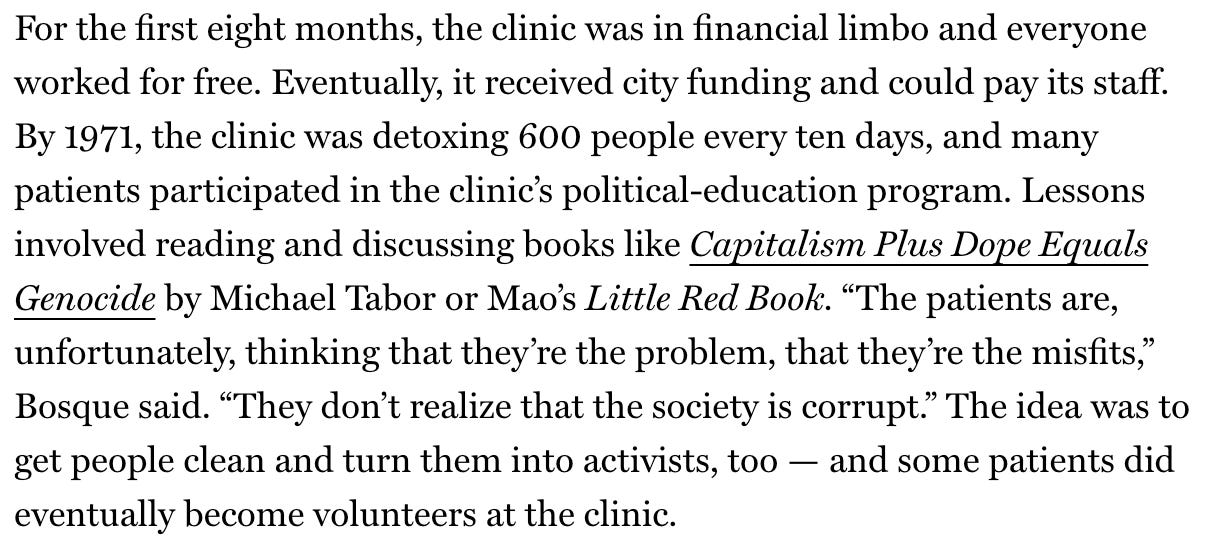
This is how acupuncture came to America. Not through elite wellness clinics. Not through private practices charging $200 a session. Through the South Bronx, through the Young Lords, through a community that took a tool and made it theirs because they had no other option and no intention of waiting.
That history matters right now, for reasons that are not abstract.
The people with connective tissue disorders, mast cell activation syndrome, and dysautonomia who have been building their own knowledge infrastructure — in Facebook groups, in patient forums, in shared spreadsheets, in the comment sections of blogs that no clinician was reading — are doing the same thing. They are not doing it because they are activists, though some of them are. They are doing it because the formal system has not shown up for them, and they cannot afford to wait.
The $850 diagnosis not covered by insurance. The six-month wait for a specialist who may or may not believe them. The practitioner who fires them for being too complicated. The insurance that does not cover the care that actually helps. The research that has not been done because the population is too heterogeneous, too complex, too expensive to study. These are not individual failures of individual providers. They are structural and they are what happens when a healthcare system is designed for the robust, the simple, the well-insured, and the quickly fixable — and a population that is none of those things needs care.
The community response to structural abandonment is always the same: You build it yourself.
You share what you know. You create the infrastructure that the institution refused to create. You become, collectively, the resource that no single provider could be. And then someone comes along later to assimilate it and take the credit. (Look up who brought acupuncture to America, and who came up with the ear acupuncture protocol… and it will take some time to actually find the article about the Young Lords. The attribution goes to Dr. Michael Smith, not the young Black liberationists who actually noticed the gap in treatment, risked their safety to travel to China to study this medicine, and developed the treatment for their community.)
Here, now, what has been built is substantial. The MCAS community’s antihistamine protocols. The dysautonomia community’s salt-and-fluid loading guidance. The EDS community’s pacing frameworks, joint protection strategies, and physical therapy modifications. The shared vocabulary for describing sensory amplification, post-exertional malaise, mast cell triggers, and autonomic flares — vocabulary that did not exist in clinical medicine when these communities started developing it, and that is only now beginning to appear in the research literature.
None of this was given to us. It was extracted, at significant personal cost, from years of careful observation and generous sharing. It was built in the tradition of the Lincoln Detox Center — not as a product, not as intellectual property, but as a commons. Here is what I know. Here is what helped me. Take it.
The research is catching up. The perimenopause community’s discovery of the antihistamine stack. The growing recognition of the POTS-hEDS-MCAS triad in cardiology and rheumatology. The emerging literature on central sensitization and sensory amplification. These are not new phenomena. They are the formal system finally looking at what the community already mapped.
What I am trying to do with Pekoe is sit at the intersection of these two worlds — the formal clinical knowledge and the community knowledge — and take both seriously. The peer-reviewed mechanistic research matters. The 45 years of mast cell acupuncture science matters. And so does what patients have figured out about their own bodies, in the absence of adequate support, through necessity and ingenuity and the particular clarity that comes from having no choice but to pay attention.
The Lincoln Detox model was not just about acupuncture. It was about who gets to be a source of knowledge. It was about the radical proposition that the people closest to a problem — the ones living it, managing it, surviving it — have something essential to contribute to its solution. That proposition was correct in 1970. It is correct now. Sadly, the article goes on to say:
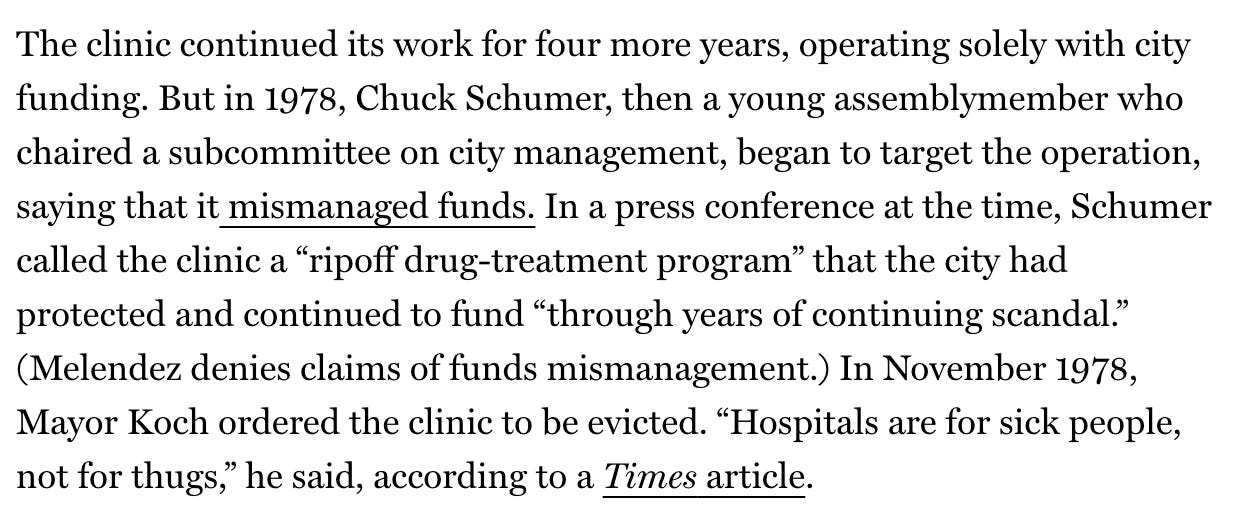
Systems built without marginalized populations in mind often interpret complexity as failure — not of the system, but of the patient. The chronically ill become “difficult.” The addicted become “noncompliant.” The unsupported are asked why they cannot function inside structures that were never designed to hold them.
The community is not a supplement to the clinical evidence. It is part of the evidence. The people who have been called complicated patients are, in many cases, the most sophisticated observers of the relevant biology that we have. The question is whether we are paying attention. The line of questioning goes on — who has done this before?
The history of chronic illness communities may ultimately look less like patient advocacy and more like mutual aid medicine. What patients built in the absence of support may become some of the most important healthcare infrastructure of the next decade.
Part one of an ongoing series.
No posts
Comments
Nothing yet. Say the first thing.
Sign in to join the conversation.