
I want to learn, and teach you Qigong.
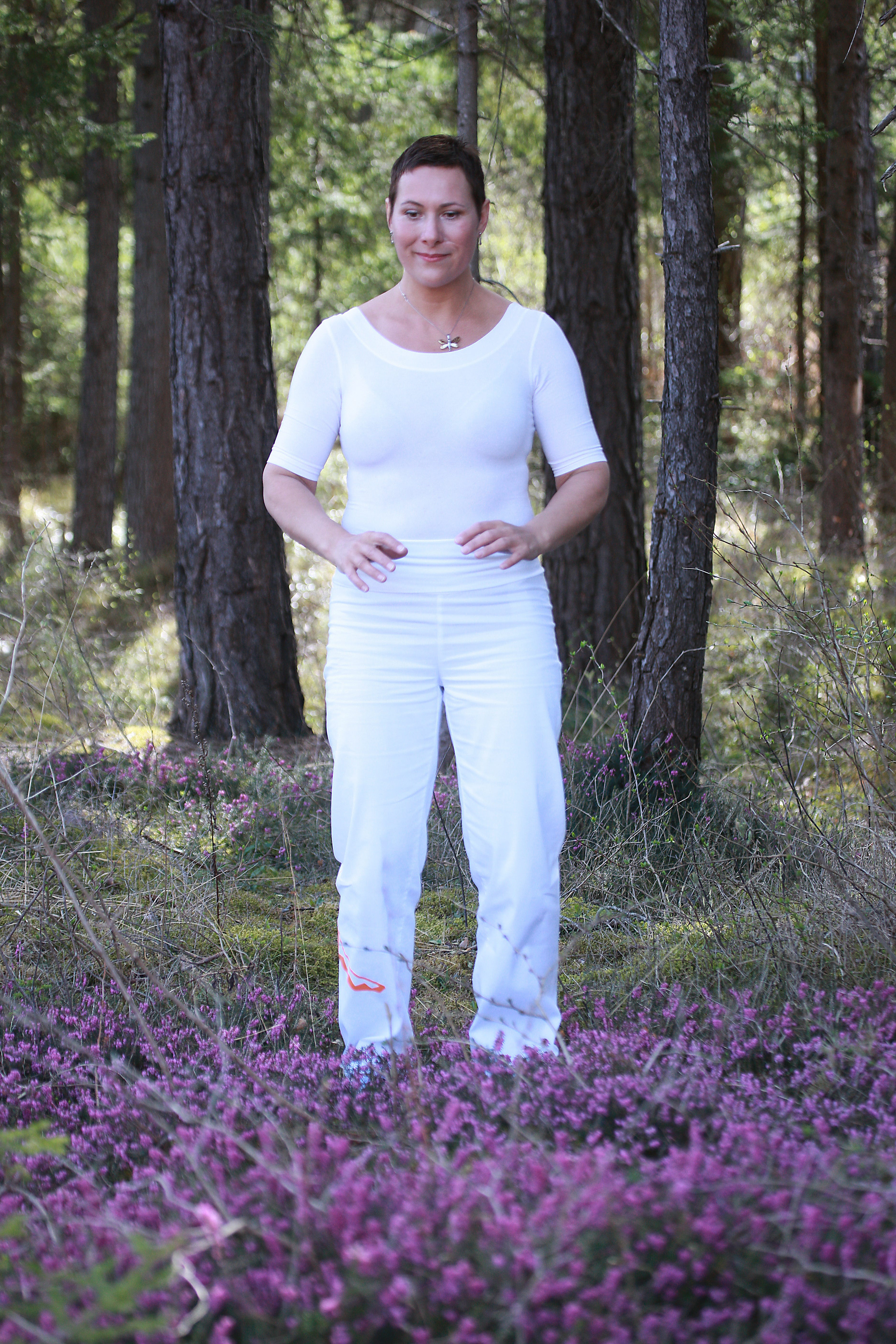
Not the version you’ve seen in a YouTube thumbnail- the one with the serene person in white linen doing slow arm circles in a garden at sunrise. That version is real, and it’s beautiful, and it is also completely inaccessible to most of the people I know and treat, who are doing well if they can get to the kitchen without their heart rate spiking.
I want to teach you the version that works when you are lying down. It works when you have two spoons and one of them is already spoken for. This version works on a crash day, a flare day, and a day when the most ambitious thing you can manage is to breathe with intention for three minutes before you have to stop.
I want to teach you the version that is not exercise, not stretching, and it is not mindfulness in the way that word has been flattened into a wellness product. It is something older and stranger and more precise than any of those things.
It is called Nei Dan: internal alchemy, and it has been describing your nervous system, your connective tissue, and your immune dysregulation for approximately 2,000 years.
What We Are Actually Doing
Nei Dan is the Taoist tradition of refining the body’s three treasures: Jing (constitutional essence- your baseline vitality, the thing that gets depleted in chronic illness and never quite comes back), Qi (vital force- the energy that circulates through the meridians, the thing that gets stuck or scattered or exhausted), and Shen (spirit/consciousness- the quality of your mental and emotional presence, the thing that goes flat when you’ve been sick for a long time).
The practice is progressive. It moves from the most yin (still, restorative, lying down) to the most yang (moving, integrating, standing). The genius of the system, and the reason it is exactly right for people with dysautonomia, MCAS, and connective tissue disorders, is that every level of the progression is complete in itself. You do not have to get to standing to have done something real. Lying down and breathing with intention for three minutes is a full practice. It moves the needle. The needle just gets measured differently than you’re used to.
We are going to work through the Ba Gua which are the Eight Trigrams. Each trigram is a cosmological symbol that encodes an element, an organ system, a quality of Qi, and a specific practice. Together they form a complete map of the body’s energetic architecture. Separately, each one is a precise clinical tool.
I am studying Medical Qigong formally, which means I am learning the mudras- the hand positions at a level of detail that goes beyond what most Qigong teachers cover. The mudras in Medical Qigong are not decorative. They are meridian-endpoint circuits. Your fingers are the terminal points of six of the twelve main meridians. When you hold a specific hand position with intention, you are essentially doing acupressure on yourself from the inside. I will explain each one as we go, in enough detail that you can actually feel what you’re doing rather than just copying a shape.
Why We Start With Water
The Eight Trigrams can be entered from any point, but we are going to start with Kan- Water.
Water is the Kidney element. In Chinese medicine, the Kidneys are the root of all Yin and Yang in the body: the constitutional foundation, the storehouse of Jing. When the Kidneys are depleted, everything else is depleted. The adrenal axis runs through the Kidney system. The fear response lives here. The deep exhaustion that doesn’t resolve with sleep, the kind that people with ME/CFS and Long COVID know intimately is, in Chinese medicine, a Kidney Jing deficiency pattern.
We start with Water because most of the people reading this are depleted. Not tired, but depleted. There is a difference, and Chinese medicine has always known the difference, even when Western medicine was still arguing about whether the exhaustion was real.
Water is also the most yin of the elements. The Kan practice is done lying down. It asks almost nothing of you physically. It is the practice for crash days, for the morning when you don’t know yet what kind of day it’s going to be, for the moment when you need to do something and the something has to be almost nothing.
It is the right place to begin.
What You Will Need
Nothing.
A flat surface. Your body. Three minutes, or more if you have them, or less if that’s all you’ve got.
You do not need a mat or special clothing. You do not need to be able to sit up or have any prior experience with Qigong, meditation, or Chinese medicine. You do not need to believe in Qi for this to work. The vagal activation, the HRV improvement, the mast cell threshold effects are adjusting whether or not you have a framework for them. You just need to be willing to try easy.
A Note on How This Series Works
Each issue will give you one trigram. You will get:
The trigram, the element, the organ, and what it means clinically for your body
The mudra, or the hand position, explained in enough detail to actually feel it
The practice of full instructions, right here on the page, nothing to click away to find
The clinical context and why this practice does what it does, in language that bridges Chinese medicine and the Western mechanisms your doctors understand
One personal note from me: what this practice has meant in my own body
The first two issues (Water and Mountain) are free. Starting with Issue 3, this series is for paid subscribers. If you are a patient of mine, you already have access.
If the paid tier is a barrier, write to me. We will figure it out. I did not build this to be inaccessible to the people who need it most.
Next Issue: Kan: Water
The Kidney Restoration Practice. Lying down. Three minutes minimum. The mudra that seals the Jing. The breath that tells your adrenal axis it is safe to rest. The practice for the day when you have almost nothing left and almost nothing is enough.
We start next week.
Try easy, my friend.
— Nicole
Thank You, Weird Lady is a Substack about Chinese medicine, chronic illness, and the body as a vessel for transformation. Subscribe to get each issue delivered to your inbox.
No posts
Comments
Nothing yet. Say the first thing.
Sign in to join the conversation.