
It has been a few months since I posted my previous update regarding machine learning. In that time, I have learned the fundamentals of neural networks while exploring several interesting machine learning frameworks.
As I experimented with many neural nets on different data sets, I noticed that dealing with matrix multiplication and the dimensions of layers can become very tedious.
One framework that has captured my attention is Keras. Keras is a deep learning API, written in Python that can run on Tensorflow. I like Keras because it’s very easy to use. The framework allows you to go from concept to reality in a more practical way than other complex machine learning frameworks. Additionally, Apple introduced CoreML in WWDC 17 allowing developers to integrate their Keras models into iOS apps. Since I have a background in iOS development, I found this feature appealing.
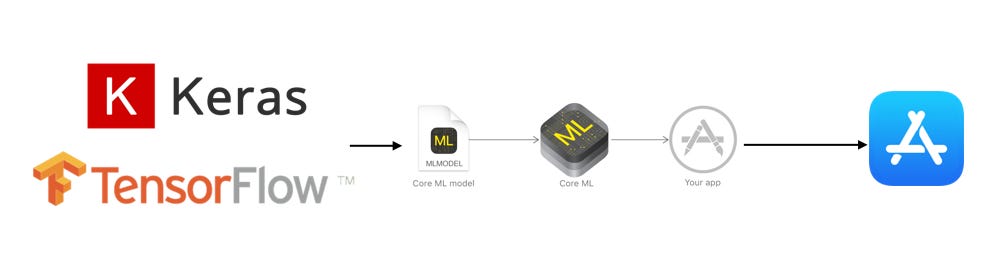
So far, I have been able to parse data from a variety of datasets, train successful models, and even integrate some of my models into iOS apps.
You can see all my recent work at my Github repo: https://github.com/nikhiljay/ml-projects.
Using Keras, I have been working on the following projects:
Boston Housing — Predict the values of houses in Boston based on: per capita crime rate by town, proportion of residential land zoned for lots over 25,000 sq. ft., proportion of non-retail business acres per town, nitric oxides concentration (parts per 10 million), average number of rooms per dwelling, weighted distances to five Boston employment centers, index of accessibility to radial highways, and pupil-teacher ratio by town. Data from CMU Statistics Department (http://lib.stat.cmu.edu/datasets/boston).
EEG Eye State — Predict whether your eyes are open/closed based on your brainwaves. Data from UCI ML Repo: EEG Eye State Data Set (https://archive.ics.uci.edu/ml/datasets/EEG+Eye+State).
Predicting E. Coli Protein Localization Sites — Predict the localization site of a protein based on accession number for the SWISS-PROT database, McGeoch’s and von Heijne’s method for signal sequence recognition, von Heijne’s Signal Peptidase II consensus sequence score, presence of charge on N-terminus of predicted lipoproteins, score of discriminant analysis of the amino acid content of outer membrane and periplasmic proteins, score of the ALOM membrane spanning region prediction program, and score of ALOM program after excluding putative cleavable signal regions from the sequence. Data from UCI ML Repo: Ecoli Data Set (http://archive.ics.uci.edu/ml/datasets/Ecoli).
Cardiovascular Disease — Predict whether a subject has cardiovascular disease based on age, sex, chest pain type (4 values), resting blood pressure, serum cholesterol in mg/dl, fasting blood sugar > 120 mg/dl, resting electrocardiographic results (values 0,1,2), maximum heart rate achieved, exercise induced angina, old-peak = ST depression induced by exercise relative to rest, the slope of the peak exercise ST segment, and number of major vessels (0–3) colored by fluoroscopy. Data from UCI ML Repo: Statlog (Heart) Data Set (http://archive.ics.uci.edu/ml/datasets/statlog+(heart))
Iris Flower Classification — Classify the specific species of an Iris flower based on sepal length, sepal width, petal length, and petal width. Data from https://en.wikipedia.org/wiki/Irisflowerdataset .
Parkinson’s Disease — Predict whether subject has Parkinson’s disease based on biomedical voice measurements. Data from UCI ML Repo: Parkinson’s Data Set (https://archive.ics.uci.edu/ml/datasets/parkinsons)
White Blood Cells — Classify different types of white blood cells based on images taken from a microscope.
ML Update: Keras and CoreML was originally published in Nikhil's Blog on Medium, where people are continuing the conversation by highlighting and responding to this story.
No posts
Comments
Nothing yet. Say the first thing.
Sign in to join the conversation.