
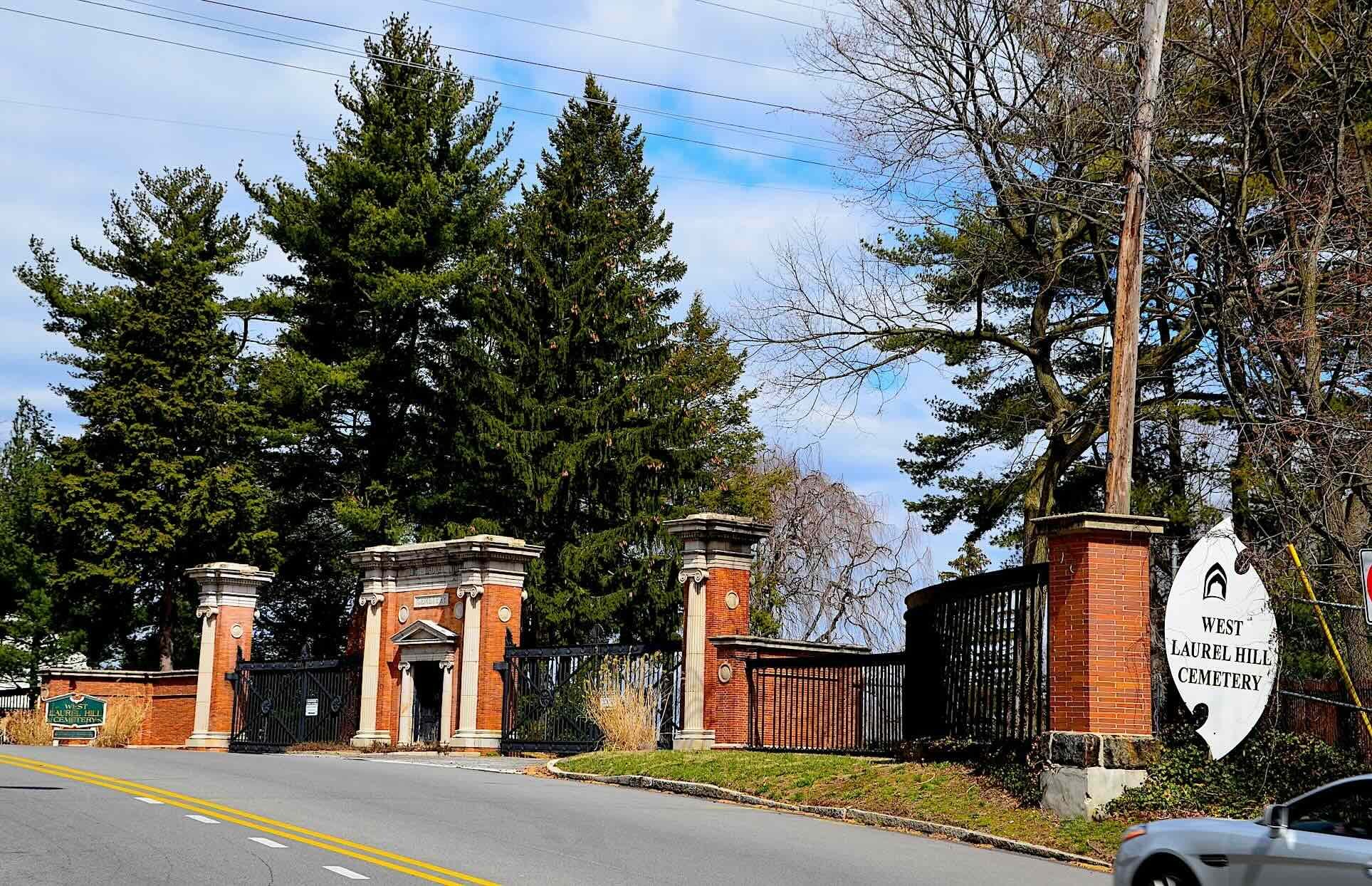
On my right is a tall, sturdy fence made of iron bars. Behind it, the hilly cemetery grounds stretch out like a massive park. Across the street, I can see many trees, large mansions and impressive residences; the front yards are very well-kept. It’s clearly a wealthy neighborhood, one in which some of the city’s prominent and wealthy families live.
An American probably wouldn’t subject himself to the weather and walk a mile along the street; They’d naturally drive in an air-conditioned car, which is why this street doesn’t even have a sidewalk. The cars passing me give me a wide berth. I can practically hear some drivers saying to their passengers, “That fella must be European...”
But I’m enjoying the short walk – it lets me take in the surroundings and gather my thoughts. What am I actually doing here? I came here to visit a grave. It’s not a relative. The man buried there has been dead for more than a hundred years—but he’s important to me. For a while, until a few years algo, I thought this man was something like evil incarnate – or at the very least, a thoughtless, perhaps ruthless person who left us with a great deal of suffering. He’s the one to blame, I believed, for turning working people into objects, into soulless human capital exploited for the sake of maximizing profit. Admittedly, I thought this man was something like the spiritual father of exploitation-as-an-ideology. Today I strongly doubt that my assessment was correct.
A stately gate awaits me at the entrance. I walk through it and check in at the cemetery office. This cemetery is clearly run like a business. The staff are professionally friendly, as is so often the case in the U.S. I’m given a folder containing information about the cemetery, including a map of the grounds and an illustrated brochure. According to the brochure, eight selected famous figures are buried here alongside many other well-to-do residents of the city. I briefly flip through the brochure; the name I’m looking for is there. The cemetery was established in 1910; the funeral I’m here for today took place just five years later. The receptionist asks me if I’m looking for a specific grave, and I tell her. “Ah, Freddy,” she says. Yes, Freddy, I reply, even though I hadn’t expected any reaction like that. So that’s what happens after death when you are famous, I think. Everybody calls you by some nickname. In the meanwhile, the receptionist is drawing a cross on the map and marking the shortest route to “Freddy’s” grave for me. The map now looks a bit like a treasure map. I set off on my treasure hunt.
There aren’t a lot of people here. The cemetery is home to a number of magnificent mausoleums and family graves, all beautifully landscaped and well-maintained. On the mausoleums and headstones, I notice a great deal of German-sounding names – a reminder that many families of German descent have lived and prospered here in Pennsylvania.
In Manhattan, where I lived for a couple of years, you’re constantly and directly confronted with remnants of the industrial age. There’s no escaping it. The early skyscrapers, the Rockefeller Center, the famous bridges, the Empire State Building – a decent part of 20th-century history was written here. When you live in Manhattan, you can sense and feel the spirit of industrial history everywhere. Which is one of the reasons why I rented an apartment in mid-town Manhattan, at the time: I wanted to immerse myself in that period—the second half of the 19th century and the first half of the 20th—to understand what changed back then. Because only by understanding the past could I grasp where we stand today, I reasoned.
Philly, at least to me, is the perfect place to get immersed in the earlier period of the the American Revolution and the Revolutionary War. It served as the central meeting place for the nation’s Founding Fathers in hosting the First Continental Congress (1774) and the Second Continental Congress, during which the Founders formed the Continental Army, elected George Washington as its commander, and adopted the Declaration of Independence on July 4, 1776. And then, during the Summer of 1778, the crafting of the Constitution of the United States. I visited all the related places during my first visit to Philadelphia, of course.
But Philly also occupies that special place in the history of management.
The man buried here, in this cemetery, and to whom I am now making a pilgrimage, was the one who had brought into the world this age-defining, core idea of management—namely, that organizations shall separate and indeed isolate the thinkers from the doers. On one hand, that idea was revolutionary and foundational to the professionalization of businesses and a worldwide rise in productivity, while at the same time creating inroads for the scientification of the field of management. But it also produced a slew of rather unintended consequences. Separating the thinking from the doing has led to increased dehumanization of workplaces. It intoxicated relationships between managers and workers. It led to estrangement of generations of employees from their corporate employers. And it would bring about a gazillion of nasty work practices and management tools – think performance appraisals, incentive systems and mechanistic cost management. For years, I thought that brutalization of workplaces had been that man’s idea, all along. Except that it wasn’t.
I walk across beautifully landscaped mounds along the winding path that my treasure map points me toward. The cemetery is enormous. I have to walk across almost the entire thing. Again and again, I come to forks in the path and intersections where I have to figure out which way to go. I see cemetery staff tending to patches of lawn, flower beds, and shrubs. Once, I ask a gardener for directions. He knows exactly where I need to be going and points me toward a side path.
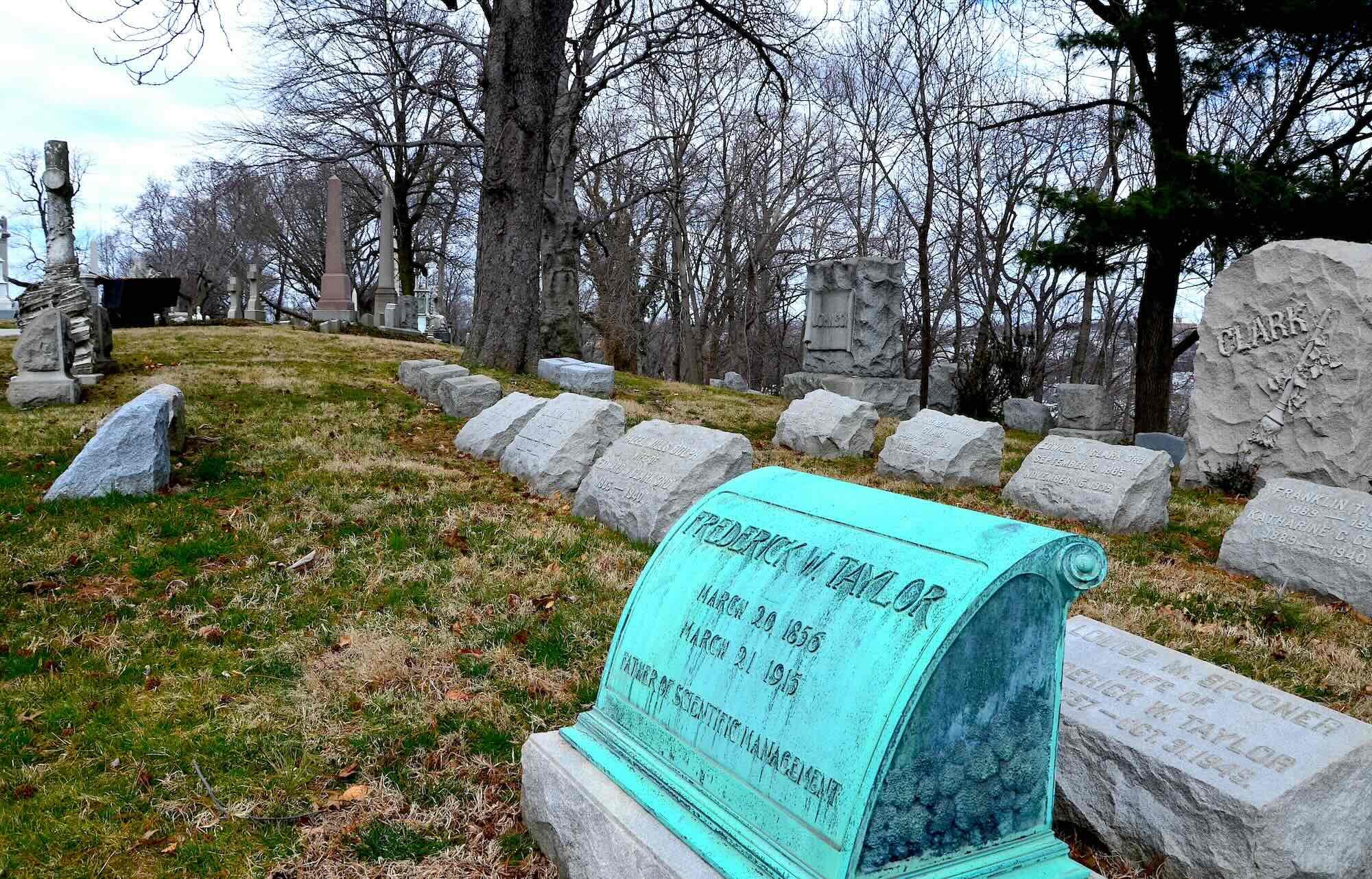
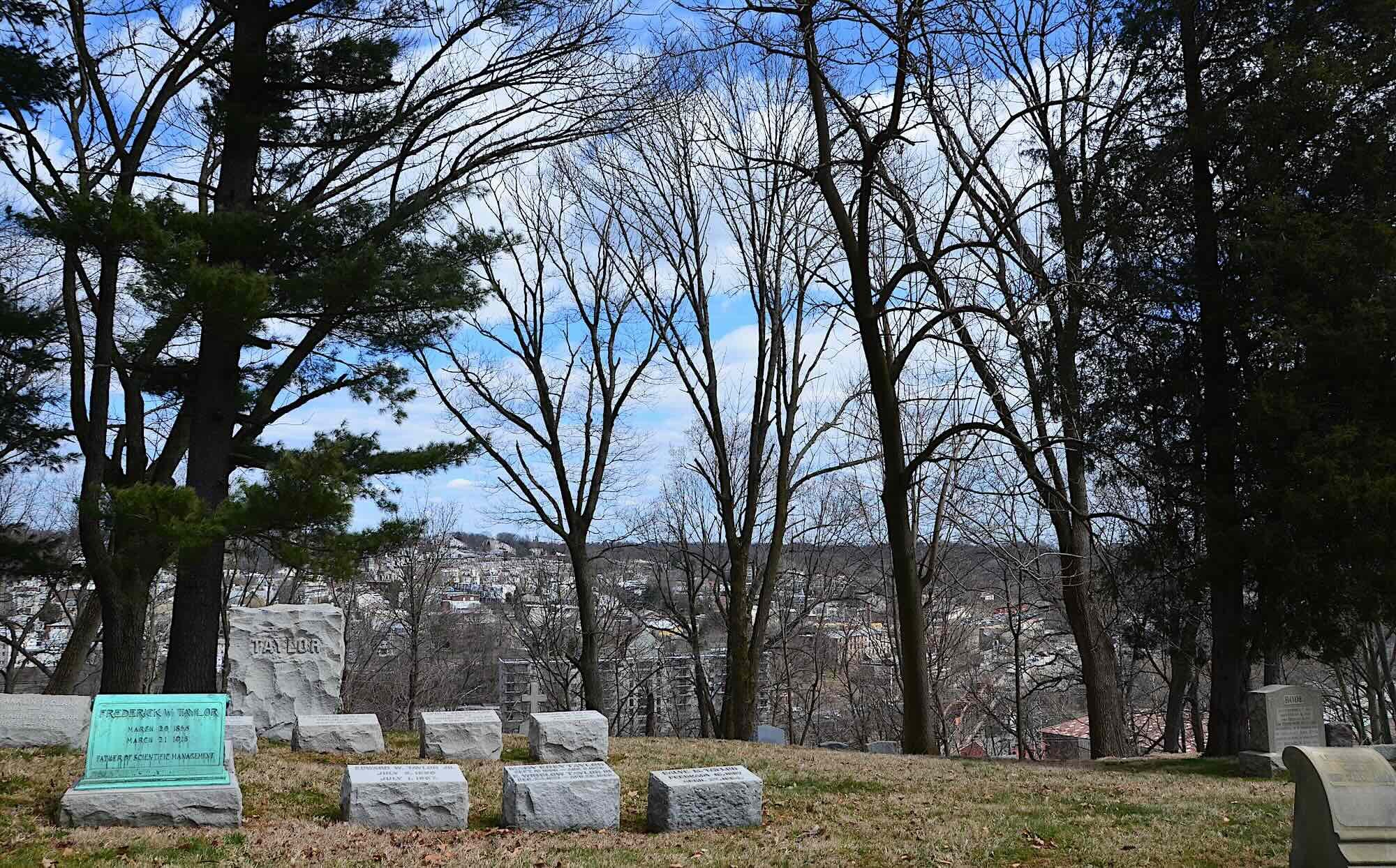
At the very end of the cemetery, high above the Schuylkill River (which means “hidden river”, in Dutch) I finally see the grave I was looking for. It’s surprisingly small. Mounted on a flat, hewn stone is a sort of small box made of brass or bronze, slightly larger than a shoebox. The metal has turned green with patina, but the inscription on it is clearly legible. No large headstone, no mausoleum. He actually came from a wealthy family and was quite rich himself—mainly due to income from his patents in the field of steel processing—but his grave is very modest. I tap on the metal box; it’s hollow. The inscription reads: “Father of Scientific Management”—I kneel before the grave of Frederick Winslow Taylor, to examine it more closely.
The sun comes out, but its rays don’t provide much warmth yet on this day in spring. Through the bare branches and twigs of the bushes in front of the cemetery fence, I can look down to the river. There’s an industrial building there, and next to it an old bridge spanning the river—a steel structure with arches and struts, typical of the late 19th century. Perhaps the metal for the bridge was produced using one of Taylor’s patents.
At that moment, I feel transported a hundred, or a hundred and twenty years into the past. I can sense the atmosphere of the Industrial Age. At the time, there are still relatively few cars on the roads, but in the cities, people have gotten used to hopping onto streetcars. Above all, it is still the era of the railroad, which has connected the cities of Northern America, bringing people closer together, connecting industrial centers, as well producers with consumers. On the oceans, huge steel steamships have replaced the windjammers and are bringing hundreds of thousands of emaciated people from Italy, Germany, or Ireland to America. The copper Statue of Liberty is being erected on Liberty Island in New York Harbor, welcoming the hopeful Europeans to the New World. The smell of smoke from coal-fired furnaces hangs in the air, along with the screech of steel on steel and the hiss of steam engines.
It is a time of new beginnings, of rediscovery—a time when much is founded and created, a time when much is achieved, when new prosperity is built, and a time when society is undergoing all kinds of physical and mental revolutions. A quantum leap in human history. It is during this time that the corporation is invented. Previously, all large enterprises had been family businesses. The legal foundations of the corporation as an independent legal entity are laid between the 1840s and the 1890s. Taylor idealizes how to operate these corporations. The origins of a key idea that would shape corporate identity and organizational life can be traced back to this cemetery.
It dawns on me that Taylor was not the gravedigger of corporate life, but rather its pioneer. He was among the first to seriously grapple with the concept of corporate life. The corporation as a legal construct had become necessary to finance the enormous capital requirements of emerging industrial enterprises with debt. But this new form of business—this new world of the corporation—also had consequences for its organization and for the way work is done in the world. Taylor was perhaps the first to thoroughly consider these consequences for the work itself – and he did so systematically, with principles in mind: Taylor was adamant about his belief that a better way of organization should benefit everyone: Owners, managers, employees and societies.
Taylor is not just “the father of Scientific Management”. In calling him so we would underestimate his role – more than a hundred years after his death, in 1915. Rather, Taylor is the founder of management itself – or at least of what would become the most important school of management (the other school was founded by Taylor’s contemporary, Mary Parker Follett, at around the same time). What Taylor pioneered was well-thought-out division of labor within the company. In this way, he is the architect of the “modern” organization of work as most of us still conceive it today. At the cemetery in Philadelphia, it’s dawning on me that someone who, in his time, was confronted with the potentialities of his era, it was conceptual shift and also a bold move to propose abandoning the organizational principle of the master craftsman at the hard of the workplace, and to envision corporations as being built around the nascent caste of professional managers. Pioneering such a novel organizational principle at the height of the industrial age was bold, and it made sense in its time.
Taylor spoke of his approach to organizing as a workplace revolution – a hint at both his self-confidence and shrewdness as a marketer. History would prove him right in this prediction: His organizational concepts would turn revolutionary indeed – even though only after Taylor’s death, in 1915. Taylorism came to full fruition at Ford in the 1920s, during WWII and, then, more broadly, during the Cold War.
It would be unfair to hold Taylor responsible for the many consequences, abuses, and excesses that occurred after his death and were caused by his followers. We should view Taylor the man in the context of his own time – not ours. Just as it would be wrong to nitpick Sigmund Freud and look down on him simply because his methods of interpretation of dreams or most of his treatment methods seem a tad ridiculous from today’s perspective. In Freud’s case, most people would grasp that the pioneers of psychoanalysis would be forced to experiment (and err) more than that pioneer’s students and later followers. We tend to overlook the contemporary errors attributable to the state of the times and still honor the genius. With Taylor, we are not necessarily as forgiving today. More than 110 years after Taylor’s passing, we tend to still not give him credit for what he actually accomplished.
In the 21st century, management the social technology, as Taylor envisioned it, is no longer in step with the times. Imagine Taylor being transported to the present day, as he approached his craft as a consulting engineer in the 1890s and 1900s, and the writings in his books Shop management (1903) and The principles of Scientific management (1911). he would appear to us as a rather ridiculous figure. There he stands with his stopwatch and clipboard, his lists and measurement charts, meticulously noting the minutes and seconds for every work step. From today’s perspective, he would seem prehistoric, and the claim of Scientific Management (adopted at a meeting in 1908 in which Taylor himself wasn’t present) would have an ironic ring to it, given the methods he used back then. But here in the cemetery, I sense that judging him from such a perspective would not do justice to the man and his work.
At a time when the world was being reinvented, it took a great deal of entrepreneurial spirit, pragmatically pioneering thinking, and decisive action to do what Taylor did: to propose a thorough systematization of management as an organizational craft. Taylor was in tune with the times. Solutions were needed: Someone had to figure out how to manage those new, quickly expanding corporations, and how to make industrial work—indeed, work as a whole—more effective and productive. Taylor provided brilliant idea to do just that.
I take a few steps back and pull the book I brought with me out of my backpack—a biography of Taylor: The One Best Way by Robert Kanigel. The book is almost 30 years old now. I reread the book’s conclusion: In the first months of 1915, Taylor is traveling extensively, restless as always. He catches a cold; then his cough grows worse; he develops a fever, followed by pneumonia. Taylor dies at the age of 59.
In the final months of his life, Taylor gives numerous lectures. Although he receives many honors, he also frequently has to defend himself against what he sees as misinterpretations of his work, and against outright hostility. His far-reaching practical proposals are almost always implemented only piecemeal in companies - a problem we know of today, too. Hardly anywhere is the entire Taylor System ever fully realized during Taylor’s lifetime. Worse still: the core philosophical idea of elevating well-being and societies is almost always forgotten and gets lost in the discussion when those “brave new methods” of process management are applied. Taylor has to reaffirm his intention time and again, often to no avail: That his goal was to bring managers and workers into harmony, to reconcile them with one another, to resolve the conflict between the classes, and to increase the prosperity of all through dramatically higher work efficiency.
I can no longer hold it against him that his choice of means and methods did not live up to his own standards. They probably couldn’t have been any better at the time. I suddenly feel a much stronger connection to him.
At the time when I published my first books, in 2003, entitled Beyond Budgeting, Better Budgeting, I spoke out vehemently against the concepts of budgeting and planned economies in organizations. The book became a huge success in the German-speaking countries. What followed here was an outcry in the controller community. The German Controllers’ Association felt attacked and fired back. A working group were formed for the sole purpose of proving that planning wasn’t bad, and to formulate arguments in favor of budgeting – all to defend finance managers against the supposed attack. My arguments were repeatedly misunderstood, or interpreted one-sidedly from the perspective of the status quo; in some cases, my arguments against planning were branded as unscientific, even though they were exactly the opposite. Taylor must have experienced similar things back then. Which begs the question: When someone writes and presents something new – introduces a new idea into the world—isn’t it very, very easy to accuse the promoters of the new thing of being unscientific? If it happened to Einstein, why shouldn’t it happen in management circles?
As a consultant in the 2000s, I pushed for the abolition of budgeting, the "planned economy” within all major companies, the plethora of command and control rituals, and against obsolete, inhumane and ineffective management-style thinking. There were companies that implemented the concepts of Beyond Budgeting (and later the BetaCodex) with flying colors and great success; but most dug in their heels at the crucial point: whenever it came to managers having to relinquish steering and centralization. I faced fierce opposition in my consulting work, too. I was kicked out of consulting projects at least twice – the behavior of individual clients was at times intense and blatantly irrational. Things occasionally got heated during workshops and assignments. Over time, I learned how quickly deep rifts could open up, spawned by group dynamics that usually had little to do with our work, or how I was suddenly cast as “the problem” – even though I had been brought in to help the client solve a business problem. Behaviors could occasionally get pretty personal and sometimes, if rarely, turn rude or harsh – things that happened to Taylor too, back then, according to Kanigel’s biography.
That man truly needed courage and stamina. And so did the other pioneers like Mary Parker Follett, like Taylor’s associates and those who came after him, like Lilian and Frank Gilbreth, Henry Gantt and others. Today, I see the heroic in them. Even in Taylor himself...
By honoring the heroes of the history of work —the pioneers of corporate life — that I begin to understand the process of development that we are currently undergoing. I suddenly realize that we are in the midst of a dynamic path of change that is not yet completed. That the way we organize work today is not an endpoint, the result of history, something right or something wrong, but that we are at an intermediate stage in the history of organizing – thus dealing with something unfinished, imperfect, and constantly changing.
In a way, we are still standing on the threshold of humanity’s arrival in the company. Only now does this become clear to me. Only now do I see the bigger picture: That what has happened since Taylor rose to fame more than a century ago, we have prepared for what will happen next. I recognize that the heritage of human nature and its relationship with the corporation is merely a starting-point, and I can clearly see where this journey is headed in the future. I can suddenly distinguish with crystal clarity between the heroes of the historical part of this process – the pioneers who have moved us forward step by step – and the poor imitators, the show-offs and mere dandies of management.
If we want to understand work and life in a company today must engage with our pioneers – and do so with respect. We should do so without condemning early mistakes, and without arrogantly judging the infinite detours and wrong turns that were taken.
I want to get to the root – the root of the idea of the corporation and the ideas of humans who have worked for them. That is why I have come here to this grave at Laurel Hill Cemetery in Philadelphia. For Frederick Winslow Taylor was one of the trailblazer of this idea; he represents the first generation of actors in this story. And I have come to offer an apology: Yes, I was wrong. Taylor was certainly not evil incarnate. I had probably succumbed to the desire for finding a scapegoat – to find someone whom I could identify as the source of evil in the working world. I had overlooked the context and done an injustice to someone I can now look at as a pioneer, a maverick, and something of a revolutionary. Today I regret that early misjudgment.
Today, I feel a certain sense of obligation toward Frederick Winslow Taylor. For he was among the first to passionately champion the idea of improving everybody’s life in the corporation, and, by doing so, within our societies. And that is precisely my guiding principle as well. Just like him, I sometimes tend toward great zeal when it comes to a good cause. And like him, I don’t let the resistance and misunderstandings I might provoke deter me.
As I close Taylor’s biography, turn my back on his grave, and head back home, the low-hanging sun shines directly into my face. I feel a little more enlightened. I’ve learned something. I paid the man a visit.
This essay is not AI-generated. Instead, it is based on the notes from a trip to Philadelphia I undertook in March 2013, as part of my research into “Heroes of Leadership”. No AI was used in the process of writing this article.
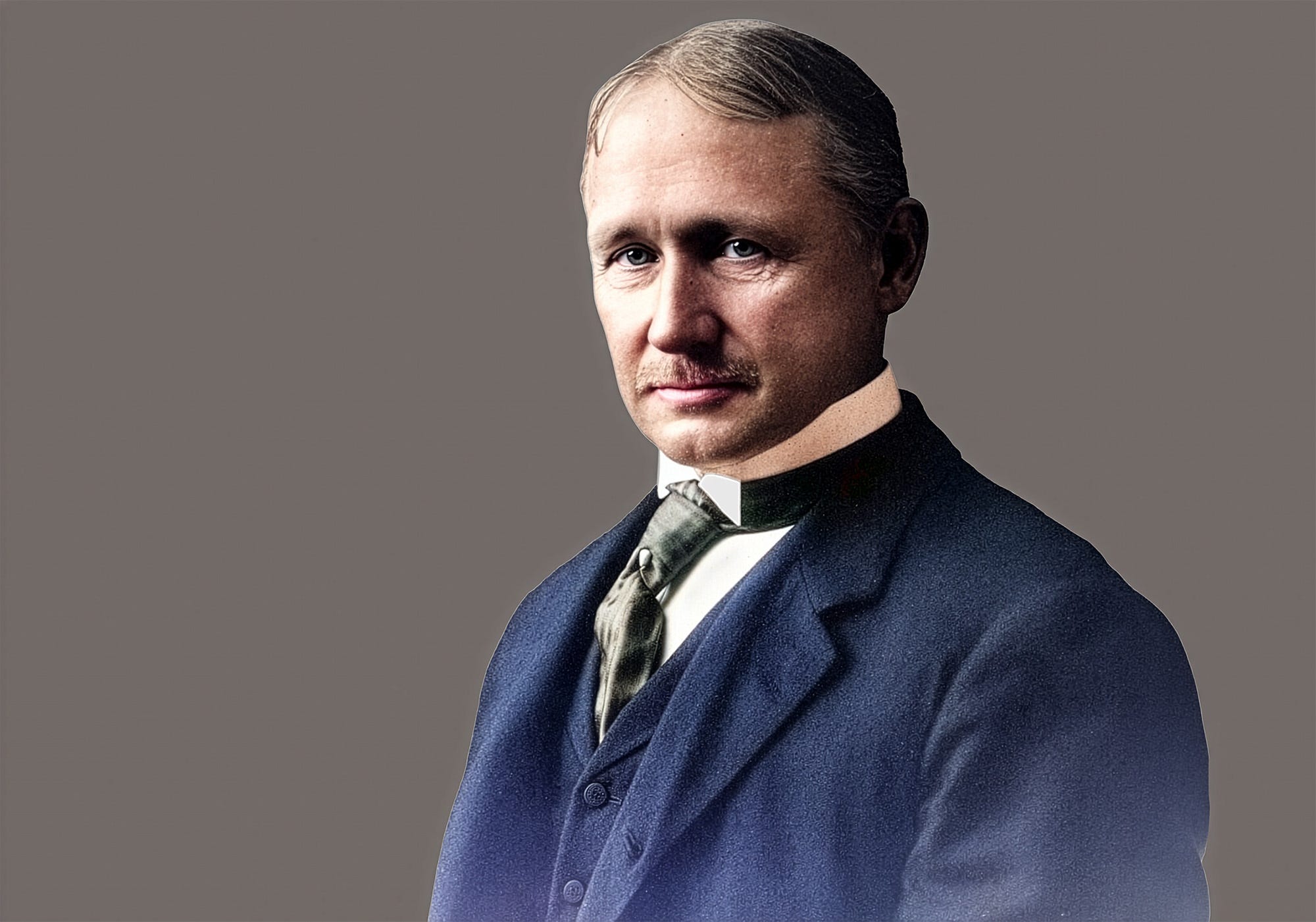
Header photo editing: Niels Pflaeging. The photo of Frederick W. Taylor was improved, colored and slightly expanded from the original portrait. Original photos from Laurel Hill Cemetery in Philadelphia: Niels Pflaeging
No posts
Comments
Nothing yet. Say the first thing.
Sign in to join the conversation.