
Both overtime and White Space are well-known phenomena. If you have worked in some kind of organization, you will likely have experienced the White Space I am talking about. Consider “company vacations”: a site or office is closed, or at least some part of the staff “goes on mandatory holiday”, in times when demand is extremely low. In Western societies, this might be the case between Christmas and New Year, for instance.
Less commonly discussed is a more granular form of White Space: When the daily portion, or the “day’s deed” is done, e.g. the work is concluded earlier than usual. Or when just nothing is going on during a particular day. While I was still a finance manager, I had a CFO who once demanded me and my team to work overtime when there was pressure, but refused to let us go when we had little to do. “That would set a bad example for those other departments”, he would tell me. Upon experiencing such principled dreadfulness, I polished my CV and set sails for a better employer, and better boss.
Sometimes it is our inner, hypocritical boss that won’t let us handle White Space in the smartest possible way. We will return to this “benevolent kind of White Space” in a moment.
Within work processes, another, more destructive kind of White Space manifests in several ways:
Waiting time: a completed item sits in a queue before the next process step picks it up
Handoff gaps: information lost or distorted as work passes between people, teams, or systems
Unowned work: activities that belong to no clear role, leading to them being done poorly, late, or not at all
Approval and review delays: work stalled awaiting sign-off that adds time but not value.
Batching and scheduling gaps: work accumulating until a meeting, a shift, or a batch run occurs
The obvious, yet somewhat counter-intuitive solutions to this kind of wasteful White Space are:
to start late and finish early,
to eliminate approvals that aren’t compliance-related (externally related),
to integrate functions into self-steering teams,
to increase multi-specialization, instead of mono-specialization.
Process management, process mapping and value stream mapping aim at eliminating or reducing this White-Space-within-processes. But the don’t change quite change our way of dealing with work and effectiveness: They merely optimize. While such approaches may produce inspiring analysis, they usually lead to little action, and only incremental improvement.
Methods like Process Management, Process Mapping or Value Stream Mapping don’t start with understanding and action, but with analysis.
They are likely get you stuck in imagination.
The opposite approach to improving processes and value creation will mean that you start by asking: How long should it take to make the total lead time excellent and fast, from a client perspective? This, at the same time. allows to shape the work into smooth, even flow, and relieve the day-to-day business from steering, scheduling and rushing. You should end up with unified speed among steps of the work, thus eliminating stop-and-go in processes. Then you design a new, and much better organization starting from that. This way, time-oriented, instead of capacity-oriented organizing, can become a reality within days or weeks.
Now let’s return to that other kind of White Space we were talking about at the beginning.
In Time orientation, we need White Space to appear in people’s work time. Not within the processes (where it causes delays), but at the end of the work day. The view of White Space from the domain of process domain isn’t wrong, but it is limited. White Space is not just something we should drive out of processes. It is also a precious resource when it appears at the end of the day’s work. Let’s take a deeper look at why that matters.
When White Space appears at the end of a work day, you have several options. You can dedicate the time that’s left to reflection and learning. You can do improvement and project work. Or you can finalize your work day and go home.
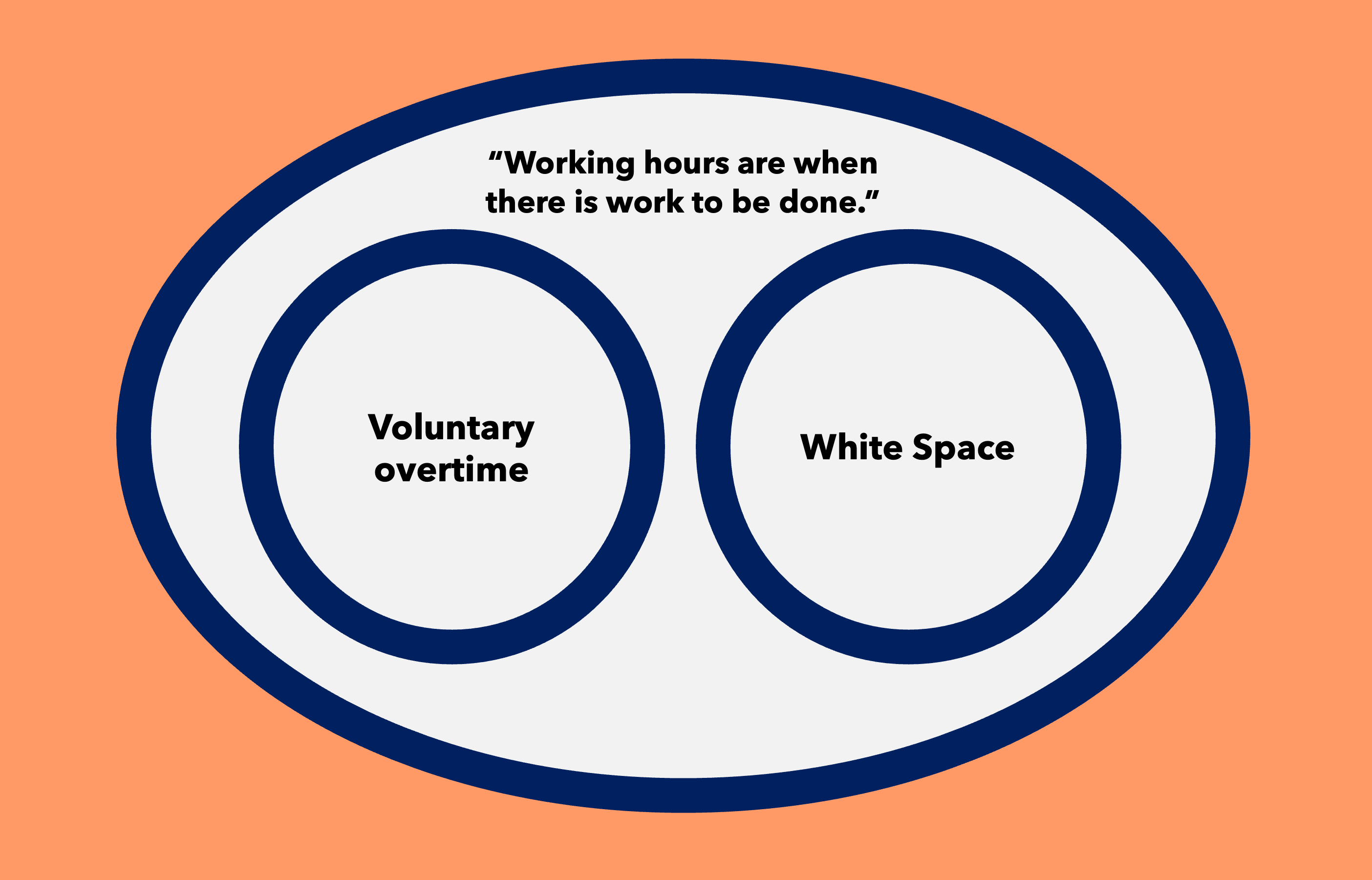
This kind of White Space means that you shouldn’t pick up some other activity that’s part of the daily business (“Let’s start this other thing earlier!”), but that you leave it be. Only in this way, White Space can truly be considered the opposite of voluntary overtime. There is a matter of ethics involved in this: Without making the White Space that appears at the end of the day clearly visible, how will you justify voluntary overtime? Also, more practically: How will you become aware of growing mastery, of better flow and improved process, or of benefits derived from making good use of AI?
An organization that doesn’t know or respect this kind of White Space is neither Lean nor Agile, in any proper sense. It remains capacity-oriented, inward-oriented and foolishly optimizing utilization.
Which brings us to the topic of flexibility, which is (sadly) often equalled to agility.
Ernst Weichselbaum says: “Work time is when there is work to do. This is the opposite of flexible.” Preaching flexibility is bad, as it imposes a morality of oppression upon people. For this reason, time-oriented organization doesn’t seek to promote flexibility. It seeks discipline, e.g. in that it assumes that occasional voluntary overtime should naturally be compensated by occasional White Space.
A time-oriented system cannot be rooted in forecasting, planning, scheduling, coordination and hectic. It cannot be preaching constant re-prioritization, or what is often referred to as “being flexible.” Instead, a time-oriented system seeks rigor, in that it promotes being principled action and punctuality. This goes hand-in-hand with respecting mastery, flow and self-efficacy. Ernst Weichselbaum puts it succinctly: “Where exceptions reign, no robust system can ever emerge.” and “A system is what remains after exceptions have been excluded.”
Flexibility is a dirty word. Don’t be flexible!
Instead, be rigorously punctual, rigorously rhythmic, rigorously self-organized.
W. Edwards Deming calls exceptions “tampering” and argues: “Sure we want best efforts, but best efforts must be guided by theory and knowledge. Those who only give us best efforts – let them stay at home, in bed, and sleep late. We would all be better off. They only tamper and make things worse. When these approaches [quick fixes] are used without the benefit of profound knowledge, they are counter-productive.”
Part of the discipline of a time-oriented system is to let people experience White Space, at the end of the day. Don’t drive such White Space out of the organization. Cherish it.
Ernst Weichselbaum suggests to elevate swinging capacity to an organizational capacity: “Working hours are when there is work to be done. And when there is work to be done depends on customer orders: if there are a lot of orders, you have to work until you are finished. If there is no more work to be done, it is better to go home, otherwise the costs become too high. This is logical and simple, but at the time it was completely unusual.”
This runs counter to faddish concepts around work time like the “4-day work week”, which does not take customer demand into account, but imposes ideas of supposed employee life-style choices upon organizations and organizing – and rather paternalistic notions, as research has shown. Letting capacity swing puts flow according to customer demand first, which is key to effectiveness and value creation.
Ernst Weichselbaum explains this combination of time orientation and swinging capacity like this: “The throughput time is fixed. Teams acquire additional free capacity on the market as needed. On the other hand: If you have free capacity, you can do whatever you want with it.”

Now available in print and E-Book versions: The book of quotes by Ernst Weichselbaum - the world’s foremost thinker of time orientation and “the Austrian Deming”. Edited by Niels Pflaeging | Red42, published by BetaCodex Press. Available internationally from your preferred online retailers. Red42 offers volume discounts starting at 10 copies. International shipping available!
No posts
Comments
Nothing yet. Say the first thing.
Sign in to join the conversation.