

I often feel a deep connection to fashion films, even though my relationship with the fashion industry can be complicated. I anticipated writing about The Devil Wears Prada 2 (TDWP2), but turns out, it didn’t give me much to chew on. Andy’s a sucker, Lucy Liu’s character is the least evil billionaire, that love interest was weird, and I will not fall for this “luxury” property development propaganda.1 Huge missed opportunity for Lady Gaga to have performed my favorite unreleased song of hers, The Fame era’s “Fashion”, during the runway show.2 I felt deflated leaving the theater, annoyed for being naive enough to think this movie held any greater meaning beyond Millennial nostalgia bait – for the original TDWP *and* for a career path in magazines that no longer exists.
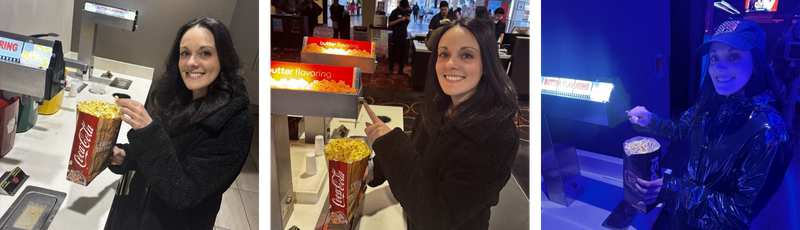
What’s represented as “fashion” in movies like TDWP2 is the media industry, not the fashion industry. (Like magazines, movies are also media lol.) I really loved Marc by Sofia, but films like this that show the creative or business side of retail generally serve as documentary rather than entertainment.3 Like in I Love Boosters, the media props up particular figures to advance its narrative. As a result, public-facing people like Miranda Priestly (and her real-life counterpart) are granted outsized importance, consolidated power, and higher social standing in the fashion space than the people who actually design, produce, or sell a design house’s goods.4
Aside from keeping up appearances (literally and figuratively), success in fashion is based on meeting specific sectorial requirements: In media, clout reigns supreme. In retail, sales are your lifeblood. In corporate, “playing the game” of office politics to gain power and resources is critical. Fashion writers have bylines, public-facing proof of expertise and knowledge, which tends to inflate their self-importance. Retail workers are treated as second-class citizens, often used and abused by both their company and customers. Corporate workers are unseen, unheard, replaceable cogs in usually dysfunctional machines. (I was shocked and upset to realize that no one really thinks about corporate people at all – insert Mad Men meme here.)
After TDWP2, I longed for a better fashion movie!!!! I wish there was critical yet absurdist art that represented the modern-day stranglehold between late-stage capitalism and labor exploitation, guised as creative vision, expression, or presentation. Perhaps without drab lighting! Well, I got what I wished for with I Love Boosters. While there are definitely Boosters characters and plot lines that could have been more developed, my mind was absolutely buzzing afterward. This is not a movie review though – I’m going to relate Boosters’ general themes to my own fashion industry experience.5 (And I’m not even getting into half of them!)
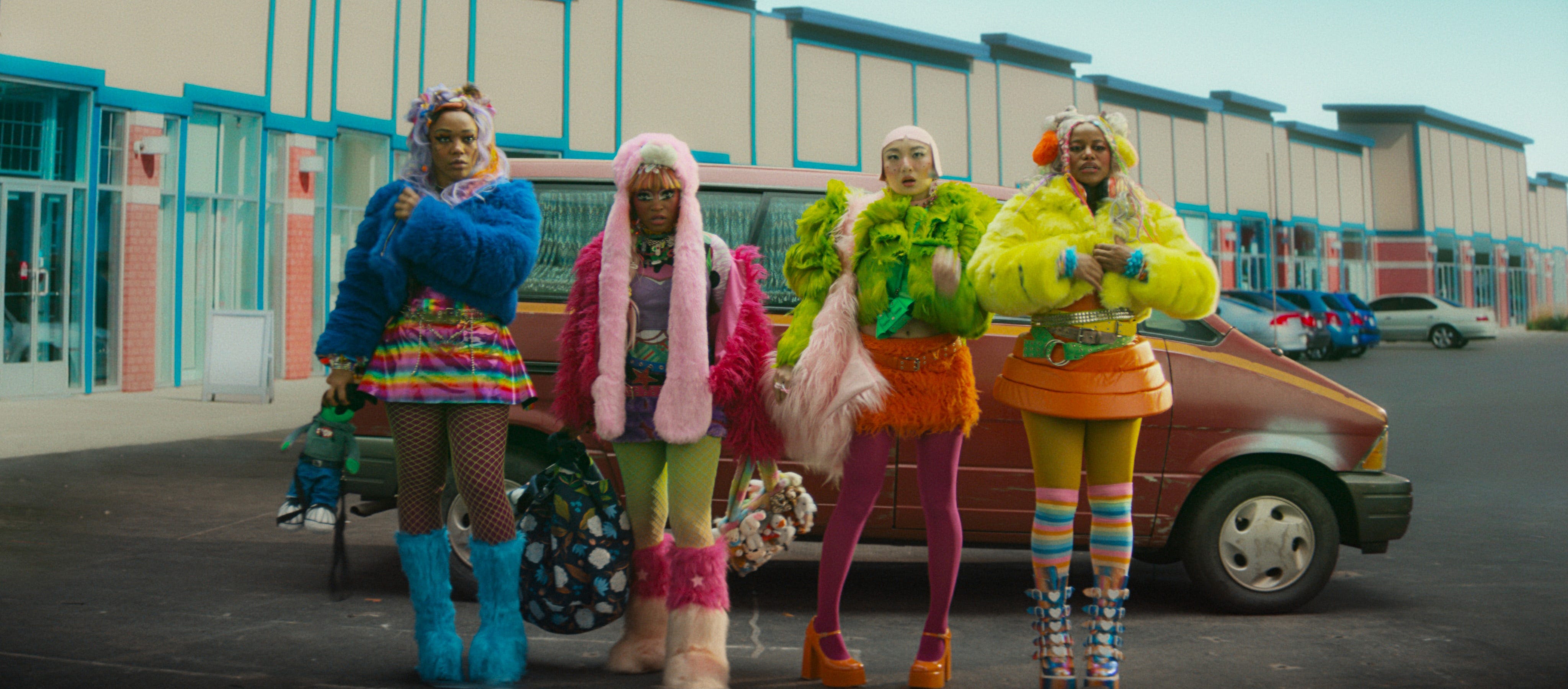
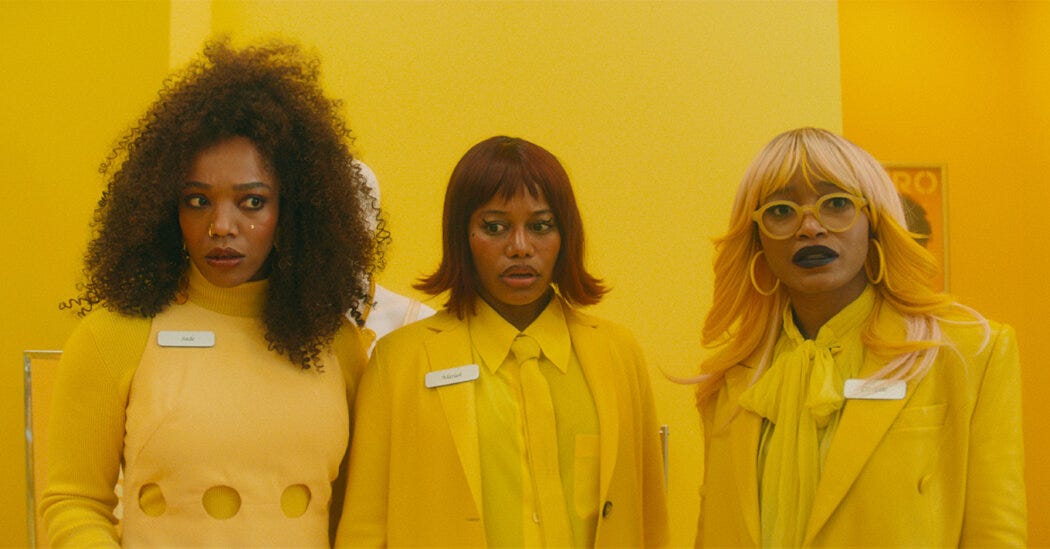
I Love Boosters is a wildly colorful, outlandish, surrealist heist movie set in the Bay Area about Corvette, an aspiring fashion designer (Keke Palmer), and friends Sade (Naomi Ackie) and Mariah (Taylour Paige). Together, they are the Velvet Gang, “boosters” who resell the shoplifted clothing at a discount, for profit.6
The Gang’s motivations for boosting are different: Sade provides for her family, Mariah gives back to the community by providing access to items her buyers would otherwise be unable to afford, aka. “Fashion Forward Filanthropy” (she knows how to spell philanthropy…branding though!), and Corvette needs both recognition and retribution from her idol, Metro Designer CEO Christie Smith (Demi Moore). Christie Smith acknowledged the Velvet Gang on TV and social media, fueling Corvette’s desire to be seen. The Gang ends up working at a Metro Designer store and meeting unexpected allies in their elaborate, zany quest to take Christie down.
I personally thought this biting satire of fashion industry excess with a strong anti-capitalist overtone made for a highly interesting movie premise. I very much relate to Corvette’s disappointment in the system after accepting the false promise of meritocracy. She was talented enough to create a jumpsuit worthy of Christie Smith’s envy. But instead, Corvette’s design was stolen by this powerful icon who positions herself as a godlike creature of unparalleled creative vision. Corvette is still desperate to feel accepted by the woman who wronged her, even if she simultaneously harbors resentment and seeks revenge upon her.
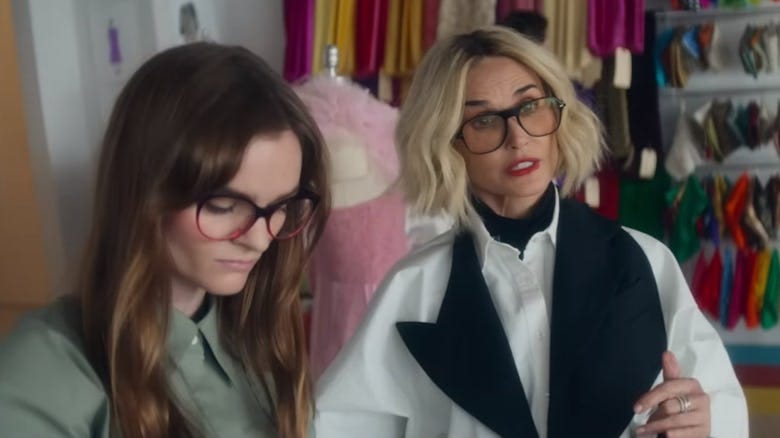
Christie Smith is an erratic boss to a meek assistant in a comically lopsided office that leans to the side at a dangerous angle.7 She’s a self-proclaimed “innovator making fucking art” who bends reality to her will and has the financial leverage to silence or extinguish anyone who obstructs her path to domination. I will say, Demi Moore looks great in that blonde wig.
To me, the slanted floor represented the uphill battle that is working for a corporation. I felt consistent friction in my mission to challenge the status quo and incredibly bored doing more busywork than purpose-driven problem-solving. I thought my job in Operations was to buck norms and conventions, but it was actually to reinforce them. Because I am an eternal optimist, there is still a light in me that believes it’s possible. I can forge a path, make an impact, make a difference, move the needle, drive results, and create amazing things – even if capitalism is the larger structure we’re ultimately serving.
Speaking only as someone who worked at a company where the CEO was described on GlassDoor as “a tyrannical toddler” (sorry, this will never not be funny), the character of Christie was true-to-form. What would’ve been more realistic is if she asked the assistant to go far beyond the scope of her job, verbally attacked her, and then cycled through three or four more assistants throughout the movie. Some people kind of scoff at the Harry Potter manuscript scene in the original The Devil Wears Prada movie, but I don’t think it’s quite as uncanny as people think.
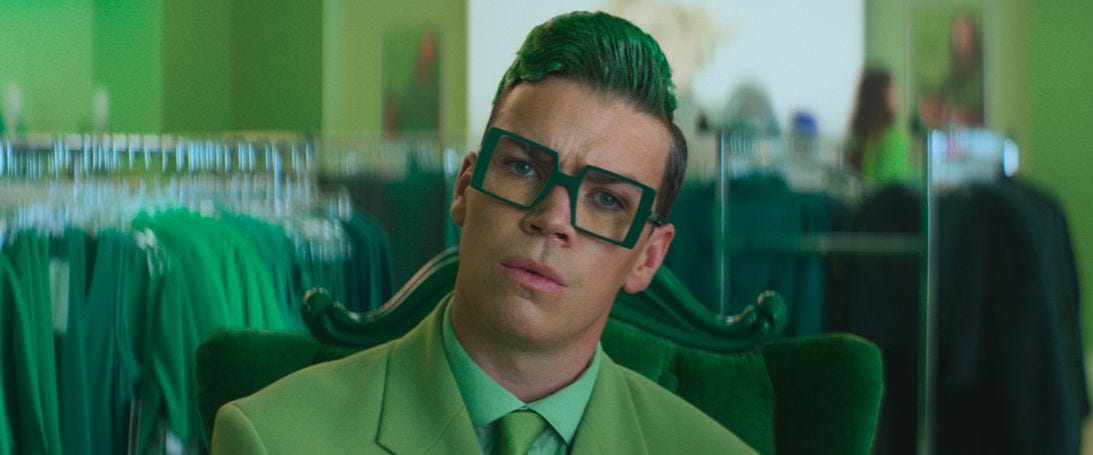
One Metro Designer Store Manager (Will Poulter) maintains a toxic in-store working environment, where employee breaks are 30 seconds long. I sympathize with this character because I see a lot of my younger self in him – eager to please, inexplicably devoted to the cause no matter how underpaid or unappreciated he is, and willing to comply with any company-mandated rules, no matter how unfair, unnecessary, or arbitrary. Like if this was 2013 and you asked me to get a tattoo – no, a cattle brand – of the store I worked at, I would’ve done it in a heartbeat.
Metro Designer Sales Associate Violeta (Eiza González) organizes employees to champion fair labor practices after costs of mandated clothing were deducted from their paychecks. I deeply relate to this, as I distinctly remember when policy shifted to require us (in-store retail workers) to pay taxes on the “free” wardrobe that we were required to wear during shifts. A uniform was considered “taxable fringe”, aka. non-cash compensation. It’s ironic when your job is to wear clothes – to convince customers to buy them – but you can’t actually afford them either.
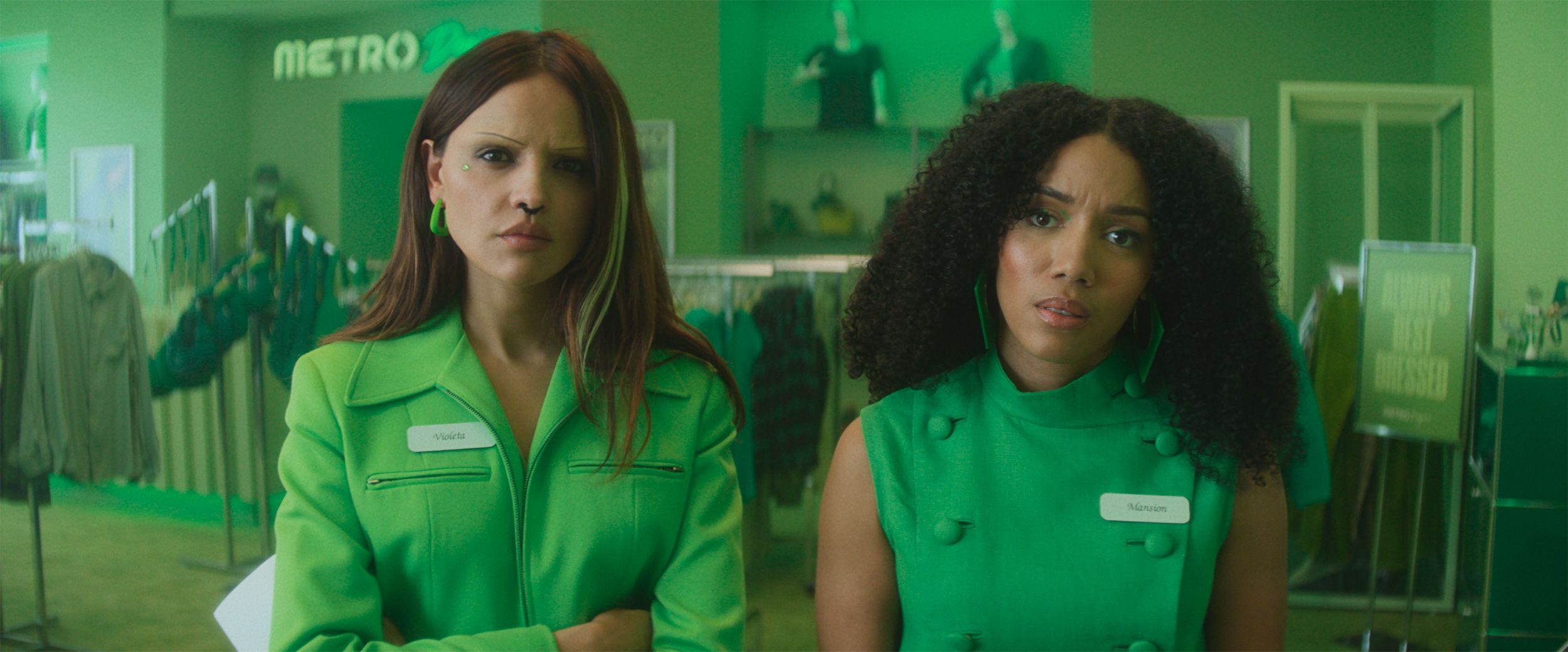
Violeta is my favorite character – someone who seemed vapid on the surface but was smart, educated, and brave enough to create solidarity, take action, and stand up for what’s right. I tried to be somewhat civically engaged during my last corporate job as a part of the Sustainability Committee. A former colleague of mine went on to have a career in sustainable, circular fashion, and I always admired her genuine goal to materially improve the design, manufacturing, and supply chain process. I didn’t feel like there was much I could do personally, when the committee was largely perfunctory, but she always inspired me.
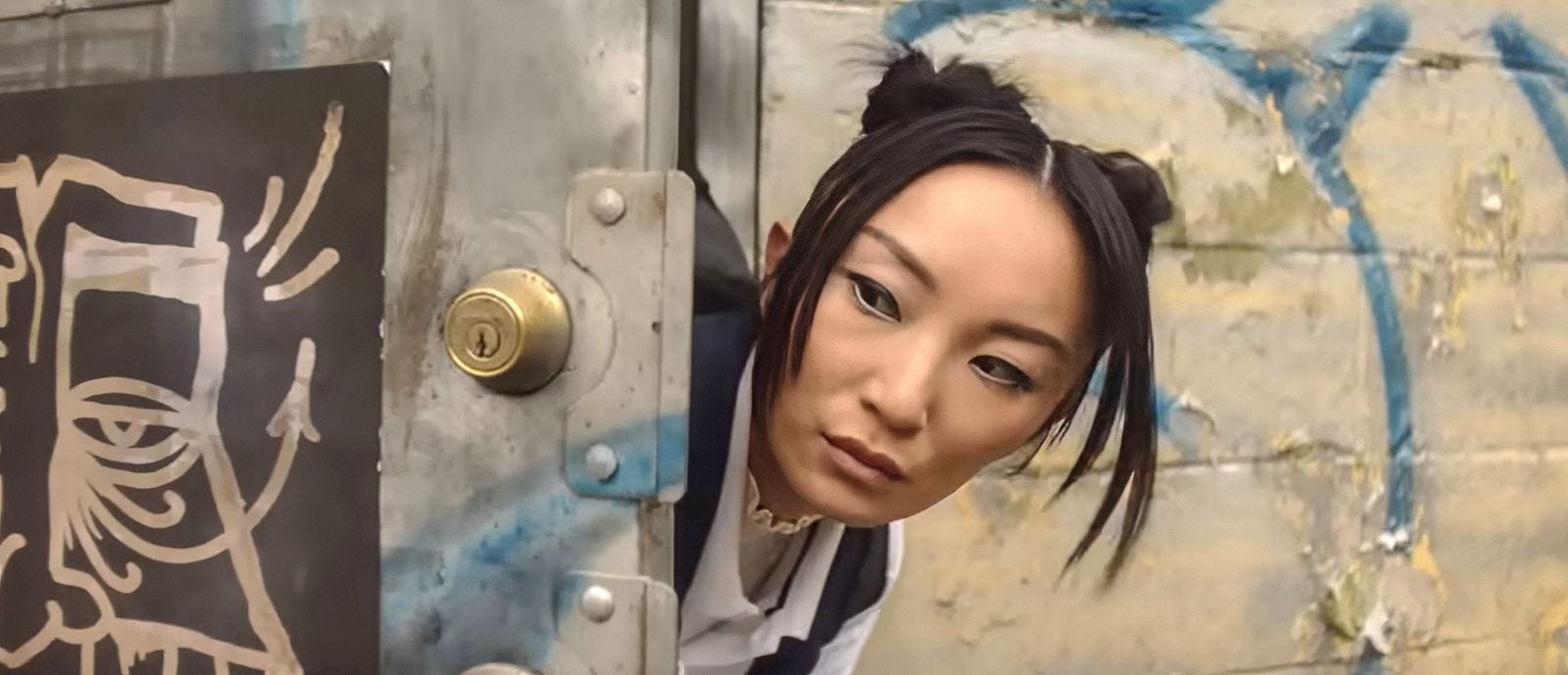
Before the Velvet Gang can make a clean sweep of the store, they are beat at their own game. Jianhu (Poppy Liu), an exploited worker from Metro Designer’s Chinese factory, uses a teleportation device to extract clothes from the racks at lightning speed. The clothes arrive on the other side, held hostage by the workers until Christie addresses the factory’s fatally unsafe conditions. The device, which has “teleportation”, “situational accelerator”, and “deconstruction” modes, is the main character of the second and third acts of the movie.
Labor exploitation, particularly of the Global South, continues to be an issue. Although it is so much more nuanced than the movie could get into, I appreciated the political angle here. (So did activist/actress Poppy Liu.) The fashion industry produces billions of tons of waste every year, consumers throw away massive amounts of clothing, and less than 1% of clothing is recycled. Supply is based on demand! It’s time people wake up about fast fashion and do their best to taper the out-of-control consumption and waste cycle. Supply chain transparency is one of my niche interests, and I highly recommend the book No Logo by Naomi Klein and Buy Now: The Shopping Conspiracy on Netflix.
In Metro Designer stores, the Velvet Gang employed the “distraction method”. I remember watching one Loss Prevention training video ten years ago that showed ELEVEN organized crime members distract employees around the store. This type of theft isn’t as popular nowadays with the advancement of surveillance technology, but it used to be very effective. While this shoplifting technique may seem far-fetched now, the judgment historically marginalized groups face in retail settings is very real.
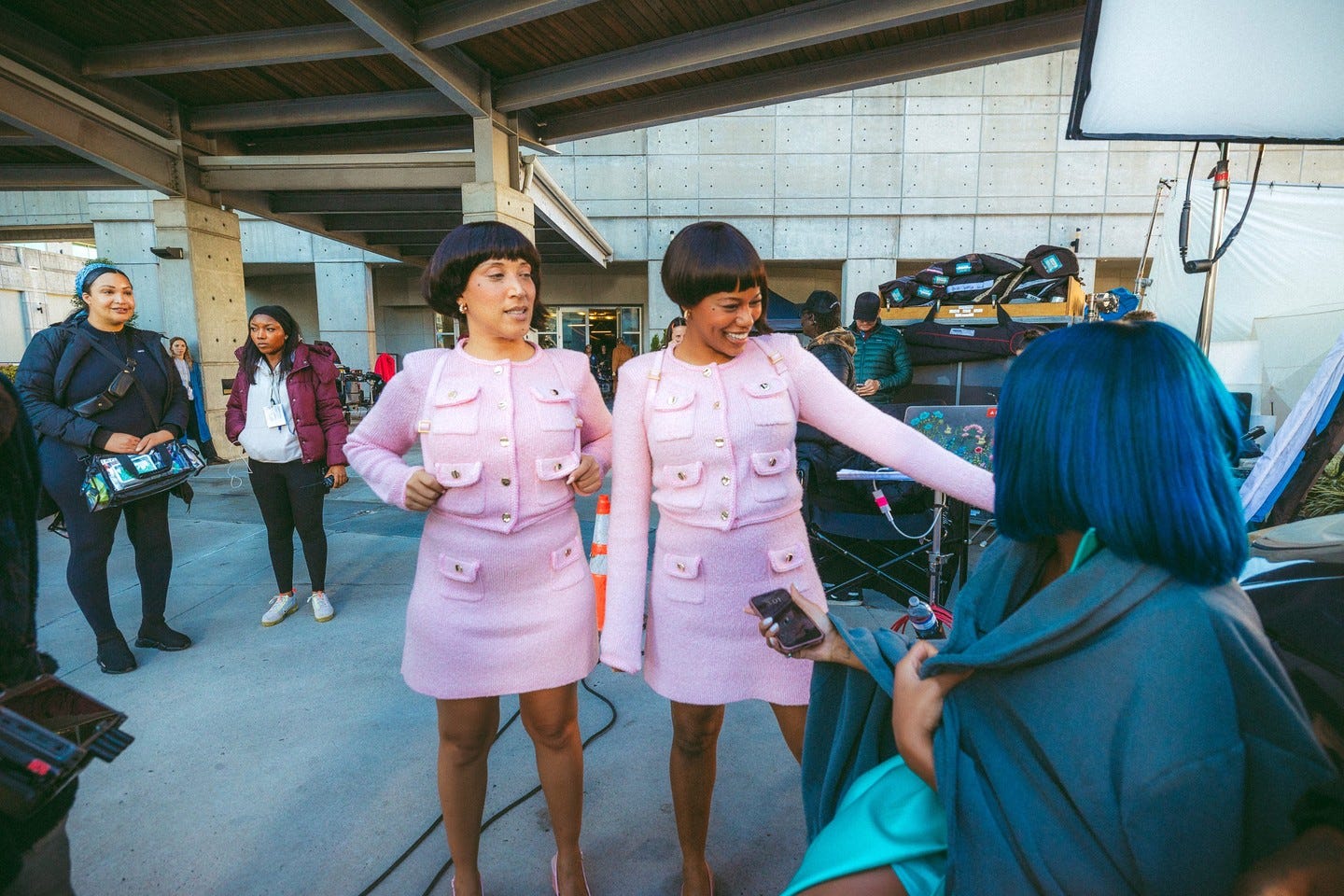
In one Boosters scenario, the Velvet Gang brought along a white girl – a “worthy” victim – who would feign distress to take attention away from the shoplifters. In another, Mariah holds her breath for such an extended period of time that she becomes “White Mariah”. Her caucasian appearance attracts the sales associates, as she now looks more sophisticated and likely to buy than Mariah with Black skin.
I worked in a particularly discriminatory time in retail, where only certain kind of girls (read: skinny, pretty, white) could represent brands, from high-end contemporary luxury brands to teen retailers like Abercrombie. Then, demographic profiling of customers was the norm. It might still be, to be honest. The best sales associates could reduce any random person who walked through the door into a demographic, which could be mentally converted into a statistic – based on pre-existing notions and stereotypes – predicting how likely they were to buy something, or how much attention they would demand. Principles of luxury, as defined by the largest and most powerful luxury conglomerate in the world, include (but are not limited to): quality, scarcity, controlled distribution, and price. That means only certain people with money and status are granted access.8
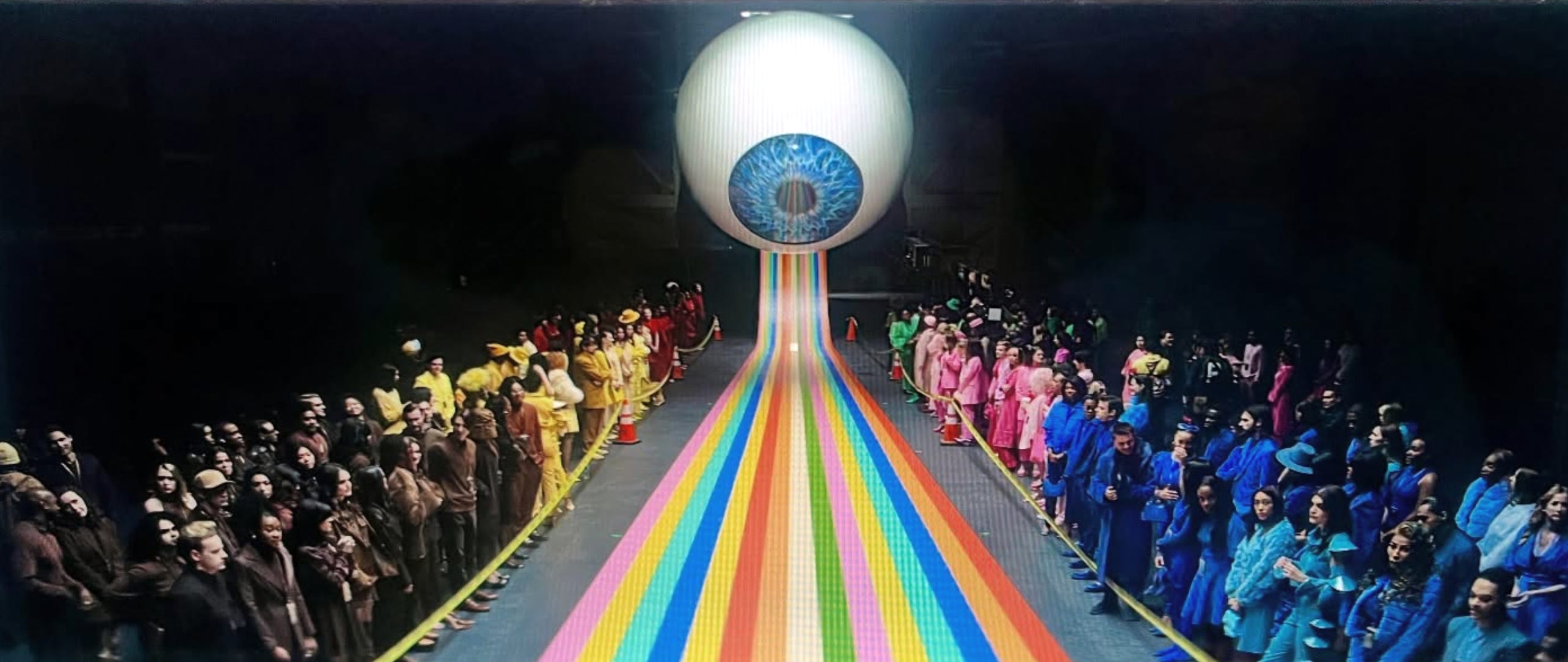
At the Metro Designer fashion show, where the climax of the movie takes place, there is a rainbow-colored runway radiating out of a gigantic eyeball. The eye to me represents surveillance capitalism and the longtime use of CCTV recording, AI-powered retail analytics platforms, and retail demographics tracking technology. Yes, you are being recorded when you’re shopping, your movements around the store can be digitally monitored, and depending on the technology, your demographic data can be tracked without you even buying anything.
I’ve worked many colorful New York Fashion Week shows as a model babysitter, giving very skinny girls rations of almonds, sips of water from a straw, and an occasional bite-sized chocolate as a treat. I never knew why this was necessary, seeing as the models were fully capable of doing their one job. After four hours, *I* was the one who needed the snack!!!! The operations department was required to always be on-call and available for 30 retail stores across the country, so being tied up all day meant you would get no work done. I always just went along with the fashion show hullabaloo because I was told to (and because the Visual Merchandising department always made fantastic sets), until my colleague said at her first show, “I’m not doing this, I have actual work to finish.” Wow okay mic drop. I rode her coattails all the way back to the office.
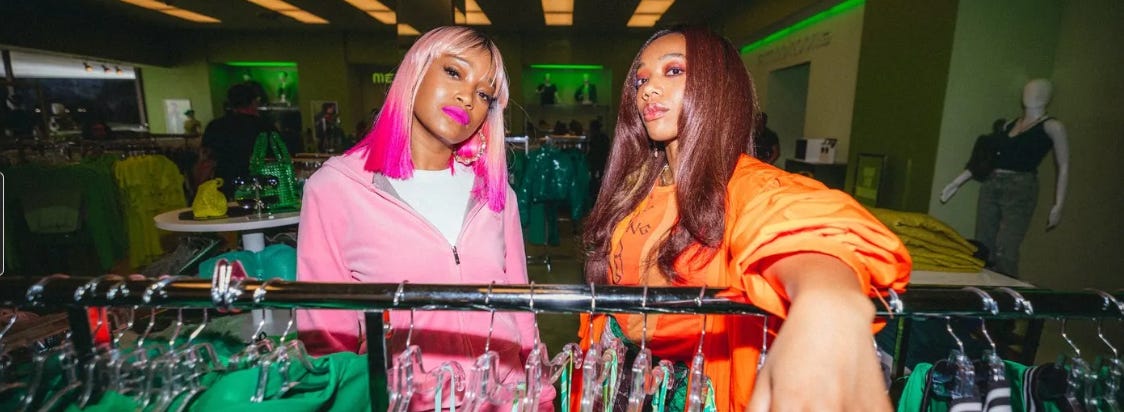
Organized Retail Crime (ORC) is a large-scale, coordinated theft and resale operation versus than petty shoplifting by sole individuals. It is a $69 BILLION dollar black market industry. While stealing is obviously illegal, and I’m not promoting shoplifting or violence of any kind, the “illegal economy” is expected and accounted for in profit and loss statements. While Christie Smith complains about the boosters affecting her bottom line, she is more concerned about protecting her standing as an artist “using humanity as a canvas”. If she cannot control her inventory – the physical manifestation of her creative vision – she cannot control her narrative.
There are three kinds of retail loss:
External theft: Customers stealing product or robbing the store
Internal theft: Employees stealing product or embezzling money
Operational error: Incorrectly filed paperwork, inaccurate inventory counts, erroneous accounting, petty cash, or other discrepancies unaccounted for
While it degrades the luxury tenets mentioned above, illegal resales and counterfeit products keep brand signatures (e.g. a Gucci or Louis Vuitton logo) relevant. It’s like a mass-appeal litmus test: If a high-end brand’s fake pocketbooks are on Canal Street, their brand is considered covetable, even if primarily to aspirational customers. The brand’s challenge, in addition to their margins and their brand reputation, becomes satiating their customer who does have the buying power and would rather be caught dead than wearing the same handbag as some low class plebian. Or as Christie Smith refers to them, “low class urban bitches, with all due respect to urban bitches.”
In that same Loss Prevention presentation, I remember hearing a jarring statistic:
15% of people will always steal (e.g. The Velvet Gang)
15% of people will never steal
70% of people will steal conditionally, if given the opportunity and expectation they will successfully steal with impunity
I watched as few reaction TikToks about this as possible, because I value my mental health, but apparently many people were scandalized by Boosters. They even walked out of theaters. This is such immature, lazy behavior that happens when people don’t think critically about art (or anything, for that matter), can’t sit with uncomfortable feelings, and are used to instantly scrolling past anything they don’t immediately like.
While everyone is entitled to their opinion of a movie, it seemed like too many “didn’t get it”. Maybe the film will become a cult classic in time. I’m also going to say the quiet part out loud: those who only see or engage with white people on a daily basis are probably also not going to “get it”. Systemic inequality, racial, and class politics make a lot of people uncomfortable, even unconsciously. Part of processing and moving on from my work trauma was acknowledging my role in perpetuating a broken system, which the average moviegoer likely doesn’t think about at all.
Okay sure, I understand being appalled by the gratuitous, highly graphic, perhaps unnecessary sex scene. But calling the movie “preachy”, when an activist created it…IN THIS ECONOMY??? People should give a shit about how unbridled capitalism, corporate greed, egregious labor exploitation, big tech overlords, and consolidated political power continues to decrease our quality of life. I’m not a political activist by any means, but there’s always something we can do to be better neighbors, friends, community members, and even shoppers. Pop culture is political, not just for entertainment, and often acts as society’s mirror. The problem is, most people don’t like what they see reflected back.

Huge thank you to the paid subscribers who support my work: Janine, Liv, CY, Matthew, Emily, Gina, Taylor, Alejandra, Lindsay, Bea, Janani, Tia, and Taylor! À la Jessica Simpson, I’m gonna love you forever 💐💐💐
If you enjoy my interviews, essays, deep dives, and other musings, please consider supporting Nicstalgia! Your support helps me continue writing the most fun newsletter about offbeat, obscure, and niche pop culture. If you’d rather send a one-time gift of a custom amount versus a recurring subscription, you can also do that here!

Nicstalgia Newsletter ☆ My Instagram ⟡ My Cool Website ♡ Aerobics Schedule ☆ Podcast Episode Archive ⟡ Physical Media Renaissance™ Zine ♡ My Physical Media Shelf ☆ iPod Shuffle Player ♡ Workout Playlist Archive ☆

I think the building he was developing had a Brooklyn address when Andy was supposed to live in Manhattan. I don’t remember exactly what the address was, but maybe Cobble Hill? Don’t get me started about Gowanus, the Superfund site complete with a Whole Foods.
Recently realized that “Fashion” actually was recorded by Heidi Montag for the deluxe version of her Superficial album. I like Gaga’s version better, but I’m not complaining.
I only saw House of Gucci from a distance – on the person in front of me on the airplane’s TV – but I guess that is an exception?
Worth noting that the social echelon to which a person belongs is not directly correlated with how much money they make.
There are plenty of YouTube reviews of the movie, including from the perspective of Black labor organizers, cultural critics, and journalists. (See: Prince Shakur, Cam James, Slumdog.)
Corvette is named after Prince’s “Little Red Corvette”, and “Adore” from Sign O’The Times is on the film’s soundtrack. Sade and Mariah are named after legendary singers Sade Adu and Mariah Carey. Perfect, no notes.
This went over a lot of people’s heads, but this lopsided building is inspired by the real-life Millennium Tower in San Francisco. It currently tilts over two feet to the side. Absolutely terrifying for more reasons than one.
I once sold a $1295 handbag to a casually dressed, very sweaty woman. No one else wanted to help her because she looked too shlubby. I closed that sale FAST because I didn’t want to have to clean the lone bead of sweat dripping down her forehead off of my watch vitrine.
Comments
Nothing yet. Say the first thing.
Sign in to join the conversation.