

Hashprice has sat below $40/PH/day since February. For miners paying fiat power bills against BTC-denominated revenue, that number forces a decision every single day: how much of what you mined do you sell to keep the lights on. Sell too much into a weak market and you hand away the asset your entire operation exists to produce, at the worst price of the cycle. The operators who come out of this ahead treat their stack differently. They hold it, they put it to work, and they build enough fiat revenue that they rarely have to touch it. That combination, not conviction, is what a treasury strategy actually is.
The Trade You’re Forced to Make
Selling At the Bottom Is a Choice
A Bitcoin Stack Is Working Capital
Stop Selling by Never Needing To
How Hosting Companies Turn Uptime into a Stack 🔒- Premium Insights
The Runway Math 🔒- Premium Insights
FBOX’s 10MW modular data center solution is designed for rapid, turnkey deployment with prefabricated cooling, power, and IT modules. With major subsystems pre-tested before shipment, FBOX helps operators reduce on-site complexity, accelerate infrastructure rollout, and achieve faster time-to-compute in high-density AI environments.

A miner earns in Bitcoin and pays in dollars. Power, payroll, maintenance, financing, almost all of it settles in fiat, and almost all of it comes due on a schedule that doesn’t care where BTC trades that week.
That mismatch is why a miner’s treasury is nothing like a corporate treasury. Digital Asset Treasury companies (DAT’s) convert cash into Bitcoin and holds. A miner mints Bitcoin continuously and has to decide, continuously, how much to convert back. “Just hold everything” is not a strategy available to anyone without a separate source of fiat cash flow.
Two metrics frame the decision. Hashprice measures revenue per unit of hashrate in dollars. Hashvalue measures the same output in BTC.Miners focused on fiat survival watch hashprice. Miners focused on accumulation watch hashvalue. Most run a blend, and the balance between them shifts with power costs, capital structure, and how much runway sits on the balance sheet. The question underneath all of it: why are you mining? For the cash, or for the asset?
When hashprice is this low, the temptation is to liquidate more of the stack to cover the same fiat bill. It feels like survival. It’s often the most expensive decision an operator makes all cycle as you convert BTC at a depressed dollar price. The miner who dumps at the bottom locks in the worst margins.
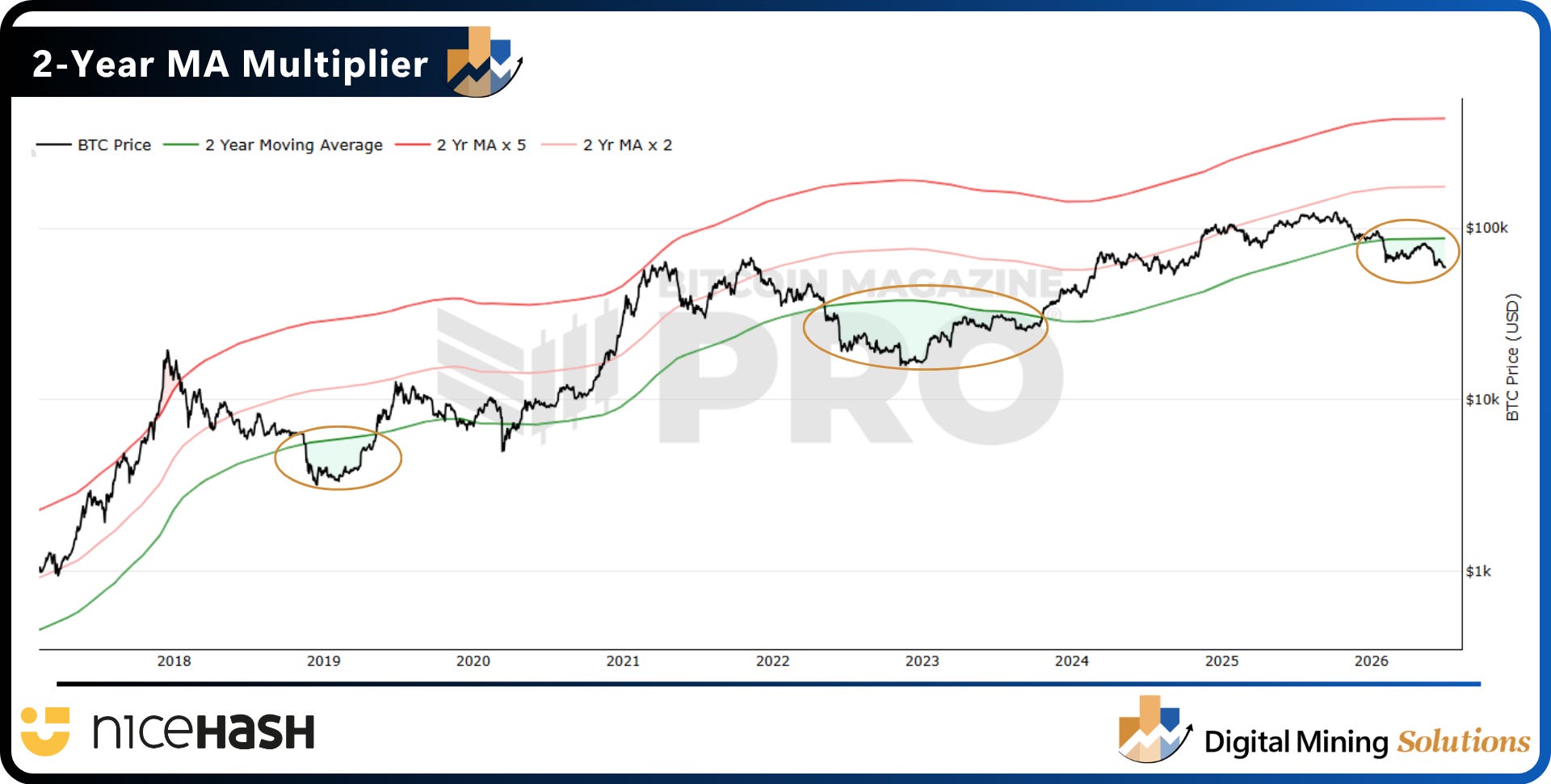
Hold instead, and the same coins carry option value. A stack accumulated at sub-$40/PH/day hashprice was expensive to produce; selling it at cycle lows crystallizes that cost as a permanent loss. Carrying it into the next leg of the cycle is the entire premise of mining for the asset rather than for fiat.
The catch is obvious and non-negotiable: holding only works if something else pays the bills. A stack you’re forced to sell in a panic isn’t a treasury, it’s deferred liquidation. That’s the difference between the operators who talk about accumulation and the ones who actually finish the cycle holding more coins than they started with. Holding is not a belief but a funded position.
Treat the stack as a trophy and it sits idle until you’re forced to spend it. Treat it as working capital and it can do three jobs without leaving your balance sheet.
First, it collateralizes fiat liquidity. Rather than selling BTC to cover opex, a miner can borrow against it, drawing dollars while keeping exposure to the asset and avoiding a taxable disposal.
Second, it finances growth. The same collateral can back equipment and expansion capital, letting an operator fund the next fleet or a new site against the treasury instead of raising dilutive equity or selling coins to buy machines. In a market where ASICs are cheap and rivals are capitulating, that borrowing capacity is a strategic weapon.
Third, idle BTC can generate yield through conservative, well-understood channels rather than sitting inert.
None of this is free money, collateralized positions carry liquidation risk if BTC falls and the loan-to-value moves against you. Counterparty failure wiped out miners who posted coins with the wrong lenders. The discipline is boring and mandatory: conservative loan-to-value, lenders you’ve diligenced, and a clear-eyed view of what a further drawdown does to your margin. Deployed with that discipline, the stack works for you. Deployed carelessly, it’s how you lose it.
A very reliable way to protect a treasury isn’t financial engineering, it’s earning enough fiat elsewhere that the stack rarely gets touched. Every dollar of non-BTC revenue is one less coin you have to liquidate.
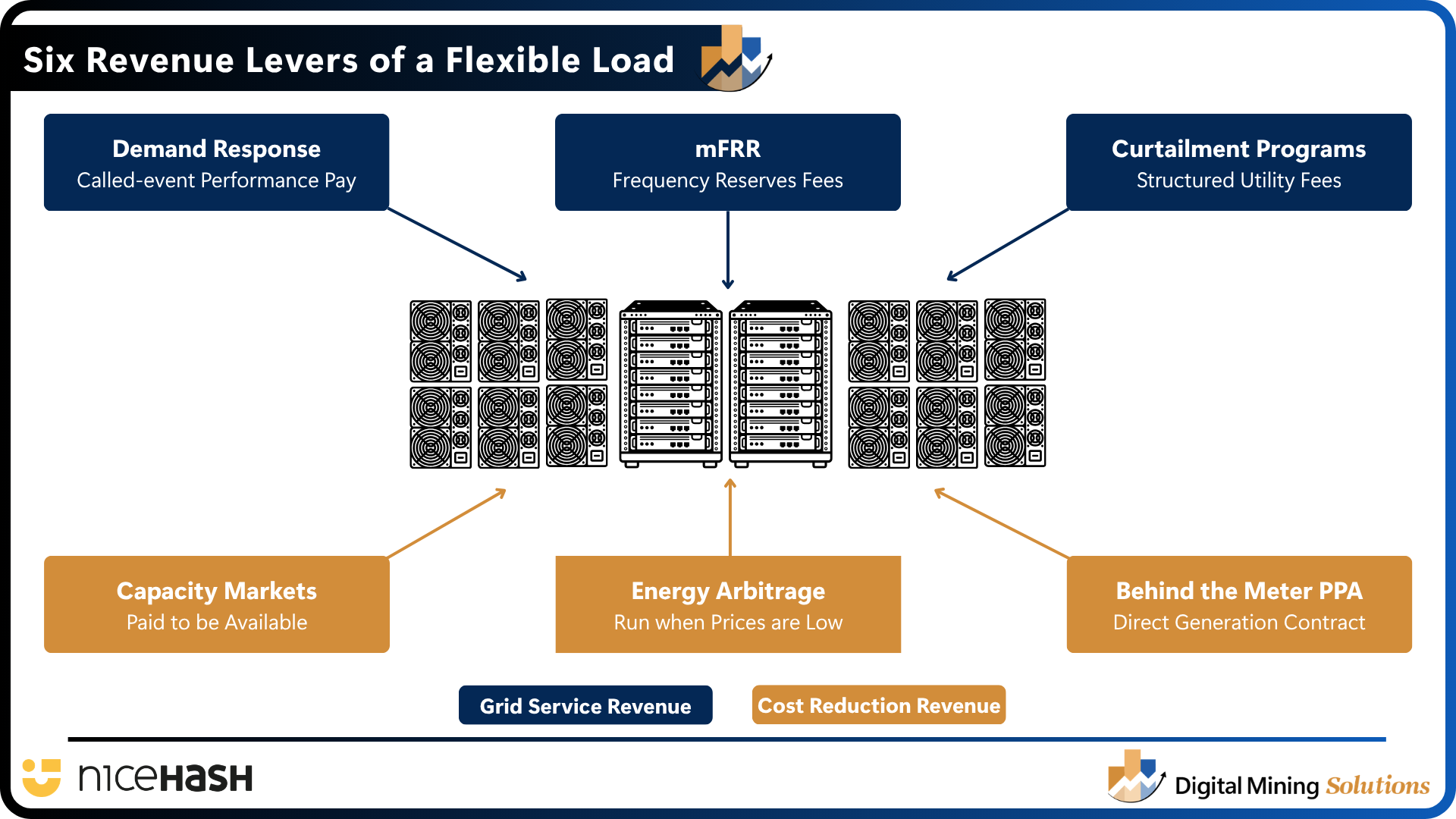
Energy flexibility is the first lever. Demand response pay miners to power down when the grid needs it, converting downtime into fiat. Ancillary services like frequency regulation and mFRR pay for the ability to respond, turning a flexible load into a grid asset with its own revenue line independent of hashprice.
Heat reuse turns a waste output into a sellable one, whether that’s district heating, greenhouses, or industrial drying. It won’t move the needle at every site, but where it fits, it’s fiat that arrives regardless of what Bitcoin does.
Then there’s the revenue mix itself. Blending hosting income with self-mining smooths the volatility as hosting fees are contracted and fiat-denominated, self-mining keeps the upside. And on suitable sites, layering in other compute, adds a demand source with entirely different economics from block rewards.
You can also sell the expertise, not just the hashrate. A team that keeps its own fleet running has repair benches, procurement channels, and operational know-how that other operators will pay for. Offering ASIC repair to third parties or running O&M contracts on sites you don't own, monetizes capability you already built. This is fiat revenue with no additional machines, no additional power draw, and no exposure to hashprice at all.
None of these are side hustles. They’re what makes holding possible. The operators who never sell at the bottom aren’t the most bullish. They’re the ones whose bills were already covered.
🔒 This section is for premium subscribers. The analysis above is free. What follows goes deeper: how hosting providers can use revenue and profit share models to keep clients online through the bear while accumulating BTC themselves, and the runway math that tells you when holding is discipline versus when it's gambling.
The difference between a well-structured infrastructure investment and a poorly executed one isn’t the thesis. It’s the underwriting, the deal structure, and the people running the project.
Digital Mining Solutions advises investors deploying $5M–$100M into energy-backed digital infrastructure: Bitcoin mining, AI compute, and hybrid energy assets. We cover the full lifecycle: evaluating opportunities before the term sheet, structuring deals that protect the downside, and staying engaged through deployment and operations to make sure capital performs as modelled.
We bring what most investors in this space lack: real operator relationships, a clear framework for underwriting infrastructure economics, and the credibility to sit across the table from developers and vendors on your behalf. Ready to deploy with confidence?
If you enjoy the content, if you have not subscribed, please ensure to click the button below and share The Bitcoin Mining Block Post.
If you want to stay ahead in the world of Bitcoin mining, make sure to follow me on Twitter and LinkedIn. Would you like to become a sponsor of the newsletter or are you interested in a workshop on mining economics? Contact me at nicosmid@digitalminingsolutions.tech.
Comments
Nothing yet. Say the first thing.
Sign in to join the conversation.