
Hello, friends! One more chapter is on the way from Hauntingly Familial, then both novels will be available only to paid subscribers. Essays and poems will still be free, and there will be a couple of those every month.
I don’t have details ready to announce yet, but it does look like both novels will appear in print form once the serialization is over. And yes, paid subscribers will get two copies of each, a mention in the Thanks pages, and my everlasting gratitude. Thanks to the current paid subscribers for going all in from the beginning. And, as always, if you know anybody you think would be entertained by this project, please forward this email.
I wrote this essay last week, and as I edited it for posting, I realize how fast things are moving and changing. We’re all on a great big ride assembled by carnies, tilting back and forth, spinning, the floor dropping out from under us any minute. On the other hand, millions of people are showing up across the country to stand for all of us, to preserve the rule of law and to attempt to salvage our global presence, our collective cultural identity before private equity buys the Liberty Bell and melts it down to make tiny screws for cell phones. My cousin, retired from the legal profession, went to his first protest ever. “Lock your phone! Write the number you will need to call in Sharpie on your arm,” I told him. He wrote me back, “I don’t know what number that would be; everybody is here with me.”
Everybody is here with us. We’re not alone. We are not helpless. I’m planning to drive up to the Smithsonian in the next couple of weeks, and if you can manage a visit, I think it would be great if they suddenly got even busier than usual. Go to as many museums as you can. I’m planning to visit the African American History Museum and also the National Gallery so I can say hi to Watson and his shark friend. Not stopping until I can’t manage to read one more Helvetica-printed rectangle. I can’t do it today, though, so I decided to get a library card.
That’s right. I didn’t have a library card. Mine had expired a few years back. But the process of getting a new one ended up solving an immediate logistical problem, and it brought me quite a lot of joy. Moreover, it helped me feel like I was contributing a few drops into the bucket of effort to construct and maintain civilization. Maybe that sounds dramatic, but I think it’s pretty dramatic to set out against Mr. Rogers, Harriet Tubman, the Parliament Funkadelic Mothership, and the Grand Canyon all in one week. Did you know that unlike the situation in many other countries, our cultural artifacts in DC belong explicitly to the people of the United States, not to the government. So if you’re thinking, this is why we can’t have nice things, that’s not true. We do have some really nice things, and it’s our responsibility to take care of them. The absolute least we can do is to accept the role of stewardship and maintain our reminders of our collective, complicated past when the vandals come to sack them. You know, like when the bullying kids come to your house and your parents make you show them your room. You know you might not be able to save everything. You try not to show too much attachment to any one thing. You block what you can, and you roll out some kind of activity or narrative to distract them and minimize the damage. When we ask ourselves what will be the hardest thing to replace or rebuild. That’s going to be our hearts and our minds, our ability to create. So hold on. Keep your feet planted, even if the floor is dropping. You have to be resolute and grounded in order to let your mind romp like the mind of God.
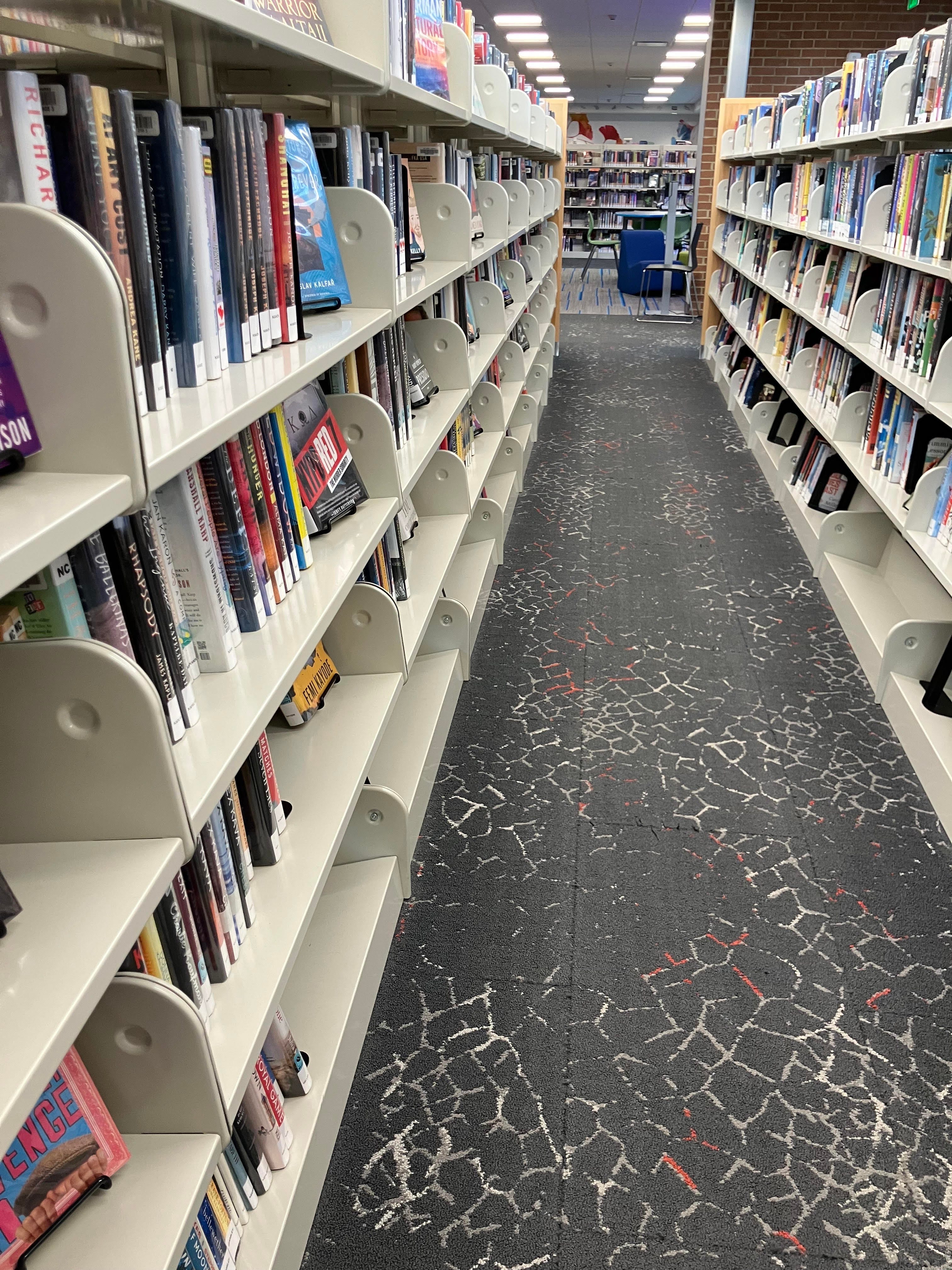
When I walked through the library lobby, I started feeling better at once. I handed over my ID and provided an email address, and since mine has the word “books” in it, the librarian peeked around the monitor at me. “Read, sell, or write?” she asked. All three, really, but I said “Write,” and she smiled. I promised to bring everybody I know to get cards, and she smiled again. Our local library in Wake Forest is magnificent: bright, sprawling, geometric patterns all around to wake up your eyes and scratch your itchy brain. Events, services, information, and contest announcements line the walls on posters and bookmarks. I tapped one with a finger absentmindedly as if the link would open up. Then I realized, I’m standing right here inside the link. It’s open. Everything is in here. This building is the pot of gold at the end of the literary and information link rainbow. All around the room I could see other people moving about, kind of having the same realization. We all came to the church of knowledge. Open your hymnal and sing.
No, we don’t need to sing. It’s a gorgeous kind of quiet in here, the occasional whoosh of the AC unit like one long “shhhhh.” Nobody talking on a phone. No beeping alarms. No obnoxious ringtones. So no singing, but I did do a little dance, alone between the shelves. The French word for library, “bibliotheque,” sounds like a place you can dance. At least it did to me when I was a little kid, so I like to dance in the library sometimes. You should try it. Nobody cares if you do. They’re all reading. Trust me, it happens all the time in the Kids section. I did my dance when I found Lanny by Max Porter on the shelves, and I’d been looking for that book at home before I realized I had given my copy away. I needed to finish writing a piece about how Max Porter is the most interesting thing happening in fiction right now, and Lanny was the only one of his that I didn’t have handy. I love having my own library at home, and it’s a great feeling being able to find what I need in my own shelves and stacks, but there’s always something that, after years of working in bookstores, I believe I own when I actually don’t. There are some books that slip through my hands like goldfish, never staying with me because I give them away so much, like Hanif Abdurraqib’s Go Ahead in the Rain. But even if you have your own substantial book collection, we can’t be arguing for the relevance and necessity of community libraries if we don’t support them. And you know it’s not just about the books. I bet if you go get a card, you’re going to find something you needed that isn’t a book. It might be the quiet workspace—for years, I had a little room of my own at the Seattle Public Library. They offered free offices to anybody who had a book contract to show them, so in my encyclopedia entry writing days, I had a small room with a window, a desk, an office chair, and a comfy chair. I could keep reference books in there, along with my project notes, locked up with my own key. Remember in the late 20th century when we still had to do all the research with books? Until recently, I didn’t see this as an advantage, but here’s the thing about books: they say the same thing when you come back and read them again, even if you don’t lock them up. You can’t just delete the main character when somebody decides they don’t like them. If there’s a book about, say, the Underground Railroad, Harriet Tubman will still be in there when you pick it up next week.
I have a shiny new library card and a worn copy of Joan Didion’s The White Album because I’ve been thinking about what she’d be saying right now, and this book is one of those that I have never owned in the first place but have always believe that I do. And I have Lanny so I can tell people why they should be reading Max Porter right now. It’s weird and destabilizing and experimental, but in a way that embodies the electricity of connected thought and feeling, a sometimes skittery, breathless awareness like an irregular heartbeat, a hesitant dance step, a trip-and-fall-and-catch, a reading of invisible states through the fingertips like some kind of emotional braille hung in the air. Max Porter spins the floor under you, sometimes a preternaturally wise child and sometimes a growl from a bottomless crater. Sometimes I recollect his books, intensely vivid and easily read in one sitting, as radio transmissions, or places I visited in my sleep, locations where I felt like an interloper but begging for permission to stay. Thank goodness for every minute in Max Porter land, a place correct in its not-rightness, its fluidity and its tentativeness. Right now, safety and nostalgia feel like idle promises offered insincerely, not fully considered.
I roam the aisles with Joan and Max, stopping briefly in front of a shelf of books by an author I’m not going to identify, because it would be beside the point. Every time I see these books, I plunge into some murky regret, which is not particularly useful, I admit. I don’t care what people read, as long as they read. Except for once in a while when I just can’t figure it out. I want to say that I honestly want to understand, I’m not just being a snob. But maybe I’m being a snob, too, and more things can be true at once. So years ago at one of my first big book conference events, I was at a promoter’s table with my first novel. A book rep chatting with me asked me about the kind of supernatural that Lit By Lightning might be, what I might compare it to. I mentioned really being inspired by writers like Kelly Link, Karen Russell, William Gay, and Joy Williams, writers whose supernatural elements might be in the realm of metaphor, with a little magical realism. But mostly left to the reader to interpret. “So, is it like X?” I didn’t recognize the author she mentioned, but before I could say anything, the other publisher in the booth broke in with “NO! Not like X. Haha. No. Different from that style.” I forgot all about the exchange until later, when a bunch of us were back at the rental we were sharing for the conference, stacks of all our free books from the day all around the kitchen and living room. Browsing through everybody’s book hauls is always a luxurious, fun activity. Great new voices and new books from familiar favorites, the Advance Reading Copy avalanche is my favorite part of conferences. I think that year I ended up with Callan Wink’s August, one of my favorite books of the decade. A marvel. Go see if your library has it. Anyway, in somebody’s stack, I saw a book by this author from earlier. So I decided to see for myself whether or not my books were like this one, and it did not go well. I’m ashamed to say that I read aloud from the text for the next hour, interspersed with profane tirades that had the authors cackling. Their encouragement just fueled more venom from me about the absolute mess of the not-copy-edited non-sentences in the book.
The last thing I would want to do, or at least among the last thing I would want to do, in any professional or amateur book-loving capacity, would be to shout down anybody’s joy. Read whatever you want to read. Listen to it, even, because I count audio books as real book experiences and I’ll stand on the fact that it’s ableist to say otherwise. I’ll do that TED talk for you later if you want to hear it. Now, have I made fun of genres? Sadly, yes. Did I once rearrange the Sci Fi section at Oxford Books into three categories I labeled “People in Space,” “Medievals in Love,” and “Medievals in Love in Space”? Also yes. I was not an especially happy person at the time, but that’s not a valid excuse. It was an ungenerous act. Standing in front of all these books I maligned, I can see they’ve all been checked out and read. They’ve been nightstand companions, seen people through business flights, vacation travels. At that conference, I’d seen about a hundred people lined up to meet this author and get an Advance Reading Copy signed by her bejeweled hand. “I guess I need a white suit from Talbots,” I’d lamented that night to my friend. “Honey, you’d need to change more than your clothes.” Maybe. Maybe I need to fix my heart, though. No author is taking anything away from anybody by putting work out. I never meant to make anything like those books. You can’t get mad at tea for not being coffee. Or bourbon. I envied the love, though. Simple, really. We tell our stories, and we want the stories to flourish and to be loved by somebody. But it’s the same if it’s five people or five thousand.
When I came into the library, this room was empty. Now almost all the tables have somebody reading, or typing, or scribbling. Thinking. Questioning. Solving. It doesn’t matter what their tasks are. We’re all in here spinning with our feet planted on the ground, making the world buzz and startle into life. In a week or so I’ll stand quietly in the National Gallery, in front of Watson until some unsuspecting person comes by and comments on how goofy that shark looks. And then, if they seem interested, I’ll explain. Eventually they will ask me if I work at the museum. “No,” I will say to them. “I just come here to think.”
No posts
Comments
Nothing yet. Say the first thing.
Sign in to join the conversation.