
This is 8 Questions: sprinkles of an author’s journey from writing through publication.
“I’ve often wished that human bodies were as clever as those of octopuses. If we could divvy up the work of one heart among three, if we could have a semiautonomous brain in each of our appendages, perhaps we’d be more efficient with our time, less likely to waste it on grudges and hurts and all the things we feel we can’t say to one another.”
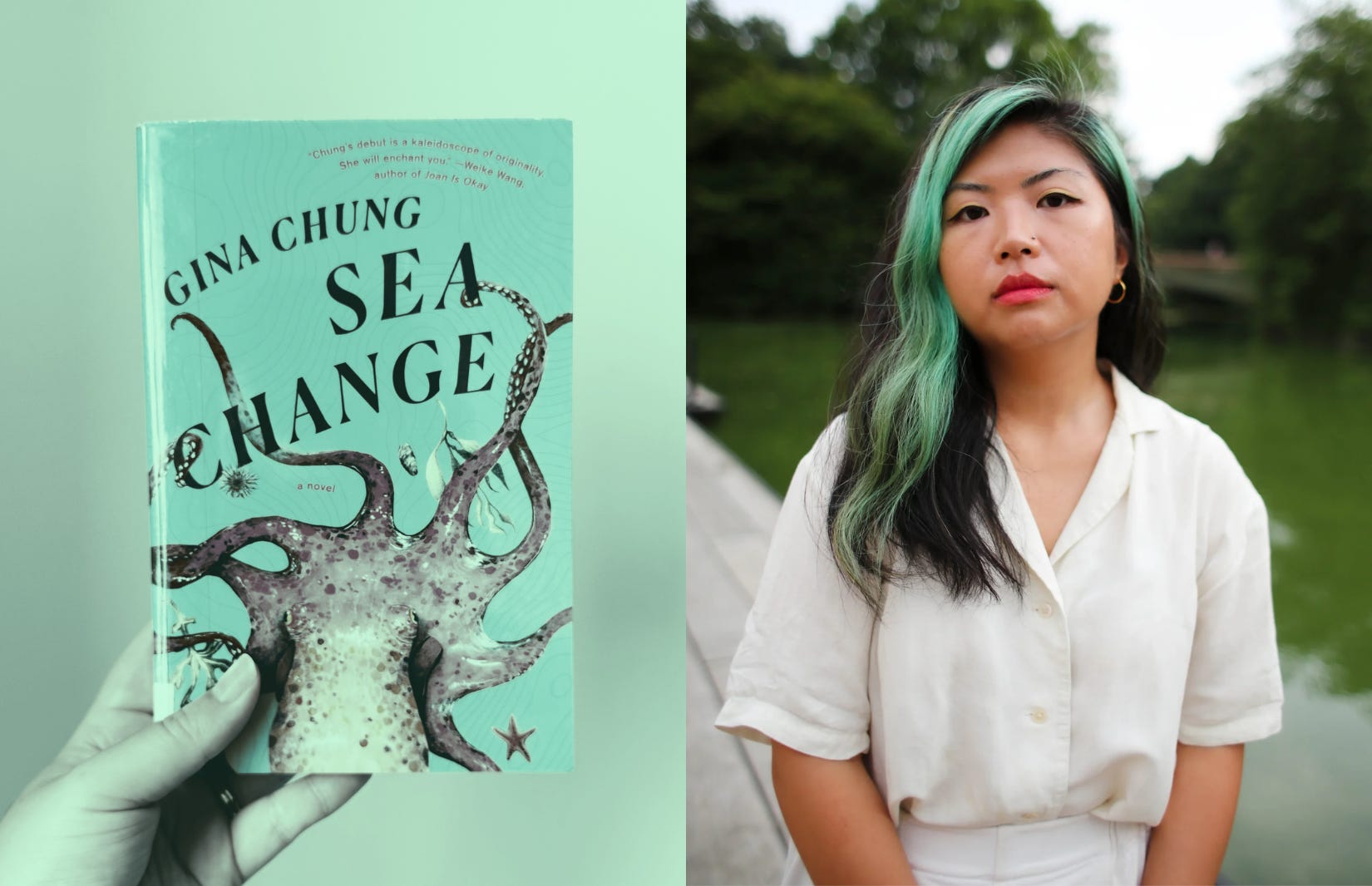
In Gina Chung’s debut novel Sea Change, the deepest lessons about human connection can be found in a mall aquarium in suburban New Jersey. Ro, a Korean American woman in her thirties, is grieving the disappearance of her father decades earlier, recovering from a recent breakup, and avoiding her estranged mother and drifting best friend. Her main companion is Dolores, a giant Pacific octopus, originally discovered by her father. Faced with Dolores’ impending purchase by a wealthy collector, Ro is forced to adapt and repair both the rifts she has with others and how she lives her own life.
I first read Gina’s work in a flash fiction class (“Mantis”), and I love how she continues to take inspiration from animals and the natural world in her work. Sea Change builds on this, exploring how people evolve—in new countries, in new identities, in new environments—with immense empathy and humor. Here’s Gina on making your protagonists feel the impacts of their actions, using music and reading to unstick yourself, and the importance of keeping the tension of a scene going.
1. What was one thing that was important to you to depict in Sea Change? How did you go about it?
One of the biggest things that my main character in Sea Change struggles with is her relationship to the outside world and to others. She’s just been broken up with by an ambitious boyfriend who is leaving the planet on a trip to colonize Mars, her best friend is pulling away from her as she plans for her wedding, and her family of origin (which consists of just her mother and herself, as her father disappeared long ago at sea) is fractured and dysfunctional.
Because the novel takes place in first person from Ro’s perspective, I wanted to strike a balance between portraying the ways in which she feels she has been failed by each one of these relationships, while also showing how she has in turn contributed to that dynamic. I wanted to show how each relationship was complex and meaningful in its own way, and how, even while it was splintering, it was perhaps breaking apart to allow something new to emerge. It can be tempting to side with our characters and go easy on them, but I wanted Ro to feel the impacts of her negligence and emotional avoidance, while also exploring how she might learn a different way of being in the world.
2. Writing is a big part of our lives, but it’s not the only part. What else was happening in your life as this book took shape? What did a typical writing day look like for you?
I wrote this book during the pandemic, so not a whole lot was going on for me outside of my screen and mind. It was a terrible time, for obvious reasons, but I think it also taught me that I could find so much space inside my mind in the story and characters that I was trying to create. I tried to write every weekday after I logged off from my job. I’m not very good at routines, but typically, I would go for a walk in Prospect Park, which was quite close to me at the time, and listen to music from a playlist I had put together as a kind of aural mood board for the story, and just pretend that I was immersed in the world of my characters. Then, I would go inside, make dinner, and only start writing until around 9 or 10 pm.
I’ve always been a bit nocturnal. I would write for about two or three hours if I could, with the goal of writing at least a thousand words each day. It was sort of exhausting, so I don’t think I would recommend this way of life to most people, especially if you don’t have the luxury of having a remote job that you can just roll out of bed for the next day, but it worked for me during those frenetic early months of tackling my first draft.
3. Did you have any creative ruts along the way? How did you unstick yourself?
All the time. I felt like a failure any time I didn’t reach that thousand word goal, even though there were also days where I really got going and exceeded it. In retrospect, I wish I had been kinder to myself about those “failures.” I was writing my manuscript as part of my thesis for my MFA, so it helped that I was accountable to my thesis advisor and needed to produce and send x amount of pages every time I submitted new work to her.
Whenever I felt stuck, I would revisit my playlist to get a sense of the narrative texture or mood I was struggling to convey. Reading other writers I admire also helps. Increasingly, I find myself reflecting on the fact that the best writers are the ones who read the most, and who read widely. I’m in a stage of not reading very much at the moment, which I feel guilty about, but I think not reading and not writing can also be part of writing. Your mind needs time to rest, adjust, and marinate.
4. What’s an edit that you received that you’ve now carried into your future work?
It wasn’t any one specific edit, but when I was revising my manuscript, both with my agent and my editor, I would find that a lot of their feedback boiled down to keeping the tension or emotional impact of the scene going, whether that meant having a conversation continue beyond where I had ended it originally, or simply forcing the characters into situations that they didn’t want to be in, and seeing what happened. Learning how to be comfortable with being uncomfortable is a life skill that I am still trying to master. I think it’s an especially good one for writers, who often deal in abstractions and ambivalences, to learn.
5. What was something that surprised you about the publishing process?
One of my very first jobs was in book publishing, so I was already somewhat familiar with the general process for how a book goes from manuscript to published object, but it’s still all very new and different when it’s your own book. I think the thing that surprised me the most was how many decisions have to be made during the process, both by you as the author and by every person whose job it is to work on this book. It was very moving to me to see firsthand just how many hands a book has to go through to be birthed into the world.
6. Any acknowledgements (parasocial relationships, music, snacks, hobbies etc.) that you’d like to shout out here that didn’t make it into the published book?
I would like to give a shoutout to the raccoon who lived on the roof of the apartment I was in at the time. My roommates and I would often hear her shuffling and running around up there, and her nocturnal movements often kept me company while I was writing late into the night.
7. (From Jemimah Wei) How did you negotiate your relationship to time inside and outside of the book?
This is a very fascinating question, and one that I’m not entirely sure how to answer. I think my relationship with time is a sort of contentious one, in that I never seem to have enough of it to do all the things I want to do. Conversely, though, in 2020 the only thing I had was time. So in that sense, the way I experienced time outside of the book felt very slow.
Within the book, I knew right away that I wanted the story to take place across two timelines, in the present day and in the past, and that I could, in alternating back and forth across those timelines, perhaps show not only how the past informed the present, but how the present was shaping Ro’s understanding of her past. The present day of the book is quite short, perhaps only a few months or so, but I wanted that time span to feel longer for the reader, in the way that the days can sort of expand and elongate when you are experiencing loss.
8. What’s a question I should ask the next author?
If you could be granted the ability to master any aspect of writing (dialogue, endings, setting, plot, etc.) what would it be?
You can find Gina at her author website and on Instagram. Check out her latest piece in the new issue of Elastic Magazine. Buy Sea Change and Green Frog anywhere books are available, but please shop local when you can.
A review of Lucy Ives’ Three six five, a collection of writing exercises, and the contradictions of writing advice: “Writing guides wrestle with the contradiction of needing to be the “one who knows” while also tacitly admitting that they can’t possibly make a writer’s crucial decisions for them.”
For summer reading, check out Electric Literature’s Most Anticipated Books by Women of Color for Summer and Fall, NYT’s Summer Reading Bucket List, and The Guardian’s 100 Best Novels of All Time
“A Writer’s Guide to Rejection Letters” by Meg Eden Kuyatt
Applications are open for the The Center for Fiction / Susan Kamil 2027 Emerging Writer Fellowship through July 31. This was an incredible experience and doesn’t have any application fee, so I definitely encourage New York-based writers to apply!
A wonderful essay by John Paul Brammer about how he learned to read more and rethink his relationship to attention: “Attention is only a resource. A precious one, but a resource. Curiosity is your very spirit. Its corruption for profit might be the worse sin. Reading, the nurturing of curiosity, is the opposite of that abuse.”
I read Heart the Lover by Lily King, Comedic Timing by Upasna Barath, and Hello Stranger by Lisa Kleypas, which is my favorite romance read of the year (England’s only female physician meets an ex-detective/spy).
I finished The Odyssey, translated by Emily Wilson, before watching Christopher Nolan’s adaptation at the Lincoln Square IMAX in 70mm (sorry, had to flex!!) Overall, I thought it was well-paced for its runtime and the visual/practical effects were impressive. There were some interesting choices made to the ending that speak more directly to our current times, and builds on what Nolan did with Oppenheimer: “The tale of a man who built a machine to win a war and wound up destroying his own world in the process.”
In theaters, I saw Toy Story 5 (fun, but repetitive twists and tropes), Obsession (paired well with Midsommar under “movies where cowardly men are the real horror”), and The Invite (hilariously relevant to me and E’s current neighbor situation minus the propositioning). We also went to a 35mm screening of All the President’s Men, which is still one of the best journalism movies.
During the Fourth of July heatwave, we fittingly watched Spike Lee’s Do the Right Thing. Continuing our Spielberg Summer, E and I watched Indiana Jones and the Last Crusade and Schindler’s List.
Recently read short stories: None
Note: Book links are connected to my Bookshop affiliate page. If you purchase a book from there, you’ll be supporting my work and local independent bookstores!
When I say it’s not a big deal, this is what I mean. Happy end of Q2, Q3 is heating up! Robert Pattinson as Antinous in The Odyssey. The new villain of the summer. Meet Seattle’s resident raccoon, Jimothy. Playeth the ‘Sand of Storms’ by Lord Darude!
No posts
Comments
Nothing yet. Say the first thing.
Sign in to join the conversation.