
I want to make it clear that I don’t want any of you to unsubscribe to this Substack. I’d love you all to stay and for you to be joined by your friends here. It’s just that two things have happened to me over the last couple of years that have distanced me from some of my subscribers: I lost faith in British politics to correct itself before something drastic happens, and I lost faith in the ability for the UK to rejoin the European Union any time soon. The two factors are not entirely unrelated.
On the latter: some of you who have subscribed for years will know that as late as early 2024, I still insisted that the UK could rejoin the EU in a short time span, maybe less than five years. I thought that public disaffection about Brexit would inevitably be seized upon by a significant section of the British political class. To say that hasn’t happened would be a monumental understatement, along the lines of “World War One was problematic in several ways”. There are many reasons for this, but I have written about this subject before, at length if you’re interested, and so I’m not writing about it here, again.
Hell, I’ve just spent more than a year and a half researching the Reform party, talking to their activists and candidates, trying to get under the skin of what the whole thing is about, and even a lot of them don’t like Brexit. There is such a widespread dislike of Brexit and how it has turned out, across the political spectrum in Britain. It wouldn’t take a genius to work out how to turn that energy into a way back into the EU over the next few years. Yet the current political class in Britain is not only lacking geniuses, it is mostly free from competence. Don’t believe me, or think I’m being bitter, or at least unnecessarily harsh? Several people I know from first-hand experience are completely and utterly useless have got SpAd jobs in the Burnham government. You know, the government so many of you are hoping will be miraculously good and save the country somehow.
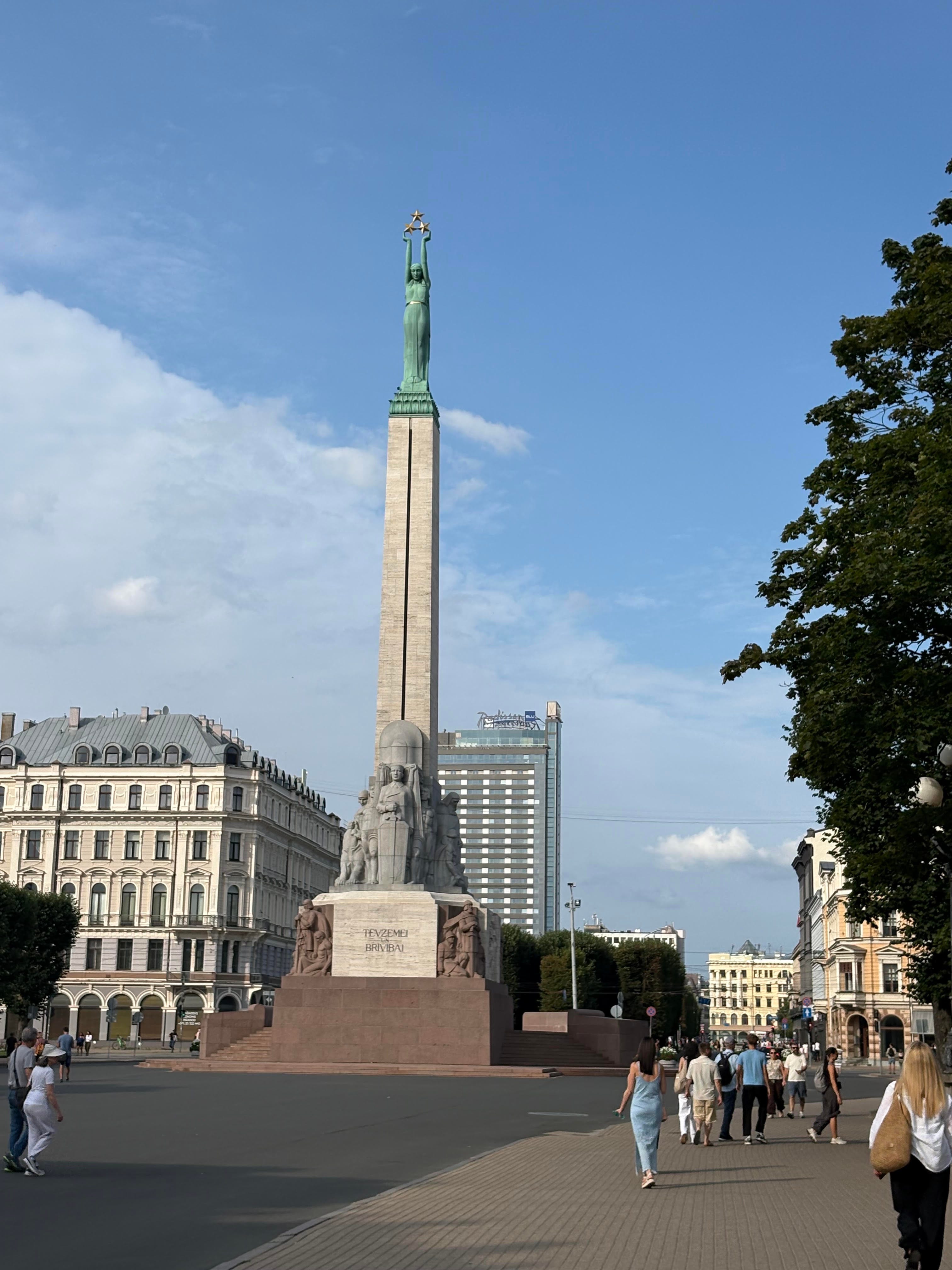
Anyway, what does any of this have to do with Latvia? It’s where I am at the moment. Not for any politically intriguing reason, I hasten to add: I’m simply here on a family holiday. In Riga, the capital, at least for now. We picked it for several reasons, one of which is that it’s about five to seven degrees colder here than in London, and we wanted to get away from the heat.
Several first impressions of Latvia to recount. First off, the country is lovely and Riga is a fantastic city. It’s got an interesting history and culture, and it displays those things well within the capital. The city is remarkably clean and safe. Driving here is, how shall I put this, idiosyncratic. I don’t mean that as code for “Latvians drive like maniacs” - in fact, they are very sane drivers from what I’ve seen so far. No, I just mean the way they lay out traffic signs and the streets themselves take a little getting used to. They also really love one way systems - not just in Riga, but everywhere I’ve been in Latvia so far. And I do mean love them: most of the streets seem to be one way only in places.
One other thing to mention: Riga feels expensive. Not more expensive than London per se; probably on equal footing, price wise. Now, younger readers may find this hard to believe, but it wasn’t that long ago that travelling anywhere in continental Europe, apart from the Nordic countries, and particularly within former Eastern Bloc, felt cheap - and sometimes, remarkably cheap. Even ten years ago, I would have expected to come to somewhere like Riga, Latvia and feel somewhat rich. No longer.
That is the consequence of two factors merging with each other. The first is that the economies of the former Second World have grown substantially over the last two decades, and particularly over the last ten years. This is mostly down to two things: one, these countries joining the European Union, and specifically, the European Single Market; two, most of them running with fairly right-leaning, free market economic policies that have sought to take further advantage of the market access EU membership brings. In Britain, because of the bizarre politics of Brexit, almost no one wants to admit that both of those things are behind the growth of eastern economies: if you’re on the right, it was the Hayekian economic policy that did it, nothing to do with the EU; if you’re on the left, it was all down to EU membership, with capitalism deserving no credit.
This growth of eastern economies has merged with the other factor, namely that Britain’s economy has flat lined since the 2008 financial crash. And flat lining has meant, in real terms, that Britain has become substantially poorer in a global sense. At the time of the crash, America and Britain had a very similar GDP per capita. Now, the US is almost twice as rich per person as compared to those in the UK. The reason Latvia feels as expensive as Britain is because it is: wages are catching up between the two countries now, particularly when you take London out of the equation.
I used to travel to New York regularly in the 2000s as part of my job at the time (so much so, I even had at one point a NYLON relationship with a woman). New York felt cheap to me back then - everything seemed to be about half as expensive as London. Now, going to New York feels like going to a different economic planet. Or, more prosaically, it feels like how a Latvian must have felt coming to London in 2014.
I am happy for the Eastern Bloc countries - particularly ex-Soviet ones like Latvia - growing the way that they are. After the hardship these nations faced for a very long period, some good times are long overdue for them. But the numbers are startling from a British perspective. GDP per capita in Latvia now is around $30,000. In 2006, it was $13,000. British GDP per capita is now around $58,000, which sounds really good, until you realise that our GDP per capita at the time of the crash was about $50,000.
So, while former Eastern Bloc countries are still technically less wealthy that the UK, they have grown substantially over the last decade, while Britain has, in real terms, declined. That is key to how Latvia feels as compared to the United Kingdom. If your economy is visibly growing, that makes your culture positive; people feel like things are going to get better rather than worse, and they also feel like working hard pays off. In Britain, things are getting worse, and most people believe they will get even more so. This is why politics in the UK seems so intractable now; that negative feeling can take over everything.
Yes, part of Britain’s troubles are down to Brexit, particularly how badly it was handled by the Tories when we left. But there are so many other problems we have to deal with - and would have to deal with, even if we were still EU members. In fact, part of the way we might rejoin the EU is by Europhiles admitting that’s true and then trying to work on solutions that involved both fixing the problems the country faces while rejoining the European Union. And sadly, that feels a very long way away from happening.
No posts
Comments
Nothing yet. Say the first thing.
Sign in to join the conversation.