
Originally published by Crikey, May 28, 2026
The NACC was established to weed out corruption in the public sector. As its commissioner Paul Brereton quits, we reveal an internal culture of integrity breaches, secrecy and silence.
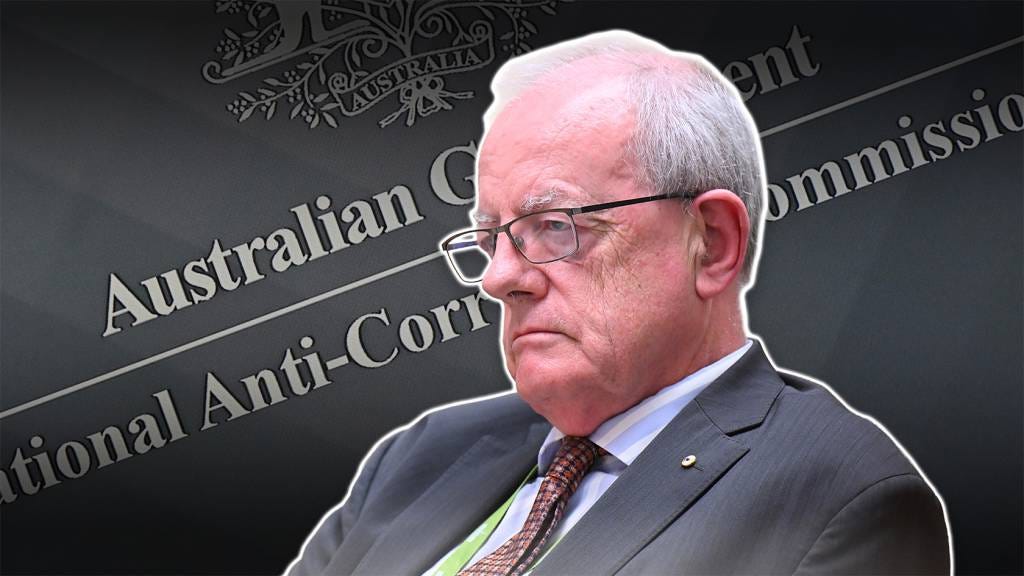
The inaugural commissioner of the National Anti-Corruption Commission, Paul Brereton, resigned unexpectedly this week, leaving the country’s peak integrity organisation in crisis. Brereton’s tenure has been disastrous, and the ramifications will continue to unfurl for months.
Brereton departs three years into a five-year term, having built an organisation with over 200 employees and a budget of more than $60 million per year, but with a legacy of no significant corruption findings, a serious public trust deficit, and a pile of tainted Defence investigations.
The NACC has also lost one of its three deputy commissioners recently: Nicole Rose, who similarly resigned unexpectedly, also two years short of her term. This leaves the NACC with just two deputy commissioners in coming months.
“The ongoing focus on matters relating to me personally rather than the commission’s work is drawing attention away from the commission’s core purpose,” wrote Brereton in his resignation statement. More specific reasons for his abrupt departure remain a matter of speculation, but in Senate estimates on Tuesday, he mentioned, in albeit cranky terms, his belief that the constant scrutiny of his Defence ties was unlikely to recede. He refused to accept that he had mishandled disclosures about them.
The Attorney-General’s Department had revealed that an updated draft report by NACC Inspector Gail Furness into Brereton’s handling of his Defence conflicts had been shown to Brereton in recent weeks, so although her investigation is ongoing, Senator David Shoebridge pursued the obvious line of questioning: did this report influence Brereton’s resignation? (Brereton’s reputation, and the NACC’s, could scarcely have survived another negative finding with him at the helm.)
Brereton stated that the content of the inspector’s latest draft was not material to his resignation. He also revealed that the legal advice he has received thus far in response to the inspector’s investigation has cost the taxpayer $204,000.
In something of a bombshell, Furness opened her evidence to Senate estimates on Tuesday night by stating that she had commenced yet another investigation into Brereton — a third investigation by her — into a complaint about his conduct. That investigation, which began in April and which Brereton did not mention to the estimates committee, is also ongoing.
Furness said this latest investigation is unrelated to her other investigation into Brereton’s conflicts with Defence and the Inspector-General of the Australian Defence Force (IGADF), but she was unable to provide further details.
Without second-guessing Furness’ conclusions about her investigation into Brereton’s Defence conflicts, there is already significant evidence of Brereton’s mishandling of his disclosures on the public record.
Brereton did not initially reveal the nature of his ongoing consulting work with the IGADF to anyone other than former attorney-general Mark Dreyfus. Brereton characterised it as voluntary and informal, and Dreyfus had accepted this in writing.
Even in his annual declarations of interests to the attorney-general, Brereton had stated only that he had a more general “affiliation” with the IGADF.
In September 2025, the ABC reported that Brereton was continuing to consult for the IGADF despite having left his position as assistant inspector-general of the ADF. While knowing of his vague “affiliation”, neither the NACC’s CEO, Philip Reed nor NACC Inspector Gail Furness was aware that this meant the commissioner was continuing to consult to the IGADF. (The details were exposed later via Senate estimates and FOI document releases.)
The policy also dictates that “staff members should not engage in secondary employment if it: could create a perceived or actual conflict of interest; cannot be performed wholly in private time; and may reflect adversely on the NACC.” Brereton’s consulting work with the IGADF arguably breached all three conditions.
Brereton also sought to avoid media scrutiny of his perceived conflicts. When direct questions were put to the NACC by the ABC, Brereton told his media team that “it may be best not to respond”.
Brereton’s Defence ties led to him eventually stepping away not just from IGADF-related referrals but also from all Defence-related referrals, at the insistence of his deputies.
The damage is ongoing. Serious questions remain unanswered. What will happen to the many Defence-related referrals that Brereton influenced or presided over in the years prior to declaring his ongoing Defence ties? Will his decisions be revisited? If not, why not? The Defence Department is potentially the NACC’s biggest “customer”, so the implications are enormous.
Even close observers of the NACC might be unaware that it has an integrity policy — because, despite the NACC’s promises to do so, it has never officially published it.
Worse, Commissioner Brereton’s actions posed an “integrity risk” for the NACC according to its own integrity policy.
The policy lists as an integrity risk “staff member misconduct, including potential breach of the APS Code of Conduct, or maladministration (that does not also amount to corrupt conduct)”.
The commissioner was found to have engaged in “officer misconduct” in relation to robodebt by the NACC inspector in October 2024. At the time, he refused to resign despite repeated calls, including from eminent lawyers and former judges. These calls would have been considerably stronger and more effective if it had been known at the time that this finding demonstrated an integrity risk for the NACC, by its own admission.
Consider the following questions, which we put to the NACC two weeks ago:
Does the NACC have an integrity policy (or a policy guiding internal integrity principles, policies and values)?
If so, is the NACC’s integrity policy published on the NACC website? The website states that “the National Anti-Corruption Commission has a range of internal integrity plans and policies in place”, but only one plan (about the childsafe program) is published.
If the NACC has an integrity policy, could it please provide this? If not, why not?
The NACC refused to answer any of these questions.
Put simply, the NACC refused to acknowledge that it even had an integrity policy. Doing so, and then publishing it, would have revealed its obvious multiple breaches of its own policy.
The only reason the policy is known to exist is because it was revealed via the NACC’s FOI disclosure log. For an organisation apparently dedicated to integrity and accountability, this represents an astonishing failure of judgement.
A “please explain” letter from Attorney-General Michelle Rowland to Brereton resulted in him updating the declaration with more details.
The NACC “requires all employees to disclose the nature of any secondary employment”, according to its own integrity policy, which defines secondary employment as including “any activity that may be perceived as a conflict of interest”.
The IGADF comes under the jurisdiction of the NACC, and referrals relating to its work have been made to the NACC. Ergo, Brereton, by not properly disclosing his ongoing IGADF work, did not comply with the NACC’s little-known integrity policy.
Brereton presided over a culture that was secretive, hierarchical and increasingly defensive. These qualities may have been appropriate in Defence organisations, where Brereton thrived, but they were never suitable for an integrity body.
While confidentiality is obligatory in anti-corruption investigations, the organisation’s own conduct must be transparent and accountable, and its integrity absolute. The examples of Brereton and his team mishandling the robodebt investigation and the commissioner’s Defence disclosures are a matter of public record, but the NACC’s attempts to silence legitimate inquiries and criticisms have gone well beyond that.
Early this year, researching an investigation into the NACC’s deputy commissioners that would eventually be published in The Point, we approached the NACC with detailed questions about a report that had been published by the Daily Telegraph about its deputy commissioner, Nicole Rose. Written in 2020 by journalist Natalie O’Brien, the article revealed that Rose had been appointed to her previous job in highly unusual circumstances, and that her highest academic qualification was a diploma of hotel management.
Asked whether Brereton or Rose contested any of the facts relayed in it — noting that the account remained on the public record — the NACC replied (without providing evidence) that the “Daily Telegraph articles published in 2020 contain false and defamatory information. The baseless claims made by the journalist were dealt with by the then responsible minister, and in Senate estimates at the time.”
O’Brien said the article was vetted by lawyers and was watertight. She added that “we received no complaint about inaccuracy or defamation at the Telegraph when we published. The ‘allegations’ were upheld for all to see in the [FOI] documents.”
The NACC then approached our publisher, alleging that our article, which The Point was preparing to publish, would contain false, misleading and inaccurate reporting — before it had even read the article.
Soon after our article was published, a NACC representative approached another publication, warning it against mentioning our article in relation to the sudden resignation of deputy commissioner Rose, making thinly veiled legal threats.
If the NACC had any objections to our work, or any corrections or amendments to propose or request, it could have made them to us directly. (NF: To me, each of the above responses by the NACC seemed defamatory.)
These are not the standards we should accept from the nation’s premier integrity agency, or indeed from any government body. If this is how the NACC responds to scrutiny, it needs a complete reset.
The process to appoint a permanent new commissioner and deputy commissioner, to be conducted by the Attorney-General’s Department, will be pivotal to the success or failure of an organisation that has so far produced more headlines about its own mismanagement than its achievements.
NACC CEO Philip Reed admitted the two senior departures would present “challenges” in prioritising the work of the two remaining deputies until temporary “acting” replacements are appointed, but he didn’t see any issues with the NACC’s capacity to manage its current workload more broadly.
Attorney-General Michelle Rowland thanked Brereton for his leadership, service and contributions to the NACC. “A merit-based process will commence to appoint a new commissioner of the NACC.”
For the sake of the NACC’s future, it must be a rigorous and transparent process. The new appointments must be the best and most qualified candidates available, because any more missteps will risk destroying the NACC forever.
No posts
Comments
Nothing yet. Say the first thing.
Sign in to join the conversation.