
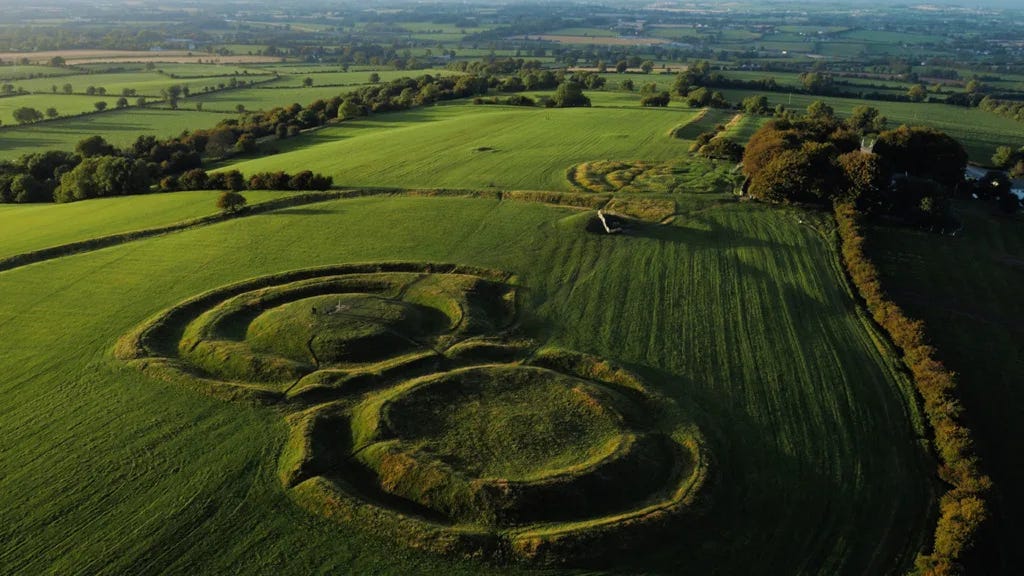
Two hills stand on the border of Cork and Kerry, in southwest Ireland. Locals still call them the Paps of Danu. They are shaped like breasts and named for a goddess. Every spring at Beltane, the old fire festival, farmers used to light fires around the base of the hills and drive their cattle between the flames for protection and a good harvest. The same ritual is recorded in the Vedas, four and a half thousand miles east, in the language and liturgy of ancient India.
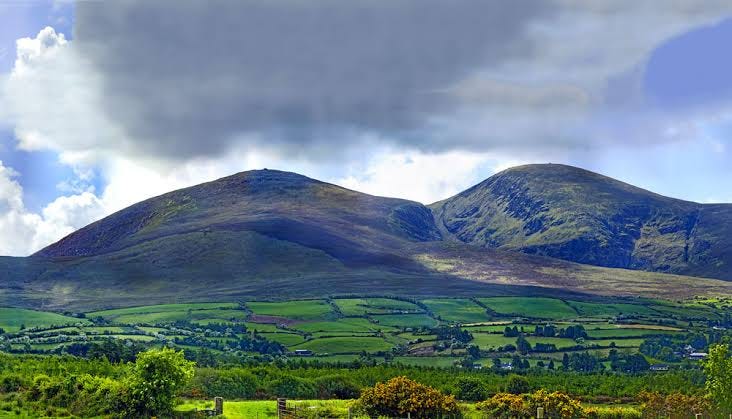
Danu is a Rig Veda deity. She is the mother goddess of the flowing waters. Her name is written into the geography of half a continent. The Danube gets its name from her. So do the Dniester, the Dnieper, the Don, the Donau. Greek Demeter. Northern Greeks once called themselves the Dannuni. And in Ireland, at the far western terminus, the pre-Christian pantheon called itself the Tuatha de Danaan. Children of Danu.
This is the last surviving trace of something much larger.
The story many of us were taught at school, that pale-skinned Aryan nomads from the central Asian steppe rode south around 1500 BC and imposed their language on a dying Indus Valley civilisation, is no longer defended in that hard nineteenth-century form. Its repackaged successor, the Aryan migration theory, remains the mainstream Western view. But it has been under sustained pressure from every scientific discipline that has examined it in the last thirty years. The genetics disagree. The archaeology disagrees. The linguistics disagrees. The Vedic literature itself disagrees, and the surviving indigenous traditions on the ground disagree.
Michel Danino reviewed nine large-sample genetic studies from 1999 to 2006 and found no invasion signal in Indian DNA. Jim G. Shaffer, one of the most careful American archaeologists working on the subcontinent, wrote over thirty years ago that “the archaeological record indicates no cultural discontinuities separating Painted Grey Ware from the indigenous protohistoric culture.” Nicholas Kazanas taught the standard story for eighteen years before he examined its evidence, and concluded that “the elusive Indo-European homeland was very probably Saptasindhu.”
The two papers still cited in the theory’s defence, Narasimhan et al. in Science (2019) on ancient DNA and Heggarty et al. in Science (2023) on language phylogenetics, do not rescue it. Narasimhan describes a small inflow of Central Asian males marrying into a much larger local population, a demographic trickle rather than a civilisational rupture. Heggarty keeps India as a destination and does not bother to test it as a source. Neither paper claims what the popular retellings claim on their behalf. The full argument is in my essay: The Aryan Invasion Theory That Refuses to Die.
Saptasindhu is the land of the seven rivers, the country of the Rig Veda. The direction of travel points the other way. Out of India, in pulses, over thousands of years, by land and by sea. This is a short survey of those pulses.
The word Iran means the land of the Aryas. The Persian language, the Persian religion, and the Persian political system all bear a Vedic signature so unmistakable that the ancient Greeks knew it. Aristotle dated Zoroaster to about 6,000 BC. Persia’s ancient name was Elam, a variation of Ila, the Sanskrit sacred land. The Rig Veda god Asura became the Zoroastrian Ahura Mazda. The Vedic priests, the magoi, gave us the Latin magi and the modern word magic. The Avesta itself is close to the Rig Veda in language and thought. Fire is central to both. In the 1990s Michael Wood filmed a village in the Iranian countryside where the Avesta was still being recited over an open flame that had been kept alight, by tradition, for generations.
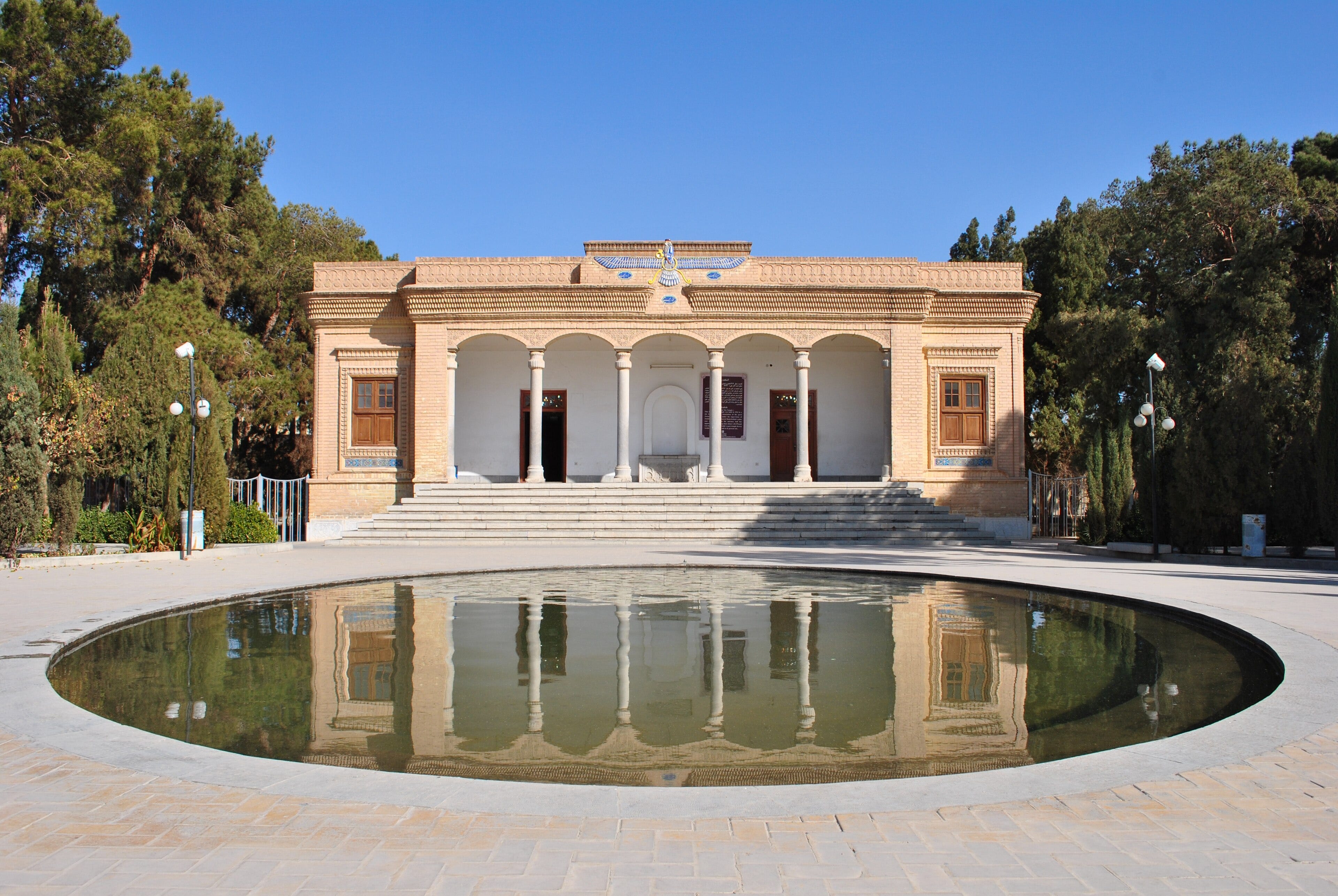
The Iranian pulse belongs in a different category from the others. There is no event to date. The Iranian plateau is adjacent to the Vedic world. Its language, its ritual and its cosmology never left the family.
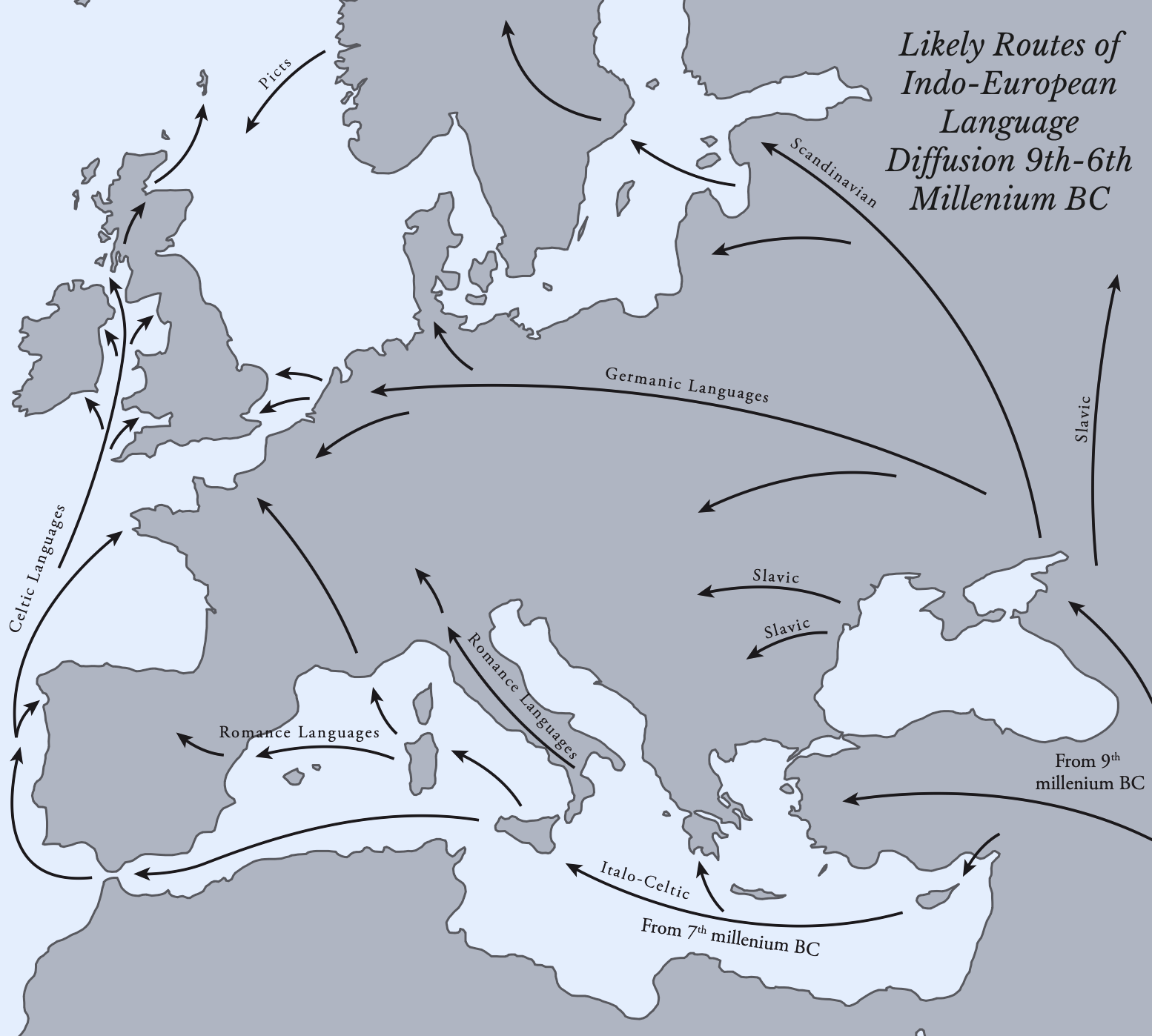
The next pulse moves further out. From about the ninth millennium BC, Indo-European speaking groups carrying what would later become the Germanic and Slavic language families travelled overland via Anatolia and north of the Black Sea into Europe. They were farmers, not raiders. They moved slowly, at the pace of the plough and the herd, and their expansion followed the retreat of the ice sheets and the opening of usable land.
The archaeology tracks them cleanly. The Linear Pottery culture, known by its German abbreviation LBK, spread from the middle Danube basin across a broad arc of central Europe between about 5,500 and 4,500 BC, leaving longhouses, cattle pens and characteristic incised pottery from the Paris basin to the Ukrainian steppe. The Bandkeramik farms sit on the loess soils that ran in an unbroken band from Anatolia through the Balkans and up the Danube corridor. The route is written into the ground. Their predecessors and cousins to the south, the LBK-related Starčevo-Körös cultures, carry the same package back into the Balkans and Anatolia and are datable to the seventh millennium BC.
They carried a religion of sky and thunder. The Vedic Dyaius, sky-father, became the Greek Zeus, the Latin Deus, the Germanic Tiw or Tyr, and echoes across the Slavic family. The trinities of gods that recur across the Indo-European world, Brahma-Vishnu-Shiva in India, Odin-Thor-Frey in Scandinavia, share a common upstream source.
They carried a shared vocabulary that survived every subsequent upheaval. The words for wheel, yoke, axle, wool, honey, horse and cow are recognisably the same in Sanskrit, Greek, Old Norse, Old Church Slavonic, and modern German and English. Sanskrit chakra is Greek kyklos is English wheel. Sanskrit madhu is Greek methy is English mead. This is not the vocabulary of a hunter-gatherer band. It is the technical vocabulary of an agrarian civilisation with wheeled transport, animal traction, textile production and beekeeping, all of which are attested on the subcontinent long before they appear in northern Europe. No invasion into India, from any subsequent direction, could have imprinted this cultural DNA on peoples spread from the Ganges to the Atlantic.
Two millennia later a fresh diffusion began, this time by sea. From the seventh millennium BC, Neolithic farmer-mariners moved out of Anatolia and along the Mediterranean coasts. They carried with them the Italo-Celtic branch of Indo-European, a language family that would eventually spawn Celtic, Latin and the Romance languages. They travelled in small boats, dugouts and reed craft, and skin boats reinforced with timber frames of the sort that survived on the Atlantic fringe into recorded history as the Irish currach and the Welsh coracle. They were island-hoppers and coast-huggers. They left behind impressed-ware pottery, a distinctive style that has been carbon-dated to about 5,400 BC at sites as far apart as Italy and Portugal. That is the moment the Italo-Celtic family split. The Italic branch stayed. The Celtic branch turned north.
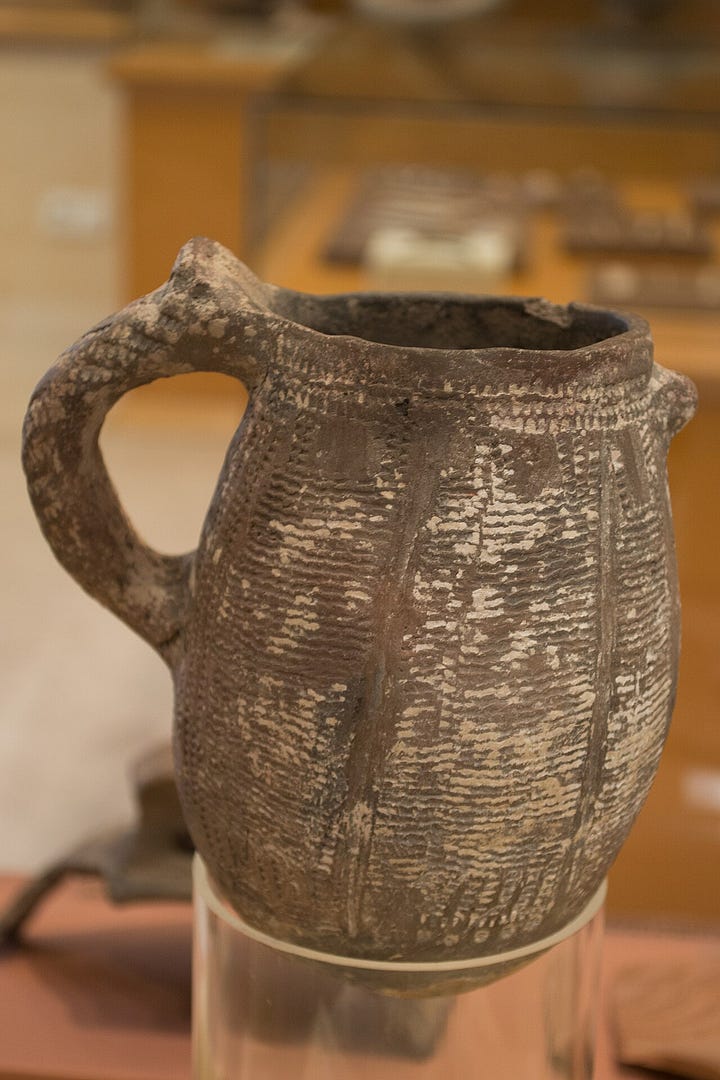
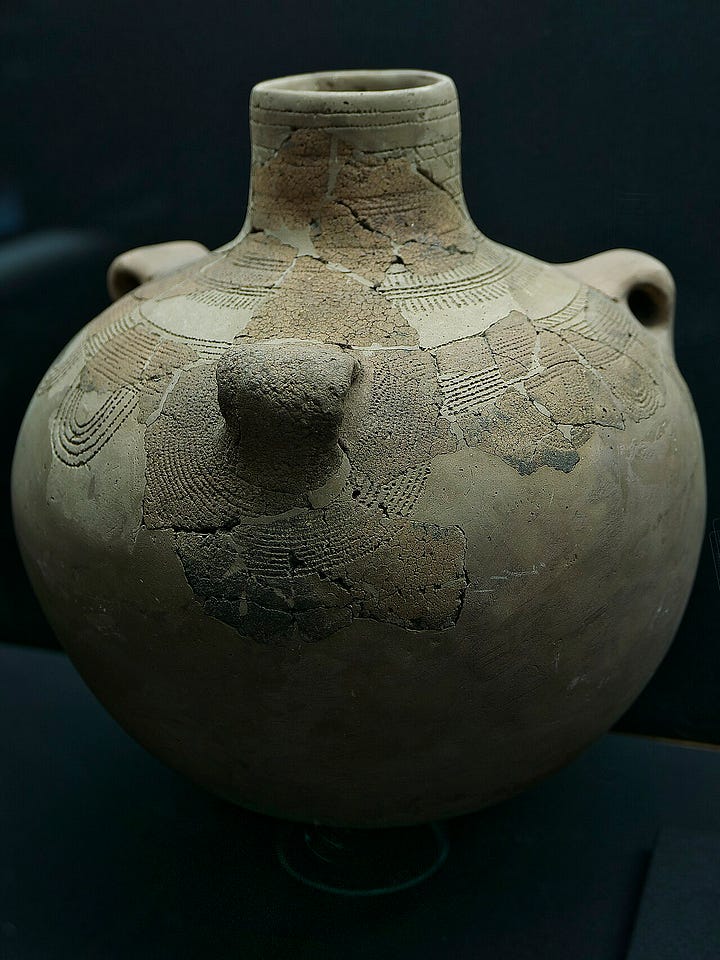
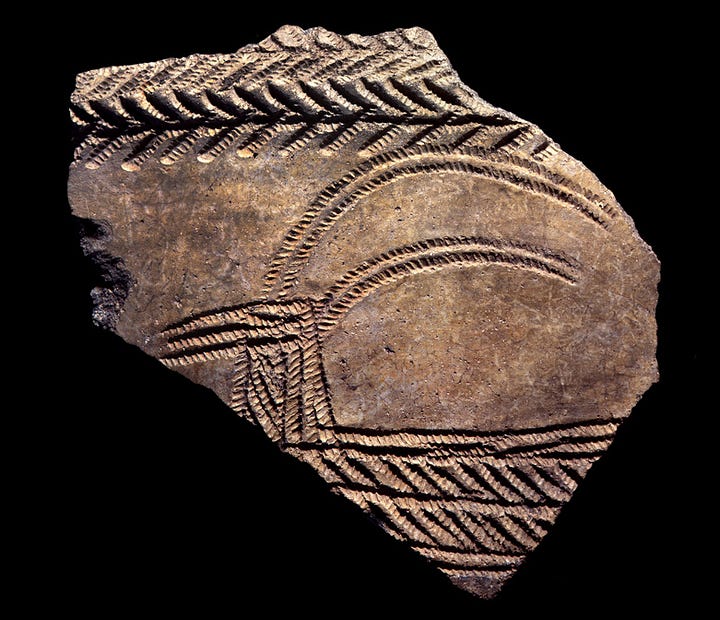
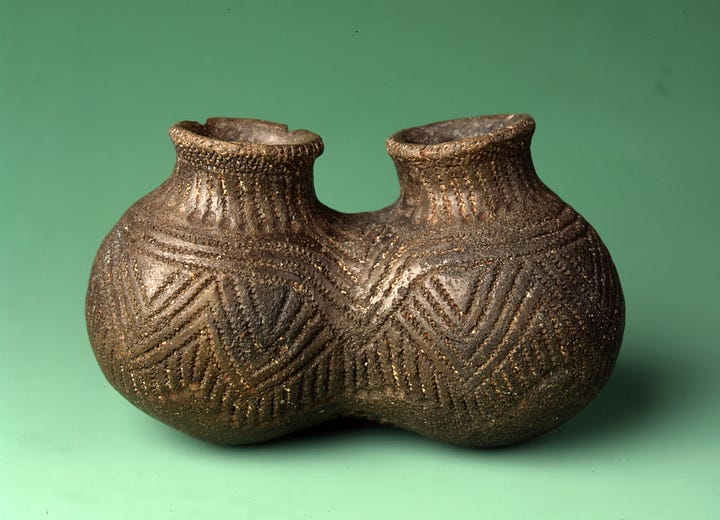
Island-hopping in the western Mediterranean in the seventh millennium BC was routine. Corsica is visible from Elba on a clear day. Sardinia is visible from Corsica. Sicily is visible from the Italian mainland. Malta is a day’s sail from Sicily. A boat that hugs the coast and makes short open-water crossings between visible landfalls moved the farming people, their seed, livestock and pottery from the Aegean to the Straits of Gibraltar in a few generations. That is what the impressed-ware distribution shows, in effect a marine motorway running along the northern shore of the Mediterranean, with the same pots in Anatolia, the Italian peninsula, southern France, and Iberia within a few centuries.
These people were farmers looking for new land in a sparsely populated post-glacial Europe. Jared Diamond explains that one language replaces another when its speakers arrive in overwhelming numbers, or when the older population dies. These Indo-European farmers who moved into post-glacial Europe entered a landscape thinly held by Mesolithic hunter-gatherers. The linguistic replacement was almost total.
The Atlantic route the Celtic branch took is still readable on the map. Portugal. Galicia. Gaul. Pays de Galles. Cornwall. Galloway. Galway. The “gal” names trace the coast, north from Iberia along the Bay of Biscay, up through the western British Isles, and terminate in the far west of Ireland. That is the fossil record of a working sea route.
Anyone who has spent time on the Atlantic seaboard can understand that the prevailing winds along the western coast of Iberia and up through the Bay of Biscay are the northerly Portuguese trades in summer. They push a small boat southward down the Iberian coast and hold it there against the return leg. To go north, they sailed headland to headland, using the diurnal land breezes at dawn and the sea breezes at dusk, and taking advantage of the northward-setting counter-currents that run close inshore against the prevailing offshore flow. You do not cross the Bay of Biscay in an open boat. You round it, hugging the French and Breton coasts and use the Channel Islands to cross to England. The Irish Sea is an inland lake by comparison. From Galloway to Galway is easy with the right wind.
A Neolithic mariner in a skin boat navigated by eye and tide. The local knowledge was passed from one crew to the next. The “gal” names on the map are the mile-markers of that knowledge, laid down over generations by people who kept using the route because it worked.
The oldest surviving Irish text, the Book of Invasions, records a tribe called the Erainn, from Arya, arriving from the south by sea and making their way inland to the sacred Hill of Tara. The Irish knew where they came from. They remembered the goddess who came with them. The Tuatha de Danaan, the children of Danu, are the far end of a chain that begins in the Rig Veda and passes through every major river system of Europe on the way.
The greatest of the Vedic rivers, the Sarasvati, dried up around 2000 BC. The tectonic event that starved her was catastrophic for the cities on her banks. Most people moved east to the Ganges. There is also a distinct pulse of Indian migration into the Near East dating to this period in the form of small, well-armed elite groups with a technological edge.
The obvious route out was the one the Indus-Sarasvati merchants had been using for a thousand years already, the Persian Gulf. The trading port of Dilmun, on what is now Bahrain, was the entrepôt. Sumerian tablets from Ur record shipments of copper, timber, carnelian, ivory and cotton arriving from Meluhha, the Sumerian name for the Indus-Sarasvati region, via Dilmun. The archaeology at Dilmun itself shows Indus weights, Indus seals and Indus-style pottery in quantity through the third millennium and into the second. When the Sarasvati failed and the cities of the Indus basin began to lose population, the trading families in Dilmun did not vanish. The small elite pulses that show up in Mesopotamia, Anatolia and northern Syria over the following centuries look very much like the descendants of that trading network moving inland to seek new patrons and new kingdoms. Trade routes rarely close cleanly. Traders adapt, and their sons ride the same routes for different reasons.
The Kassites took over Babylonia after the fall of Hammurabi’s dynasty. They ruled for over 500 years, longer than any Babylonian dynasty in history, with thirty-six kings. Koenraad Elst has argued that they arrived from India after the Sarasvati collapse, moving through Dilmun as their bridgehead. The first known Kassite king was called Gandash, an unmistakably Indian name. Indus-Sarasvati seals have been found at Kassite Nippur. Kassite pottery has been found at Dwarka on the Gujarat coast. The trade continued. The traders had moved.
The Mitanni ruled a kingdom in northern Syria and eastern Anatolia. Their king Mattiwaza signed a treaty with the Hittite king Suppiluliuma around 1350 BC in which he swore by the names of the Vedic gods Mitra, Varuna, Indra and the Nasatyas. Their charioteers were called mariyannu, a Vedic word for young warrior. Their throne names were archaic Vedic. Peacocks, native only to India, recur in their art. Their people spoke Hurrian, a non-Indo-European language, but their aristocracy did not. The pattern is standard for a small conquering elite settling among a much larger native population, like Anglo-Saxons in England. They ruled, gradually married in and their language faded but their gods and names stayed on the record.
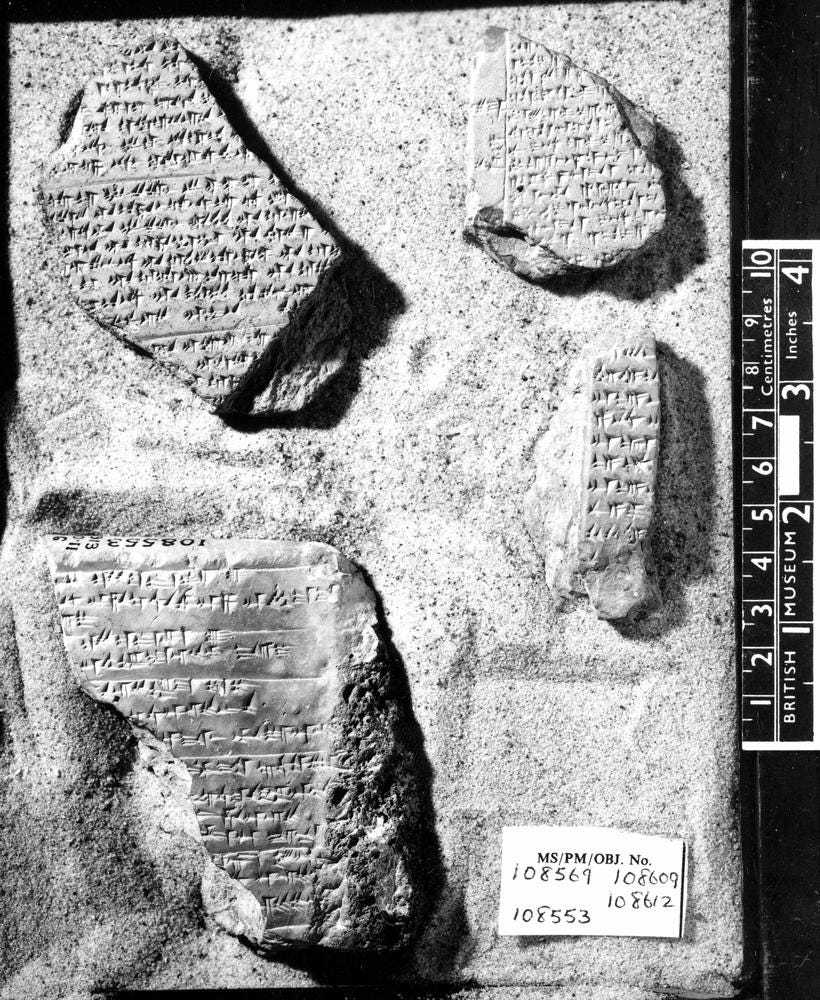
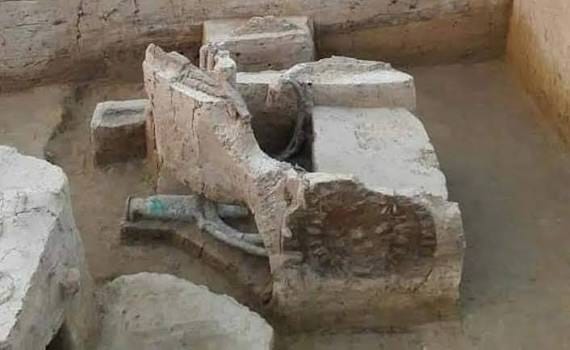
The Hittites came into Anatolia during the same window. They shared the chariot technology, the horse culture and the elite structures of the Mitanni and Kassites. Together, these three powers introduced Indian chariot warfare into the Near East. It became the ubiquitous form of Bronze Age warfare from Egypt to the Aegean.
The Greeks are the last of the Bronze Age pulses. Some of the earliest Indo-European speaking arrivals in the Aegean came the same way as the Kassites and the Mitanni, up the Levant and across into Anatolia. Others may have come overland. Their sky-god Zeus is the Vedic Dyaius. Their heroic literature is similar to Vedic epics in structure and in specific motifs, including the great battle over a stolen wife and the return of the wandering hero. Herodotus reported that when Alexander crossed the Hindu Kush into what is now northern Pakistan, the people of Nysa met him claiming descent from Dionysus, offering wine, and pointing to a mountain they called Meros. The Greeks recognised Mount Meru. There were legends, they said, that some of their heroes had come this way.
The Ionian cities that produced the first natural philosophers faced east. Miletus traded with India through Phoenician intermediaries throughout the sixth century BC, and the goods travelled with ideas as they always do. The philosophical framework of the earliest Greek thinkers reads like Vedic and Upanishadic material rendered into Ionic Greek. Thales held that everything comes from water. The Rig Veda opens with the primeval waters. Pythagoras taught the transmigration of souls, vegetarianism, numerical mysticism and a famous theorem, which have exact counterparts in Indian tradition. Herodotus himself is candid throughout his Histories that the Greeks learned their gods, their calendars and much of their science from older eastern sources.
The invasion myth must die. The migrations were out of India, in pulses. The Iranian branch was continuous. The Germanic and Slavic pulse moved overland in the ninth millennium. The Italo-Celtic pulse moved by sea in the seventh. The Celtic branch broke off in the sixth millennium and travelled up the Atlantic to Ireland. The post-Sarasvati military wave, Kassites, Mitanni, Hittites, and a fair proportion of the earliest Greeks, moved through the maritime trade routes of the ancient Near East around 2000 BC and installed themselves as ruling elites from Babylonia to Anatolia.
None of these pulses ran the other way. There is no linguistic substrate under Sanskrit. The Rig Veda knows no mountains, rivers or animals from a cold climate. The horse, the chariot and the fire altar all appear at Indian sites long before anywhere else. The Vedas describe the Sapta Sindhu. They do not describe a homeland elsewhere.
The outstanding character of ancient India is continuity. Very few civilisations can trace an unbroken cultural thread from six thousand years ago to the present. India can. The Rig Veda is still recited. The mother goddess is still worshipped. The rivers are still sacred. The rituals are still performed.
The two hills on the Cork and Kerry border are the far end of the same thread. The people who once lit the Beltane fires around them, and drove their cattle through the flames for protection, were doing what their ancestors had done in the Sapta Sindhu at the dawn of the record. They had come a long way from home. They had not forgotten where home was.
The full argument is set out in the first volume of my Maritime Trade History series, How Maritime Trade and the Indian Subcontinent Shaped the World (Pen and Sword, 2021). For the genetic and archaeological case against invasion, Michel Danino, The Lost River: On the Trail of the Sarasvati (Penguin, 2010), and his 2006 review article on genetics and the Aryan debate. Jim G. Shaffer’s contributions to Lukacs, The People of South Asia (Plenum, 1984) remain fundamental on the archaeological continuity. For the linguistic argument, Nicholas Kazanas, Indo-Aryan Origins and Other Vedic Issues (Aditya Prakashan, 2009). On the shared Indo-European vocabulary and the LBK farming diffusion, J.P. Mallory, In Search of the Indo-Europeans (Thames and Hudson, 1989) remains a serviceable overview even where its conclusions on direction of travel differ from mine. On the Dilmun trade and the Meluhhan quarter at Ur, Daniel T. Potts, The Arabian Gulf in Antiquity (Clarendon, 1990). On the Mitanni treaty and the Vedic gods of the ancient Near East, Gary Beckman, Hittite Diplomatic Texts (Scholars Press, 1999). Koenraad Elst’s essays on the Kassites appear in his collected volumes on the Aryan debate. On the Ionian philosophers’ debt to eastern sources, Thomas McEvilley, The Shape of Ancient Thought (Allworth, 2002). Michael Wood’s BBC series The Story of India documents the Persian fire ritual.
This essay is drawn from a three-volume history of maritime trade. The books are available on Amazon, via Garuda Prakashan in India, Pen & Sword in the UK.
Thanks for reading Maritime Trade History! This post is public so feel free to share it.
Comments
Nothing yet. Say the first thing.
Sign in to join the conversation.