
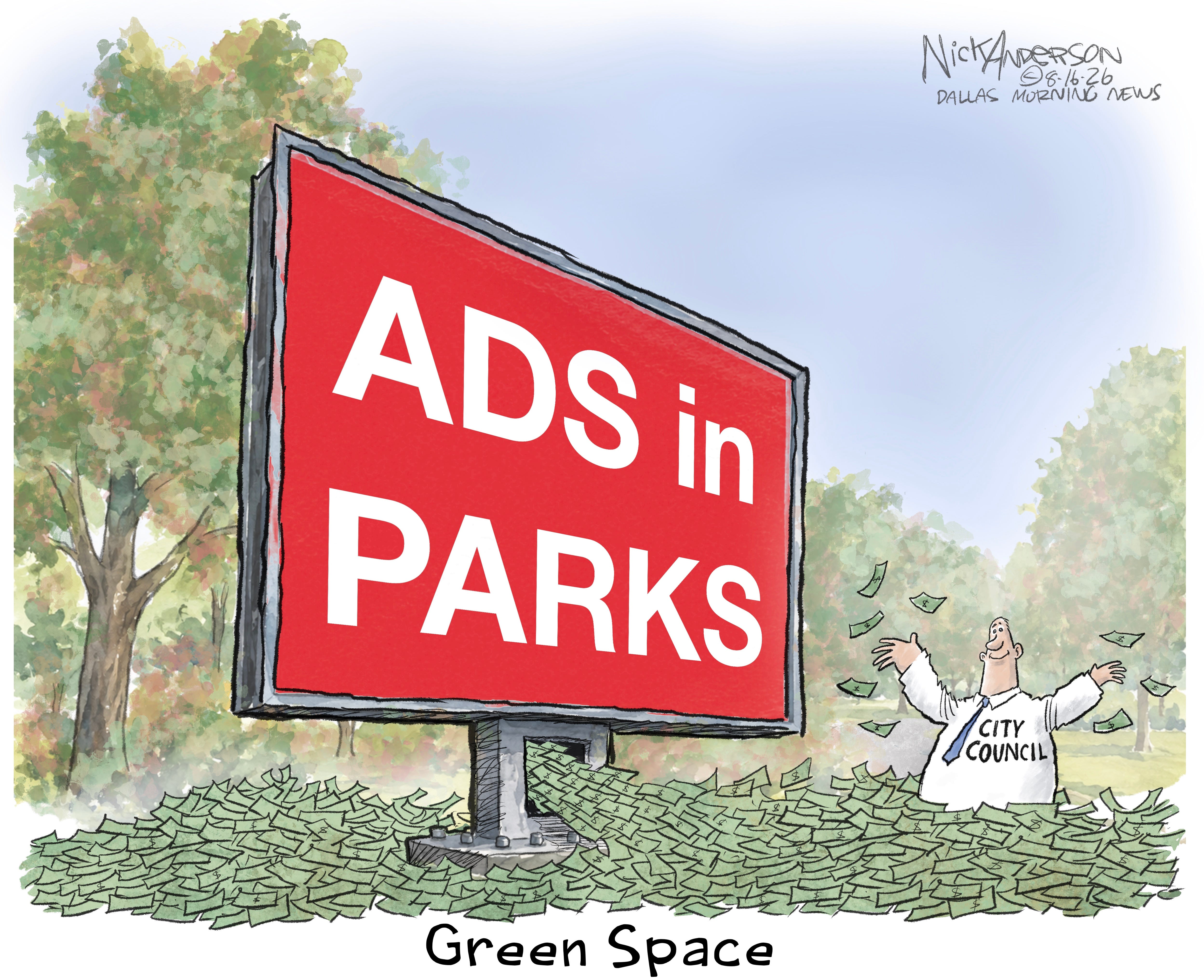
This cartoon for the Dallas Morning News is based on one of their editorials about putting billboards in parks to help fund them. The editorial board argues that Dallas is steadily commercializing public spaces in its search for revenue, and that the latest proposal—to install large digital billboards in city parks—crosses an unacceptable line. I agree.
The editorial traces what it sees as a pattern: first allowing digital highway billboards, then oversized digital signs on buildings, followed by advertising kiosks on sidewalks, and now proposing digital displays as large as 2,500 square feet inside public parks. The board contends that each step has further eroded the city’s commitment to preserving public spaces from commercial intrusion.
While acknowledging that the Park and Recreation Department faces legitimate budget pressures, the editorial argues that parks should not be treated as revenue-generating assets for advertisers. It notes that parks are often among the first services cut during budget shortfalls, but warns that selling advertising rights in parks sacrifices something far more valuable: the peaceful, public character of those spaces.
The board also expresses little confidence that the City Council will resist the proposal, citing its previous willingness to approve intrusive advertising elsewhere in the city. It argues that advertisers will inevitably seek the most scenic and heavily used park locations, fundamentally changing the experience of places intended for recreation and respite.
Ultimately, the editorial concludes that Dallas is making a mistake by trying to solve fiscal problems through the commercialization of public space. Parks, it argues, exist to provide peace, recreation, and community—not to capture residents’ attention for private advertisers—and City Hall has lost sight of that fundamental mission.The Dallas Morning News Editorial Board argues that Dallas is steadily commercializing public spaces in its search for revenue, and that the latest proposal—to install large digital billboards in city parks—crosses an unacceptable line.
The editorial traces what it sees as a pattern: first allowing digital highway billboards, then oversized digital signs on buildings, followed by advertising kiosks on sidewalks, and now proposing digital displays as large as 2,500 square feet inside public parks. The board contends that each step has further eroded the city’s commitment to preserving public spaces from commercial intrusion.
While acknowledging that the Park and Recreation Department faces legitimate budget pressures, the editorial argues that parks should not be treated as revenue-generating assets for advertisers. It notes that parks are often among the first services cut during budget shortfalls, but warns that selling advertising rights in parks sacrifices something far more valuable—the peaceful, public character of those spaces.
The board also expresses little confidence that the City Council will resist the proposal, citing its previous willingness to approve intrusive advertising elsewhere in the city. It argues that advertisers will inevitably seek the most scenic and heavily used park locations, fundamentally changing the experience of places intended for recreation and respite.
Ultimately, the editorial concludes that Dallas is making a mistake by trying to solve fiscal problems through the commercialization of public space. Parks, it argues, exist to provide peace, recreation, and community—not to capture residents’ attention for private advertisers—and City Hall has lost sight of that fundamental mission.
No posts
Comments
Nothing yet. Say the first thing.
Sign in to join the conversation.