
When Cambridge University Press recently asked whether it could license my textbook, “Diplomatic Tradecraft,” to artificial intelligence companies for training, I declined. The financial offer wasn’t terribly appealing — the publisher proposed giving me just 20 percent of the licensing revenue — but money wasn’t my main concern.
I said no because I believe there are professions whose essence cannot be reduced to patterns in text. Diplomacy is one of them.
This may sound odd coming from someone who wrote a textbook explaining how diplomats do their jobs — and who is dedicated to making diplomatic knowledge more accessible. Having founded the world’s first independent practical diplomacy school, the Washington International Diplomatic Academy (WIDA), I’ve spent nearly a decade helping to prepare the next generation of diplomats.
So why wouldn’t I want AI systems to learn from that work? Because they wouldn’t actually be learning diplomacy.
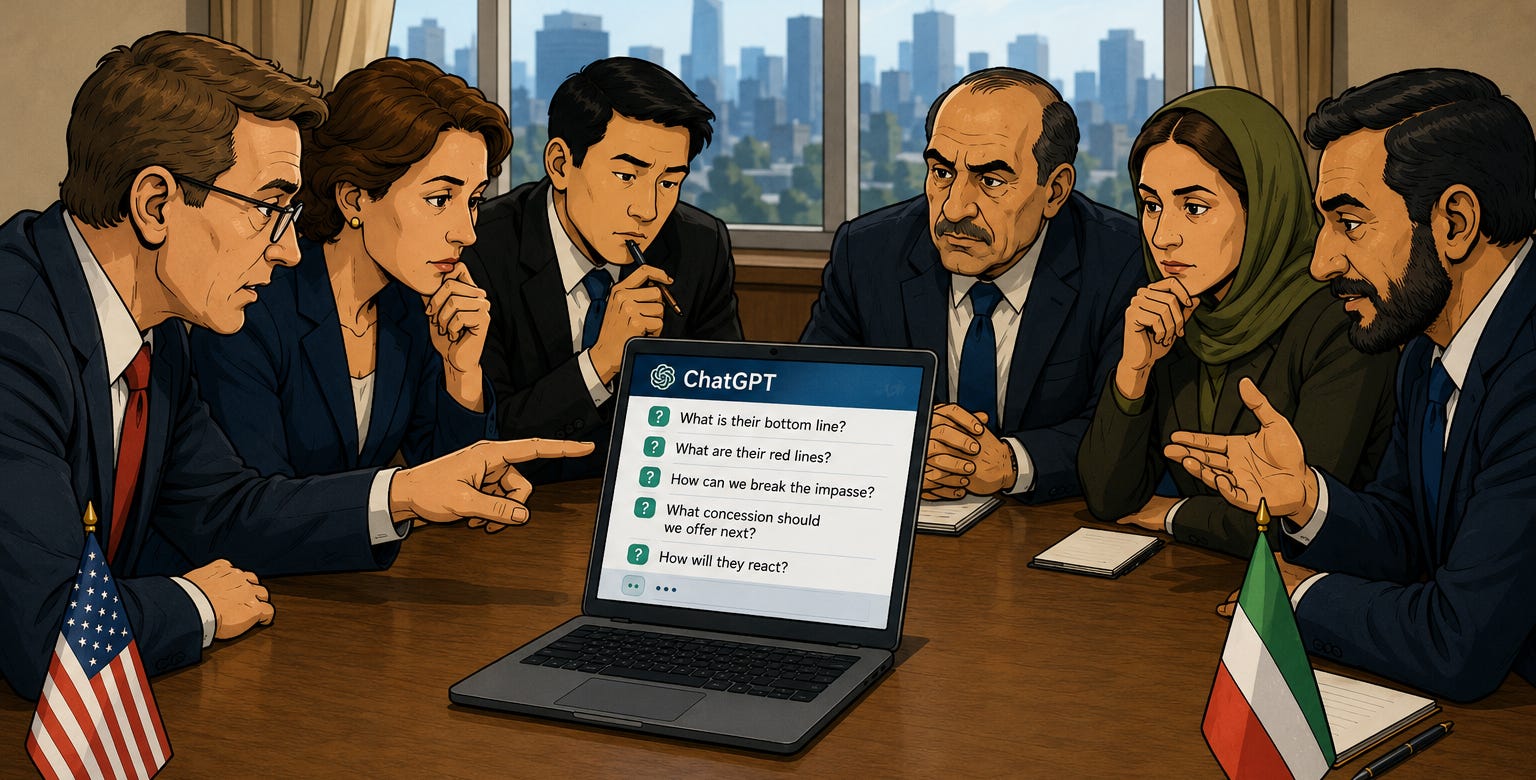
Here is how OpenAI’s ChatGPT described its relevant capabilities: “Modern artificial intelligence excels at processing information. It can summarize treaties, compare negotiating positions, draft speeches and even produce competent diplomatic cables. Those are impressive achievements, and diplomats will undoubtedly use such tools more often in the years ahead.”
But diplomacy is not principally an information profession. It’s a judgment profession.
The most consequential diplomatic decisions are made when information is incomplete, emotions are high, political constraints are shifting and the consequences of failure may include war. Success depends less on knowing facts than on interpreting people.
Can the person across the table be trusted? Are they bluffing? Which concession will unlock an agreement and which will invite further demands? When should silence replace argument? How do you preserve a relationship while delivering an ultimatum?
These are not questions with objective answers hidden in a database. They require judgment built through experience, observation and repeated interaction with human beings. That’s why governments shouldn’t expect new diplomats to master their profession by reading books or to rely solely on academic degrees — yet many governments take that exact approach.
At WIDA, where we train aspiring and practicing diplomats from around the world, this reality shapes everything we do. We teach not only what diplomats do at embassies, consulates and other diplomatic missions, but how they do it. Our courses are built around simulations, role-playing, negotiations, crisis exercises and constant feedback from career ambassadors with decades of experience.
Practical experience is so fundamental to learning diplomatic tradecraft that, until relatively recently, formal classroom training was largely nonexistent. Governments believed that tradecraft could be learned only on the job and made little effort to design curricula. Shockingly, Britain, which once ruled a global empire, didn’t have a diplomatic training facility until 2015. Australia opened one in 2018.
It’s quite telling that “Diplomatic Tradecraft,” which came out in 2024, remains the only practical diplomacy textbook ever published. Based on the material we’ve developed at WIDA, I did my best to ensure that the book teaches as well as informs, with help from some of our instructors and other highly skilled diplomats. Still, no book can fully replicate our training programs.
Academia prepares students to understand international affairs, not practice diplomacy. That’s the gap WIDA was created to fill. While experience is essential, new and aspiring diplomats don’t have to wait years to gain foundational skills on the job.
We built a curriculum that accelerates that process by teaching key abilities, such as forging and cultivating relationships, realigning interests, diplomatic reporting and writing, navigating government bureaucracies, negotiating, designing strategies and managing crises.
AI may describe how to de-escalate an international crisis. But that doesn’t mean it can recognize the subtle shift in a counterpart’s body language that signals a breakthrough — or a collapse. It may recommend a negotiating tactic based on historical examples. But it can’t build trust, earn credibility with skeptical foreign officials or persuade a leader to take an unpopular political risk.
Those are profoundly human achievements. The irony is that, as AI improves, diplomacy will become even more dependent on uniquely human skills.
If every foreign ministry can instantly produce briefing papers, draft talking points and summarize intelligence reports, technical writing will become less valuable. Judgment, creativity, empathy, cultural awareness, discretion and emotional intelligence will become more valuable.
These have always been the skills that separate exceptional diplomats from merely competent ones. AI isn’t likely to change that. If anything, it will make those differences more consequential.
My decision not to license my work for AI training won’t slow the technology’s advance. Countless books and documents about international relations, negotiation and other aspects of diplomacy will be available regardless of what I choose.
But at least for the time being, “Diplomatic Tradecraft” remains the only textbook that explains in detail the know-how of a grossly misunderstood profession — and I have the right to decide how it is used.
We live in the darkest time for diplomacy in at least a century, when the incompetence of those entrusted with some of the highest diplomatic positions too often leads to failure to end wars and save lives. It’s imperative that they gain real diplomacy skills and learn from longtime professionals.
Diplomatic tradecraft can’t simply be downloaded.
Nicholas Kralev is the founder and CEO of the Washington International Diplomatic Academy, and a former Financial Times and Washington Times correspondent. His books include “Diplomatic Tradecraft,” “America’s Other Army” and “Diplomats in the Trenches.”
Comments
Nothing yet. Say the first thing.
Sign in to join the conversation.