
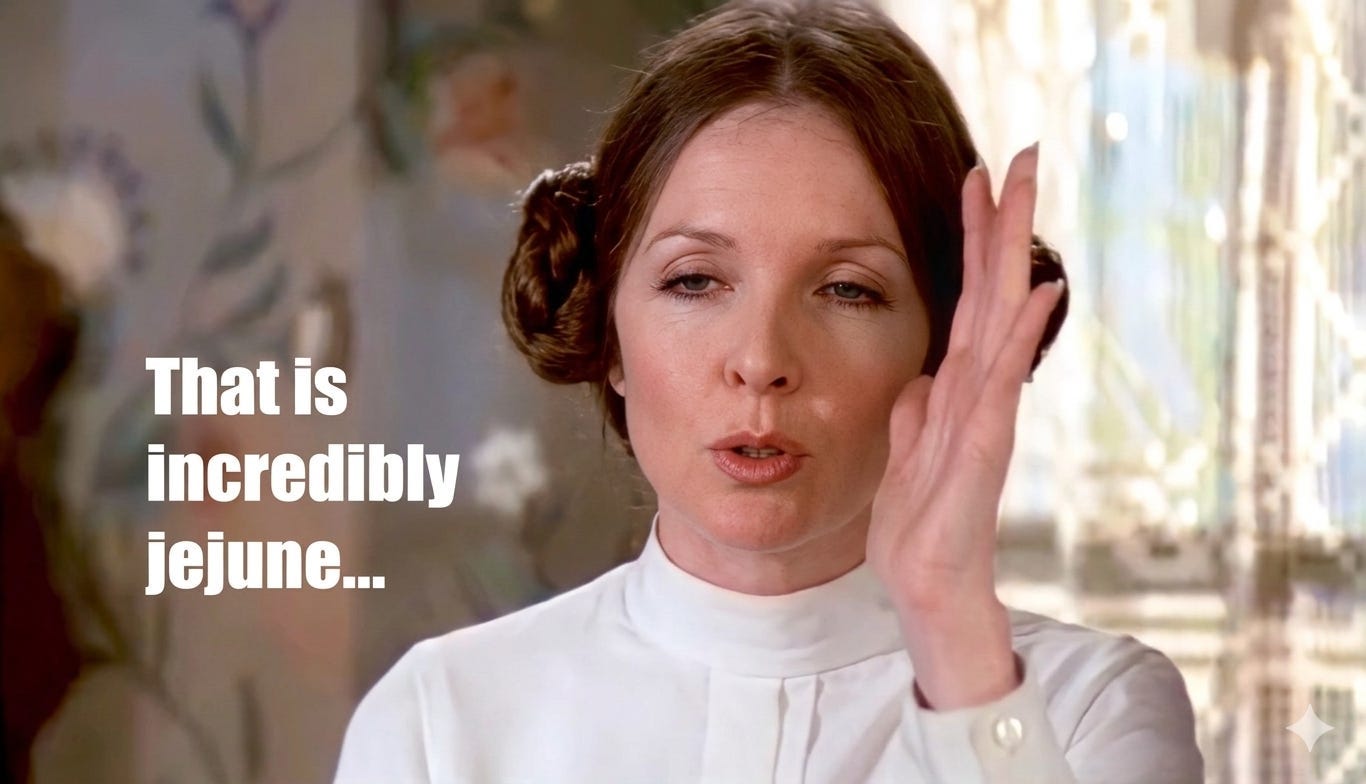
This is a good piece which did the rounds on Substack last week. It is true how amazingly full of shit certain people and ideologies are. And how one’s maturing involves casting off at least some of this.
I’d add that, as I’ve argued previously, running our political system by getting politicians to compete on all things (for promotion within their party and for the privilege of fighting other parties) and then making the whole operation a vertical of the entertainment industry means that awkward issues are never confronted directly. So shit (aggressive assertions of what ‘everyone knows’) can travel round the world before thoughtfulness has time to get its boots on - to coin a phrase.
This post is inspired by a series of articles that Dan Williams wrote on “becoming less left-wing”...most people on the left have no desire to become less left-wing...
Personally, I would be loathe to characterize [my own political evolution] as “becoming less left-wing.” What stands out for me...is that I used to be full of shit – utterly and completely full of shit – and that over time I became somewhat less so...everyone...should aspire to be less full of shit.
Before getting to the story...my basic worldview was inherited from my parents, a blend of 1960s countercultural ideology and Catholic social teaching. Both believe that the human condition...is one of profound immorality (hippies blamed this on “the system,” Catholics blamed it on original sin)...
By the time I finished high school...I had become an atheist...This is what made me so full of shit. I took left-wing utopianism and plugged it into the slot that heaven had occupied in the Christian worldview...none of that stopped me from condemning [society], based on a sense of moral superiority that was, in retrospect, entirely unearned.
This led me to strike a series of political poses that I now find deeply cringe. ([Naomi Klein, incidentally, still holds the exact same worldview I once did, which is why I can’t resist criticizing her — it’s really my younger self I’m arguing with.])
I don’t think there are any all-purpose rules for becoming less full of shit...The episodes I remember most clearly are ones in which some other person, face to face, called me out on my shit...
The first political ideology I explicitly endorsed was anarchism. This was less a coherent thought process and more an extension of the music I was listening to...So when I started university, in 1985...I naturally decided that mine was anarchism.
This was a pretty commonly held view at the time...because it allowed one to strike a radical political stance (”burn it all down!”), while avoiding all the difficult questions about what one intended to replace it with...
[While working as a computer programmer], one of [my colleagues] was from Lebanon...I mentioned that I was an anarchist. This caused him to say, “What, you mean like no government, no state?”...He replied with a question...: “But then who would manage the currency?” This brought me up short, because central banking wasn’t something that I...had spent even one second thinking about...I hadn’t really been taking political questions seriously...
As soon as I start[ed] thinking seriously about what the state does...that was the end of my youthful dalliance with anarchism...so I quickly got interested in the Frankfurt School...
This project led to my next turning point...at Northwestern University...Jim Johnson...decided to teach a seminar on the Frankfurt School...until one day he lost it: “You people and your critique of instrumental rationality…you would go over to the Department of Decision Sciences and take a course on rational choice theory.”
[This sent me to study] game theory...it’s the only reason I got a job in philosophy...it caused me...to understand why...the “prisoner’s dilemma” and collective action problems [were] actually important...
The last big turning point...occurred after I had started teaching at University of Toronto...I found myself teaching a course that had at least a hundred commerce students in it...they asked me a lot of questions that I didn’t know the answer to.
What made the situation so arresting was that the questions they asked were not complicated. One day a student asked “When you say ‘the corporation’, what sort of corporation are you talking about?”...I discover[ed] that studying 19th century political economy had provided me with a woefully deficient understanding of modern capitalism...
I was a man with a lot of big opinions about capitalism unmatched by any clear understanding of how capitalism worked...I resolved...to become less full of shit, by learning [how society’s institutions actually functioned] before passing moral judgment on them.
[There’s no general lesson here, except] that people have their reasons, but also their motives, and their motives are at least as important as their reasons...When I first read John Stuart Mill, I thought he was wrong about quite literally everything...I have no particular insight into how to create that sort of receptivity in others, other than calling them out on their bullshit, as the occasion merits.
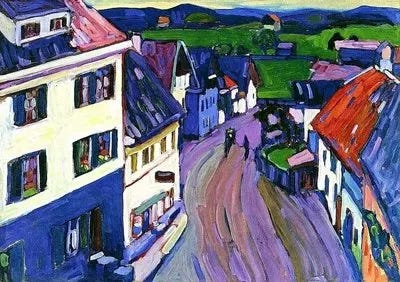
Answer here.1

Ana@AnaLolaNeva
Santiago Rusiñol (1861-1931) "Garden of Elegies, Son Moragues", c.1903

12:37 PM · Jul 27, 2026 · 2.11K Views
1 Reply · 26 Reposts · 156 Likes

#WOMENSART@womensart1
Cornish artist Kirsty Elson trawls the beaches of her home collecting driftwood as the raw material for her coastal scene sculptures #WomensArt

4:36 AM · Jul 28, 2026 · 3.6K Views
2 Replies · 40 Reposts · 225 Likes
I was intrigued by the coverage of Lindsay Graham’s death. Like so many of Trump’s enablers, Graham warned us about Trump before, having lost the battle, he became a massive Trump supporter and enabler. Given the way this kind of thing is covered, this is supposed to be about the lowest thing you can do. After all, if the electorate can’t trust your most passionate utterances, what’s the point of them? Well of course we all know the point of them. They’re all part of an elaborate practice in which words are used as part of the struggle for advantage over your opponent. Yes it’s ugly when you see it, but in some senses this is precisely what you’d expect from competitive electioneering. All successful politicians do it, though usually less brazenly, when they tack towards their base in the primaries and towards the centre in the election, when they campaign in poetry and govern in prose.
As you’ve already read, going through heaviosity half hour with a fine tooth comb every week as you do, heaviosity half hour favourite, Carl (Nazi Schmazi) Schmitt was onto this. He set out the issue here:
The situation of parliamentarism is critical today because the development of modern mass democracy has made argumentative public discussion an empty formality. Many norms of contemporary parliamentary law, above all provisions concerning the independence of representatives and the openness of sessions, function as a result like a superfluous decoration, useless and even embarrassing, as though someone had painted the radiator of a modern central heating system with red flames in order to give the appearance of a blazing fire. The parties (which according to the text of the written constitution officially do not exist) do not face each other today discussing opinions, but as social or economic power-groups calculating their mutual interests and opportunities for power, and they actually agree compromises and coalitions on this basis. The masses are won over through a propaganda apparatus whose maximum effect relies on an appeal to immediate interests and passions. Argument in the real sense that is characteristic for genuine discussion ceases. In its place there appears a conscious reckoning of interests and chances for power in the parties’ negotiations; in the treatment of the masses, posterlike, insistent suggestion or—as Walter Lippmann says in his very shrewd, although too psychological, American book Public Opinion—the “symbol” appears.
I also think of Paul Keating’s line that to be really good at the game, you have to know when and how to nick through the fence - which he did by turning tail on the GST he’d promoted as fundamental to Australia’s prosperity. Why? Because it enabled him to win an election. And I think more than anyone else, of LBJ who might have been the only person who could have got civil rights through the Congress because he’d posed as a racist all those years to get himself a Senate seat from Texas. But he grew up in a house with dirt floors. And when the time came, he betrayed all the racists. I still remember the thrill I got listening to the audiobook of this episode in Caro’s biography. It ends with the speech of his life. “We’ll write it in the book of law.”
In any event, I’m not writing an apology for Lindsay Graham. But the story in the piece below of Graham moving from a carefully hedged support for the Confederate flag to opposition to it moved me. Who knows whether it was cynicism throughout. I certainly don’t. Certainly most of us would have liked to have heard Graham denounce that flag from the get-go. But Graham’s handling of the issue might well have been a fine piece of statesmanship. I am somehow moved by the situation, and moved by something which Manning Clark turned into one of his stock phrases. Who knows what goes on in the heart of a man?
Lindsey Graham’s death this weekend has already produced a flood of assessments, most of them centered on his ... transformation from Donald Trump’s fiercest Republican critic into one of his most reliable defenders.
That transformation deserves the attention it is receiving. In December 2015 Graham called Trump a “race-baiting, xenophobic, religious bigot.” Five months later he warned that “if we nominate Trump, we will get destroyed” ... “and we will deserve it.” By 2017 he was a fixture at the president’s side. On January 6, 2021, he ... declared “count me out, enough is enough,” only to return to the fold within weeks...
But for those of us who study how Americans remember the Civil War, Graham’s career offers an earlier and equally revealing case study. His handling of the Confederate battle flag in 2015 was the template for everything that followed...
I never had the sense that Graham was ever a true believer in the Lost Cause. That was precisely the point. He inherited a political landscape shaped by Strom Thurmond ... in which the flag functioned less as a statement of conviction than as a loyalty test.
Graham had supported the 2000 compromise ... and for the next fifteen years he treated that arrangement as settled...
That reflex was on full display two days after Dylann Roof murdered nine Black worshippers at Emanuel AME Church in June 2015. Asked on CNN whether the flag should come down, Graham conceded that South Carolinians could “revisit that decision” if they wished, but insisted that “this is part of who we are.” He acknowledged that the flag was, for many, “a racist symbol,” yet argued that the state’s problems stemmed not from symbols but from “what’s in people’s hearts.” ...
Then the ground shifted. Governor Nikki Haley ... called for the flag’s removal on June 22. Graham stood behind her... Within a week he was on Meet the Press describing the flag as a “road block to the future of my state”...
The families of the victims had called for its removal... What had been “part of who we are” on Friday had become an obstacle to progress by Sunday.
Even then, the limits of his conversion were visible... he refused to countenance removing Robert E. Lee’s name from schools and roads, insisting that Lee had “earned the right to be called one of the great figures in American history.” ...
Graham’s final position on the flag was the right one... But the sequence matters. Graham did not lead public sentiment in South Carolina. He tracked it, with a delay of roughly seventy-two hours.
The flag came down not because a senior statesman spent political capital to bring his constituents along, but because the victims’ families made continued defense of the flag untenable, at which point defending it no longer served anyone’s career.
This is why the flag episode belongs at the center of any honest assessment of Graham’s public life. His reversals on Trump were not aberrations. They were expressions of the same instinct he displayed in June 2015: [a sensitivity to where power was moving, joined to a willingness to abandon yesterday’s position without discomfort].
Historians of Civil War memory have long understood that Confederate symbols persist not primarily through the passion of their defenders but through the calculation of politicians who find defending them cheaper than removing them.
Lindsey Graham’s career is a case study in that calculation. When the price changed, so did he...
The battle flag that flew over his entire rise through state politics came down only when defending it finally cost more than letting it go.
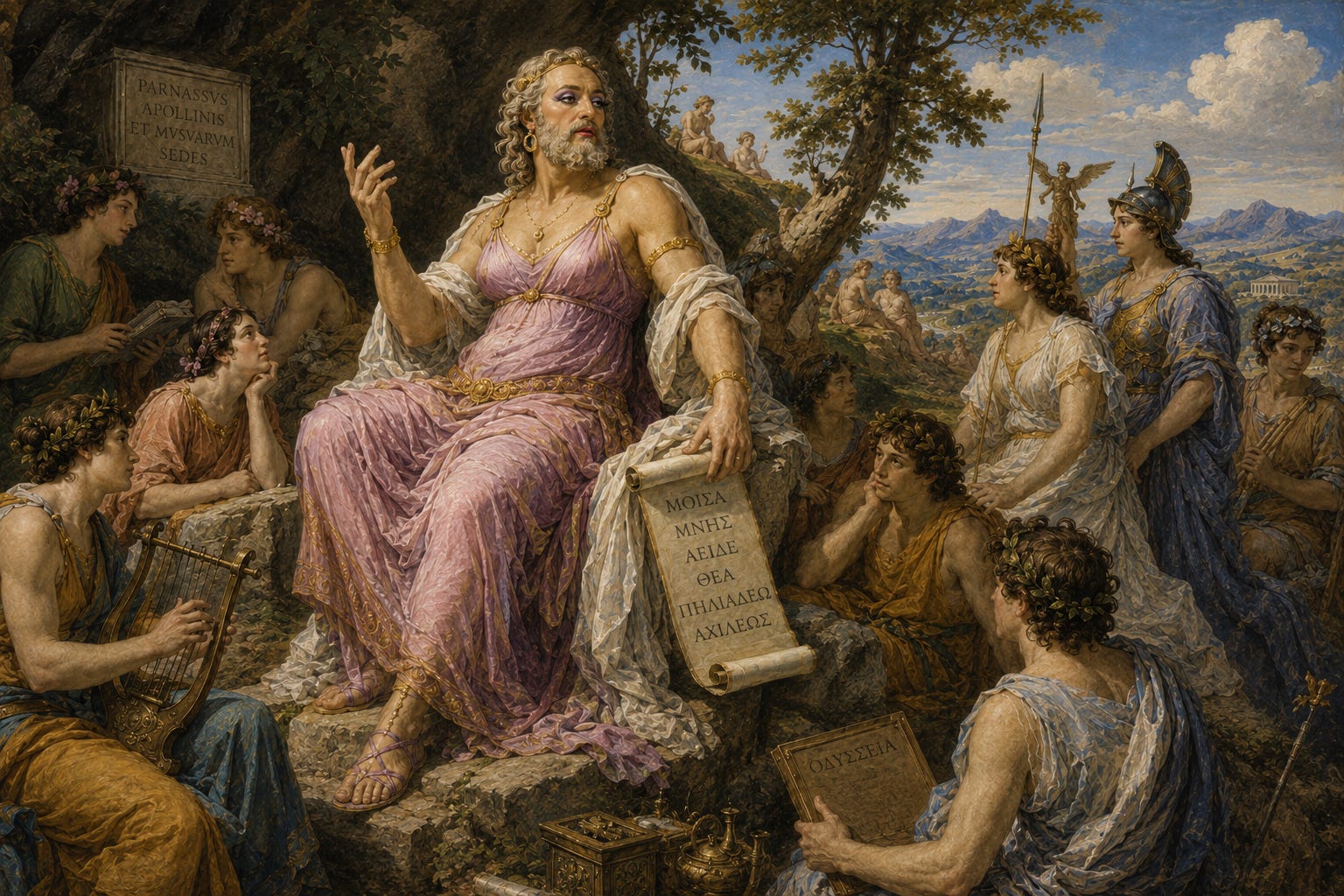
Though she is a person of gender, as Paul Krugman hilariously referred to Janet Yellen, Emily is sick of being asked about gender. A fair call indeed, though the entire interview is about gender, which is a tad awks.
You’ve dedicated much of your career to bringing the Odyssey to life. What are your initial reactions to the film?
I very much hope many people go and see it in cinemas... But I hope those who do so will also read or reread the poem. I hate to be that guy, but the book is a lot better than the film.
You’re the first woman to have her translation of the Odyssey published in English. What does that mean to you, and why does it matter?
Mostly, I don’t think it matters at all. It’s a silly little factoid... But all of a sudden, “Woman Translates Odyssey” became the universal headline, and then journalists began to ask me endlessly... about my supposedly...feminist perspective.
I’ve found it quite limiting to have my work constantly framed by journalists in terms of my gender... as if all our toys must be pink and no other color... As members of the unmarked gender category, men get to imagine that their gender has nothing to do with their...perspectives on...literature...
I took on the project of re-translating the Odyssey, and then the Iliad, for reasons that had nothing to do with my gender identity, but had to do with my specific scholarly training... I felt that there was an opportunity to provide English readers with translations in traditional, regular meter...
[Most translations of ancient texts into English have been done by men, despite plenty of qualified women classicists.] Maybe it’s partly about networks: I personally would have never done any of my translations if I hadn’t been invited to do so...
I’m interested in Athena and some of the other Goddesses in the Odyssey... How, if at all, does the movie explore this complicated status?
Nolan strips away most of the divinities in the film - apart from Zendaya’s Athena, who... lacks all her usual attributes as a war goddess and goddess of strategy... I still missed the divine elements of the poem.
To address your actual question: Calypso, in the poem, has a wonderful speech complaining that male gods get to kidnap and rape any mortal woman they choose - whereas female gods are often stymied when they do the same, as with her own attempt to keep Odysseus prisoner... Charlize Theron has no such speech... her role in the film is mostly to be Damon’s helpful psychiatrist...
What goddess’ power would you want and why?
As a translator, I see my work as having most affinity with Iris, the divine messenger goddess... But I don’t really want to be any kind of goddess; it means, inevitably, having mortal blood on one’s divine hands...
[In the Iliad, Achilles uses a small power from his goddess mother, Thetis, to help the Trojans - and even that small piece of power turns out to be deadly for both sides.] Odysseus has some of the strategic cunning of Athena... I would rather have less power and less honor. If a goddess, any goddess, offers me power, I plan to decline.
You are no stranger to sexism in the world of Classics... What are one or two comments that have made you laugh, and do you have any strategies for not letting them get to you?
My partner had the idea of the misogynistic trolling button, after I got a little rash of hate mail and death threats... I have had quite a lot of people click it and then write things like, “I love your translations!”
In general, I remind myself that none of it has anything to do with me... “If you can keep your head when all about you/ are losing theirs and blaming it on you....” - then, “Yours is the earth, and everything that’s in it;/ And what is more - you’ll be a man, my son!”...
I think often about Euripides’ Helen - a wonderfully funny, dark, profound tragedy... in which Helen never went to Troy at all: Hera made an “eidolon” in her stead, over which men fought, while Helen herself waited it all out in Egypt... this version of Helen has the patience of Penelope, and the cunning of Odysseus: she can... get out - of both a marriage and a narrative she doesn’t want... I can invent new stories.
If you want to see what Emily Wilson really thinks of the film (not much) you can read a more serious effort in the London Review of Books.

Historic Vids@historyinmemes
The famous “Duck” at the Avenida Palace Hotel in Barcelona. The famous “Duck” at El Avenida Palace in Barcelona is an optical illusion created by the hotel’s elegant spiral staircase. Viewed from the very bottom while looking straight up, the staircase’s sweeping curves, brass

6:30 AM · Jul 31, 2026 · 112K Views
40 Replies · 280 Reposts · 1.98K Likes

LeoDaVinciWave@LeoDaVinciWave
Designed by Julia Morgan, Hearst Castle's Roman Pool is a stunning masterpiece of architecture and craftsmanship.

10:35 PM · Jul 30, 2026 · 11.7K Views
14 Replies · 111 Reposts · 839 Likes

Boo@333too3
Where no mushroom has gone before.

1:33 AM · Jul 31, 2026 · 99.2K Views
176 Replies · 989 Reposts · 8.2K Likes

Paul Kelly has written numerous books of ‘instant history’ in which blow-by-blow reporting on the various machinations of daily politics is re-told and spun into a larger story. Sometimes the larger story offers something new and powerful, as in the case of his The End of Certainty. However, often I find these explanatory overlays of what was really going on ponderous and unconvincing. They remind me of Henry Ford’s famous edict. Just after he opined “history is bunk” he said something which I find genuinely funny - why I’m chuckling now (can you chuckle inside?) “It’s just one damn thing after another”.
Anyway, here are extracts from Frank Bongiorno’s review of his latest.
[W]ith his new book on the Abbott–Turnbull–Morrison era, the Australian’s editor-at-large Paul Kelly has completed what his publishers call a “masterful trilogy on modern Australian politics”...
Kelly’s perspective is that of a C/conservative... who believes the decline of traditional morality has made governing harder... he argues the demise of shared values... provided overwhelmingly by Christian belief has led to a proliferation of “progressive” causes pursued with moral passion... [this] demanded skills beyond the capacities of three prime ministers [and] the political system...
Is his account convincing? My own sense is that the decline of Christian belief and observance have indeed been far more disruptive for Western politics than most conventional commentators concede... Christian belief informed a broad set of values that sustained community and belonging. All accepted they would eventually be judged before God...
I suspect I’m more sympathetic to the gains from the decline of shared values than Kelly... [but] he rests too much of his argument on culture and values and too little on economics and inequality — the other story of the last forty years...
Yes, the Liberals were often out of tune with “progressive” social values... but many of these same voters loathe the Liberals and Nationals because they defend the asset-owning class... middle-aged and older Australians, with homes and superannuation, are the Coalition’s most cherished constituency, while younger people, with stagnant wages, [pay] for these concessions to their elders...
To argue that cultural or moral concerns overwhelmingly caused the Coalition’s humiliation of 2022 and crisis of 2025 is to overlook quite a lot... where Kelly saw populism and overreach in Bill Shorten’s policies, many younger voters saw a leader... dealing with... a legacy of unfairness from the Howard era...
In his splendid portraits of each of the prime ministers Kelly has revelations for us. He presents Abbott as a “warrior” [with] an unhealthy interest in whether the Australian Secret Intelligence Service could carry out Mossad-style assassinations... Abbott nonetheless wants to send Defence Force personnel into Ukraine to secure the site of the downed Malaysian Airlines Flight 17 jet... the 2014 budget’s broken promises that most damages his government... Abbott [is] gone in two years, passing a wasted majority to Turnbull.
For Kelly, Turnbull was a technocrat and a businessman in an intensely political environment... his failure to call an election towards the end of 2015 was “the turning point at which modern history failed to turn” (to borrow from G.M. Trevelyan...) — for Turnbull would surely have won handsomely...
Turnbull’s fate points to one issue little discussed [here]: Kelly has much to say about the progressive media, but his own employer, News Corp, gets limited coverage. He does note Peta Credlin, translated to Sky, labelling Turnbull “Mr Harbourside Mansion”... an understanding of the period calls for attention to the Murdoch media’s role in... undermining Coalition leaders...
I agree with Kelly’s assessment that the transactional Morrison was the most successful of the three prime ministers... the surprise victory over Bill Shorten’s Labor Party in May 2019... Australia’s performance in minimising deaths was impressive...
Kelly argues Covid was instrumental in bringing Morrison down, but he is also alive to his defects of judgement, empathy and character... his tin ear left him ill-equipped [for] the fallout of the sexual assault of Liberal staffer Britanny Higgins...
Kelly is scathing of Morrison’s handling of the 2019–20 bushfires and his secret assumption of several ministries: a prudent decision to swear him in as health minister developed into behaviour that wrecked Morrison’s credibility... he was secret treasurer even while Frydenberg, the real treasurer, shared the Lodge with him during the pandemic...
Morrison was the most consequential of the three in terms of legacy: AUKUS was a masterpiece in the judging of the moment... But in the end, he “was stranded in a transforming nation he struggled to understand.”
And in many ways, that is the story of the Liberals between 2013 and 2022, [and] still the story today... Future historians will debate what mixture of structural determinants and personal follies turned Australia’s most successful political party since the second world war into a rabble in danger of being replaced by One Nation...
The book, and the larger body of work of which it forms a part, is an exceptional contribution to the history of modern Australian politics.
Some good questions from Martin McKenzie-Murray.
In 2021, Paul McCartney sat for a New Yorker interview. The resulting profile... was 10,000 words long and almost perfectly devoid of fresh insight... his long fossilised schtick might radiate a dull warmth but it has also principally served as a powerful shield to any interesting disclosure.
At the time, I wrote:
‘These days, McCartney often strikes me as the world’s least interesting man... He was in control, as he almost always is.’
What is popularly known about McCartney... is that he’s a savvy man and very often in control and it was his de facto leadership of The Beatles that so alienated the others...
This is neither an implied criticism, nor prelude for an explicit one. A genius took control. Good for him, good for us.
In Peter Jackson’s eight-part Get Back documentary series... McCartney argues... he’s simply filling a vacuum left by Epstein’s death and Martin’s absence... The Beatles weren’t just a band, but a phenomenon, and it required a stable, central force to keep the ship from listing in weird and heavy weather. ...
Anyway... I simply write this as preamble to a thought experiment I occasionally indulge: what questions would I ask Paul McCartney if given the chance?...
And the short answer I’ve given myself in all these years is: fuck knows.
But if I can hypothetically assume McCartney’s tolerance for a series of questions... my first source would be Ian MacDonald’s Revolution in the Head...
These are some possibilities:
Lennon/McCartney was the consistent credit on all songs written by one or the other. I’d like to know if McCartney thought the best Beatles songs, besides George’s, were ones written in collaboration with Lennon – or in competition...
I’m certain this question... has been put to McCartney before... he’s deflected an honest reflection by genuflecting to his dead friend...
But what was lost, and what was gained, by shifting from collaborators to competitors? The answer, perhaps, is in this recent Ian Leslie book which I’ve recently ordered.
Perhaps, rather than simply finding questions from Macdonald’s book, I’d ask McCartney about his contempt for it... Here’s McCartney discussing the book with Uncut in 2004, a year after MacDonald’s suicide:
“...I should know because I was fucking there. It’s all this received wisdom shit.”
McCartney never audits his grievances... So it’s been allowed to stand: McCartney’s characterisation of MacDonald as a kind of pretentious fantasist and solemn spewer of received wisdoms... Is McCartney objecting to a scandalously sloppy and tendentious book – or merely the work of interpretation itself? ...
Related question: You’ve spoken derisively... about “received wisdoms” about The Beatles. But does that make you the custodian of the truth?... The Beatles have attracted parasites just as much as witless academics...
Question: John Lennon had a sharp tongue. He could be cruel, verbally and physically... Lennon spoke caustically about you: in song, in the press, in private. What criticisms do you now consider legitimate?...
A follow-up question: How much were you aware of John’s history of violence – against his partners, and others? Did Cynthia ever confide in you about his abuse?
Question: The Rolling Stones went to America in the mid-’60s to enjoy eight-track recording there. The Beatles stayed home, and used four-track. Did you consider recording in America?...
Question: Do you regret your treatment of George? His writing developed later than yours – but then a load of great songs, rejected for the last Beatles albums, were released on his first solo record...
Question: When the Beatles broke up, not one member had yet turned 30. The majority of brilliant, history altering and long beloved albums were made by people in their twenties. Why? How?
Question: Towards the end of The Beatles... John told Rolling Stone: “I no longer believe in myth, and Beatles is another myth... The dream is over... It’s over, and we gotta – I have to personally – get down to so-called reality.”
Many years have passed, and The Beatles are no longer folk devils. Are you now a custodian of myth? And does it matter if you are?
A thought experiment, and no more. But I’d be delighted to hear any answers you might have to some of these – and to hear what questions you might put to the chap yourself.
From a movie star - who else?

NowThis Impact@nowthisimpact
This speech has been circulating in MAGA circles, and they’re absolutely horrified by it.
7:30 PM · Jul 27, 2026 · 140K Views
78 Replies · 1.06K Reposts · 4.79K Likes

Museo Privado 🔻@museo53
Noche en Niza, 1891 🖌️Edvard Munch (1863-1944) noruego. #munch

12:35 PM · Jul 25, 2026 · 1.68K Views
2 Replies · 23 Reposts · 126 Likes
Ana@AnaLolaNeva
Santiago Rusiñol (1861-1931) "Gardens of the Generalife", 1909

1:50 PM · Jul 27, 2026 · 4.42K Views
31 Reposts · 301 Likes
HT: Simon Corden on LinkedIn who pointed me to this paper. After Claude summarised it for me, I asked it to write you an article. Which it did. Apologies for the odd AI tick eg “Startling”. Really?
A text message arrives on your phone in October: your flu shot is overdue, here’s how to book one. It costs the health department a few cents to send. It takes you four seconds to read. Nothing about it looks like policy in the usual sense — no vote in a legislature, no line in a budget bill, no politician standing at a podium explaining sacrifice.
And yet a new paper by John List and colleagues asks a question that turns this small nudge into something much bigger: what would it cost, in a tax or subsidy, to move as many people as that one text message does?
For the flu shot, the answer is startling. To get the same lift in vaccination rates through price alone, you’d need to make the shot completely free — a 100% subsidy. The nudge that fits in a text message is doing the work of an entire government spending program.
It isn’t alone. Cigarette nudges are matching the pull of a 28% tax hike. Alcohol nudges, a 34% one. Even the mildest case — a home energy report comparing your electricity use to your neighbours’ — stands in for an 11% tax on power.
So the case looks settled: cheap nudges doing the job of expensive policy. Except this is where the paper does something more useful than count things. It asks what “doing the job” is actually worth — and that turns out to be a different question from how cheap the job was.
Here’s why the two come apart. A tax on a “bad” — cigarettes, alcohol, carbon-heavy electricity — isn’t just a way to raise money or make people behave. When it’s doing its job, it’s closing a gap: between what a purchase costs the buyer and what it costs everyone else, or between what people want in the moment and what they’d tell you they wanted if they’d thought it through properly. A pack of cigarettes doesn’t only cost the smoker eight dollars; it costs bystanders in secondhand smoke, and it very often costs the smoker more than they’ve bargained for, in money or in years. Price the pack correctly, and you’ve closed that gap. That’s the sense in which a tax on a bad can raise welfare rather than just raise revenue — it isn’t punishment, it’s correction.
Nudges try to close the same gap through a different door: instead of changing the price, they change the moment of choosing. And that’s where the paper’s real twist arrives. Judged dollar for dollar spent, nudges look extraordinary — a dollar put into a flu-shot nudge returns something like sixty dollars of welfare, more than almost any government program on the books. But judged in total, a nudge can only move the people it reaches, while a tax touches everyone who buys the good. Scale both instruments up to their best possible size, and in four of the five markets studied, the tax delivers far more welfare overall than the nudge ever could — seven times as much, in the case of electricity. Nudges win the sprint; taxes win by turning up to every race.
The one market where the nudge wins outright, at every scale, is cigarettes. And there the paper delivers its sharpest finding. Current US cigarette taxes are already almost exactly where the model says they should be — the gap they’re meant to close is already closed. Add a nudge on top now, and you’re not correcting anything. You’re pushing smokers below the level they’d freely choose, while chipping away at tax revenue that was doing useful work. The one instrument that looked cheap and virtuous everywhere else turns, in the single market it dominates, into something that quietly makes things worse.
The lesson isn’t that nudges are a trick, or that taxes are always superior. It’s narrower and more useful than that: nudges earn their keep at the margin, in programs too small or too specific for a price lever to bother with. Ask them to replace a tax at scale, in a market with a real problem, and the cheapness that made them look so good starts to cost something after all.

helen warlow@HWarloww
"Behind the Plough' Simon Palmer North Yorkshire Watercolours artist (Wensleydale and Uredale) A personal favourite Housework beckons. Back soon. H

9:51 AM · Jul 23, 2026 · 3.28K Views
4 Replies · 42 Reposts · 290 Likes

gregorio catarino@gregcatarino1
Michelle Morin

1:21 PM · Jul 27, 2026 · 4.83K Views
4 Replies · 63 Reposts · 395 Likes

Maude Frome@frome_maude
From 1772 to 1783 Mary Delany made 985 intricate & botanically accurate floral mosaics from paper. The precursors of the collage style of #art, Mary said she had invented a new way of ‘imitating flowers’ & continued until her eyesight failed. #MythologyMonday #FairyTaleTuesday

8:48 AM · Jul 27, 2026 · 5.35K Views
7 Replies · 101 Reposts · 397 Likes
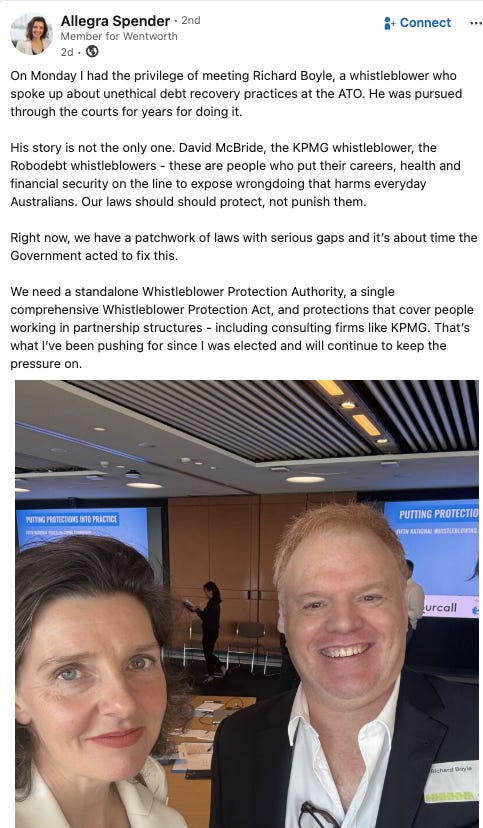
Party politicians may have always been hopeless at this, but my suspicion is that a few backbenchers from the major parties cared and did stuff. Perhaps I'm being unfair, I'd be happy to be corrected, but have any Labor or Coalition backbenchers stood up for whistleblowers generally? (And if so, have they done it while their party was in government?)
And in the meantime good on you Allegra for fighting the good fight.
helen warlow@HWarloww
"Behind the Plough' Simon Palmer North Yorkshire Watercolours artist (Wensleydale and Uredale) A personal favourite Housework beckons. Back soon. H
9:51 AM · Jul 23, 2026 · 3.28K Views
4 Replies · 42 Reposts · 290 Likes
Further details here.

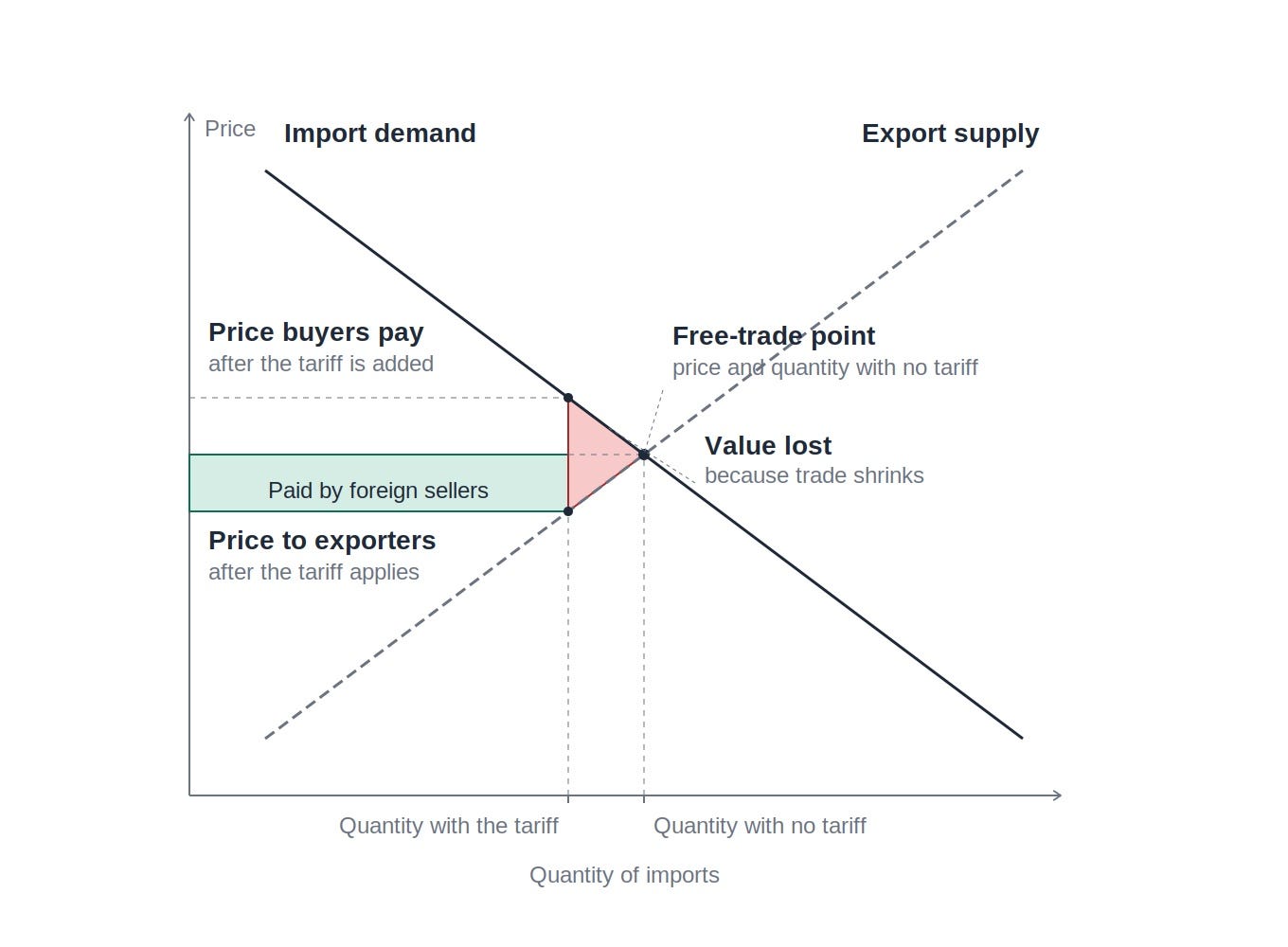
I don’t know what Soumaya Keynes was thinking (or smoking?) when she wrote this column. Perhaps I misunderstand her, though I can’t think how. In any event, if you apply the simplest bit of intuition, if Donald Trump can impose tariffs on imports and the importers pay 60% of them, I’d call that a pretty good day’s work for America. For the modest price of American consumers paying the other 40%, they get foreigners to pay them a big new tax slug. Oh, and that additional 40% of the tariff they pay, it doesn’t disappear. It turns up in Government coffers and so enables higher entitlement spending or lower taxes elsewhere. And while 60% seems way too large to be true in the long-term, it’s otherwise consistent with the idea that large countries’ tariffs shift the terms of trade. It’s been dispiriting to watch how rarely economic pundits show an understanding of this.
As Gene Tunny and I wrote here,
This means that for large countries, tariffs create two offsetting effects. First, they harm an economy by “distorting” it — moving production and consumption away from their optimal configuration. This “rocks in the harbour” effect is minimal when tariffs are low because it rises as the square of the tariff. By contrast, the terms of trade effect are linear. So, below some moderate level, tariffs induce more in terms of trade gains than they cost in distorting the economy.
Simple, indicative modelling by Lateral Economics, of which I’m CEO, suggests gains outweigh losses for a general tariff imposed by the US of up to 40% and that the “optimal tariff” is around 20%.
None of this is an endorsement of what Trump has done, even if he’d done it in a more coherent and considered way.
While the US might benefit in the short and even medium run, it is effectively sawing through the branch it sits on. Though it requires forbearance from the Americans, as from all countries, the international trading system was never built on pure altruism — it was built because even the strongest economy benefits more from being the leader of a prosperous, rules-based order between nations (however imperfect) than the biggest bully in a Hobbesian state of nature.
That lesson, demonstrated economically in the 1930s and militarily in the 1940s, seems to have been forgotten. Whether we’ll have to learn it again hangs in the balance.
Anyway, here’s the dodgy column:
Most of the world might have tired of American tariff wars a long time ago, but the Trump administration is buzzing with energy. Over recent weeks it has announced punitive tariffs on imports from Brazil... and readied replacement levies... on 60 trading partners. So much fighting. Is any of it generating results?
On some obvious metrics, not really. The public seems sceptical; around six in ten Americans lack confidence in Donald Trump’s trade policy decisions.... Manufacturing is not booming. The goods trade deficit has shrunk recently, but only because last year it ballooned.... It has barely budged.
The tariffs have delivered some revenue, though less since the Supreme Court ruled some illegal. Refunds aside, in June they raised $24bn, or about 5 per cent of government tax receipts. Admittedly, that puts the US in unusual company....
On other indicators, performance is more mixed. Tariffs have clearly squeezed concessions from some trading partners... bullying can work when your interests are narrow, your targets depend on your market.... Or also when your target seems big, but in fact is 27 squabbling member states dressed in one large coat.
Critics argue that since the administration isn’t trying to negotiate tariffs back to zero... the president is trying to hurt other countries by punching Americans in the face. Although in theory foreigners might lower their prices to retain access to the US market, economists have mostly struggled to find evidence of this....
One [study] published in February argued that in fact exporters to the US have taken quite a big hit. Trump’s tariffs in 2018 and 2019... crushed volumes and increased costs, which... should have pushed up prices. The fact that they didn’t rise means exporters bore around 60 per cent of the tariff burden.... This doesn’t mean that Americans were winning, just that foreigners were losing too.... [Poppycock: Ed].
Another study of last year’s tariffs confirmed that where US importers... buy the same items..., prices didn’t budge.... But when importers switched suppliers, an 8 percentage point increase in tariffs was associated with a roughly 5 per cent drop in pre-tariff import prices.... Around half seems to be because buyers substituted towards worse-quality stuff....
What of the goal of nudging US buyers away from a dominant... supplier? As the relative tariff... rose to stratospheric levels last spring, direct imports from China dropped.... [The switch persisted even as tariffs fell.] China’s share of US imports was 13 per cent in 2024, in the 12 months to May 2026 its share was below 8 per cent....
A final metric is one that stressed US importers may find distasteful: oomph. Here Trump had been scoring increasingly poorly. Even before the Supreme Court ruled his “liberation day” tariffs illegal, he would occasionally make pronouncements... that never came to pass. Afterwards, questions over his legal authority meant he increasingly resembled a grandpa shaking his fist at some clouds.
In effect, the court ruling transferred a bit of power away from the President and towards the more lawyerly types at the US Trade Representative. That doesn’t mean the administration has become cuddlier. Trade policy as a coercive weapon is clearly here to stay. But it is becoming more deliberate and probably more targeted, which... means it will pack more of a punch.

Art Guide@ArtGuide_db
Gustav Klimt Malcesine on Lake Garda, 1913

10:17 PM · Jul 29, 2026 · 17.3K Views
4 Replies · 193 Reposts · 1.09K Likes

Art Encyclopedia@artenpedia
A shepherd in abandoned Sacred Grove, Italy, ca. 1952 - by Herbert List (1903 – 1975), German

12:52 PM · Mar 9, 2026 · 373K Views
41 Replies · 1.09K Reposts · 7.7K Likes

This is a Claude summary of a basic point made by David Moretto from AGL. He’s an interested party who has to pay attention to the politics. And politics dictates that if you focus on difficult things, they open up attack surfaces which are exploited by your opponents in what we call free and open discussion but which is really competitive disinformation. Anyway, interested as he may be, he makes some good points.
An achievement, with a limit built in
Batteries have genuinely changed the National Electricity Market (NEM). Daily price patterns look nothing like they did five years ago, and the shift from megawatts to gigawatts of storage is real. AGL’s investment is well placed; batteries are essential to the future mix. But a battery only does one thing: it moves energy from one hour to another, losing a little on the way. On an ordinary day that works exactly as designed. The question that matters shows up only on the days that test the system: when the grid needs the battery to discharge, was there energy to charge it with in the first place?
What a battery actually needs
Averages don’t run the grid. What decides a battery’s output in a crunch is not the battery but whether there was energy available to charge it in time — and a battery fleet that lasts about two hours cannot cover a shortfall running for days.
June: a wind lull that stayed survivable
For most of a week in June, wind across NSW, Victoria and South Australia fell to a few hundred megawatts while winter demand sat near its peak. South Australia, most exposed to wind, felt it first: prices spiked repeatedly and twice touched the market’s legal ceiling of $20,300 a megawatt-hour. Yet the battery fleet held up — because midday solar was still available, batteries refilled each day and ran into the evening. It didn’t keep South Australia off the cap, but it kept a hard week from becoming something worse.
May: the mirror image nobody noticed
The condition that removes that escape route — low sun and low wind together, over several days — also happened this year, in May, in what the author reads as the deepest multi-day stretch of depressed solar and wind in the past two years. It went almost unnoticed, for one reason only: demand was mild that week. Move the same conditions onto June’s demand peak, and the numbers stop working. Both ingredients of a genuine shortfall — a multi-day renewable lull, and a separate high-demand event at cap prices — have occurred this year. They simply haven’t landed on the same days yet.
A gap between the modelling and the public conversation
AEMO’s own reliability modelling already accounts for this: it discounts batteries below their nameplate rating and tracks whether they can actually recharge in time. That discipline doesn’t survive into public discussion, where the transition gets scored in installed megawatts and gigawatts on a chart, with a megawatt of storage standing in for a megawatt of supply. As the author puts it, the fault is not in the technology — “batteries do exactly what they are designed to do. They shift energy in time” — the fault is in talking about something that stores energy as though it produced it. Bigger batteries don’t close that gap, because it isn’t a problem of size. It’s a problem of correlation: the weather that drains the system is the same weather that stops the battery charging.
What actually closes the gap
The fix isn’t abandoning storage — a reliable transition still needs more renewable generation, storage and flexibility. What’s missing is capacity whose output doesn’t depend on yesterday’s weather, standing behind the batteries for the days when both sun and wind go missing at once. That, the author argues, is not a retreat from the transition — it’s what finishing it looks like.
The warning
This year has already delivered both halves of the dangerous day — separately, and at no cost. A system that has faced each ingredient of a genuine shortfall but not yet both together has not actually been tested. As the piece closes: “That is notice, not reassurance.” And notice is useful precisely because it arrives while there’s still time to act on it.

Dan Berthod@DanBerthod
Georgia O'Keeffe The Red Hills with Sun, Lake George, 1927

10:17 AM · Jul 31, 2026 · 1.84K Views
2 Replies · 42 Reposts · 150 Likes

Marysia@marysia_cc
Marc Chagall For Vava, 1955

2:52 PM · Jul 31, 2026 · 539 Views
1 Repost · 13 Likes
I was alerted to Joseph Raz by John Tasioulas’s new Substack, particularly the item highlighted above. The Morality of Freedom is one of the major alternatives to Rawls’s A Theory of Justice. Where I’ve always struggled with Rawls’s emphasis on abstract principles for organising institutions, Raz sketches a liberalism of aspiration centred on human flourishing. He rejects the idea that the state must remain strictly neutral between competing conceptions of the good. Instead, in a broadly Aristotelian spirit, he argues that political institutions can help create the conditions in which people pursue genuinely valuable forms of life, both individually and collectively.
Anyway, you know the drill. Here’s a short summary of the book followed by substantially more detail - with fairly limited duplication between the two sections.
Joseph Raz
The short summary
Liberalism’s oldest boast is its devotion to liberty. By the early 1980s that boast was in trouble — and the trouble came from inside the family. Liberals such as Rawls and Dworkin had begun to suspect that freedom, considered as a single value, was a mirage; that when people cherished “liberty” they were really cherishing justice, or equality, or some list of particular rights, and merely flattering the lot with a grand name. Raz takes this revisionist suspicion seriously enough to spend his opening chapter conceding most of it. The familiar quick defences of freedom collapse under his hand. A general presumption of liberty turns out to be undiscriminating, weighing freedom of worship no more heavily than the freedom to spend a fortnight on a mountain summit. The “simple principle” that liberty is intrinsically valuable fares no better, and decades of linguistic analysis of the word “freedom” settle nothing, because the moral distinctions never line up with the verbal ones.
So the book opens by dismantling the easy case for its own conclusion. What makes it remarkable is the rehabilitation that follows. Raz restores the value of freedom — but only by abandoning two convictions most liberals treat as bedrock. The first is individualism, the idea that nothing but individual lives and their qualities can be intrinsically good. The second is the conviction that liberalism forbids the state from acting on any view of the good life. Raz argues that liberalism, properly grounded, is neither individualist nor neutral. It is perfectionist, and it rests on goods that no individual can own alone.
The pivot is autonomy. To be autonomous is to be, in part, the author of one’s own life — not merely to choose after weighing information, but to adopt projects, form attachments, and shape a life one can call one’s own. Raz’s word for this is memorable: autonomous agents are “part creators of their own moral world.” But authorship is impossible in a vacuum. A person needs an adequate range of valuable options to choose among, and the quality of those options does the moral work. A man who can pick his career only by committing a murder for each post he declines is not autonomous, because a choice between good and evil is not a choice of goods. Two images fix the point: a man trapped in a pit with nothing to decide but when to scratch his ear, and a woman sharing a desert island with a beast that hunts her, every choice a matter of life and death. Both have choices; neither has a life worth calling free.
From here the argument widens with surprising consequences. The valuable options autonomy requires do not fall from the sky. They live inside social forms — careers, marriages, games, practices — that only a culture can sustain, and they depend on collective goods such as a tolerant, educated, cultured society. These goods are shared in common: it is no individual’s private possession that one’s society is tolerant. And here individualism breaks. My interest in living among such goods is real, yet it is not enough, by itself, to saddle anyone with a duty to provide them — so on Raz’s own theory of rights, it grounds no right. The goods autonomy most needs are exactly the goods a rights-based, individualist liberalism cannot reach. That is why liberalism must look beyond rights and beyond the lone individual.
Autonomy also carries a hidden commitment to value pluralism. An adequate range must offer options that differ in kind in the reasons that favour them, including a variety of morally worthy lives. But worthy lives call for different and often incompatible virtues — more good lives than any single person could ever live. Raz secures this with a patient argument about incommensurability: two options can be such that neither is better, yet they are not equal either, since some third option may beat one without beating the other. Friendship cannot be priced; treating a relationship as a candidate for exchange does not measure it but destroys it. A world without such incommensurabilities would not be our world made more rational — it would be a different and poorer culture.
Once autonomy and pluralism are in place, the politics follows. If autonomy is what makes freedom matter, then the state’s task is not to stand back but to foster the conditions of autonomous life: the inner capacities, and above all the range of worthwhile options. Mill’s harm principle survives, but transformed. Harm is reinterpreted as the setting back of autonomy, and the principle is demoted to one element of a larger doctrine. It is no longer a wall against enforcing morality but a rule about how morality may be promoted — coercion reserved for preventing harm, while everything else proceeds by gentler means. Because failing in a duty to improve someone’s situation can itself be a harm, the principle leaves ample room for taxation, public goods, health and education.
The result is a perfectionist liberalism that asks the state to promote good lives — yet it is hedged on every side. The state may act only on what is truly valuable, never on what it merely deems valuable; if it cannot judge such matters well, it has no authority to judge them at all. Much of its perfectionism is non-coercive: honours, grants, the public recognition of valuable forms of life. And the whole edifice is disciplined by the service conception of authority developed earlier in the book, which keeps in view how limited, fallible, and corruptible governments are. The ideal sets the target; the frailty of power forces the compromise. Freedom from government, where we have it, is often not a triumph but a confession — the freedom of imperfection, an admission that the fuller freedom remains out of reach.
The long summary
Clearing the ground
A book that means to defend freedom might be expected to begin by praising it. Raz begins by attacking the defences. This is deliberate. He is writing for people raised inside the liberal tradition, or at least drawn to it, who want to know whether their attachment to liberty rests on anything firm. And he has noticed that the firmest-sounding foundations give way the moment any weight is placed on them.
Take the presumption of liberty — the idea, offered as common ground for everyone who loves freedom, that any restriction of anyone’s liberty carries an initial burden of justification. Raz separates out the several things “presumption” can mean, in law and in ordinary argument, and shows that on each reading the presumption is either false or trivial. In the only version that is not false it is so diluted that illiberal people can sign it too, because it tells us nothing about which liberties matter. It places no more value on freedom of religion or expression than on the freedom to be cruel to animals or to spend two weeks alone on a mountaintop. A principle that cannot distinguish these has lost sight of everything its supporters cared about.
The “simple principle” — that freedom as such is intrinsically valuable, so that every restriction needs to overcome a standing reason against it — meets the same fate. If the value of a given freedom depends on the worth of what it is freedom to do, then freedom is not an independent value at all, and the freedom to perform some acts may be worth nothing. Nor will conceptual analysis rescue the situation. Raz lays out four cases — a man driven by hunger to take a job he dislikes, a man handing money to a gunman, a man selling his car cheaply to reach a dying father, a man kept indoors by a lie about poisonous fumes — and shows that the ordinary language of “force” and “free choice” cuts across the moral distinctions rather than tracking them. The selling case feels free yet is politically irrelevant; the deceit case does not use the language of unfreedom yet matters greatly. What is needed, he concludes, is not a sharper definition but a moral theory, since “one can derive a concept from a theory but not the other way round.”
So the opening clears away the standard machinery and leaves a single positive thread to be pulled through the rest of the book: a quiet but persistent critique of individualism, the doctrine that only individual human lives and their qualities can be intrinsically good. Liberalism and individualism grew up together, Raz observes, but they are separable, and his wager is that liberty is better defended once they are pulled apart. Individualism, left in charge, pictures liberalism as a doctrine of limited government — a list of what rulers may not do. Raz wants to show that governments can be a source of freedom and not only a threat to it, and that the deepest liberal commitments cannot be honoured by a state that merely keeps its hands off.
Authority as service
Before freedom can be located, the authority that freedom limits has to be understood, because the doctrine of liberty is part of the doctrine of authority. Raz’s question is austere: what is it for one person legitimately to have authority over another? The common answer ties authority to a right to rule matched by a duty to obey. Some recent writers, of a broadly Hobbesian cast, had tried to detach authority from any duty of obedience, treating it as justified power. Raz resists. Justified power is not yet authority. If officials knock out and lock up a person carrying a dangerous disease, they may be fully justified, yet they exercise no authority over him — he has, in Raz’s bracing phrase, “no more authority over them than I have over mad dogs.” Power becomes authority only when it appeals for compliance, and to appeal for compliance is to invoke a duty to obey.
To see what such a duty involves, Raz turns to a homely case that becomes the hinge of his whole theory: two people who refer a quarrel to an arbitrator they have agreed to obey. The arbitrator’s ruling has two features. It is meant to be based on the reasons that already apply to the parties — to sum them up and reflect their balance. And it is meant to replace those reasons rather than join them. The original considerations, as lawyers say, merge into the decision; they can no longer be relied on once the ruling is given. A reason of this displacing kind Raz calls pre-emptive — not an extra weight on the scale, but something that takes certain weights off it. The ruling is not beyond challenge: it can be set aside if the arbitrator was bribed, or drunk, or if startling new evidence appears, and the parties remain free to think and even to criticise. What is barred is acting on the reasons the arbitrator was meant to weigh for them.
From this case Raz lifts three theses that together form what he calls the service conception of authority. The dependence thesis holds that authoritative directives should rest on reasons that already apply to their subjects. The pre-emption thesis holds that an authority’s directive is a reason that excludes and replaces some of the subject’s other reasons rather than competing with them. And the normal justification thesis — the keystone — holds that the normal way to show that someone has authority over you is to show that you will do better at complying with the reasons that already apply to you by following his directives than by trying to act on those reasons directly. Authority, on this picture, is a service. Its role is to help the governed act on the reasons that bind them. This need not mean serving their interests in every case: a commander may order soldiers against their own interests, because soldiers have reason to place their country first.
The illuminating analogy is advice. The normal reason to take advice is that it is likely to be sound; one can also take it to spare a friend’s feelings or to mark one’s membership of a group, but those are secondary or deviant grounds, parasitic on the normal one. The same holds for authority. And because authority is justified by how well it helps us track reasons we already have, it can legitimately make a difference — settling coordination problems and rescuing us from situations where each acting on his own judgement leaves everyone worse off — without thereby ceasing to depend on the reasons that apply to us.
This account also recasts what it means for authority to be limited. We usually think of an authority’s limits in terms of the acts it may or may not regulate. Raz adds a second and subtler kind of limit: the kinds of reasons on which an authority may rely, and the kinds of reasons its decisions are entitled to pre-empt. A directive may be meant to settle a matter only from the economic point of view, displacing economic considerations while leaving others in place; or it may be open to challenge in an emergency, or where it tramples fundamental rights, or where the authority acted arbitrarily. These non-excluded reasons and grounds of challenge mark out where an authority’s rightful power runs out. And because directives are binding even when mistaken — there would be little point in authority otherwise — the test of legitimacy is never whether a particular directive got things right, but whether following the authority’s directives generally helps its subjects do better by the reasons that already bind them.
One consequence is sharp. Consent cannot be the foundation of political authority, because consent binds only under conditions that turn out to coincide with the conditions that establish legitimate authority anyway. And there is no general obligation to obey the law, even in a reasonably just state. The duty to support just institutions does not stretch into a duty to obey every law, for it is an exaggeration to imagine that each small breach threatens the survival of the state. Governments in fact move people in three ways: some accept their authority and obey; the environment is shaped around everyone, as roads are built and canals dug; and coercion does the rest. The service conception will return, much later, to discipline the book’s perfectionist conclusions — but first those conclusions must be reached.
Against the neutral state
The dominant liberalism of Raz’s day answered the question of how far government may go by drawing a line around the good life. On one side, justice and the protection of rights; on the other, ideals of how one should live, which the state must leave alone. Raz calls this family of views anti-perfectionism, and he distinguishes its two strategies: neutrality, which forbids the state from helping any conception of the good more than another, and the exclusion of ideals, which forbids political action grounded in any view of the good at all.
What he notices first is that both are doctrines of restraint — they tell the state not to do as much good as it could. That gives anti-perfectionism a faintly paradoxical air, though its appeal is real: a distrust of concentrated power, and the conviction that no one may use the machinery of state to force a way of life on other adults. Raz means to honour those intuitions while denying that they support neutrality.
His decisive move against strict neutrality is to show it cannot be had. Where the state owes its citizens positive duties, failing to help is a way of hindering. A surgeon who stands idle over a patient on the table is not being neutral about the recovery; he is obstructing it. And the conflict the state is asked to be neutral about — people’s ability to choose and pursue conceptions of the good — is not one province of life but the whole of it. One cannot be neutral in a conflict that has no outside.
The most demanding version of neutrality belongs to Rawls, and Raz presses on the original position. Why should beliefs about the good be excluded from it? The argument that only such exclusion secures unanimity assumes what it needs to prove, namely that we are already bound by whatever a veil of ignorance delivers. And Rawls overlooks a humbler possibility: that people with rival conceptions of the good might converge, as a second best, on a shared public framework precisely because none of their ideals can win general agreement. Neutrality is not required to make political life mutually justifiable.
There is, Raz allows, something behind the neutralist impulse worth keeping — but it is not neutrality. It is pluralism: the recognition that there are many incompatible yet valuable forms of life. Pluralism, though, does not entail neutrality, because pluralism also allows that some conceptions of the good are worthless or demeaning, and there is no valid inference from “many goods” to “no judgement among them.” The gap between the two is where the rest of the book lives.
The deepest stroke comes when Raz asks why coercion, in particular, so troubles the liberal. His answer reaches past consequences. To coerce someone is to subject his will to yours and, in serious cases, to force his hand by attacking the very options a life is built from. It is, in its intention, an insult — it treats a person as “a non-autonomous agent, an animal, a baby, or an imbecile.” But notice what this makes the wrong of coercion depend on: the value of autonomy. And autonomy is not only a thing coercion can violate; it is a thing that needs conditions to exist at all. “The completely autonomous person is an impossibility,” Raz writes; the dream of the self-creating existentialist with no fixed nature is “an incoherent dream.” Autonomy lives within constraints, and harsh circumstances can crush it as surely as a jailer can. So the liberal who limits coercion out of concern for autonomy must, by the same concern, be willing to act — even to coerce — to secure the conditions in which autonomous lives are possible. The value that powers the objection to the perfectionist state turns out to license a perfectionism of its own. Anti-perfectionism is undone not by an external attack but by the value it rests on.
What rights can and cannot do
Having unsettled the neutral state, Raz turns to the other great limiting device of individualist liberalism: fundamental rights. Here he offers an account of rights that has become a landmark. A right, on his definition, exists where an aspect of someone’s well-being — his interest — is, other things equal, a sufficient reason for holding another person to be under a duty. One can have rights at all only if one’s well-being is of ultimate value, or if one is an artificial person such as a corporation. The crucial feature is that rights are grounds of duties, not the duties themselves. A single right can generate different duties as circumstances change, which makes rights dynamic, sitting between ultimate values and the specific duties they support.
This interest theory stands against a rival tradition that ties rights to the will — to a right-holder’s power to demand or waive performance. Raz’s grounding in interests rather than choice has two effects worth marking. It widens the class of possible right-holders to take in those who cannot exercise a choice, since what matters is whether a being’s well-being is of ultimate value. And it makes rights intermediate conclusions rather than ultimate premises: a right names an interest weighty enough to ground duties, while leaving open which duties, on whom, and when. As circumstances and the surrounding facts shift, one and the same right can throw off new duties that were not there before. A right is less a fixed entitlement than a standing source of obligation whose yield depends on the world it operates in — which is why Raz can call rights dynamic without making them indeterminate.
This interest theory does quiet but heavy work, because it lets Raz ask which goods a right could possibly secure — and answer that the most important ones lie beyond reach. First, though, he argues that morality is not, at bottom, a matter of rights at all. A morality built only from rights and duties is impoverished in three ways. It cannot give their due weight to ordinary reasons that fall short of duties. It cannot accommodate supererogation, the actions that go beyond what duty demands. And it cannot grant intrinsic value to virtue and the pursuit of excellence: the exemplary honest person, Raz notes, does more than the duty not to deceive requires, acting from settled motives and attitudes that no duty captures.
Behind this lies the book’s running quarrel with individualism, now made precise. An individualist morality is a humanistic one that allows collective goods only instrumental value. But some of the goods that matter most are inherently collective. It is a public good, and inherently so, that one’s society is tolerant, or educated, or imbued with respect for human beings. These are not the benefits of having tolerant friends, whose kindness can be parcelled out; they are diffuse goods that come from the general character of a society and cannot be switched on for one member and off for another. Raz argues that humanism can consistently treat such goods as intrinsically valuable, just as it can treat the existence of works of art as a constituent of the good of a life lived with art.
Now the trap closes. Living in a tolerant, cultured, prosperous, beautiful society is plainly in each person’s interest. But that interest, on Raz’s own theory, is not enough to put anyone under a duty to supply it — so it grounds no right. One may say the government ought to pursue such goods, but its reason rests on everyone’s interest together with the special character of government, not on any individual’s right. The goods that autonomy most depends on are exactly the goods that individual rights cannot deliver. A liberalism that makes rights fundamental has disqualified itself from defending its own deepest concerns. Liberty, it follows, is not based on individual rights; the constitutional rights liberals prize are better understood as protecting a collective good — a free society — than as adding up individual claims, since no single person’s interest in speaking freely could justify the costs a regime of free speech imposes.
The mirage of equality
If rights cannot ground liberalism, perhaps equality can. Raz devotes a celebrated chapter to showing that, for the most part, equality is doing no work where it seems to be doing the most.
He separates strictly egalitarian principles, which aim to promote equality as such, from the much larger class of cases where “equality” is invoked rhetorically — and he insists the word is meant literally, not as an insult. Consider a parent who withholds medicine from a sick child while indulging a healthy one. We can call this unequal treatment, but the wrong is identical if the parent has only the one child and withholds the medicine from him. The wrong is the neglect, not the inequality. The same holds across society: poverty is no worse, and wrong for the same reasons, in a society where only some are poor as in one where all are. The charge of inequality adds only this — that resources may exist elsewhere to remedy the real wrong. It points to what can be done; it does not name the wrong itself.
Then comes the deeper claim. Raz argues that the principles at the foundation of morality are diminishing and satiable: the hungrier a person is, the stronger the reason to feed him, and once he is fed the reason weakens. Distribute food by such a principle and you get rough equality as a by-product — but the equality is a side effect of caring about hunger, not a separate concern. Strict egalitarianism, to do any independent work, needs principles that do not diminish and are never satisfied, such as the pursuit of pleasure. Raz’s verdict is that the fundamental principles are not like that, and so strict egalitarianism, having misdiagnosed the deficiency it set out to cure, falls with the very principles it tried to correct. Wherever one looks, what moves us is not the gap but the need beneath it: “the hunger of the hungry, the need of the needy,” the suffering of the ill. Even the utilitarians, he adds, fell into confusion here, mistaking happiness — a satiable quality of a whole life — for the insatiable accumulation of pleasant experiences.
Well-being, social forms, and the limits of self-interest
The positive theory now needs an account of what makes a life go well, and Raz approaches it through the long argument against consequentialism. The familiar objection invokes the separateness of persons — that consequentialism, in summing everyone’s good, treats the boundaries between people as morally weightless. Raz follows Bernard Williams in locating the difficulty in integrity: consequentialism would turn a person into a mere conduit between everyone’s projects and an optimific decision, severing him from the projects he is most identified with. But Raz refines the complaint. Consequentialism’s error is not that it is too demanding; it is that it misperceives the relation between morality and integrity.
Putting that relation right requires a theory of well-being, and Raz builds one around goals. A person’s well-being is the success or failure of his wholehearted pursuit of valuable goals — goals he has but might not have had. These goals are nested in hierarchies, so that the importance of an action is measured not by how many goals it serves but by how comprehensive the goals are that it serves. He illustrates with his own writing, undertaken to teach his students, as part of a plan for a book, and to clarify his thinking — each reason folded into something larger. Well-being so understood pulls apart from self-interest, which Raz treats as largely a biological notion. One is not made worse off by failing to reach a goal one never had: having no wish to be a concert violinist, he is none the worse for not being one. And because well-being runs through a person’s goals, one can help another only through his goals — by helping him reach them or leading him to change them.
The chapter’s most consequential thesis concerns where goals come from. The goals that give a life shape and meaning are not invented from nothing; they are available only within social forms — the careers, institutions, relationships, and practices a culture carries. One cannot pursue a profession, or a marriage of the modern kind, or a sport, unless one’s society sustains the form. Individual flourishing therefore depends, all the way down, on collective goods that no individual creates or owns. The anti-individualism of the early chapters reappears here as a thesis about the very fabric of a good life.
Incommensurability
The book’s metaphysical engine is its account of incommensurability, and it is what allows autonomy and pluralism to be welded together rather than merely asserted side by side. The difficulty is to find conceptual room for the idea at all. Given two valuable options, must it not be true that one is better, or the other is, or they are equal? Raz’s answer is that there is a fourth possibility. Two options are incommensurate when it is neither true that one is better than the other nor true that they are of equal value.
To keep this distinct from mere equality, he offers a test resting on the failure of transitivity. If two options were equal, then anything better than the one would have to be better than the other. With incommensurable options that inference fails: there can be a third option better than one of them yet not better than the other. He borrows an analogy from John Mackie — asking whether Peter resembles his brother James more than his brother John, where there may simply be no fact of the matter, and yet a slight added resemblance to either would not settle it, which shows the case is not one of fine balance but of incomparability.
This dismantles a favourite argument of the economist and the consequentialist: that since people choose, they must be ranking, and so all values are commensurable after all. Raz answers that choice does not require ranking. One can choose between equally valued options, between incommensurable ones, and even — through weakness of will — against one’s own valuation. Revealed preference is therefore a poor and misleading guide. The person who insists that friendship cannot be measured in money, yet sacrifices a friendship for a job in another city, is not secretly pricing his friend; to read a monetary value off that choice is to assume the very transitivity in question.
Some incommensurabilities, moreover, are constitutive. Certain relationships and pursuits require, as a condition of entering them at all, the belief that some options are not to be weighed against others. To treat a friendship as a candidate for exchange does not measure it but damages or destroys it; a person willing to price such a relationship is thereby unfit for relationships of that kind. The belief in incomparability is part of the capacity for the relationship. Raz closes the chapter by turning a famous passage of Marx and Engels to his purpose: they wrote that the bourgeoisie had dissolved personal worth into exchange value. They were wrong, he says, that capitalism abolished social forms — it merely replaced some with others — but right to view the universal reign of commensuration with horror. The ideal of measuring everything against everything is not the voice of pure rationality. It is itself a moral ideal, the advocacy of one particular culture over another.
Autonomy and the adequate range
Now the strands draw together. Autonomy is part-authorship of one’s life: not just rational choice, but the adoption of projects, the forming of attachments, the acceptance of commitments through which one’s integrity and self-respect take concrete shape. Coercion and manipulation offend it along a dimension Raz calls independence — they subject one will to another — and their wrongness is partly conventional, a socially loaded meaning of contempt that holds even where the tangible damage is slight. That conventional character is confirmed by the exceptions: there is nothing insulting in grabbing someone to stop him stepping under a car.
But autonomy demands more than the absence of interference; it demands the right materials. It requires not merely choice but a choice among goods. Raz makes the point with a deliberately extreme case: a person allowed to pick his occupation only on condition that he murder one person for each post he declines. Such a person acts freely if he refuses to kill and accepts the first job — yet his life is not autonomous, because a choice between good and evil is not a choice of goods. The inmates of concentration camps, he notes, are moral agents, fully responsible, and still lack personal autonomy. A related observation cuts against any romance of mere choosing: the autonomous wrongdoer is worse, not better, than the unreflective one, casting a darker shadow precisely because the wrong was his own creation. Autonomy has no value when it is poured into evil.
A natural worry arises here. If autonomy needs worthy options, is there nonetheless some value in keeping evil ones on the table, so that people may prove themselves by freely turning away from them? Three thoughts seem to push that way: that the good must be tested, that choosing refines moral judgement, and that the presence of evil gives the virtues something to work against. Raz grants each a grain of truth, but traces it back to a single source — the thought that the good person would have done well even under heavier temptation — and denies that this makes the availability of evil itself valuable. In any case the question is somewhat academic, since opportunities for the immoral can never be cleared away. One might invent a tape that makes illicit copying of music impossible, removing a single occasion for dishonest dealing; the vice it expressed would still have countless other occasions to be practised. The world cannot be purged of bad options, and autonomy does not ask it to be.
The conditions on options are caught by two images that have entered the literature. The Man in the Pit has fallen where he will live out his life fed but immobile, his only choices whether to eat now or later, whether to scratch his ear — options all trivial. The Hounded Woman shares a small island with a beast that hunts her without rest, so that her every choice is dominated by survival — options all horrendous. Each has choices; neither is autonomous, because neither has an adequate range. Between these extremes lies the requirement of a fair spread of options, trivial and weighty, short-term and life-shaping. And what matters is variety, not number: a choice among hundreds of identical houses is no choice, while a choice between a town flat and a suburban house is one. This also marks off autonomy from self-realisation, the full development of one’s capacities, which an autonomous person is free to pursue or to decline.
Autonomy, Raz adds, is bound up with the creation of value. By committing to goals we generate new reasons and new ways of succeeding and failing, much as a promise creates a duty that was not there before. His example is Joan, who resolves on New Year’s Eve to help her local charity, forgets, and a year later finds that her inaction — which would otherwise have been nothing — has become a failure, because her own resolution made it one. A life shaped by such commitments is, in part, a normative creation of its own.
And here autonomy reveals its hidden dependence on pluralism. An adequate range must contain options that differ in the reasons that favour them, including a variety of morally worthy options. Worthy lives, varied in character, call for different and incompatible virtues — more good lives, and more virtues, than any single person could realise. To value autonomy is therefore to be committed to value pluralism. The commitment carries a sting: pluralism breeds intolerance, since some genuine virtues incline those who hold them against rival ways of living. That standing tendency is exactly why a doctrine of toleration and freedom is needed to keep the peace among incompatible goods.
Freedom, harm, and the perfectionist state
The politics now falls out of the morality. Positive freedom is the capacity for autonomy — an adequate range of options together with the mental and physical powers to use them — and negative freedom, freedom from coercion, is valuable only as it serves this. The notorious vagueness of these notions is, Raz suggests, no defect but a faithful reflection of the incommensurabilities that pervade life.
If autonomy is what gives freedom its point, the state cannot discharge its duty by standing aside. One cannot make another person autonomous — “one can bring the horse to the water but one cannot make it drink” — but one can secure the background conditions, and those conditions ground duties that reach well past non-interference: to help cultivate the inner capacities an autonomous life needs, including character traits such as stability and loyalty, and to create an adequate range of options to choose among.
Mill’s harm principle is preserved through this lens, and transformed. Harm is reinterpreted as the setting back of autonomy — depriving a person of options or capacities, or frustrating the projects he has set upon. The principle is then demoted from a complete doctrine of liberty to a single element of a wider one. It is no longer a barrier against the state’s promoting morality; it becomes a principle about the proper way to promote it. The state may and should foster good lives, but it may reach for coercion, and likewise for manipulation, only to prevent harm. Two objections seem to threaten this — that it forbids taxation and public provision, and that it cannot explain why one would stop at preventing harm rather than enforcing the whole of morality. Raz accepts the second: it is indeed the state’s business to promote the moral quality of its citizens’ lives. And he dissolves the first by observing that failing in a duty to improve someone’s situation can itself harm him. An employer who refuses a post he is legally bound to offer harms the applicant without making him worse off than before, as a debtor harms a creditor by delay. So the reinterpreted principle leaves room for redistribution, public goods, and tax-financed health and education.
There is a further pay-off in tying harm to autonomy, and it cuts in an unexpected direction. The harm principle is often treated as a mere threshold: no conduct may be suppressed unless it harms others, with nothing said about how much harm justifies how much coercion. Raz finds this oddly silent, since surely preventing a greater harm justifies more than preventing a lesser one. Grounding harm in autonomy supplies the missing scale: the seriousness of a harm, and so the coercion its prevention can warrant, is measured by the degree to which it restricts a person’s autonomy. The same lens disarms a temptation in the other direction — to stretch the principle to cover offence. Mere offence is reprehensible on its own account, but it is not, as such, a setback to autonomy, and so it is to be restrained by means other than coercion, except where it grows severe enough to disable a normal life in the community. And what holds for coercion holds for manipulation, which subjects the will quite as much as force does and is held to the very same condition.
What results is an unembarrassed perfectionism, and Raz is at pains to show it is not the tyranny the word conjures. It is fenced on every side. Its measures must respect autonomy, confining themselves to creating autonomy’s conditions, and must respect the harm principle’s limit on coercion. Most perfectionist action, in any case, is not coercive at all: conferring honours on artists, funding those who start community centres, taxing some leisure pursuits more heavily than others, giving legal recognition to valuable forms of life. The recognition of monogamy is his example of a social form that no individual can sustain alone and that therefore needs public support to remain available — for “perfectionist ideals require public action for their viability.”
The sharpest leash is epistemic. The state is permitted to act on what is valuable, never on what it merely believes to be valuable; the bare fact that the government deems something good is, Raz writes, no reason for anything — “only its being valuable is a reason.” And if a government is unlikely to judge these matters well, it has no authority to judge them at all. The normal justification thesis from the opening chapters thus reaches forward to bind the perfectionism of the closing ones. Even paternalism finds a qualified welcome — seat-belt laws, safety and quality standards, professional licensing — where it touches matters of merely instrumental value and so leaves autonomy untouched. Raz does not duck the hardest case: communities whose own cultures do not support autonomy. Here he proposes a test of viability, counselling toleration where such a culture is morally worthy and offers its members an adequate and satisfying life, and insisting that any change come gradually.
The shape of freedom
Three features, in the end, mark the doctrine the book has been building toward. Its primary concern is positive freedom, the capacity for autonomy. It charges the state not merely to prevent the denial of freedom but to promote it by creating autonomy’s conditions. And it forbids the pursuit of any goal by autonomy-infringing means except to protect or promote autonomy itself. Two limits hold it in: it requires no particular option but only an adequate range, which lends it a conservative cast and a preference for gradual change; and it offers no shelter to morally repugnant ways of life, since autonomy directed at the worthless adds nothing of value.
These commitments place Raz close to communitarian and collectivist thinkers — in his perfectionism, his rejection of moral individualism, his insistence on the reality of collective goods. Yet he parts from them on the role of the state. Because value is grounded in concrete social forms, there is no warrant for radical political action to remake society at a stroke. “Politics is the art of gradual amelioration.” The government’s role is extensive but bounded, its task to maintain the framework conditions in which pluralism and autonomy can flourish.
The book ends on a sober note that loops back to its beginning. The ideal of autonomy-based freedom asks much of governments — but governments are corruptible, fallible, poorly informed, and the pursuit of even sound perfectionist policies can provoke civil strife. So in practice we settle for more freedom from government than the ideal alone would yield. Raz refuses to dress this up as a triumph. This extra liberty is the freedom of imperfection, a result of the practical inability of governments to secure the fuller freedom for their subjects, and in most cases that fuller freedom simply goes lacking. “The impotence of politics to do good,” he writes, “is the basis of the freedom of the individual” — and then immediately adds that the picture is “both true and false.” True, because the frailty of power really does justify hedging it about, out of concern for autonomy. False, because the freedom so gained is mostly a confession that the better freedom could not be reached. The service conception of authority, developed at the outset, here does its final work: it dampens the expectations the autonomy ideal raises, reminding us how limited the good that power can reliably do really is. The ideal sets the target. The weakness of governments writes the terms of the compromise. Between the two lies the morality of freedom.
The Morality of Freedom was first published by Oxford University Press in 1986 (Clarendon Press), and issued as a Clarendon Paperback. The chapters draw on material first published in the Virginia Law Review (1981), Philosophy and Public Affairs (1985), Mind (1978, 1984), the Midwest Studies in Philosophy (1982), the Proceedings of the Aristotelian Society (1986), and in J. Waldron (ed.), Theories of Rights (Oxford, 1984), and R. Gavison (ed.), Issues in Contemporary Legal Philosophy (Oxford). Library of Congress: JC571.R39 1986; ISBN 0-19-824807-5 (paperback).
No posts
Comments
Nothing yet. Say the first thing.
Sign in to join the conversation.