
Here’s some more.
As regular readers will know, one of my bugbears is the way in which public debate retreats to the battle between a for and against, each of which is sufficiently ideologically motivated to avoid the difficult questions. It was my training in history and in particular reading the philosopher R.G. Collingwood which first showed me the waste involved in people not understanding where the other was coming from.
And one’s best chance of avoiding this comes from trying to sympathetically understand those you disagree with. Once you’ve done that, once you think you really do understand where they’re coming from, you can always disagree with them then! As I was prosecuting this mission writing a study of car industry policy in Australia I discovered this quote from John Stuart Mill’s On Liberty and made it the epigram at the head of the study.
He who knows only his own side of the case, knows little of that. . . . He must be able to hear the arguments of adversaries; . . . He must feel the whole force of the difficulty which the true view of the subject has to encounter and dispose of. . . . Ninety-nine in a hundred of what are called educated men [do not do this], even those who can argue fluently for their opinions. Their conclusion may be true, but it might be false for anything they know. They have never thrown themselves into the mental position of those who think differently from them, and considered what such persons may have to say, and consequently they do not, in any proper sense of the word, know the doctrine which they themselves profess.
Strikingly, the illiberalism Mill was most exercised about was not laws constraining free speech like blasphemy and obscenity, though he wasn’t mute about them, but the way in which social mores enforce social confirmism and thus constrain thought.
Which is a long-winded, overly theoretical introduction to Henry Ergas’s effort on mono and multiculturalism. It’s mostly a non-debate. Much as I dislike Hanson and her mean-mindedness, her point was a reasonable one, and the simile of the Australian soccer team makes it well. But of course we don’t try to make sense of what people are saying, so the discussion lands us at the point at which most of us can agree. For me that would be to hang on to what we call our ‘multicultural’ society but doing so with a strong sense of basic underlying values. By ‘strong’ I mean there would be some very basic things we’d really go in hard about. I can think of only two which I’ve articulated before: that politics is a non-violent activity and our basic equality across identity markers like sex, gender, race, religion and ethnicity (with the last three categories subordinate to the others). Unfortunately, you can’t say such things on the left. Nor can you say the opposite. You’re just supposed to ignore the whole thing while your opponents get to speak to the commonsense of the electorate.
I should conclude this by saying that I’m not arguing this principle of generosity for a person. Thinking the worst of Pauline Hanson seems like an act of prudence to me, especially given the way things have turned out with one of her political heroes - Donald Trump. I’m lamenting how little debate in our system tends to improve the arguments of either side.
When Pauline Hanson told the National Press Club ... that Australia “cannot be a multicultural society. We must be monocultural. Australians must live under the one cultural umbrella”, she sparked a political bushfire.
Anthony Albanese answered emphatically: “Modern Australia is not a monoculture ...” He offered the Socceroos—a 26-man World Cup squad from 15 cultural backgrounds—as proof of Australia’s “rich culture”.
But Hanson reached for the same example to prove the opposite: “... like the Socceroos. It’s all under one flag.” ...
Yet none of the warring parties paused to define the word on which the whole argument depended: culture. ...
Nobody in this argument is wrong to think culture matters. But everybody is wrong about what culture is.
The correction is embedded in the word itself. “Culture” descends from the Latin colere—to cultivate—and Hannah Arendt pointed out that cultivation was traditionally understood as the opposite of “fabrication”. A carpenter fabricates a table according to a fixed design. A farmer cultivates a field in accordance with its capacity to grow. ...
Yet political argument has increasingly made “culture” mean almost the reverse: a thing, complete on arrival, to be protected beneath a single umbrella or ... tallied on a roster. Each is a picture of fabrication masquerading as cultivation.
That is what makes the Socceroos such a good example—just not for the reason either side supposes. ... A roster is merely a list until its members train together, submit to common rules and disciplines, and, without losing their individuality, unite around a shared goal. ... The roster can be assembled; the team must be cultivated. Nor is the result ever final. ... new members learn ... the rules they have inherited. ...
[Wittgenstein called it a form of life—the “bedrock” guiding the flow of a people’s myriad purposes, yet one that ... shifts, like a riverbed beneath the current.]
The nearest word for the process by which such a bedrock takes shape ... is neither monoculturalism nor multiculturalism. It is acculturation: the reciprocal adjustment of habits and expectations that sustains a cohesive, diverse society.
That process ... is what built modern Australia. The English, Scots and Irish, and later successive waves of migrants, did not automatically become a people who could plausibly say “we”. ... it was also deliberate: equal rights were extended and enforced, ... a shared national story taught and sectarian provocations contained. It demanded hard, reciprocal work, and it succeeded.
Yet the present debate has ceased even to acknowledge that work, for two equally damaging reasons.
The first is a multiculturalism that measures its success as the Prime Minister measured the Socceroos—by the length of the list—while ... abandoning the older expectation that a shared civic life must be cultivated ...
The second is an intellectually incoherent cultural relativism. If stoning adulterers and amputating thieves’ hands are barbaric, then a culture that has abandoned those practices is ... better than one that retains them. ... Lucien Febvre observed that successful acculturation requires a “complicity of sentiment”—an aspiration by newcomers to belong. But a society trained to claim no more for its own way of life than that it is one option among equally valid others has little ... to attract that aspiration. It can still compel obedience to its laws. It cannot credibly ask to be joined. ... joining must be chosen—and choice requires compelling reasons.
Yet instead of providing those reasons, multiculturalism has supplied powerful incentives to remain apart: subsidising organisations devoted to preserving separateness and then hailing its persistence as evidence of the policy’s success. The result is utterly predictable: the roster Albanese glorifies masquerading as a team, increasingly at war with itself.
That is the ground on which Islamism has become entrenched: present in Australia’s largest cities in the census sense, but resident in Beirut in every sense that matters, and organised around social norms that reject acculturation as a matter of principle. ...
Our aim ... should be not stifling uniformity but social cohesion, secured by ... preventing the importation ... of ancient hatreds and forging common bonds strong enough to sustain diversity. Achieving that requires an exit from the mono/multi argument, not a new position within it: a return to ... promoting, rather than undermining, acculturation ... Culture was never something Australia could own or count. It has always been ... something Australians have to do.
Cleverly positioned just after the J.S. Mill quote above. Really, does the artfulness of this newsletter know no bounds?
“[O]ne does not go about identifying the weaknesses of what another person says in order to prove that one is always right, but one seeks instead as far as possible to strengthen the other’s viewpoint so that what the other person has to say becomes illuminating. Such an attitude seems essential to me for any understanding at all to come about. This is nothing more than an observation. It has nothing to do with an ‘appeal’ and nothing at all to do with ethics. Even immoral beings try to understand one another.”
Hans Georg Gadamer.


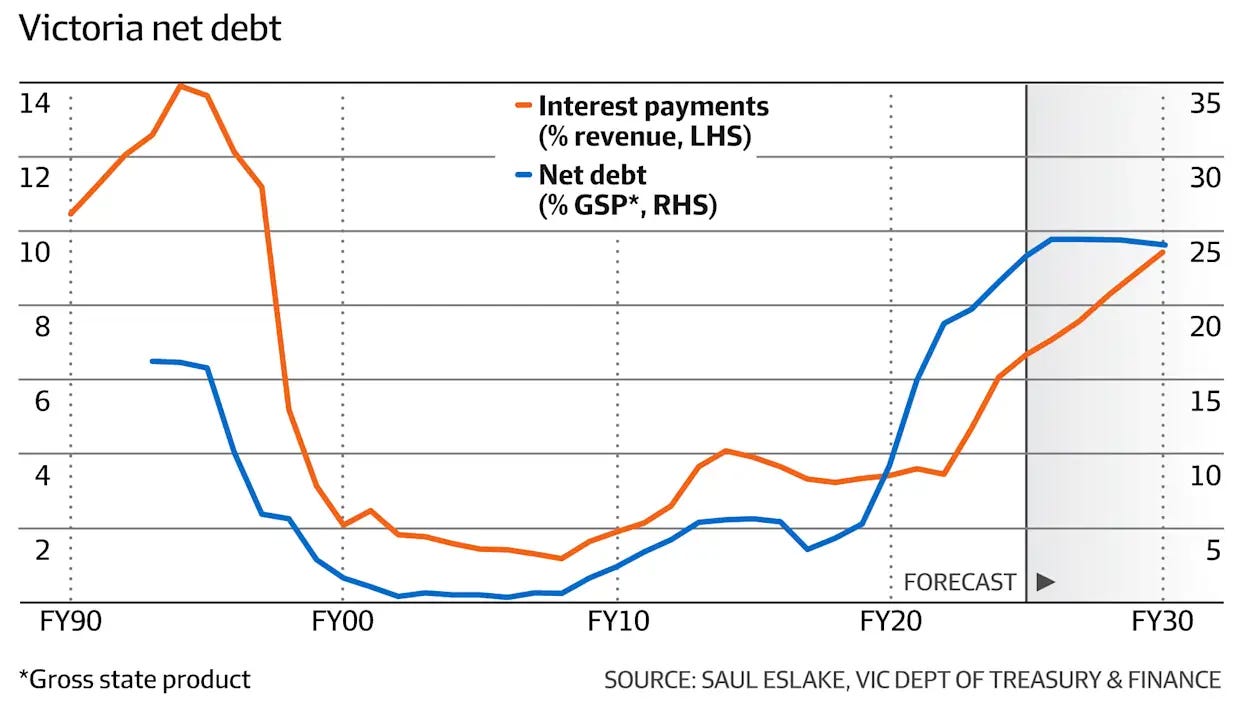
This week, after more than 1000 days under ... Jacinta Allan, the crew of the good ship State of Victoria mutinied, handing over the helm to former First Mate, Ben Carroll ...
Captain Carroll’s first words ... [signalled] a different course from his two predecessors. What might that course look like?
Among the new helmsman’s priorities ought to be ... a major course correction for Victoria’s public finances.
The most recent ... budget foreshadowed that Victoria’s “general government” net debt, having risen by $143 billion (or 641 per cent) since Labor came to office, would rise ... to $199.3 billion by ... 2029-30 ... almost 25 per cent of Victoria’s gross state product – well above the previous peak of 16.5 per cent ... in 1992-93 ...
The budget projected ... “operating” surpluses ... through 2029-30 ...
The “operating” balance is in any event an incomplete and misleading depiction of the government’s “bottom line” – in particular because it includes grants from the Commonwealth for “capital” purposes, but excludes capital expenditures.
A much more meaningful ... picture ... is provided by the cash balance ... which the ... budget projects will remain at $7-8 billion per annum over the next four years. It’s those cash deficits – totalling $118 billion ... – which ... [drive] the enormous increases in Victoria’s net debt ...
Absent asset sales – and ... Kennett and Stockdale sold almost $26 billion of assets during the 1990s, and the Andrews government ... a further $20 billion ... – the only way ... to stop accumulating debt, is by running cash surpluses.
And ... it will need ... revenue increases and cuts in “operating” and infrastructure spending.
There’s little, if any, scope for increases in Victoria’s state taxes. State taxes already amount to 6.2 per cent of Victoria’s gross state product – ... well above the average for all states and territories of 5.0 per cent. ...
However, there would appear to be ample scope for ... curbing the growth in “operating” expenses, and ... reducing infrastructure spending.
The Grants Commission’s assessments ... suggest that the Victorian government is spending some 7 per cent more than it “needs” to ... to provide Victorians with ... public services ... [matching] the average of all states and territories. ... That excess spending ... amounts to $772 per head, or a total of $5.4 billion ... [and] almost $1.8 billion ... more on infrastructure investment ...
In total, therefore, ... there’s scope ... to reduce ... annual spending by up to $7.2 billion without Victorians ... accept[ing] a lower ... quality of public services ...
None of this is to suggest that the Victorian government must immediately slash its spending by $7.2 billion. Poorly conceived ... spending cuts ... can do more harm than good.
But the Victorian government does have a starting point ... [in] the Independent Review of the Victorian Public Service by Helen Silver ... [whose] 52 recommendations ... [would] save about $5 billion ... to 2028-29. However, ... the Allan government accepted only 27 ... in full and three in part ...
Captain Carroll could usefully pull Silver’s report out of whatever drawer it’s now hiding in, and revisit the recommendations that his predecessor was unwilling to pursue.
He could equally usefully commission an urgent review of the business cases for Victoria’s major infrastructure ... projects ... [to decide] which ... [to] defer or abandon ...
The other ... challenge confronting Captain Carroll is the ongoing deterioration in Victoria’s economic performance ...
Over the course of this century, Victoria has gone from having above-average per capita gross state product and household disposable income to ... ranking third- and second-last, respectively, among Australia’s states and territories ...
But it also stems from Victoria’s sub-par productivity performance. Since the turn of the century, labour productivity growth in Victoria has averaged just 0.75 per cent per annum – the second-lowest of any state or territory ...
That is ... the result of Victoria pursuing growth in intrinsically low-productivity activities. The share of ... gross state product accounted for by the six industries with the lowest ... labour productivity – retailing, accommodation and food services ... – has risen by 2.6 percentage points over the past 25 years ... more than double the national average ...
For a while, the pursuit of growth in labour-intensive industries helped propel employment growth in Victoria. But not any more. Since the end of 2023, Victoria’s trend unemployment rate has been above the national average ...
In short, the good ship State of Victoria needs ... a re-fit. Whether that ... [is] undertaken by the current crew, or a different one, will be decided in less than four months.

I recall the the UK’s Government Digitial Service (GDS). The British Government was one of the first to appreciate that outsourcing the government’s digital services wasn’t going to work. They’d brought a lot of work in house and were getting great people to do it.
Bur if you think of the basic structure within which GDS operated, it isn’t promising. It’s a small part of a huge bureaucracy and, while the political system rabbits on about wanting better digital services, but it’s hard to get them right. Keep in mind that most large corporations themselves are pretty terrible at digital services. The only ones I can think of that are any good are our Silicon Valley overlords. Even Toyota which might be the best run traditional corporation, isn’t a patch on Tesla in providing digital services.
So it’s kind of a fluke that GDS was as good as it was. There were lots of government innovation initiatives which weren’t much chop or didn’t get much beyond pilot stage. And anyway, if you do get a bit of a success, it’s just a hostage to fortune until whatever political cover you had goes away - on other newer priorities, or as in the UK on complete madness - Brexit, Boris, briefly installing a lettuce as PM and so on. And now we have Andy “I have a plan for a plan” Burnham who’s thrown the cards up in the air to see where they’ll land.
The creation of the Government Digital Service in 2011 was the start of one of the boldest and most impactful reforms of the last 60 years. ... it acts as a barium meal exposing the embedded dysfunction of the Civil Service ...
This week feels like Groundhog Day as the patient rebuilding of ... digital, AI and data over the last two years is thrown up into the air by a machinery of government change ... cobbled together in 10 minutes on a cabinet office whiteboard. ...
David Varney’s review ... argued that improving the user experience and saving public money were complementary rather than competing goals. His most compelling critique was that ... government organised itself around its own siloed transactional convenience ...:
“underpinned by a mass of helplines, call centres, front-line offices and websites… The end result is that the citizen who needs multiple services is left to join up the various islands of service to meet his or her needs.” (Varney, 2006)
So the ideas that fuelled the GDS insurgency had bubbled and brewed for a decade as these unlikely three tribes – civic tech, pioneering civil servants and politicos - engaged outside and inside government. ... [T]he essential political leadership came from the new Cabinet Office Minister Francis Maude ... [with] cross party support for the agenda. ...
A Playbook for High Impact Reform
The GDS story matters because it offers a playbook for successful reform lead by a central team that changed the mindset and capability of swathes of civil servants. ... [It had] a bias for getting things done rather than producing endless briefings, policy papers, reports ... They chose to trust high-quality people who were committed to the missions ... and backed them when things sometimes went a bit wrong. ...
It shone most brightly from 2011 to 2016, when a combination of internal and external changes meant GDS lost its mojo and its thread[:] the loss of political backing and therefore its mandate; ... the departure of many of its founders; ... and, a succession of ineffectual Cabinet Secretaries. ...
Despite the difficulties of the last 10 years, there is a very significant GDS legacy that enables departments and agencies to provide better services to citizens: GOV.UK; the ‘standard for digital services’; ... common platform components that departments use enthusiastically like Notify, Pay and Submit; the Digital Data and Technology (DDaT) professions ... are all embedded even if the full vision of the GDS founders has not been realised. The most enthusiastic user facing agencies like the passport office, DVLA ... have transformed the user experience ... by drawing on the methods and the diaspora of GDS. ...
Yet the biggest impact is less visible: the change in mindset ... A change from:
· policy-first to services first;
· specifying to discovering;
· secrecy to working in the open;
· vendor dependency to in-house capability; and,
· project to product. ...
A Barium Meal Exposing Civil Service Dysfunction
Once the ambitions of the GDS insurgency became clear - that it was about more than a website and sorting out crap IT choices - digital transformation threatened the established supremacy of the policy classes that ... dominate the senior civil service. [It] exposed the barriers ...: the Treasury’s ... fantastical approach to business cases (making the numbers add up theoretically but not asking ‘is it any good’) ...
The Civil Service tends to tolerate innovative approaches so long as they are in a sand pit peripheral to ... their principal role: the supreme policy adviser to their ministers. But once innovative units threaten to disrupt the mainstream ... senior leaders usually ignore them, say yes and do no, shut them down or shove them into an inconsequential department without clout. ...
The Implications for Civil Service Reform
The hard wiring and accountabilities of a federal civil service is of course a substantial barrier – but the learned, endlessly reinforced behaviour, mindset and identity of senior civil servants is a much greater one. Machinery of government changes have never and will never change that. The Civil Service substitutes process for leadership, ... micromanagement for trust and empowerment. ...
“The record shows that managerialism alone is not enough ... better public managers cannot restore fiscal balance; they cannot save the welfare state and they are certainly not the prime guardians of democracy…” (Pollitt, 2016)
In other words, politics matters. Transformation is not coming from managerialism or by importing business methods ... – all that has been repeatedly tried and substantively failed. ...
A Smaller Government That Acts as a System Steward?
The failure to make bold change ... is not for the lack of a tangible vision ... We now have over 20 years of strong arguments and evidence for a better approach by Government to its role as a system overseer. ... But these ideas have had little traction on most senior officials whose identity and illusion of control as supreme policy adviser would be imperilled by such a change. ...
[I] increasingly think you cannot reform the Civil Service by trying to reform the Civil Service. Instead, something big bold and political is needed to change the game. ... The radical devolution of ... policy making (and policy makers), fiscal devolution including tax raising powers to ... strategic authorities and mayoralties would force a change. If you have 150,000 less central civil servants ... then you need think differently about what they are for and how they add value. ...
Only politics will make this happen. ... But they will not propose it.
I enjoyed this film of Pride and Prejudice when I saw it on the screen. I enjoyed the scene above - didn’t really get excited about it. But somehow when I saw it on YouTube many years later, I was transfixed with how good it was. I was transported into the world depicted, a night that might make a lifetime’s difference for its younger participants who were ‘coming out’. So absorbed had I been that I hadn’t really thought of it as fancy cinematography. But it’s the fancy cinematography what got me transported. Finally I was reminded of this by the video below which makes the point.

Call them “The Unfounding Fathers”, the extreme wing of the US Supreme Court (the majority) and its intellectual infrastructure in the Federalist Society have been working towards this project for decades: reducing the executive branch of the US Government to the plaything of the Chief Executive. Calling it “originalism” seems a stretch. It assumes that the Founders wanted every executive official including those who’ve been confirmed by the Senate to owe their first loyalty to the President. Doesn’t sound like too many of the founding fathers I know.
Even Francis Fukuyama, whose essay below explains why this project has become so dangerous, occasionally adopts the tendentious framing of the unfounders. He writes of Congress “imposing” limits on the President as if this was a simple case of applying the separation of powers more rigorously. That’s just what the bad guys want you to think. But those limits imposed on the President are not imposed by Congress. They’re imposed by law. And you can’t make law except through the Constitution’s prescribed lawmaking process. In this case, it was passed by Congress and signed by President Woodrow Wilson. Accordingly, once enacted, the law speaks with a superior authority to the President, or the Congress for that matter, where either acts alone.
The constitutional question is therefore not whether Congress may boss the President around, but whether the President may disregard obligations created by law itself. Anyway, as Trump rampages through the executive branch and Pete Hegseth sacks generals for offering independent advice or the even worse offence of being black, Fukuyama explains why the consequences of this constitutional revolution are proving so alarming.
As we move toward the end of the Trump era, we need to reckon with the changes his administration has wrought in the American system of government. The most significant is the enormous concentration of power, not just in the executive branch as a whole, but in the office of the president. Any successor administration, Republican or Democratic, will inherit these powers, and will have to decide how it wants to define the limits of executive authority in the future.
The U.S. Constitution limits presidential power in a number of ways: Article II says the president’s chief duty is to see that the laws are “faithfully executed,” and even [in foreign policy], the right to declare war is given to Congress...
Donald Trump has tried to expand executive authority in any number of ways, issuing a blizzard of executive orders that have in effect usurped Congress’s legislative powers... Among the many examples are:
Ending birthright citizenship;
His failure to spend money appropriated by Congress;
The closing of entire departments, such as the U.S. Agency for International Development;
Launching a major war without seeking authorization from Congress.
The lower courts have blocked many of these initiatives, and the Supreme Court has reversed both the birthright citizenship order and last year’s tariffs...
However, in one case the Court clearly ruled in favor of the administration: Trump v. Slaughter, decided last month, which overturned an earlier decision called Humphrey’s Executor. That precedent, set in 1935, upheld the right of Congress to impose limits on the president’s power over the boards of “independent” multi-member agencies like the Federal Communications Commission and the Federal Trade Commission...
The one such agency the public (and more importantly the markets) care about is the Federal Reserve Board, where Trump had already tried to fire one member, Lisa Cook. The Court exempted the Fed from its general evisceration of Humphrey’s Executor, arguing somewhat speciously that the Fed has a different historical status from other agencies...
The Slaughter decision ... has huge implications for the way America will be governed, and it is only the first shoe to drop in a long-term conservative effort to remake the federal executive, under a doctrine of the “unitary executive” [that holds] the Constitution gave executive authority to the president alone, who ... could not be restricted by Congress in his control over the executive branch...
The argument I would make against the theory of the unitary executive is not based on any originalist reading of the Constitution but on a pragmatic observation: today’s executive branch is so large, sprawling, and powerful that there needs to be a separation of powers within the executive, [as well as] between the executive and the other two branches of government, [in order to preserve] the expertise that is necessary to run a modern state.
We see this most clearly in the case of the Federal Reserve, exempted from political control [in the Slaughter decision]. Painful experience with inflation has taught the world that central banks must be made independent, [since] the incentives of politicians are almost always short-term and self-interested. The independent structure of the Fed protects it from politicization and lets it operate on the judgment of experienced professionals...
Quite apart from the illegality and unconstitutionality of many of the Trump administration’s actions, there is also its incompetence, on display since the beginning of the second term, when Trump appointed a series of individuals with no expertise in the agencies they were to run: Tulsi Gabbard as Director of National Intelligence, Pete Hegseth as Defense Secretary, Robert F. Kennedy Jr. as Secretary of Health and Human Services, and Kash Patel as head of the FBI. The consequences are clear: by sidelining regional experts, [for example,] there was no one to warn the president that launching a massive air assault on Iran might lead to the closing of the Strait of Hormuz. The Justice Department likewise has been diverted from [impartial law enforcement] to [personal] revenge, [with] its cases susceptible to being overturned by the courts and indictments rejected by grand juries...
Underlying the theory of the unitary executive is a flawed concept of hierarchical organization: “principal-agent theory” [holds that] all authority lies with the principal, and problems arise only when agents follow their own agenda. But as Nobel laureate Herbert Simon pointed out, real-world organizations don’t work that way. Agents often have more expertise and local knowledge than the principals who give them orders, [so] authority flows upward too—a truth well-functioning militaries understand when they [trust] their junior officers... So too in government: the knowledge of how to handle an airline accident, a disease outbreak, or a financial crisis lies with the experts trained to act, not the elected politician at the top...
Multi-member commissions are an imperfect [protection] for that expertise, but they make it harder for an incompetent president to do damage—[as do] “for cause” removal requirements, [both] a clear target of this administration...
The Trump administration’s war on expertise has only just begun. Greater political control over multi-member commissions will have limited day-to-day impact on most citizens, but believers in the unitary executive want that control extended to the whole of the federal government, [down] to your local postmaster.
This assertion of executive authority was attempted at the end of the first Trump administration with an executive order creating a new “Schedule F” employment designation into which the whole of the civil service could be moved, and then fired or replaced at will. Schedule F was rescinded by the Biden administration, but has re-emerged in the second Trump term as “Schedule P/C.”
This is not a casual innovation off the top of Donald Trump’s head. The authors of the Heritage Foundation’s Project 2025 spent their four years out of office designing a policy [to] radically reshape the entire federal bureaucracy, and eliminate the checks and balances Congress had inserted to limit the president’s power. The overturning of Humphrey’s Executor is only part one; the [war] against the “deep state” also seeks to invalidate the 1883 Pendleton Act, which created a merit-based civil service, [and] return the United States to the 19th-century spoils (or patronage) system—[a system] known for its corruption, from Credit Mobilier to Tammany Hall. Today we have massive corruption at the top... [and] eliminating a professional civil service will open vast new areas for corruption in every city and county...
The next president—and there will be a next president—will have to confront the question of how much of Trump’s authority he or she will want to retain. This is complicated, because the status quo ante was itself very problematic, [and] a new president... will be strongly tempted to use the kind of executive power claimed by Donald Trump...
I hope to be able to outline some of the ways that authority can be structured in future articles.

Impressions@impression_ists
Monet posing with his Water Lilies

11:32 AM · Aug 6, 2026 · 175K Views
20 Replies · 742 Reposts · 8.26K Likes

Marysia@marysia_cc
Wassily Kandinsky Sky Blue, 1940

12:21 PM · Jul 31, 2026 · 11.7K Views
6 Replies · 161 Reposts · 771 Likes
Marysia@marysia_cc
Katherine Quinn Into the Blue

1:20 PM · Jul 31, 2026 · 6.32K Views
3 Replies · 92 Reposts · 452 Likes
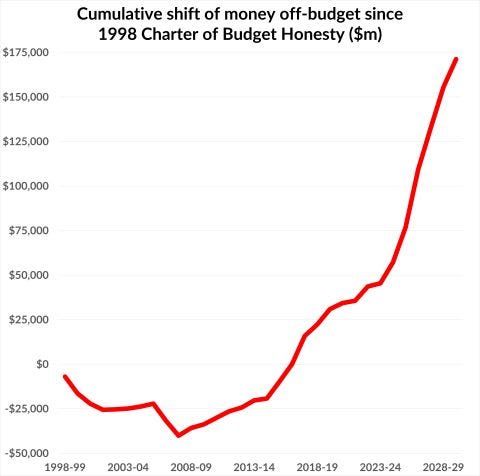
I remember a time when everyone was solving our fiscal woes with charters of budget honesty. All the very serious people were saying it. But at the same time Ronald Reagan was trashing the US Federal Budget, and the lack of push-back he experienced wasn’t because of lack of transparency. It was all there in the accounts - or mostly there. So we needed to think a little harder about the problem. That’s one reason why I proposed to take a leaf out of the monetary policy book to move towards greater independence of the fiscal balance.
This was the argument’s latest outing in the FT.
Debate on fiscal policy occupies its own special place in the culture wars into which political debate has descended. Here, the right is Dad and the left is Mum. Seriously! Baked into our political psyches, largely immune from evidence, the electorate instinctively feels that the Conservatives manage money better, while Labour’s strength is “caring”. And so the economic pain Cameron inflicted could be depicted as the inevitable result of Labour’s prior fiscal profligacy (real or imagined).
So, in recovering from the deepest recession in three centuries, how could fiscal policy be reformed as monetary policy has been? We must first distinguish its two aspects. The microeconomic composition of taxation and spending — who gets taxed how much and how governments spend the money raised — should continue to be determined by politicians.
However, the macroeconomic question — the extent to which taxes exceed spending or vice versa — should be determined more independently. In the UK, the Office for Budget Responsibility already delivers independent fiscal transparency. But, unlike the Bank of England’s role in monetary policy, it leaves politicians free to set policy. This should change.
Small across-the-board cuts or increases to legislated tax rates would be a fiscal policy instrument analogous to the official bank rate in monetary policy. Just as the Bank of England’s Monetary Policy Committee sets the official bank rate, so the power to make such across-the-board adjustments could be given to an independent fiscal board, or even to the BoE, reconstituted as a consolidated Macroeconomic Stability Board.
Anyway, we didn’t do any of that. We did ‘Budget Honesty’. And what did we get? Balance sheet dishonesty. Well we should have a Charter of Balance Sheet Honesty too, but don’t expect it to do much good for reasons explained above. Politicians are loath to address problems that can be handed to their successors. Indeed, if you take their role as competitors seriously, that’s kind of their job.
Anyway, here’s the indefatigable Chris Richardson on LinkedIn.
The Charter of Budget Honesty helped clear up a lot of crap
But it also encouraged everyone to focus on a different number
And that created a loophole: politicians of all stripes increasingly realised that, if money went off-budget, it got much less scrutiny
The rough rule is that you shouldn’t have to care about the money that goes off budget, because it will earn enough of a return to pay for itself – in effect, this is meant to be money that is safe to ‘set and forget’
(And, if it were, this chart would stay closer to zero over time.)
In practice, and aided by a variety of accounting lurks and perks, this has become the spot where poor policy goes to play
The upshot is that hundreds of billions are now in play. And it could be summarised as the crappiest crap in the budget
Better budgetary rules and reporting wouldn’t stop bad behaviour by politicians
But the added sunshine would make it harder to hide bad behaviour.

Bauhaus Movement@BauhausMovement
Walter Gropius, Director’s Office, 1923. Artwork by Sander Patelski

5:10 PM · Aug 2, 2026 · 36.9K Views
13 Replies · 259 Reposts · 1.59K Likes
If you like Kandinsky’s geometric paintings like me, you’ll enjoy seeing them assemble and disassemble themselves in this 60 second video.
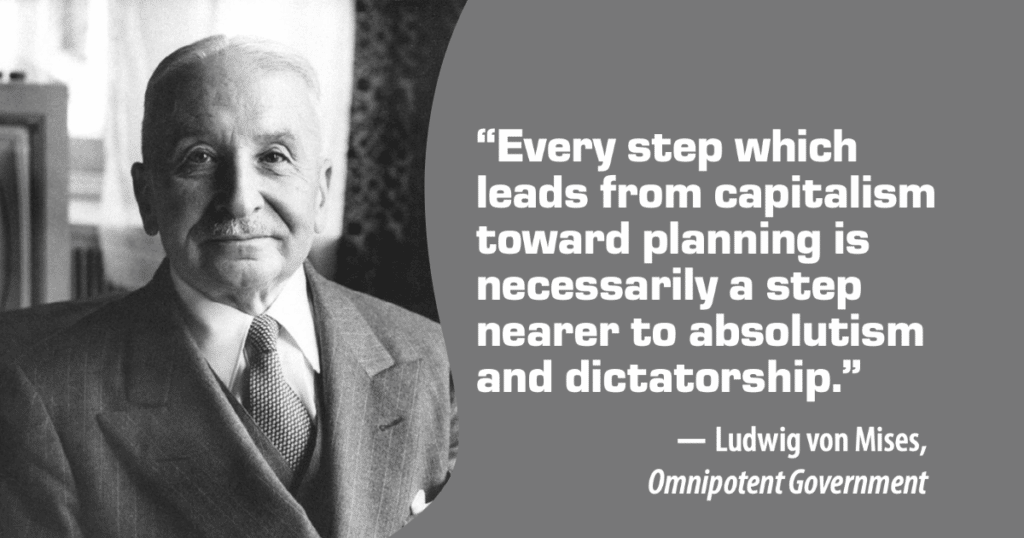
I’m OK with people saying bad things about Ludwig von Mises. Why, I’ve said them myself. But if I was publishing on him, I’d try to quote him honestly. It’s also not that hard to accidentally misquote someone if you’re trawling through their writings with one eye on quoting them revealing themselves in all their pomp and nasty pastiness. So you apologise if evidence turns up that you’ve stuffed up.
Oh well, I guess if you’re a high-profile academic, that’s just being a sucker. This happened a while back in a similar way with a hit-job on James Buchanan. There, in another case where I was far from sympathetic to the victimeof the hit-job the author’s response to critics made me instantly suspect. She didn’t respond to show she hadn’t quoted him out of context. She just went on the attacked her critics as neoliberal shills — the old David Graeber tactic.
Anyway, turns out even the journal that published the offending article won’t respond in good faith. Just another day in academia, formerly known as arguably the finest flowers of Western civilisation.
Academic works on “neoliberalism” almost invariably share three characteristics. … they portray neoliberalism as the dominant paradigm … they treat that development as harmful … they rarely explain what “neoliberalism” actually means.…
Quinn Slobodian is among the most visible figures in … “neoliberalism studies.” His 2025 book Hayek’s Bastards … won the National Book Critics Circle Award …
Hayek’s Bastards … purports to uncover a “neoliberal” origin of MAGA populism … born out-of-wedlock from the … Austrian School … [of] Mises and Hayek. …
Slobodian’s thesis is that, while Mises and Hayek were not racists themselves, they left a “parenthetical opening” to racial pseudoscience in their writings, which later bigots and cranks exploited. …
There’s a problem with Slobodian’s argument, though. … I found a pattern of contextomy: selectively edited quotations in which phrases were clipped from sentences and adjoining passages omitted … to shoehorn Mises’s … words into Slobodian’s own … political interpretations. …
Slobodian quotes a passage … that seems to rationalize … colonialism … In reality, he omits the second half of the sentence, where Mises disavows the position … attribute[d] to him. …
In his Contemporary European History essay … Slobodian wrote (bold added): …
Though ‘one can think only with shudders and anger of the fearful mass murders that prepared the basis for many of the colonial settlements flourishing today’, [Mises] wrote, the net gain made it worthwhile; in the end, ‘all other pages of world history were also written in blood.’ …
In Nation, State, and Economy, Mises wrote (bold added): …
one can think only with shudders and anger of the fearful mass murders that prepared the basis for many of the colonial settlements flourishing today. But all other pages of world history were also written in blood, and nothing is more stupid than efforts to justify today’s imperialism …
Slobodian accuses Mises of distinguishing persecuted white European minorities from nonwhite racial groups. … Mises was describing Nazi efforts to identify … “Jewish” ancestry among … white Europeans … Slobodian spliced this into an unrelated passage about … skin color. …
In “Perfect Capitalism, Imperfect Humans,” Slobodian wrote (bold added):
Yet Mises proved incapable of extending a similar cosmopolitan attitude to populations of colour. Even as he argued … that ‘there are today no pure stocks within the class or race of white-skinned people’, he did so by pointing out the difference with black populations. …
In Omnipotent Government … Mises wrote (bold added): …
it is certain that there are today no pure stocks within the class or race of white-skinned people. …
Finally people have tried … to discover the physical characteristics of an alleged Jewish or Semitic race … These quests, too, have failed completely. …
[A 2015 lecture had Mises insisting that keeping the colonies “was the first priority,” under a “muscular super-state.” But Liberalism (1927): “no chapter of history is steeped further in blood than the history of colonialism … we must strive for its abolition.” The super-state was the League of Nations.] …
I submitted [a response] to Contemporary European History … [whose] editors issued a rapid desk rejection. … Slobodian [was then] appointed a co-editor … …
[Asked for a corrigendum, I got an unsigned email:] “we are confident about the academic rigour of Slobodian’s piece.” … [The] same misquotation issues had been flagged by the journal’s own referee in 2018 … [whose report] described the paper as “based on dubious historical scholarship: quoting out of context …” … The journal nevertheless overruled its own reviewer and published the piece … …
Slobodian again quoted from Mises’s untranslated 1940 book Nationalökonomie …
In Hayek’s Bastards, Slobodian wrote (bold added):
[Mises wrote] that “we may take as given that the racial element plays a role among the factors that form the personality and, with it, our values and understanding.” What he objected to was not the possible truth content of race theory but its misuse. …
In Nationalökonomie, Mises wrote (bold added):
We may take as given that the racial element plays a role among the factors that form the personality and, with it, our values and understanding … But in the present state of our knowledge, we know nothing about the connection between the physical and the mind, and therefore cannot make any statement as to whether … the physical is capable of influencing Verstehen. …
Mises was … arguing against the scientific validity of efforts to link … race or ethnicity. And once again, Slobodian was “bastardizing” the text—rearranging quotations, splicing together unrelated excerpts …
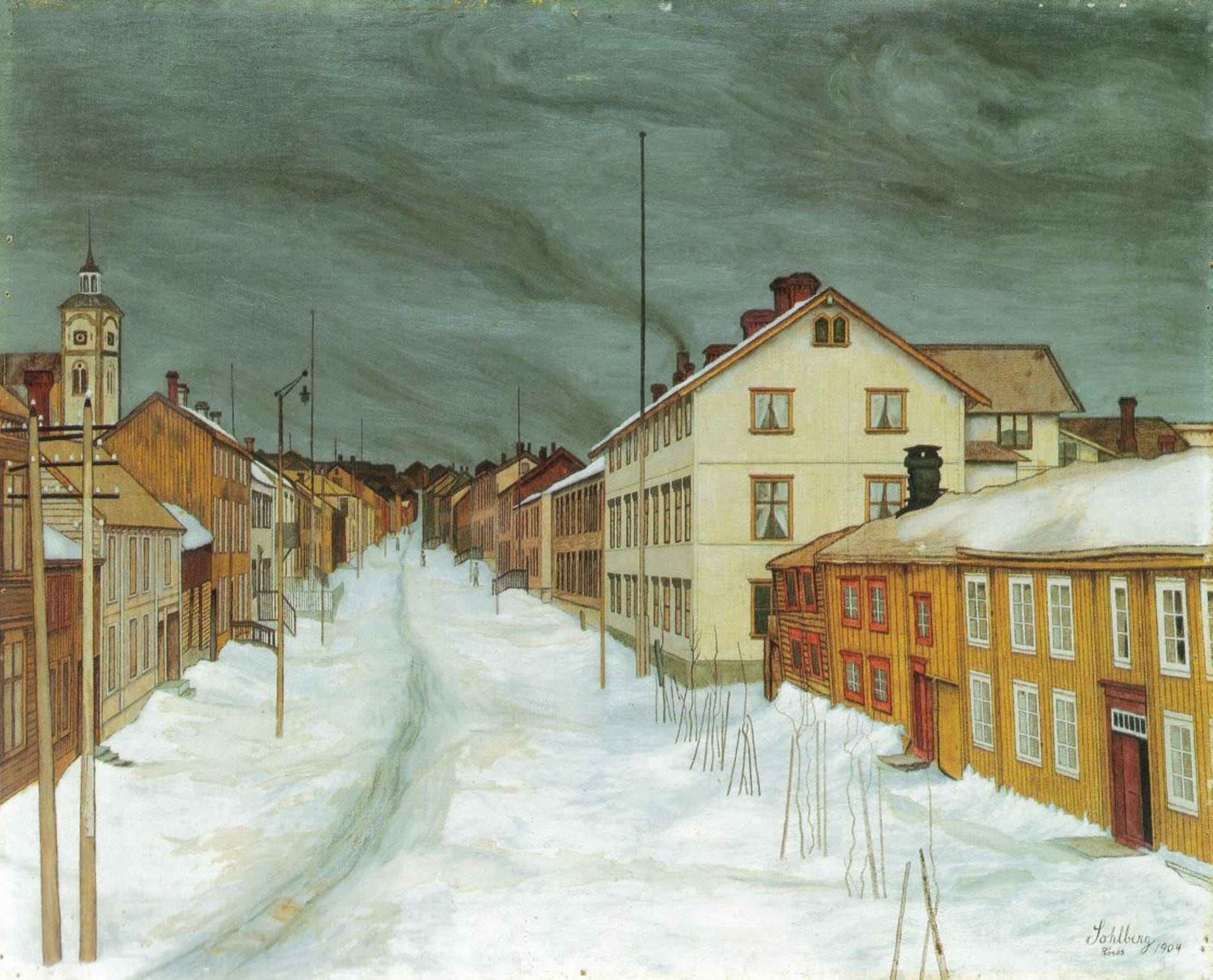
Did I mention I love Lin Onus - yes I did. This one is yours to keep for 400K odd.


Quico Toro says it is!
Two-thirds of global warming this century is the result of cleaning up air pollution. Do not adjust your sets, your screen is not malfunctioning. If Professor Peter Cox, of the University of Exeter, and his colleague Margaux Marchant are right, greenhouse gases are no longer the main driver of global warming.
The mechanism is no mystery: albedo is well understood. Some portion of the sun’s energy that reaches the Earth bounces right back out to space, that’s albedo. The rest of the energy is absorbed. The balance between the two is not fixed. Sulfur pollution in the atmosphere increases albedo. The more sulfur pollution, the less solar energy reaches the atmosphere in the first place.
The truth that dare not speak its name is that sulfur pollution counteracts global warming, so when you clean it up, the globe warms up faster...
Let me be clear, SO₂ in the air sucks: it causes acid rain, it’s bad for your lungs, it messes with terrestrial and aquatic ecosystems in all kinds of ways. We have very good reasons to clean it up.
But when we do clean it up, we diminish albedo. And that speeds up climate change.
That this could happen isn’t at all news to climate researchers, but Cox and Marchant’s research shows this effect is possibly quite a lot bigger than we’d grasped...
And this isn’t some fringe theory from some internet rando: Professor Cox is one of the most senior climate researchers in the world. He’s a lead author on the 4th, 5th and 6th Assessment Reports of the Intergovernmental Panel on Climate Change and a member of the UK Government’s Defra Scientific Advisory Council, as well as leading one of the world’s top centers for Climate Research...
This is big news. And yet, I bet you haven’t heard about it. The mainstream media hates to cover this kind of story. There’s a strong bias towards climate stories that are morally tidy. Stories where pollution is bad and kills the earth, and stopping pollution is good and saves the earth...
The reality is, the atmosphere isn’t interested in your morality play. The laws of thermodynamics couldn’t care less if they line up with your NGO’s Vision statement. Sulfur dioxide in the air will keep both acidifying the rain and cooling the planet whether we like it or not.
If we were generally saner about climate change, we’d recognize this story for what it is: a loud, blaring siren telling us we’ve spent decades actually doing geoengineering, without ever quite acknowledging it to ourselves.

Dachshund Lovely@dachshundlove06

12:23 PM · Aug 1, 2026 · 1.25M Views
257 Replies · 2.39K Reposts · 34K Likes
AUKUS saga looks increasingly weird. According to Trump on TruthSocial, “South Korea will be building its Nuclear Powered Submarine in the Philadelphia Shipyards, right here in the good ol’ U.S.A.”
So, South Korea with a much greater industrial and skills base than Australia, has decided not to build nuclear submarines in its own country! And, this is despite the fact that South Korea already produces very capable diesel-electric attack submarines.
I have not been able to identify one independent expert who believes that Australia has a industrial and skills base to build the AUKUS submarines in Adelaide. On the other hand, there are plenty of experts who are doubters!

Tom the whistleblower@blowingtom2
Fuck he was good.
12:11 PM · Jul 27, 2026 · 37K Views
71 Replies · 365 Reposts · 1.37K Likes

I’d hire them if I was hiring journalists.
If you’re looking for a reason to despair over the state of American education, there are many places you could start. You could, for example, worry about the all-consuming phones—or the gambling and TikTok addictions that come with them. You could worry about the free fall in literacy ... the teen mental-health crisis, and on and on.
Yet something that deserves more attention is damage to free expression—not in the classroom but in the public sphere of high school: the realms of student newspapers, student government, and other aspects of everyday life. School is meant to prepare students for the real world, but too many institutions are training kids to be silent.
The three of us are the editors of our high-school student newspaper in Washington, D.C., with a staff of about 60 student journalists. We ask a lot of questions ... We cover big policy changes (a ban on phones) ... We cover all kinds of controversies—among them, senior pranks, changes in faculty ... theatrical productions ...
Although many teachers at our school agree to interviews, some consistently decline them. They tell us they’re afraid that saying the wrong thing will result in a stern lecture from a boss ... They say they do not want their views ... to be permanently findable on the internet. That’s their right, of course ... But we ask teachers for interviews because they are experts ... But our readers cannot get a full view of the community when people are too afraid to talk.
And people are definitely afraid ... The era of social media came with the promise of hyper-democratization—no longer do you need to be an established pundit to get your message out ... Although there is much to celebrate about the ways in which the internet has connected us, the permanence of the internet has given rise to censorship pressures—both individually and institutionally. People are so nervous about saying the wrong thing that they choose to say nothing.
Taken to the extreme, a culture of silence can be extraordinarily harmful. As a society, we have to accept that people’s opinions change over time. We can start by treating high school as a time for students to take intellectual risks ... The adults who care about students—parents, teachers, school administrators, prospective employers—should encourage them to speak up, to debate, and, yes, even to fail ...
Recently, the Montgomery County, Maryland, school district made local headlines after officials required administrators to review student newspapers prior to publication and outright censor certain reports based on vague standards ... One administrator at our school floated the idea of a prior-review system for our articles ... while another told us our decision to publish an article about them was reprehensible.
Administrators owe it to their students to support a culture of free expression, and high schoolers need to keep contributing to that culture by saying what they think ... To start, we must reaffirm that our individual and collective right to free expression transcends the substance of anything that any one of us might say. A robust—and sometimes messy—marketplace of ideas is in the best interest of all of us.
In Des Moines, Iowa, in 1965, five students wore black armbands emblazoned with peace symbols to school in protest of ... the Vietnam War. Local high-school administrators suspended three of the five students. The school district soon found itself justifying the suspensions in a three-year legal battle that ended with a Supreme Court victory for the students in Tinker v. Des Moines Independent Community School District.
The Des Moines administrators said they blocked the armbands because of the possibility that the silent protest could create a disruption, even though no disruption occurred. If a police officer were to prohibit a person on the street from wearing a black armband because that person could hypothetically incite a large protest, any reasonable American would rightly see the officer’s actions as a violation of the First Amendment. The same logic should apply across society.
Of course, creating a culture of openness and respectful debate requires more than staving off government interference. If large groups of people decide that silence is safer than risking disagreement, and if they instruct children to be silent in turn, our fundamental right to free expression will crumble from within.
My wife told me to put this in the newsletter. Who am I to argue? Paspaley have funded an artist to come up to their neck of the woods and paint nice paintings. Which she has.





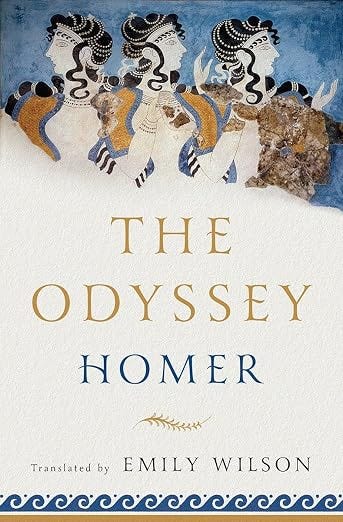
Acclaimed translator of Homer is not too impressed, and quite amusing about it.
Christopher Nolan’s $250 million action movie version of Homer’s ancient Greek poem is an entertaining way to hide from the high temperatures for a few hours... My teenagers had a good time. Unlike some of Nolan’s other films, The Odyssey is not boring, thanks to the source material, which is impossible to mess up entirely. It’s a family-friendly audiovisual spectacle, like an elaborate Fourth of July fireworks display – and with about the same level of narrative and emotional depth.
As in his previous films, Nolan is interested in the discontinuities of space and time, in magic, tricks... masks, miscommunication, what we remember and what we choose to forget... But The Odyssey features his usual combination of grandiosity and superficiality. Without a tub of wax for my ears – which Himesh Patel’s ever anxious Eurylochus... uses to sail safely past the Sirens – I was exposed to the full din of thumping sticks, staffs, swords and clashing armour, thunderbolts, crashing waves... toppling palaces and burning temples... My eyes stayed dry, even for Argos the dog – whose adorableness as a puppy is predictably amped up to suit our animal-loving times. If only the human characters had been treated with such serious attention...
Nolan’s spectacle threatens to drown out his story just as the towering waves of the wine-dark sea – more grey than purple – threaten to overwhelm his hero’s ship... Nolan gives us an all-inclusive buffet...
There are more female characters than in most Nolan movies, thanks to the source material... Homer’s Calypso has a wonderfully outraged, operatic speech about divine double standards: male gods can kidnap and rape any mortal woman they desire, but when a goddess tries it, Zeus and his cronies scupper her chances... Charlize Theron’s Calypso looks gorgeous, but she is never angry, never funny, not skilled in rhetoric, and never consumed by lust for her scraggly mortal victim. She’s an unpaid therapist, soothing the soul of the bedraggled, PTSD-ridden Odysseus with drugs, and graciously listening to his disjointed tale of woe...
It’s a challenge to represent deities on film without veering into Clash of the Titans silliness... One of my favourite moments was when Zendaya assures Damon that gods are not hard for mortals to understand: ‘Who doesn’t understand thunder? Fire?’ But the film wants to have it both ways. There are no gods, and yet shipwrecks and death are presented as the inevitable consequence of blinding the son of Poseidon... Nolan’s vision of the world is not quite big enough to include either real gods or real people who might be different from us...
As they say at the awards shows, I was humbled to learn that Nolan has read at least the first line of my translation of The Odyssey into iambic pentameter. In at least one interview, he cited my version of the first line of the poem: ‘Tell me about a complicated man.’ But I would be ashamed to have written any part of this script. Sadly, Damon’s Odysseus isn’t complicated or wily or artful. One of Odysseus’ funniest (and most famous) tricks in Homer is to tell Polyphemus that his name is ‘No Man’. When the blinded giant screams for help from his neighbours, the other Cyclopes are reassured to learn that ‘No Man’ is hurting him. In the movie Odysseus doesn’t have to outwit Polyphemus because the Cyclops is a puppet who has no wits...
Nolan’s Odyssey lacks many of the elements that make the poem great. It has nothing convincing to say about time, memory, history, war, or about the relationship between one warrior’s glorious return and the lives of his family, adversaries, comrades, friends and neighbours. It lacks psychological, emotional, political and ethical depth. Its narrative structure is gimmicky. The writing is abysmal. None of the characters has convincing motivation for their actions or words. There are no sex scenes, and all the food looks horrible...
Despite all this, the release of The Odyssey is still an event to celebrate. In what we are told is the streaming era, this epic is bringing audiences back to cinemas. In what we are told is a time of declining literacy and the ‘death of the humanities’, translations of The Odyssey, including mine, are flying off the shelves... Nolan, who studied English at University College London – where students still study The Odyssey as a first year ‘foundational text’ – is doing his best to get the general public reading again, and I am grateful.

Journal of Art in Society@artinsociety
Most people know Dutch artist Piet Mondrian for his block colours and geometric abstraction, but here also are two of his earlier, naturalistic works created before 1910 ~ Apples, Ginger Pot and Plate ■ Still Life with Oranges
7:02 AM · Jul 28, 2026 · 13.9K Views
23 Replies · 170 Reposts · 1.04K Likes
I’ve been doing quite a bit of reading around French theorist, René Girard much promoted by Peter Thiel. His basic idea is that human beings are mimetic machines, and he gives this idea an existentialist and indeed apocalyptic flavour. Resolutely uninterested in the positive ways in which imitation helps us learn from our parents and our peers and those we admire, he focuses only on the ways mimetic rivalry threatens our existence. The basic idea is that we desire through others; we see others and desire their ‘fullness of being’. (Girard is French.) And so we become rivals with them for what they have. This mechanism then propagates more widely creating society-wide cataclysms. The threat of cataclysm, is solved by the society picking some poor soul and making them the scapegoat.
That’s just the beginning. The end ends up in all kinds of mayhem, of which much has been made by Thiel, the antichrist, the apocalypse, the end of days and so on. In any event, one interesting thing about this is that at the turn of the 20th century, the idea that imitation was fundamental to human life, that this distinguished us from the other primates, was actually quite central to social science. Plato and Aristotle also made much of mimesis - both rivalrous and adulatory - as a constituent part of what makes us human.
Intriguingly, under the influence of behaviourism and Durkheim, who argued that social phenomena required social causes to create and sustain them, mimesis as a foundation of humanity more or less disappeared. The low watermark might be given by Chomsky’s review of Skinner’s book Verbal Behaviour. Chomsky observed that children produce sentences they have never heard, which neither imitation nor reinforcement explains. The review appeared in the year Girard dated his own discovery of mimesis — 1959. Ironically since the 1990s the idea of imitation has come roaring back into social science via Richerson and Boyd’s trailblazing work on the co-evolution of biology and culture in human development. Here’s a good write-up of it by Joseph Heath.
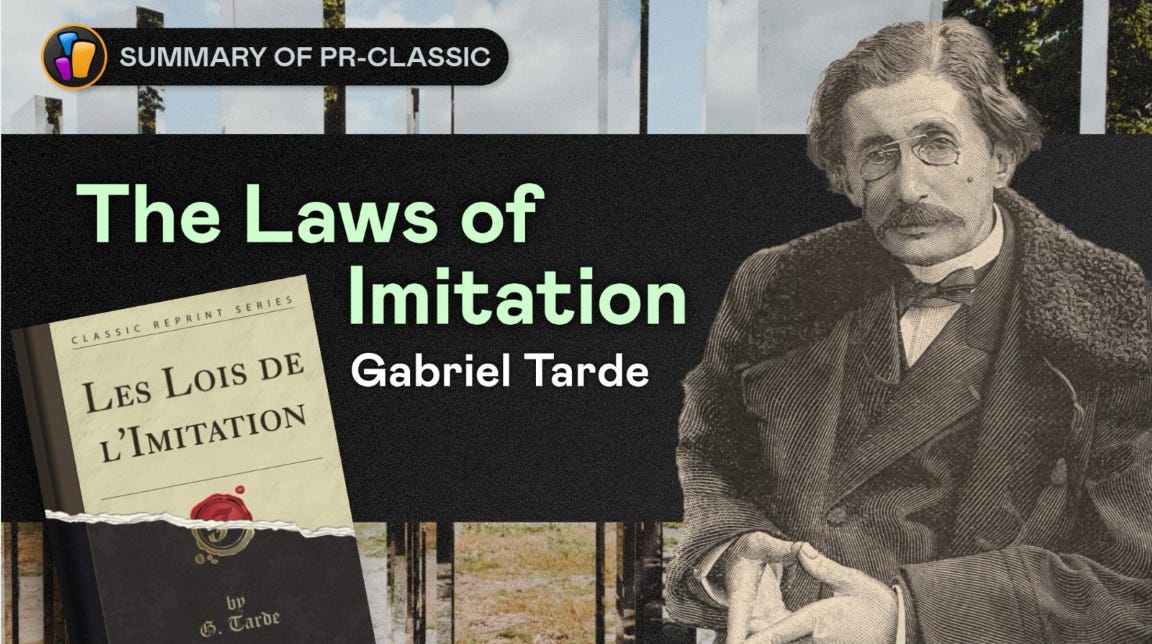
Be that as it may, this week’s heaviosity half hour is a Claude summary of a book from the turn of the century, the high watermark of pre-Giradian, pre-Richerson and Boyd.

Short summary
A single ant leaves the colony, begins digging alone, then turns and taps its neighbours with its antennae until they follow. Alfred Espinas, watching this in the 1870s, called it individual initiative followed by imitation, and Gabriel Tarde seized on the image: if ants can be explained this way, so, he thought, can everything else in the social world, human or not. It is a strange place to start a theory of civilisation, but it tells you exactly what kind of theorist Tarde is. He is not interested in societies as organisms, or as machines, or as the working-out of great impersonal forces. He is interested in the moment one mind copies another, and in what happens when you take that moment as seriously as physicists take a wave or biologists take a gene.
When Tarde was writing, in the 1880s, sociology did not yet have that kind of elemental unit. Comte’s followers were preoccupied with ranking the sciences; Spencer’s were busy comparing society to an organism, mostly by analogy and mostly without asking what, concretely, played the part of a cell or a nerve. Tarde, a provincial magistrate who had spent nearly two decades presiding over criminal cases before he ever held an academic post, thought both camps had skipped the only step that mattered: finding the actual repeating unit of social life, the thing that does for sociology what the vibrating wave does for physics and heredity does for biology. His candidate was imitation — not the deliberate, self-conscious copying the word usually implies, but something closer to what he called a quasi-photographic transmission of a belief or a desire from one mind to another, whether the person doing it notices or not.
The claim sounds modest until you see what Tarde does with it. Repetition, he argues, is the precondition of science itself: without resemblance, without things happening again in recognisably the same way, there is nothing to count, measure, or predict, only a chronicle of unrepeatable events. Physics finds its repetitions in vibration, biology in heredity, sociology — properly practised — in imitation. An invention, by contrast, is the rare, singular event that starts a new current of imitation running: it changes nothing visibly at the moment it occurs, the way nothing changes in a body’s appearance the instant a microbe enters it, and only becomes historically significant once it has been copied, copied again, and diffused through a population in something like a geometrical progression. Invention is the mountain, Tarde says; imitation is the river that runs from it. Sociology, on his account, should mostly be studying the river.
From this single move, an unusual number of things start to fall into place. A society, Tarde argues against both the economists and the jurists of his day, is not fundamentally a group bound by mutual services or mutual rights — both definitions turn out to be either too broad (extending “society” to any animals that cooperate) or too narrow (excluding people bound only by shared belief). It is, instead, a group of beings disposed to imitate one another, or who already share traits that are simply old, settled copies of the same original model. Even hunger and desire, which look like the most natural, pre-social facts about a person, turn out on inspection to have been thoroughly nationalised: the desire for food becomes a desire for a particular grain or a particular cut of meat, sexual desire becomes a desire to be married according to a particular local rite. Nothing, for Tarde, sits safely outside the reach of imitation once you start looking.
The book’s middle chapters work out the logic and the psychology of how imitation spreads. Two inventions in direct competition — say, two rival grammatical forms, two candidate laws, two artistic conventions — fight what Tarde calls a logical duel, which can resolve in only three ways: one side wins outright, one is violently displaced, or a third option emerges to supersede both. Compatible inventions, by contrast, simply accumulate in a logical union — though Tarde notices that some things accumulate almost without limit (a language’s word-stock can grow forever by simple addition) while others cannot (a grammar, like a legal code or a scientific theory, has to be periodically overhauled rather than merely added to, because its parts must stay consistent with one another). Underneath this logical layer sit two “extra-logical” tendencies that operate whether or not an idea is the best one available: imitation moves from the inner man to the outer — beliefs and goals get copied before the rites and techniques that serve them, admiration before envy — and it moves, with real but not absolute regularity, from social superiors to inferiors, from Venice’s merchant aristocracy or a cathedral hierarchy down through the ranks that watch and follow them.
The most memorable structural claim in the book, though, is the rhythm Tarde finds running underneath all of this: the alternation between ages of custom, when the ancestral or domestic model holds sway and imitation runs vertically down the generations, and ages of fashion, when a new or foreign model displaces it and imitation runs horizontally across a living population, cut loose from descent. He traces the same three-beat pattern — closed custom, open fashion, custom re-forming at a wider radius — through the emergence of the Romance languages out of Latin, through the way every religion begins in tribal exclusivism, passes through a proselytising phase, and eventually re-closes into orthodoxy, and through government, law, and economic life, where he suggests that consumption habits always travel faster than the production capacity meant to satisfy them, which is part of why gluts and slumps keep recurring.
In the preface he added for the second edition, Tarde filled in a gap he admitted to in the first: counter-imitation, the practice of doing the exact opposite of a model rather than following it, which he insists is not really independence from the model at all, since the counter-imitator remains just as thoroughly organised around it, only inversely — the medieval black mass, he points out, could only exist as a mirror of the Catholic mass it inverted. He is equally insistent, against the racial theorising fashionable in his day, that blood is not what decides whether one people imitates another: Japan, he notes, kept Europe at arm’s length for centuries and then, the moment its people judged Europeans superior in certain respects, dropped its resistance almost overnight, physical difference notwithstanding, while the Greeks — of all Rome’s conquered peoples the most closely related by blood — were the ones who most successfully refused Roman customs, because defeat never dislodged their sense of superiority. Race, he concludes, is an effect of long-settled imitation, a product fused out of many peoples over time, not a wall that stops it.
It would be easy to hear all this and conclude that Tarde has abolished the individual, dissolved every person into an intersection of borrowed currents. He argues the opposite is true, and it is where the book ends its case: once a person is no longer copying a single model but drawing, consciously or not, on a thousand different models at once, each for a different trait, the particular combination they end up with is exactly what constitutes their originality. Society’s disciplinary weight, on this reckoning, is not opposed to individuality but is the very medium that produces it.
The long summary traces how Tarde builds this case.
Long summary
A science without a unit
Picture a nineteenth-century sociologist trying to explain why one custom spreads across a continent while another dies in the village where it was born. The tools on offer were not built for the job. One school, following Auguste Comte, spent its energy arguing over where sociology belonged in a hierarchy of the sciences, and over which of history’s “three stages” a given fact should be filed under — an exercise in classification that never got around to explaining anything. The other school, inspired by Herbert Spencer, had seized on the idea that society is an organism, and had gone looking for its tissues, its nervous system, its circulation — biological analogy standing in for biological evidence. Gabriel Tarde, who came to sociology sideways, after nearly two decades as an examining magistrate in the small Dordogne town where he was born, thought both approaches had made the same mistake: they had reached for a borrowed vocabulary — mechanical or organic — instead of asking what a social science, if it existed, would be counting.
Tarde’s diagnosis of the problem is worth dwelling on, because it sets up everything that follows. Physics, he argues, is not fundamentally about force or energy; those are, in his phrase, verbal palliatives for the physicist’s ignorance of what is really going on underneath — placeholders erected because matter does not announce its own causes the way a person does. A social scientist, by contrast, has something no physicist or chemist has ever had: direct access to real, specific, intentional acts. When someone adopts a new word, converts to a new religion, or votes for a new law, the cause is not a hidden force inferred from its effects; it is a belief or a desire, visible in the acting person, communicated to them by another acting person. This is, Tarde insists, an extraordinary privilege, and one that sociologists have squandered by dressing their subject up as a pale imitation of physics or biology instead of exploiting what makes it different.
But privilege is not yet a method. To make a science out of intentional acts, Tarde needs the thing every science needs: repetition. His argument here is close to a definition of science itself. Knowledge of a cause is sometimes enough to predict a single event, but knowledge of a resemblance — the fact that this event is like other events — is what allows enumeration, measurement, and law. A world with no resemblances, only novelty, would still have causes and effects in it, but no science could ever get a purchase on it, because there would be nothing to count. Tarde’s claim is that all the resemblance we find anywhere in nature reduces, on inspection, to one of three kinds of repetition: the periodic, mostly vibratory motions that explain resemblance in the physical world (the atoms of a single substance, the waves of a single beam of light); the hereditary transmission that explains resemblance in the living world (why a species keeps recognisably reproducing itself); and, in the social world, imitation — every kind of it, from custom-imitation to fashion-imitation, from sympathy to obedience, from deliberate copying to the involuntary absorption of an accent or a gesture. Vibration, heredity, imitation: three forms of what Tarde calls universal repetition, standing in the same relation to their respective domains.
It is worth pausing on how strange, and how useful, this move is. Tarde is not claiming that societies are secretly physical or biological systems. He is claiming the reverse: that imitation is a fully independent kind of repetition, on a par with the other two, not reducible to either. The proof he offers is negative but pointed. Take away vibration and mathematics loses its subject matter in physics; take away heredity and biology has nothing to explain; take away imitation, in the same way, and there is no such thing as a social quantity at all — no prices, no values, no money, no statistics, because none of these exist without the levelling, standardising effect of large numbers of people coming to resemble one another through fashion and custom. Political economy, Tarde notes almost in passing, is only possible because European societies had, by his day, imitated their way into a single recognisable type of consumer, spread across hundreds of millions of examples. Economists who tried to build theories of value without reference to imitation, he suggests, were building on sand without knowing it.
What is imitated, and by whom
Having claimed his elemental unit, Tarde has to say precisely what it is. His definition, refined in the preface he wrote for the second edition after early critics complained he had stretched the word “imitation” past its ordinary sense, is deliberately wide: imitation is the action at a distance of one mind upon another, a process he compares, memorably, to a quasi-photographic reproduction of a mental image on the sensitive plate of another brain. Crucially, this includes involuntary and unconscious transmission as much as deliberate copying. If a person unconsciously absorbs the opinion of their circle, or unconsciously picks up someone else’s turn of phrase, that is imitation in exactly the sense Tarde means, even though ordinary usage might reserve the word for cases of knowing borrowal. He defends the extension on the grounds that there is no sharp line, psychologically, between conscious volition and mechanical habit — we shade from one into the other by imperceptible degrees, and the social character of an act does not change just because the person performing it has, or has not, noticed themselves doing it.
This definition lets Tarde answer a question that had troubled sociology since Comte: what, exactly, is a society? He rejects two familiar answers in turn. The economic definition — a society is a group whose members render one another mutual services — is too permissive, since it would turn any group of cooperating animals into a society, collapsing a distinction Tarde thinks matters. The juristic definition — a society is a group bound by mutual rights and duties — is, conversely, too restrictive, since it excludes people who feel bound together by nothing more than a shared belief, with no formal claim on one another at all. Tarde’s own definition threads between them: a society is a group of beings who are disposed to imitate one another, or who, without any current act of imitation taking place, already share traits that are simply old copies of a common model, absorbed by earlier acts of imitation now sedimented into second nature.
One of the more arresting demonstrations of this idea is Tarde’s treatment of appetite. If anything looks pre-social, untouched by culture, it is hunger and sexual desire — the two most basic animal drives there are. Tarde argues that even these have been thoroughly annexed by imitation by the time we encounter them in any actual human being. A person does not simply want food; they want a particular kind of bread, or a particular grain, or a particular cut of meat, according to what their community imitates as edible and desirable. They do not simply want a mate; they want to be married according to a specific local rite, with all its imitated particulars of ceremony and obligation. Even the desire for amusement, Tarde points out, resolves on inspection into a desire for this or that specific, culturally transmitted form of amusement — the circus, the bullfight, a particular card game — rather than amusement as such. Nothing, on this account, sits safely outside the reach of imitation; it does not create new appetites so much as it takes over and particularises the old ones.
Invention and its river
If society is imitation, what starts an imitation running in the first place? Here Tarde introduces the concept that does the most work in the whole book after imitation itself: invention. An invention, for Tarde, is any innovation at all, however slight — a new word, a new tool, a new melody, a new legal clause — and he is careful to strip the term of any implication of genius or difficulty. Simple, nearly automatic innovations and rare strokes of individual brilliance both count, on his account, as inventions; what makes them significant is not how hard they were to produce but whether they succeeded in starting a current of imitation. Most inventions, of course, do not; they die with the person who had the idea, unnoticed and unrepeated. The ones that matter historically are the ones that got copied.
This gives Tarde his central image: invention is the mountain, imitation the river that flows from it. A historian who tried to write history purely in terms of unique inventive moments — the discovery of fire, the domestication of the horse, the discovery of America — would be doing something closer to natural history than to social science, cataloguing origins rather than explaining regularities. Tarde’s example of the discovery of America is instructive: Columbus’s voyage was a true invention in his sense, a singular, non-repeating event, but what made it historically significant was the current of imitation it opened — every subsequent voyage across the Atlantic was, in a real sense, a copy and a variation of the first, each one in turn generating further imitators. The interesting scientific object, for Tarde, is not the first voyage but the accelerating, ultimately geometrical progression of voyages that followed it, the same shape he finds in the diffusion of any successful new want, from tobacco and coffee to the spread of a manufacturing process.
Tarde extends this logic to a striking claim about the underlying structure of history: because every invention is built out of prior imitated elements, recombined by an individual mind, inventions form a genealogical tree, branching from master-inventions in an order that is sequential and, in its way, irreversible, even though which particular branch gets realised at any point is radically contingent. He illustrates the contingency with the case of the horse: taming and riding a wild animal looks, in retrospect, like the most obvious and inevitable of innovations, yet the horse, native to the Americas, had already gone extinct there — hunted for food, Tarde notes, long before anyone thought to domesticate it instead — by the time Europeans arrived. An idea that seems irresistibly natural in hindsight can simply fail to occur to anyone for millennia; nothing guarantees that the useful branch of the tree gets found.
Tarde makes a related claim about two disciplines that might seem, on the surface, to have nothing to do with sociology at all: archaeology and statistics. He argues that both, without knowing it, already think the way he thinks a social scientist should. An archaeologist digging up arrowheads or coins is not interested in the single, unrepeatable moment a particular tool was first conceived; that moment left no trace and could not be recovered if it had. What the archaeologist studies is the imitated, replicated run of a design — the fact that thousands of near-identical flint points or minted coins were produced across a wide area, which is exactly the kind of homogeneous, countable material Tarde thinks sociology needs. A statistician, gathering figures on birth rates, crime, or the consumption of a new commodity, is doing the same thing with modern instruments: a statistical curve, in Tarde’s reading, is nothing but the visible trace of an idea or a want spreading through a population, rising as imitation accelerates, levelling as it meets a rival want or reaches the limit of its reach, falling as a newer fashion displaces it. Where a historian in the ordinary sense chases singular events, the archaeologist and the statistician are already, if only by professional habit, chasing the same geometrical-progression logic of imitation that Tarde wants to make explicit and general.
The logic and the extra-logic of spreading
Not every invention that could spread does spread, and not every invention that spreads is the best one available. Tarde devotes a central stretch of the book to sorting out why. He distinguishes logical causes of imitation from extra-logical ones. Logical causes operate when someone adopts an innovation because they judge it more useful, or more true, than the alternatives — when the choice really is being made on the merits, at least as the chooser sees the merits. Two mechanisms govern logical competition. The first is what Tarde calls the logical duel: two incompatible inventions — two candidate laws, two competing scientific claims, two rival grammatical constructions — compete for the same imitative space, and the duel can only resolve in one of three ways: one alternative simply wins out and spreads, one violently displaces the other, or, most interestingly, neither wins outright and a third option emerges to supersede both, converting what looked like a two-sided contest into an occasion for new invention. The second mechanism is the logical union, in which compatible inventions simply accumulate rather than compete. Tarde’s example here is sharp enough to double as an aphorism: a language’s dictionary can grow almost without limit, since new words can simply be added alongside old ones, but its grammar cannot grow in the same additive way, because a grammar’s parts have to remain mutually consistent — sooner or later it must be reorganised rather than merely enlarged. He extends the same logic to legal codes, scientific theories, and religious dogmas: all of them can accumulate content for a while, but eventually reach a point where consistency forces replacement rather than addition.
Beneath this logical layer, though, Tarde identifies two “extra-logical” tendencies — patterns that shape which inventions get imitated regardless of whether they are the best available option. The first he calls the movement from the inner man to the outer: beliefs and ends are imitated before the rites and means that serve them. Dogma spreads before ritual; admiration is imitated before envy; a people takes on a new religion’s convictions before it fully absorbs the religion’s outward practices. The second, more famous, tendency is the movement from social superiors to inferiors. Tarde is careful to qualify this: “superior” is relative to what a given society currently prizes, and the rule has exceptions, but he offers historical instances of the general pattern — the trading prestige of the Phoenicians and later the Venetians, whose commercial customs radiated outward to peoples who admired their wealth and reach; the effects of ecclesiastical hierarchy on the spread of religious practice; and, in more democratic ages, the way great cities take over the imitative role once played by aristocracies, becoming the point from which fashions of dress, speech, and opinion radiate outward to everyone else, for good and for ill alike.
Custom and fashion
The book’s most memorable structural claim, and the one Tarde returns to most often once he has introduced it, is the alternation between two great regimes of imitation: custom and fashion. In an age of custom, the model that gets imitated is the ancestral or domestic one — the parent’s way of doing things, the patriotic and religious inheritance of one’s own community — and imitation therefore runs vertically, down through the generations, riding on the same channel as heredity itself. In an age of fashion, by contrast, the model that gets imitated is a new or foreign one, and imitation runs horizontally, across a living population, cut loose from any dependence on generational transmission — which is why fashion can spread far faster than custom ever could, exactly as a rumour can outrun a bloodline. Tarde’s account of the relationship between the two is not a simple story of progress from custom to fashion; it is closer to a spiral. Fashion, having done its disruptive work, does not remain fashion forever — it settles, over time, into a broadened custom, which in turn becomes vulnerable, eventually, to the next wave of fashion. History, on this reading, does not move in a straight line so much as breathe.
Tarde traces this rhythm through five domains in turn, and the exercise is where the book’s argument becomes most concrete. In language, he finds the pattern in the emergence of the Romance languages out of Latin: Latin was, in the provinces of the Roman Empire, a fashion — an imported, prestige model displacing older Celtic and other customary tongues — which then settled, region by region, into new customary languages of their own, stable enough to become, centuries later, targets for further fashion in their turn. In religion, Tarde argues that every faith, however universal it eventually becomes, begins in something closer to tribal exclusivism, restricted to a particular blood-line or people; it then passes through a proselytising, fashion-like phase, actively recruiting converts across lines of descent; and it eventually withdraws again into a settled orthodoxy, its early missionary energy converted into inherited custom for the descendants of its converts. In government, he finds a permanent tension rather than a completed cycle: every state, from remote antiquity onward, contains both a party of custom and a party of fashion, and Tarde reads a recurring historical pattern — royal families of notably foreign blood, the feudal fief as an institution that spread by something like imitative fascination rather than logical necessity, the modern monarchy itself — as instances of fashion-imports that were gradually nationalised, absorbed into the custom of the country that had originally imported them. He extends the same three-beat pattern to legislation, distinguishing custom-law, which is multiform and highly stable, from statute-law, which is more uniform but changes far more readily, and traces its rhythm even in the history of criminal procedure. And he applies it, finally, to political economy, where he proposes a distinctive and testable-sounding claim: the transmissibility of wants for consumption is always faster than the transmissibility of wants (or capacities) for production, because consumption habits are fashion-like and travel quickly, while productive skill is custom-like and travels slowly — a mismatch that Tarde suggests underlies the recurring gluts and slumps of industrial economies, since demand for a new good can spread through a population far faster than the productive apparatus needed to satisfy it.
The unfinished business of the first edition: counter-imitation and non-imitation
By the time Tarde wrote his preface to the second edition, in 1895, he had absorbed five years of criticism, and used the preface to close what he considered the most serious gap in his original argument: he had said nothing about counter-imitation, the practice of doing the exact opposite of a model rather than following it. His point is not merely that people sometimes rebel against a model; it is that rebellion of this kind is still, structurally, a form of imitation, just an inverted one. Every positive affirmation, Tarde argues, calls up its own negation somewhere in the surrounding population — the assertion of a supernatural belief provokes naturalism as its shadow, the establishment of monarchy provokes the idea of republicanism, and, in his sharpest illustration, the medieval Catholic mass provoked, as its direct mirror image, the black mass: a rite that could not exist except as a systematic inversion of the very thing it opposed, and which therefore remained, for Tarde, thoroughly assimilated to its model rather than independent of it. Counter-imitators, he insists, must not be confused with true inventors; they are reacting to an existing current, not opening a new one, however much their opposition may feel, from the inside, like independence.
Tarde draws a further, finer distinction between counter-imitation and simple non-imitation. Failing to imitate someone with whom you have no contact at all is not really a social relation of any kind — it is just an absence, a non-event. But refusing to imitate a neighbour or an ancestor with whom you remain in contact is something else again: an active, meaningful refusal, which Tarde credits with its own “purgative” function. A community that declines to adopt a foreign neighbour’s dress, language, or customs is making, in effect, a continuous declaration of its own separateness. A generation that deliberately refuses to reproduce its parents’ habits in law or custom is enacting something close to a rupture between old and new society — and Tarde suggests this kind of refusal, far from being merely negative, clears the ground either for a threatened home custom to entrench itself more securely, or, in truly revolutionary moments, for a new fashion to spread without the resistance it would otherwise meet from the customs it is displacing.
Race, and the case of Japan
Tarde uses a substantial part of his second preface to argue against a form of racial determinism that was gaining ground among some of his contemporaries — the idea that fixed racial difference is what ultimately blocks or permits the transmission of civilisation from one people to another. He is unambiguous in his rejection of this view, and his argument rests on two paired historical cases. The first is negative: of all the peoples Rome conquered, the Greeks were the closest to the Romans by blood, and yet the Greeks were precisely the population where Roman language and culture failed most conspicuously to take root, because, in Tarde’s reading, the Greeks never lost their sense of cultural superiority even in military defeat, and that retained pride, not any biological difference, was what kept Roman imitation from spreading among them. The second case is positive, and is the one Tarde returns to with evident relish: Japan. For centuries, Japan had held European influence at arm’s length behind what Tarde calls an opaque screen, notwithstanding centuries of contact and awareness. Then, at the moment its people judged Europeans their superiors in certain specific respects, that screen came down, and Japan began welcoming exactly the imitative influence it had shut out before — a reversal that had nothing to do with any change in the physical or racial distance between the two peoples, since none had occurred, and everything to do with a change in the direction of perceived prestige. Tarde predicts, writing in 1895, that China will eventually follow the same course, once it reaches a comparable judgment about where superiority currently lies.
The upshot, for Tarde, is that race is not the independent variable it is often taken to be. Rather than explaining a people’s civilisation, race is itself an effect of long-settled imitation: a “national product,” in his phrase, formed when a particular civilisation, itself assembled out of ideas gathered from many directions, melts together the different prehistoric populations that fall within its reach. Races do not make their own civilisations, on this account; long-run civilisations, sustained by imitation, make the races that eventually seem to embody them.
The corollaries, and the individual at the end of it all
Tarde closes the book by drawing out two general corollaries from everything that has come before. The first is that social relations, traced across long stretches of history, tend to move from the unilateral to the reciprocal: the one-sided decree gives way, over time, to the two-sided contract; unquestioned dogma gives way to free enquiry that answers back; the older pattern of simple man-hunting between hostile groups gives way to war, with its rules and its at least notional reciprocity between combatants; the rigid one-way etiquette of court manners gives way to the more mutual, negotiable etiquette of ordinary urbanity. Imitation, in maturing, tends to convert commands into exchanges. The second corollary is a distinction between what is reversible and what is not in history: particular fashions can and do recede back into custom, and particular customs can be swept aside by fashion in turn, but the underlying accumulation of invention — the genealogical tree Tarde described earlier in the book — moves in one direction only. Societies can revert to older manners; they cannot revert to a state of not having discovered what they have already discovered.
It would be easy, at this point, to read Tarde’s whole system as a machine for dissolving the individual person into an intersection of impersonal currents, no more autonomous than a point where several waves happen to cross. Tarde’s own conclusion runs the other way, and it is where the book’s argument becomes, unexpectedly, almost consoling. When a person imitates only a single model — one parent, one leader, one authority, copied in everything — imitation does flatten them, producing conformity in the ordinary, uninteresting sense. But once a person is drawing on a thousand different models at once, each imitated only in some particular respect, and combining these thousand partial borrowings according to their own selection and their own arrangement, the resulting combination is exactly what constitutes their originality. Nobody else has drawn from precisely that set of sources, weighted in precisely that way. Society’s disciplinary weight, on this final reckoning, is not the opponent of individuality; it is the medium through which individuality gets made, the raw material a self has no choice but to work with and which, worked with long enough and idiosyncratically enough, becomes indistinguishable from a personality of one’s own.
Afterward
Tarde lost the argument he most wanted to win. Émile Durkheim, his younger and far more institutionally successful contemporary, insisted that social facts had to be explained by other social facts, not by chains of inter-individual psychology of the kind Tarde was proposing, and Durkheim’s version of sociology became the discipline’s mainstream for most of the twentieth century, with Tarde relegated to a historical footnote. It is only more recently — in work on the diffusion of innovations, on network effects, and in the actor-network theory associated with Bruno Latour, who cites Tarde approvingly — that his instinct to track the concrete path an idea takes from mind to mind, rather than treating “society” as an entity with causal powers of its own, has come to look prescient rather than eccentric. Readers should keep in mind, working through the book, the difference between what Tarde demonstrates and what he merely asserts: the custom-fashion rhythm, traced through language, religion, law, and government with real historical material, is argued rather than simply proposed, and holds up as a durable interpretive tool; the larger cosmic picture, in which imitation, heredity, and vibration stand as three parallel and equally fundamental forms of universal repetition, is a suggestive organising image that unifies the book, but it is not something the text goes on to establish with anything like the same evidence.
Chapters I, III, and VII carry the argument; the rest can be skimmed.
Gabriel Tarde, The Laws of Imitation, translated from the second French edition by Elsie Clews Parsons, with an introduction by Franklin H. Giddings (New York: Henry Holt and Company, 1903). First published as Les Lois de l’imitation (Paris: Félix Alcan, 1890); second French edition, 1895.

TacitusChrono@TacitusChrono
If train travel still looked like this, I'd never complain about the commute.

12:34 PM · Aug 1, 2026 · 7.42K Views
5 Replies · 59 Reposts · 425 Likes

Fascinating History@Fascinate_Hist
Rome gets 35,000,000 tourists a year. Fewer than 1% know that an hour south, under an old cathedral in Anagni, sits the actual "Sistine Chapel of the Middle Ages." 800-year-old frescoes blending biblical art, medieval medicine, and even alchemy.

8:36 PM · Aug 6, 2026 · 44.4K Views
25 Replies · 514 Reposts · 3.01K Likes
No posts
Comments
Nothing yet. Say the first thing.
Sign in to join the conversation.