
I really enjoyed this interview. In fact, it’s one of the very few I listened to once it was released and still enjoyed it — though it is possible I like the sound of my own voice more than you will.
We kick off with how I ended up on the show after being nominated by Rory Sutherland, whom I met at Kilkenomics—a festival acting as a giant depomposifying machine for economists. From there, we explore my five choices: the cinematic masterpiece Casablanca, Alasdair MacIntyre’s After Virtue, Ennio Morricone’s "On Earth as It is in Heaven", my years at Harkaway State School after getting into trouble for scuffling my feet in Canberra, and a fragile glass chamber orchestra from Venice that reflects the pure pleasure of pouring your effort into creating something.
Along the way, we touch on ethics, scale in education, and how moments of kindness ripple down through generations.
Audio is here:

Francisco Ribeiro@fraveris
Joan Mirò The Wagon Tracks, 1918 oil on canvas

12:57 PM · Jul 31, 2026 · 5.11K Views
1 Reply · 40 Reposts · 215 Likes

My friend (and former boss) Ezra Klein wrote a great piece this weekend about the right-wing uproar over Christopher Nolan’s The Odyssey. Well, “uproar” is maybe the wrong word here. [See below]. “Confusion” is more on target. ...
We’re talking about a mythic poem about gods and monsters composed centuries before anything resembling our modern conceptions of race or historical representation. Complaining that its cast does not look sufficiently “Greek” is like complaining that the actors in The Lord of the Rings do not look sufficiently Gondorian.
As best I can tell, the more interesting distortion has received much less attention. ... [Nolan’s film] softens [Homer’s] pagan morality and filters Odysseus’s story through recognizably Christian ideas about guilt, mercy, repentance, forgiveness, and the moral equality of human beings. ... What’s revealing is that the self-appointed defenders of Judeo-Christian civilization seem far more exercised by the racial makeup of the cast than by Nolan’s replacement of Homeric morality with Christian morality.
Watching all this discourse reminds me of when I was covering Trump and the alt-right ... Back then, the alt-right was deep in its obsession with Nietzsche. ... Nietzsche and Homer offer visions of a pre-Christian moral universe organized around strength, hierarchy, honor, conquest, glory, and domination rather than humility, charity, pity, or universal human dignity.
The issue is that many of the people drawn to this vision also insist that they’re defending Christianity. They want the warrior ethic of Achilles and Odysseus, the aristocratic radicalism of Nietzsche, and the civilizational authority of Christianity. ...
If you recall, the once-famous white nationalist goober Richard Spencer told the Atlantic’s Graeme Wood back in 2017 that he was “red-pilled by Nietzsche.” ...
In his clearest and most straightforward piece of writing, The Genealogy of Morality, Nietzsche shreds the intellectual justifications for Christian morality, calling it a “slave morality” developed by peasants to subdue the strong. ...
The “post-liberal” right, like the alt-right before them, seems infatuated with this strain of Nietzsche’s thought, probably because of the emphasis on “decline.” I think this is what gives the current fascination with Homer its political charge. ...
Homer’s world, in other words, isn’t even remotely Christian. ... Odysseus is admirable because he’s cunning, powerful, resilient. His greatness doesn’t consist in loving his enemies or caring for the meek. When he returns to Ithaca, he slaughters the suitors. He also orders the execution of the enslaved women who slept with them.
Nolan’s film can’t fully accept this morality ... So the story is recast as a meditation on guilt and civilizational trauma. ... That, to me, is the real modernization of The Odyssey. The stupid casting controversy is a distraction from it. ...
In his interview with the Atlantic, Spencer surprised Wood with a peculiar defense of Christianity: that the religion is false but it “bound together the civilizations of Europe.” ...
Surely you can see the paradox: They believe the West has grown degenerate and weak because it internalized Christian values, but they find themselves defending Christendom because it’s the glue that binds European culture together.
But the moral legacy of Christianity is part of the plague they’re rejecting. Christ’s identification with the poor, the weak, the stranger, the prisoner, and the outcast is hard to reconcile with a politics organized around domination and exclusion. ... This is the moral center of Christianity. ...
Nietzsche, at least, was honest about the conflict. ... He also understood that rejecting Christian theology while preserving Christian morality was unsustainable. You can’t just kill God and keep everything else.
The people raging about The Odyssey want to kill Christian morality and keep Christian identity. They want Christendom without Christ. ...
What you can’t do is pretend that [the pagan] ethic is indistinguishable from Christianity. ... Christianity introduced a moral revolution that privileged the weak over the strong, mercy over vengeance, and the equal value of souls over the natural hierarchy of the ancient world. Nietzsche hated Christianity precisely because he understood this.
The most interesting thing about the conservative response to The Odyssey is that it exposes a confusion about Christianity that the American right has never resolved because it’s not resolvable. Their heroes are pagan. Their morality is Nietzschean. Their identity is Christian.
Good luck with all that!
I’ll admit I’m a little late weighing in on “The Odyssey.” ... But what a trick its director, Christopher Nolan, has pulled off. Elon Musk did not understand what this movie was. But this movie understands what Musk is. ... it points a way out.
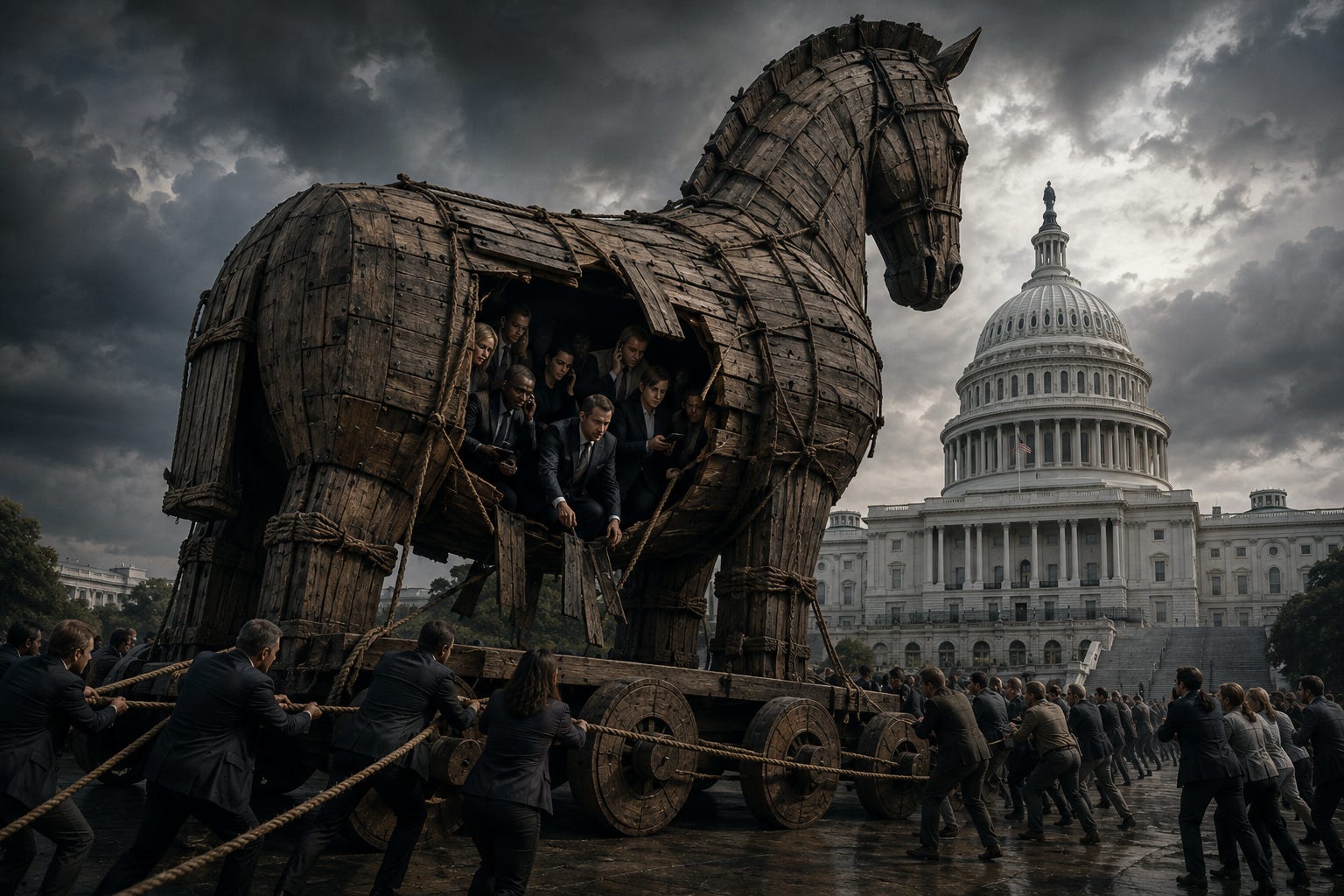
Tricks are central to “The Odyssey.” In myth, Odysseus is a trickster. He is described, in the first line of the story, as the man of many ways or of many wiles or of many turns. ...
But Nolan wasn’t looking for a trickster. His Odysseus is something else. That, you can say, was Nolan’s first trick. ...
The function of the trickster, writes Lewis Hyde in ... “Trickster Makes This World,” is “to uncover and disrupt the very things that a culture depends on.” ... The trickster causes the damage that makes growth possible. ... Coyote brings fire; Raven brings the sun; Loki brings Ragnarok.
Hyde’s argument is that tricksters are both necessary and dangerous. ... A culture that cannot meet disruption with creativity cannot survive change. A culture that cannot protect its core values will be consumed by corruption. ...
We have been living in an age of tricksters. Musk, President Trump, Tucker Carlson, Andrew Tate, Nick Fuentes — the grammar of the modern right is tricksy. ... the dominant personalities of the age have gathered power by bulldozing customs and taboos, by saying what may not be said...
[Hyde said in 1998 that Americans love tricksters for voicing what cannot be openly admitted, and American institutions had arguably ossified in the years since, leaving too much unsayable.] ...
But today there is little that may no longer be said. The ideas and morals upon which the best of our culture was built have been disrupted and desecrated. The question now is whether that disruption can be met with creativity and renewal. ...
This “Odyssey” ostensibly hinges on Zeus’ law: Treat the beggar and the stranger as you would want to be treated. But as ... classicists have pointed out, that is not the law of Zeus, which is narrower: It demands hospitality toward the guest or the stranger... It is not an ethic of compassion or even reciprocity.
And here we find Nolan’s central trick: Nolan has smuggled the core of Judeo-Christian ethics into “The Odyssey.” Zeus’ law ... echoes Leviticus 19:34: “The foreigner residing among you must be treated as your native-born. Love them as yourself, for you were foreigners in Egypt.” ...
But the problem with adherents of the modern right is not just that they don’t live up to it; the issue is that they detest it. To treat the foreigner residing among us as well as we treat our native-born is derided as suicidal empathy. ...
The modern right is built on the logic of tribute and dominance. “We live in a world ... governed by strength, ... force, ... power,” Stephen Miller ... told CNN’s Jake Tapper. “These are the iron laws of the world since the beginning of time.”
But weren’t those iron laws replaced by the Golden Rule? When Odysseus concocts the trick of the Trojan horse ... to sack the city ... is he a hero or a villain? ... To Homer, he was a hero. To Nolan, he is a soul in need of redemption. Between Homer’s time and ours came a revolution in civilizational values... Which side of that divide are we on? ...
What Odysseus sees, eventually, is that his violations of the moral order have brought ruin to all around him. ... Odysseus and his men were not fighting the barbarians; they were the barbarians. ...
So, too, has the political movement that rose promising to make Western civilization great again betrayed its inheritance. The world now looks at America and sees us as the barbarians...
And what the political opposition has to do now is recognize what Nolan recognized: That it is an affirmation of our civilizational values to say that cruelty is a weakness. That only compassion and reciprocity build a durable and decent society. ...
Justice in America has come, repeatedly, when those seeking progress realize that the language of the Torah, of the New Testament and of the Declaration of Independence can be wielded on behalf of a new world. ...
Nolan’s Odysseus is not a trickster. He is a man living in the ruins brought about by tricksters. So, too, are we. This movie, and the reaction to it, is a sign that the age of the trickster is ending.
Now we need those who would remake this world.
And if you haven’t filled out your census form, please lift your game.
This might surprise you. I know there’s a lot of arson going on in Melbourne. But it still surprised me.
Not running a retail store, we’ve avoided the arson. Still, in poncy Port Melbourne, our 80+ year old neighbour’s car was stolen from inside his garage in the middle of the night and wrecked. And hooded folks loitered around our own house with machetes. This concentrates the mind and seems to be rather unpopular among the voters.
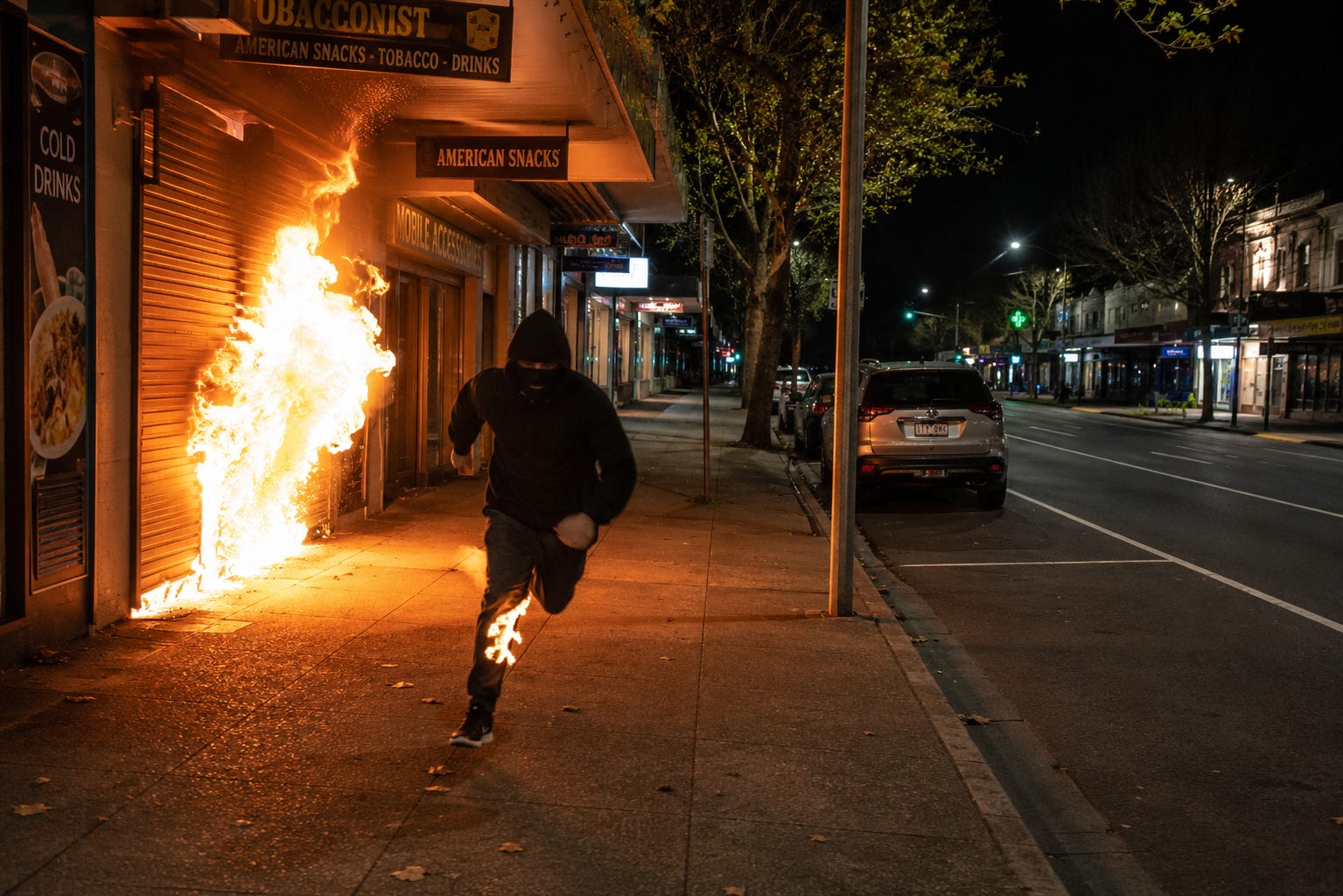
A note on the shutter door of a Melbourne bayside business selling American snacks and tobacco was the first warning.
It read: “This is The Commission. You need to contact us.”
The transnational crime network that has terrorised Melbourne and regional Victoria from the safety of Iraq over the last few years was not making empty threats.
Days later, under the cover of darkness, a masked man carrying two jerry cans was filmed approaching the business in Mentone. The containers were emptied under the door and a fire lit — the eruption of flames so violent it caught the shady figure off guard and set his leg alight.
The incident ... has been replicated dozens of times during a reign of terror at the hands of kingpin Kaz Hamad.
But the tactics have escalated. Hamad, the organised crime boss behind Victoria’s tobacco and bar wars, was jailed for life in Iraq last month. ...
While the wheels of justice turn in the Middle East, The Commission has hardly sputtered. If anything, the extortions have become more violent, more brazen, more terrifying.
The Age newspaper this week reported the syndicate behind firebombings across the state is in the midst of a “major new escalation of violence” that includes abducting individuals off the street in broad daylight.
The most notable example of that tactic was carried out in Morwell ... last month. There, a local shop owner refused an extortion attempt before a relative was abducted off the street [on a Saturday], forced into a black sedan and assaulted with a knife.
A Victoria Police spokesperson told news.com.au the incident unfolded in broad daylight on August 1. ...
Naumenko, the Melbourne underworld reporter [with contacts inside the network in Iraq], said he was “shocked by that kidnapping in Morwell”. ...
Victoria Police last month claimed a major breakthrough with the arrest of alleged firebombing director Jesse Hadchiti. But Naumenko shared a message after Hadchiti’s arrest from those overseas. “Nothing stops and nothing changes,” The Commission told him. “The beast has awoken. Tax continues to be paid and the boys will continue to burn.”
This week, Naumenko again reached out to those in the Middle East. “Have the arrests made any real impact,” he asked the current leader ... “Hahahaha does it look like it,” was the reply. “No effect brother. (Zero).”
Naumenko told news.com.au on Friday that the Morwell incident is a genuine escalation. ... “The Commission ... is incredibly well organised. They have multiple indispensable ‘lieutenants’ available ... to take over senior positions as others are pinched.”
Rohan Pike, a former Australian Federal Police officer, said it is almost impossible for authorities to get a grip on the city’s organised crime crisis. “Victoria Police has made so many arrests that it’s almost impossible to count them now ... It’s the worst it’s ever been.”
The Age reports that a 23-year-old associate of Hamad has taken control of operations ... and has ordered several kidnappings and shootings, some of which allegedly took place with children present.
The so-called “Kaz tax” has been blamed for more than 200 tobacconists being burned to ground in Victoria in the past few years. Bars, clubs and high-end restaurants were targeted next, many of which received a haunting threat via text message that read: “If you got this message ... we won’t stop till we get what we want.”
April was the most brutal month for venue owners. ... On April 26, footage emerged of arsonists setting Bar Up alight. The popular Chapel Street venue was engulfed in flames around 5am and completely destroyed.
Teens, recruited [via] an Airtasker-style approach, are carrying out the firebombings for a few hundred dollars. Detective Inspector Chris Murray ... said they are disposable and their co-operation keeps organisers at arm’s length from the violence — and from police.
“Often they don’t even know who they’re working for. ... These young kids are being used as cannon fodder for a few hundred dollars.”
Insp Banks said in June that The Commission won’t stop at tobacco or alcohol. They’ll get into “every single thing you can think of — and then they think of something else.” ...
In the Middle East, the group is continuing to evolve without Kaz at the controls. “There a man in Saudi Arabia doing a lot of ordering of this shit, too,” Naumenko told news.com.au. “He’s linked with Kaz.”

Richard Morris@ahistoryinart
Like Pierre Bonnard who had a significant influence on his early work, Alberto Morrocco painted best what was closest to him. Here it is his wife Vera, doing her hair early one Tuesday morning in 1953.

5:52 AM · Aug 11, 2026 · 2.78K Views
1 Reply · 26 Reposts · 226 Likes

Prof. Federico Heuer@FedericoHeuer
El árbol de la vida 1909. Gustav Klimt. Austria

6:16 PM · Aug 10, 2026 · 2.33K Views
3 Replies · 67 Reposts · 275 Likes
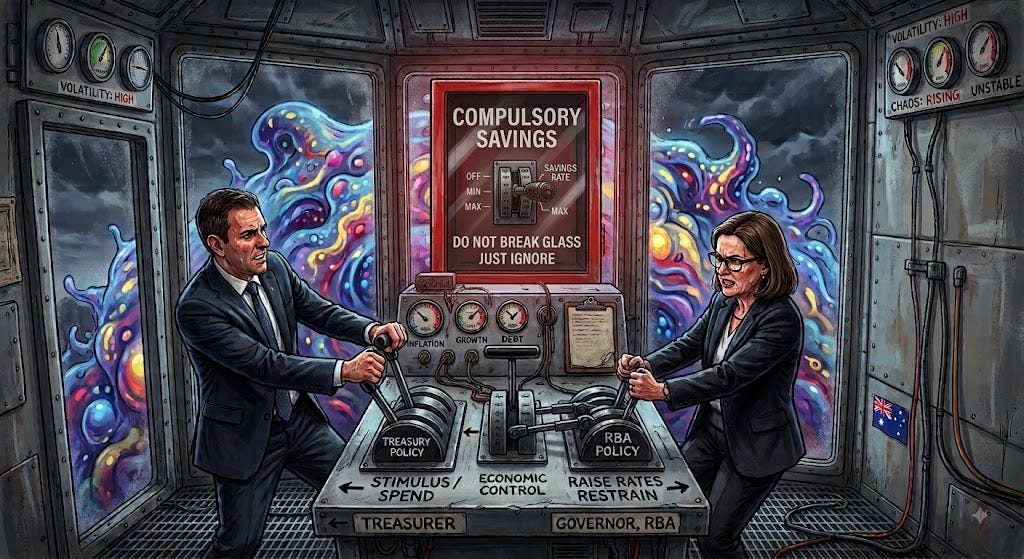
I was pleased to see Chris Richardson promoting the idea of using our gigantic compulsory savings system as an additional tool of macro-economic management - and Saul Eslake backing him. It is a great idea, though I do say so myself.
Still, I remember the same thing doing the rounds the last time rates started rising again and the media interest was a response to the cries of pain. Sadly, they thought that the policy would manage the economy without pain or less of it. I used to tell interviewers that if it was seeking to slow consumption, the point of the policy was to inflict pain. So the only case for the new policy I was proposing was that it spread the pain around more widely (and so less intensely) and in a way that made its consequences more predictable and stable.
Anyway, here’s the article quoting my friend Chris and my friend Saul (who deserves a special mention in dispatches for defending my reputation down in his home state of Tasmania at some potential hazard to his own - not forgotten).
As the article makes clear, making a change like this requires some institutional development. That’s the kind of thing that had been pretty much continuous from 1983 to the end of the Keating Government in 1996 with a paroxysm of near suicidal reform commitment in Howard’s first term. I don’t want to dump on the Albo Government as being quite as disinterested in good policy as Abbott and Morrison were. It’s not. It’s been working away in various ways. But it could easily have been working away on this kind of reform. It wouldn’t have amped up the short-term political difficulty much but it would have built political capital as it did it.
Every time the Reserve Bank of Australia (RBA) meets to discuss the cash rate, millions of Australians hold their breath, knowing the outcome could affect their mortgage repayments, savings and household budgets.
Some economists say there’s another way to cool spending — one that builds your retirement savings instead of handing more money to the bank through higher interest rates.
But it’s one almost nobody talks about.
Cooling inflation means squeezing demand somewhere...
But this design hits homeowners in Australia harder than it does in many other countries, economist Chris Richardson says.
“Because we haven’t built enough homes...when we fight inflation, it tends to fall more on the shoulders of mortgage holders than you see in most other nations.”
Richardson believes there’s another lever that could be used instead of or alongside the cash rate: superannuation...
The difference is where the money goes — not interest to a bank, but savings for your own retirement...
Could Super Help Fight Inflation?
The super guarantee (SG) is the compulsory minimum share of wages employers pay into eligible workers’ superannuation...Right now, that 12 per cent is fixed. But under this theory...the super guarantee could become a temporary economic lever instead, raised when inflation runs hot and lowered when spending weakens...
For some workers, it could mean an extra $20 a month being redirected into super during periods of higher inflation, and returned to take-home pay when inflation eases...
Spreading the Inflation Burden
Richardson argues the most efficient lever to dampen spending is the one that reaches the broadest share of the population — and on that measure, super has the edge over mortgages.
Roughly a third of Australians have a mortgage, compared with around 40-45 per cent who receive compulsory super contributions through employment...
That’s backed by 2023 modelling from economist Tim Toohey...which found a 1-percentage-point rise in compulsory super could have a similar impact on household savings as a 1 per cent rise in interest rates...
There is a catch...because Australians can’t touch their super until retirement, this extra saving wouldn’t help households who need more cash to cover immediate expenses...
Broader Gains — and Losses
But where there are winners, there are losers — with some households potentially better off and others worse off...Savers relying on higher interest rates are one example.
“Those with money in the bank wouldn’t win as much when interest rates go up, because their savings won’t go up by as much,” Richardson says.
There’s a more direct trade-off too: pushing more wages into super would dampen wage growth, he says... “A super levy is not necessarily a magic pudding. It’s a complex problem. There are no simple solutions...”
Is the Super Lever Even a Possibility?
Economists agree the idea could boost savings in the long term, but convincing people to accept lower take-home pay today is another matter entirely.
“Payroll systems would have to adjust. You have to convince the unions, because what you are saying is that tomorrow’s wage in the hand is lower than today’s,” Richardson says.
“And remember that on average, people with a mortgage are wealthier than people with a wage...”
The RBA is clear this isn’t on its radar...the cash rate remains [its] primary tool...
Treasury...has not modelled the idea...and says the RBA’s monetary policy remains fit for purpose.
Eslake says there would be little political appetite for a super guarantee increase...
“Politicians are wary of owning decisions that make people [initially] worse off.”
One Lever to Pull
Richardson and Eslake...say the super levy wouldn’t be a replacement for interest rates, but they believe it should be on the discussion table.
“Think of the old saying about investments — don’t put all your eggs in one basket,” Richardson says.
“When it comes to controlling inflation, Australia has a lot of eggs in the basket of pain that hits homeowners...”
Eslake says a lever would be “a complement to rather than a complete substitute for movements in interest rates”...
He’s also unfazed by the fact that no other country has tried this idea.
“I can’t think of any other countries in the world who have something like this. But we don’t necessarily need a template from another country to do something that might be sensible.”
From this podcast.
I’ve known Clyde Rathbone since he and his brother started ‘Letter’ which pitted people who laughingly call themselves ‘public intellectuals’ against each other in a debate. It was a good format, but a lot of work for the participants and eventually disappeared when Clyde - and I think his brother - were bought up by Substack where I occasionally encounter him - or shoot him some thought about Substack. Anyway, so little am I exposed to the sport at which he previously excelled that all the details of this note were news to me.

Giselle@gisellecaldei3
Paul Gauguin The Big tree 1891

12:54 AM · Aug 11, 2026 · 778 Views
16 Reposts · 101 Likes

Duille@DuilleDesign
"The Man of Confusion". Paul Klee. 1939.

7:00 PM · Aug 10, 2026 · 1.92K Views
8 Reposts · 88 Likes

I have a friend who’s a serial entrepreneur and very good at it, and he just doesn’t get why the Labor Government has changed capital gains taxation just to pick on him. I keep telling him it’s nothing personal, but Peter Martin’s recent Substack puts it more analytically. His basic message? You can’t make an omelette without breaking eggs.
Bob Breunig of the ANU Tax and Transfer Policy Institute made some important observations in his submission to the Senate inquiry into the budget’s tax package.
Tax Reform Is Never Neat and Simple
Tax system changes (unless they are revenue-reducing tax cuts) result in some individuals paying more tax than under the previous system and some individuals paying less tax than under the previous system.
Changes to the system need to be evaluated against broad objectives of reform... Attempts to isolate particular individuals or groups of individuals from changes by creating carve-outs or exemptions are likely to do more harm than good... Creating carve-outs to avoid groups being worse off directly undermines this objective.
We should have a healthy scepticism towards claims by individuals who feel hard done by because their investment strategies were based upon government tax policies which are now changing.
All investing is done by assessing, ex-ante, the potential risks and rewards of an investment...
More investment sins are probably committed by otherwise quite intelligent people because of ‘tax considerations’ than from any other cause.
Investors complaining about changes in government policy not going their way is akin to complaining about a high-risk investing gamble not paying off.
The New System Creates Some Odd Situations
Any system does. Pointing out that the new system creates some strange outcomes is not a considered critique of reform. The current system creates all kinds of oddities; it’s just that we are used to them.
Summary
Tax reform is hard. The government should be praised for attempting to take it on. One possible response to the proposed package of reforms is to reject them because they fall short of perfection... Another response is to respond to the shortcomings of the package by complexifying the changes with exemptions and exceptions, and consequently worsening the complexity and unfairness of the existing system. A third possibility is to accept the constraints of the political environment, move forward with this worthy, if imperfect, package of reforms...
Our considered opinion is that the third option is best. Momentum for tax reform has been hard to get and now that we have it, we shouldn’t waste it... We consider the current package to be a significant improvement to the existing tax system...
Each of our guests on this week’s The Economy Stupid picked up on these themes...
Are the Changes Surrounding Capital Gains a Good Idea?
They remove the concession that taxed only half of each capital gain, and instead tax the complete (real) gain after adjustment for inflation.
And they ensure that at least 30% of each real gain is taxed. Investors were postponing the sale of their assets until their tax rate was low...
And they limit full negative gearing (the ability to write off costs against wage income) to newly-built properties.
Graeme Samuel is a former head of the Australian Competition and Consumer Commission...
[Graeme, responding to the argument that capital is scarce and needs lighter tax to keep it from moving overseas:] See, we might need capital investment, but we also need more surgeons and more anesthetists and more plumbers and, and more electrical contractors to be able to build houses and builders and the like, but we don’t give them the tax concession that we give to capital.
Just a little while ago, I unfortunately had to have a complete knee replacement.
And I said to the surgeon, um, after he finished... I said, “Tell me, do you have a 50% reduction in tax for what you’ve just done to my knee?” And he looked at me puzzled, and then laughed. I said the same thing to the anesthetist... Why is it that people who are earning income through personal exertion, and I earn it through PAYG, why is it that I’ve got to be subsidizing by paying a full rate of tax, subsidizing those who invest in capital?...
I added my own reminiscences.
Do you know, I remember 1985. I was actually in the room for the final press conference at that tax summit. The talk at the time was about the things that were going to end. Property investment was going to end because of the capital gains tax and restaurants were going to end, we weren’t going to dine out because they were going to have a fringe benefits tax. As I remember, it didn’t take many months at all until life went on as it had...

Elle Lookbook@EvaLovesDesign
The 1880s through the 1910s were the golden age of colorful antique ink bottles in beautiful shades of red aqua, amber, green, and other jewel-like colors, often in wonderfully unusual shapes. Tiny pieces of history made to be useful yet ending up beautiful.

7:24 PM · Aug 11, 2026 · 7.21K Views
8 Replies · 101 Reposts · 783 Likes

Makel@Makel_art
🎨Lumière du Nord Intérieur avec rayon de soleil Vilhelm Hammershøi - 1900

5:47 PM · Aug 11, 2026 · 2.2K Views
40 Reposts · 223 Likes
But these moral qualities, which deserve admiration, clearly did not prevent some of them from participating for many years in the game of deceptions and falsehoods. Confident “of place, of education and accomplishment,” they lied perhaps out of a mistaken patriotism. But the point is that they lied not so much for their country, certainly not for their country’s survival, which was never at stake, as for its “image.” In spite of their undoubted intelligence—it is manifest in many memos from their pens—they also believed that politics is but a variety of public relations and were taken in by all the bizarre psychological premises underlying this belief.
Still, they obviously were different from the ordinary image makers. Their distinction lies in that they were problem-solvers as well, hence they were not just intelligent but prided themselves on being “rational,” and they were indeed to a rather frightening degree above “sentimentality” and in love with “theory,” the world of sheer mental effort. They were eager to find formulae, preferably expressed in a pseudo-mathematical language, which would unify the most disparate phenomena with which reality presented them, that is, they were eager to discover laws by which to explain and predict political and historical facts as though they were as necessary, and thus as reliable, as the physicists once believed natural phenomena to be.
Hannah Arendt, on the US Administration’s public ‘messaging’ (as we’d call it today) around Vietnam, Lying and Politcs.


dee nickerson@dEEN1cKers0n
It's possible that I'm a passive luddite. Anyway, a summer painting from the archive. With best wishes for a soothing Sunday 😌

6:06 AM · Aug 9, 2026 · 924 Views
13 Replies · 43 Reposts · 209 Likes
Richard Morris@ahistoryinart
Eliot Hodgkin's picture shows his usual meticulous technique. On this occasion it's a mix of red and white currants (1957).

11:06 AM · Aug 9, 2026 · 1.35K Views
14 Reposts · 63 Likes
Drafted for this newsletter by ChatGPT after I asked it about the origin of the name “Coogee” thinking it was an aboriginal name but then wondering how it could turn up on either end of the continent where the languages spoken were quite different. I asked it to write up the discovery in my voice. Hmmm.
What does Coogee mean? A bad smell? A body of water? A basin? A bone? “Little”? Musk ducks?
All of these have been proposed at one time or another, which is one reason Jan Tent’s monograph On the scent of Coogee? is such fun. I’d always assumed Sydney’s Coogee was simply a local Aboriginal name. Then I discovered there was another Coogee Beach in Perth. That seemed odd enough to raise the possibility that I’d been carrying around a bogus folk etymology.
Tent finds more than twenty Coogees, or close variants, across NSW and Western Australia. Better still, every one of them names, or sits beside, water.
Sydney’s Coogee probably does come from a local Aboriginal word for “stink” or “bad smell”, perhaps from rotting seaweed, perhaps from the swamp that once ran down towards the bay. But Perth’s Coogee is pronounced differently, and the standard claim that it too means “bad smell” seems to have little linguistic support.
From there things become wonderfully untidy. In NSW, some Coogee-like names may be related to words for a basin, coolamon or rockhole. In Western Australia, Tent thinks some may instead derive from words meaning “bone” or “bony”. One official explanation for a northern Perth Coogee Swamp offers “musk ducks” as an alternative to “bad smell”.
(“Such fun”, “wonderfully untidy”. Really? Surely I’m more pretentious than that!)
Michelle Goldberg from the NYT on the Israeli critic of Israel who’s not pure enough for the anti-Israel cause.
In 2021, the Israeli film director Nadav Lapid moved to France because, he told me, he felt his country was in a state of “total moral collapse.” After Oct. 7, as Israel ground much of Gaza into dust, Lapid returned to Israel to make “Yes,” an impossibly scathing, bitterly surreal attempt to capture that collapse on film.
“Yes” tells the story of a struggling pianist and party entertainer ... who is commissioned to write a new national anthem celebrating genocide in Gaza. ... Lapid’s film is a vision of a traumatized country where life has become a frenzy of orgiastic partying and histrionic self-righteousness. ... In “Yes,” you can sometimes see and hear the real-world annihilation of Gaza in the distance.
Making “Yes” in a country at war ... wasn’t easy. Many in the Israeli film industry refused to have anything to do with it; Lapid had to bring a makeup artist in from Serbia. ... He forbade his actors from posting anything about the project online, and dodged the military to film guerrilla-style along the Gaza border.
“Yes” has been furiously denounced by leaders in Israel. The night of the Ophir awards — Israel’s version of the Oscars — police officers detained its star, the left-wing performance artist Ariel Bronz, on dubious grounds. ...
Israeli outrage about the film was predictable. More surprising is that some leftists in Europe are boycotting Lapid and his work. Last month, about a dozen pro-Palestinian filmmakers threatened to pull out of the Marseille International Film Festival because Lapid, an Israeli who’d taken public money, was going to be on the jury. ... Lapid agreed to step down and instead hold a public master class on his films, but that too was canceled under pressure. ...
This wasn’t the first time that Lapid has felt stung by the European left. [In Spain, the film screened under police protection after bomb threats, and though it premiered at Cannes,] he thinks others have shied away from him and his work because they feared precisely the sort of dispute that broke out in Marseille.
Given that Lapid believes in boycotting Israel, the boycott of him has elicited a smug satisfaction in some quarters. ... Israel’s culture minister gloated that no matter how much Lapid tries to curry favor with the country’s enemies, they will always see him as nothing but “a Jew from Israel.”
“Yes” mocks Israelis who view themselves as eternal victims and insist that all their critics are antisemites. After being driven from the film festival in Marseille, Lapid felt like the butt of his own film’s joke. For about 10 minutes, he said, he thought that “maybe those people in Israel were right.”
But since then, he said, the film industry has rallied around him. Open letters supporting Lapid have been signed by leading figures in French cinema, as well as by the Palestinian intellectual Elias Sanbar and the actress Natalie Portman. The letter signed by Portman calls Israel a criminal state but argues ... that its dissident artists should be treated like those from any other rogue regime. ...
All this support, said Lapid, has exposed where cultural power really lies. ... “I don’t enjoy this feeling,” he said. “I don’t like to be a part of the majority.”
Surveying the whole debacle, Lapid puts much of the blame on cultural institutions that let themselves be cowed by a noisy purist minority. Most festival programmers and film distributors, he believes, don’t care all that much about Israel or Palestine. ... Decades ago, he said, conflict and controversy “made cinema relevant and important and sexy.” Now a sort of prudence reigns.
The result is that relatively few films reflect the discombobulating, absurd and often apocalyptic texture of modern life. Sometimes Lapid feels that the most truthful moment in a cinema is when patrons read news updates on their phones before the feature starts. ... “While the present is playing crazy punk death metal,” he said, movies are playing “a nice intermezzo by Chopin.”
“Yes” is in part a disgusted condemnation of such escapism. Almost two hours into it, a voice-over says, “The Israelis, who grew up with the question ‘How could people live normally while perpetrating horror?,’ have themselves become the answer.” The inanity of the leftists who’d censor such a film shouldn’t distract us from the right-wing nightmare it reveals.

Massimo@Rainmaker1973
Every autumn, a huge golden cross appears in the forests of County Donegal, Ireland. 3000 Japanese larch trees were planted among pine trees, creating a cross pattern when the larch trees turn yellow.

11:28 AM · Jul 31, 2026 · 31.3K Views
20 Replies · 227 Reposts · 1.41K Likes
Richard Morris@ahistoryinart
The Dutch painter Menso Onnes was initially influenced by the Hague School and then after meeting the artist Floris Vester his style became freer and much looser. Shown here (1895) is his studio decorated with bottles and glass vases to catch the sparkling effects of light.

8:28 PM · Aug 7, 2026 · 3.91K Views
5 Replies · 43 Reposts · 257 Likes
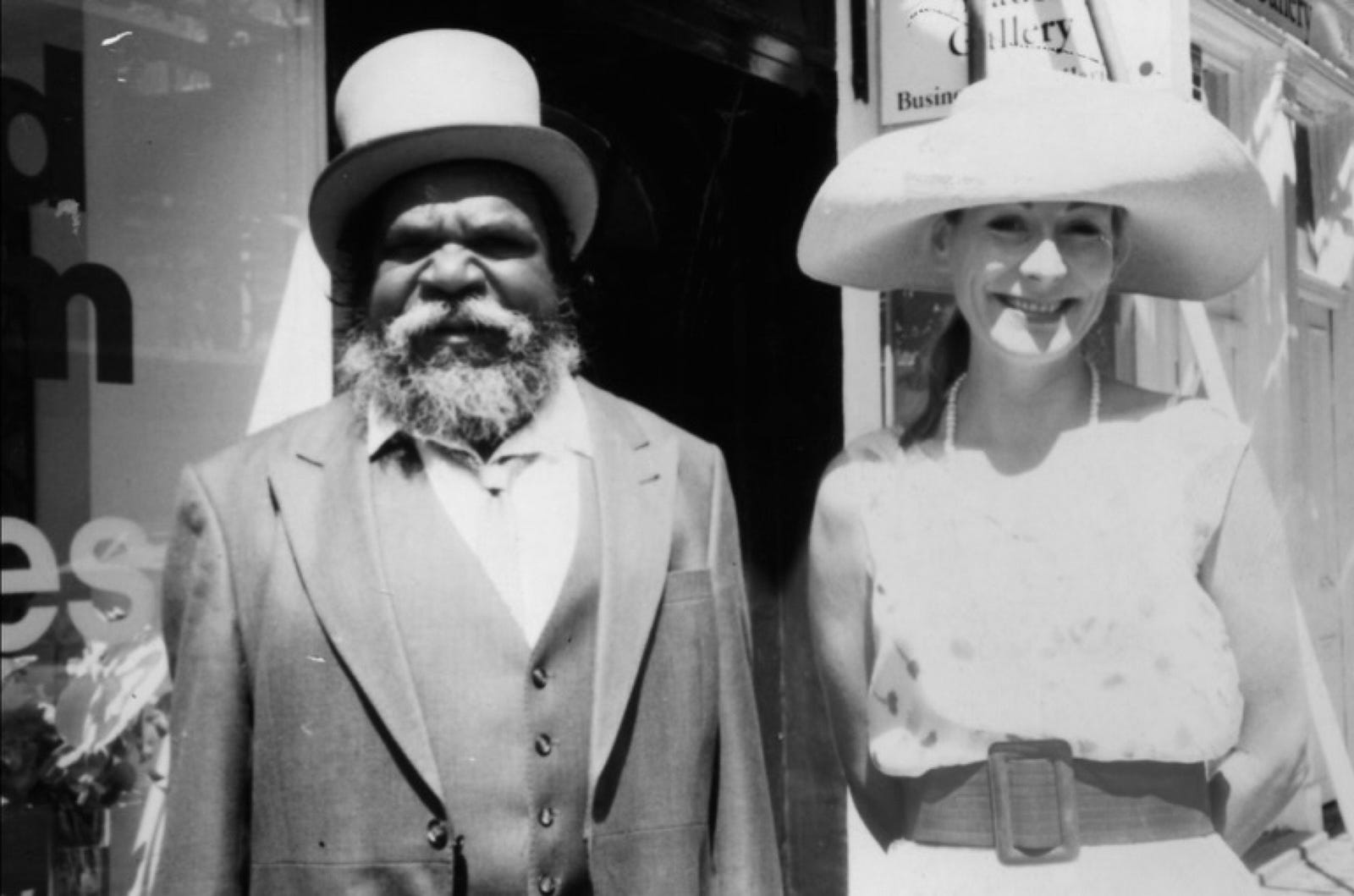
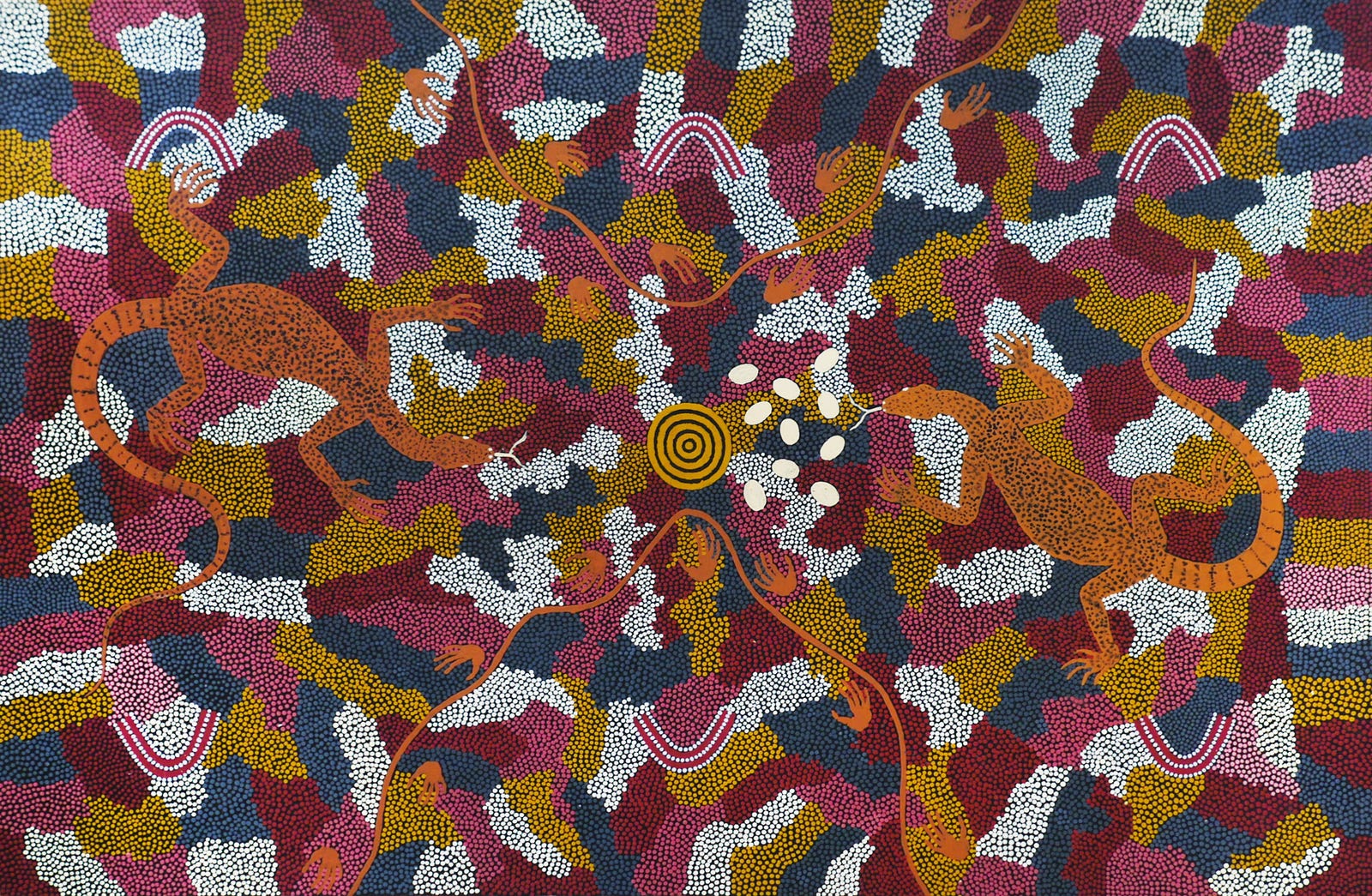
Clifford Possum was one of the leading lights of the renaissance in Aboriginal painting in Australia. I subscribe to the Rebecca Hossack Gallery newsletter as I know her from old uni days. Anyway, here’s a bit of a splurge on Mr C Possum Esq.
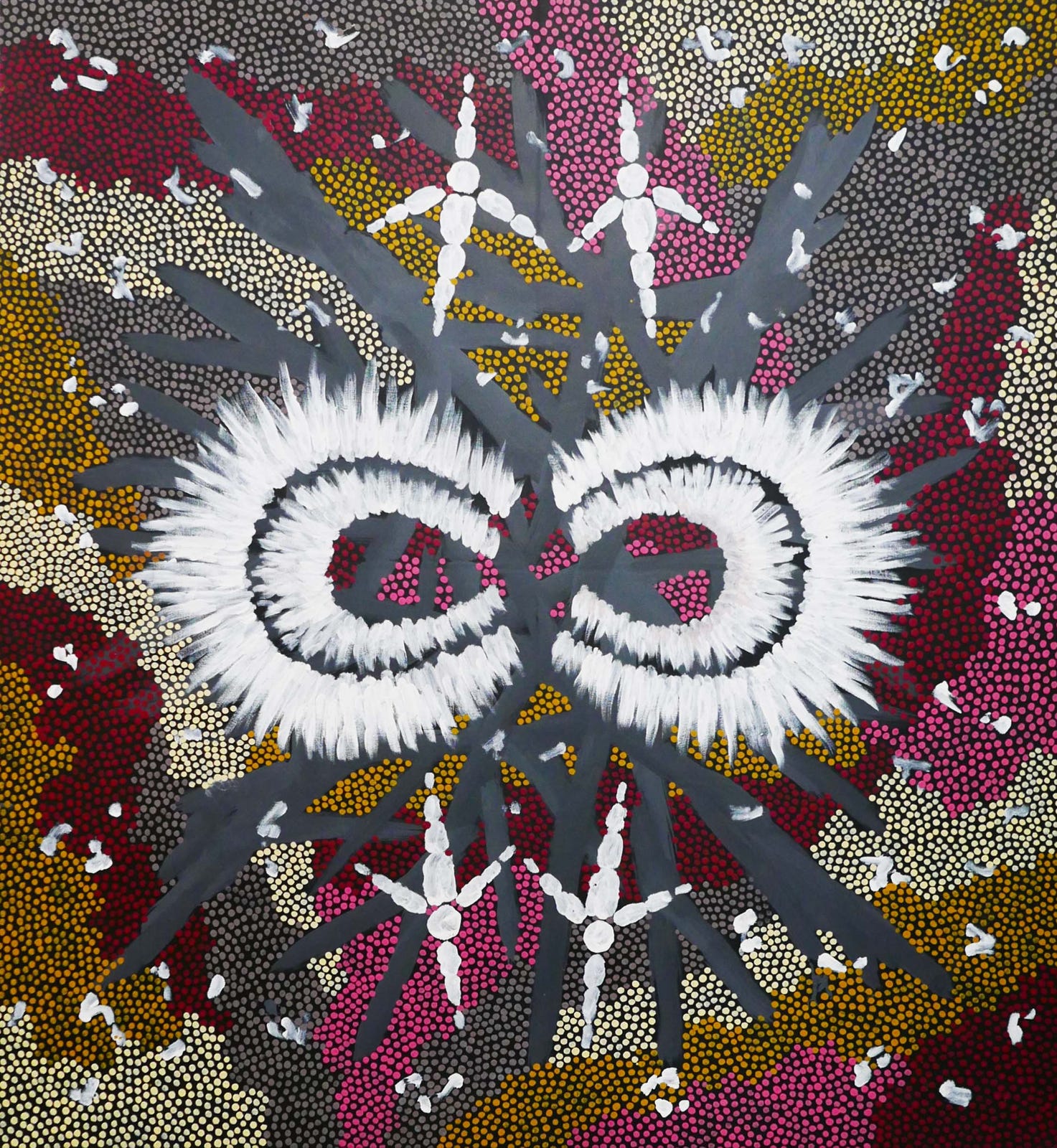
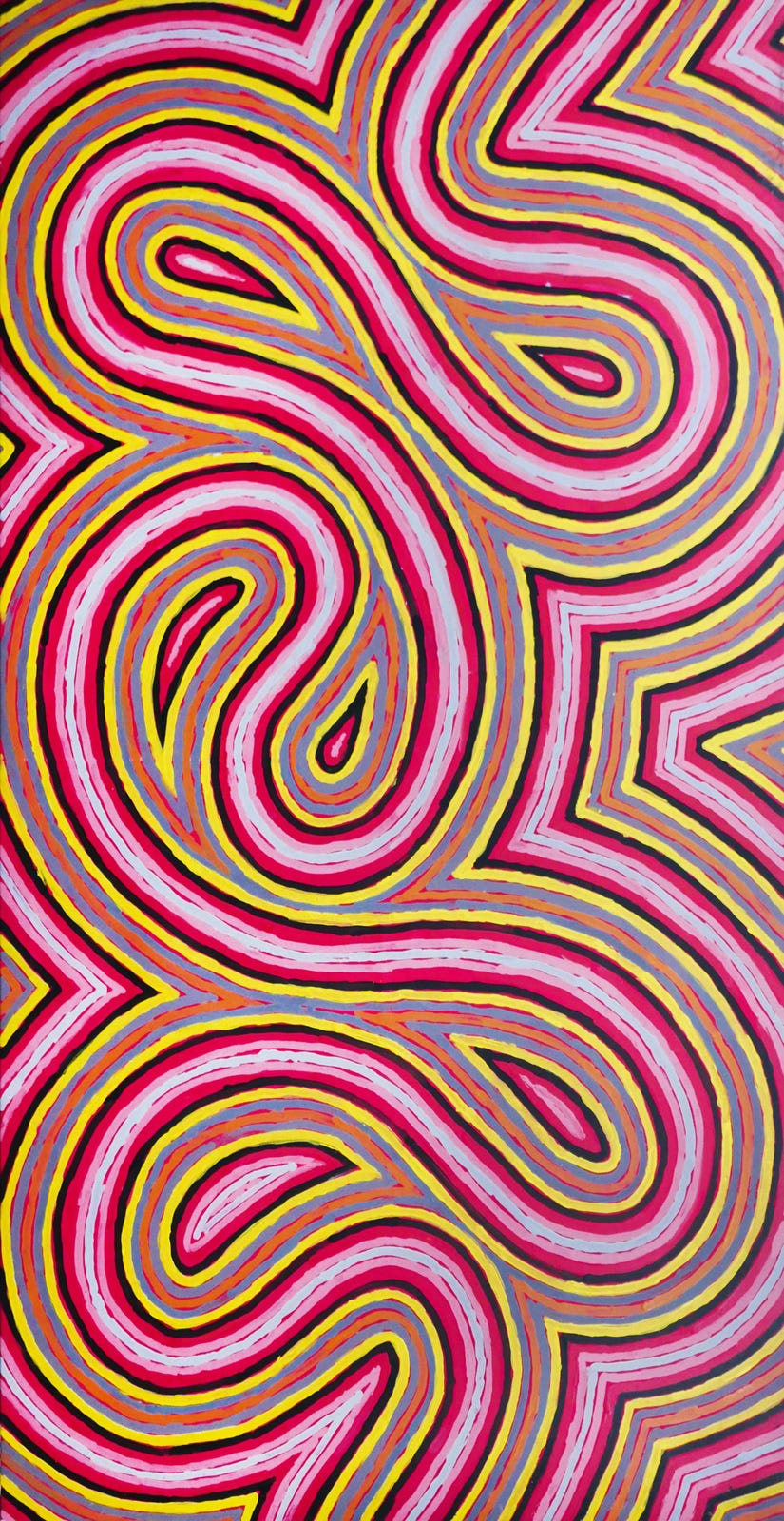
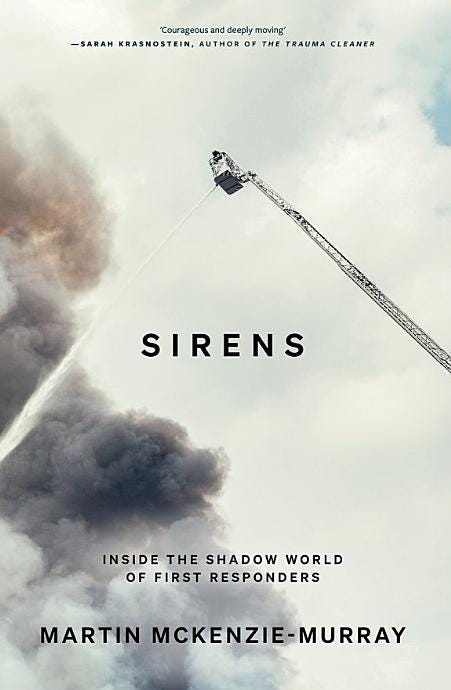
Martin McKenzie-Murray is a good writer who recently published a good book, the first chapter of which you can read in the Kindle sample, or below.
Ever since I was a young boy, I’ve experienced variations of the same nightmare. The dreams involve aircraft – planes, usually, but sometimes helicopters. I’m never a passenger, but instead a prophetic witness on the ground, before its destruction.
This awareness, and my recognition of its uselessness, is perhaps the most sinister quality of the dream. My knowledge is impotent, and I submit to the atmosphere of doom and paralysis.
Then comes the demon whine of failing engines. Then the plane stalls and drops from the sky like a dead angel. There is a great roar, the earth shakes, and then comes the fiery rain of debris.
Only once did I bother to record the details of one of these dreams. It was about seven years ago, when my partner was pregnant with our daughter.
On this occasion, uniquely moved to record the dream, I reached over to my bedside table and wrote:
Day: Saturday. Time: 5:43 am. Stress levels: Okay. Description: British Airways commercial liner. Warped by imagination – plane doesn’t have regular engines, but one afterburner. Is taking off. Despite the wicked sound of the engine, appears to be climbing normally. An old friend is watching with me. Orphaned young in waking life. Then the plane slows. Too slow. It stalls, falls. Explosion. Dread. I wake.
My dream-self witnesses mass death and is sometimes mortally threatened by the ensuing inferno. But that’s not what lingers. What lingers is the quality of dread – the sticky, black residue that lines my consciousness long after I’ve woken.
Such dreams have startled me from sleep for nearly forty years now. What element of my unconscious life has remained constant all that time? Or perhaps that was the wrong way to think about it. Could there be some unprocessed memory that was begging for conscious treatment?
In 2024, about a month before what I’ll call my unravelling, we celebrated my daughter’s fifth birthday in a community hall, which we decorated with bright strings of balloons.
I had developed a problem with balloons. I knew by then that the sudden bursting of one was agonising for my nervous system – just as any other sudden noise was and, increasingly, my own shadow, which had, in the fulfillment of a terrible cliché, developed the capacity to startle me.
Much of this I kept to myself. But being in a room filled with balloons was an agony of anticipation, and I crept around, hypervigilant, saddened by how distracted I was on this day of celebration.
At the end of my daughter’s party came the job of disposing of the balloons, and I was determined to do it myself. The thought of piercing dozens of them didn’t thrill me, but assuming control of the job was preferable to allowing someone else to do it.
When your child stops breathing, time dilates. Seconds are experienced as long and hysterical days. And there’s a wickedly vivid compression of thoughts – thoughts that mark like a tattooist’s pen; thoughts that I can’t describe here. Enough to say that these are diabolically crowded seconds, in which the bleakest future is both seen and deeply felt.
She choked. On the food I gave her. I was right beside her. I knew she’d put too much in. At first, her expression was one of sweet, innocent confusion. Then alarm. Then her face changed colour. Then there was silence. From her at least. I had her over my knee horizontally, face down, while I called triple zero. How do I unlock my phone? Do I scream for the neighbours’ help? I was alone, my partner at work. How long did we have?
I slammed her back. Nothing. I slammed again. Nothing. How much force is too much? How much is too little? I thought about the baby first-aid course I took before she was born. I thought about the mannequin and its hard plastic flesh.
The emergency service was on speaker now.
“Don’t hit her back,” they said. I wondered how I’d managed to make contact with them – did I call them? Of course, I was the only one there.
Only months earlier had I called triple zero for the first time. I’d stepped off my tram and found an old lady had fallen, her head split open. Blood was splashed on her bag of grapes. I put pressure on the wound, shielded her from the sun, held her hand. She was in shock; she was repeating herself. A sweet woman. After a while she improved. She wanted to get up; she wanted to go home. I told her an ambulance was on its way, and their advice was for her to stay here. She obliged. I asked about her life, got her address for the paramedics.
But what I was thinking about with my daughter over my knee was how long that ambulance for the old lady had taken to arrive – about forty-five minutes. But I thought: surely, they triage? As I held the woman’s hand, the operator had asked me a lot of questions – answers to which were surely fed into a system of prioritisation. So maybe this ambulance would be faster? Surely, surely.
It wasn’t needed. I thrust my index finger in her mouth, down her throat and scooped out the food. Was that all of it? It didn’t seem like enough. But she was screaming now – a good sign. I went back in, scooped out some more. Our two cats pounced on it, and their opportunism and obliviousness seemed faintly obscene.
I was holding my daughter’s hand now. She recovered quickly. I didn’t. Paramedics called me again, and falteringly I told them I didn’t think they were needed anymore. But I could barely speak. I was shaking, crying, while my daughter was asking for a book. Unlike the cats’, her obliviousness was cherished. How much time had passed? I couldn’t tell you. After my partner returned from work, I spent much of the afternoon trembling and experiencing sudden bursts of weeping.
For many months, I had intrusive memories, which I worsened by elaborately transforming them into worst-case scenarios. The poisonous thing about intrusive memories is that they introduce not merely an image, but the feeling of that moment.
I drank more, and developed an intense interest in space exploration.
The supermoon lived at the end of our street, or it did briefly one evening, and in the days before I’d excitedly primed my daughter for its appearance. I scooped her up, ignored her protests and walked out into the middle of our street.
Her reluctance thawed, and she charmingly mistook the streetlights for our supermoon. But then, unmistakably, there it was: bright, plump and enthroned just above the horizon.
“I get step?” she asked. She wanted to climb and touch it.
Perhaps seven or eight months had passed since the incident. The choking. We were still in Melbourne’s Covid lockdown, and I found great pleasure in showing my daughter the moon and the stars. As I did in writing to astronauts, and to a man who had designed a sculpture of one that was placed on the moon to commemorate those who had died in the pursuit of space exploration.
The sculpture is still up there now, along with the abandoned moon buggies and ziplocked bags of shit. Along with the flags and golf balls and long faded family photos that astronauts left behind.
My own diagnosis of PTSD came years after I began work on this book. After years of hearing about the symptoms of others, it became harder to deny my own. But instead of making this admission and seeking help, I simply recalibrated my denial: instead of denying that I likely had PTSD, I now denied its importance and severity.
I was labouring naively under the belief that the symptoms would improve the more time passed. I was humbled to learn that the opposite was true. Things worsened. The intrusive memories slightly improved, but everything else got worse: the irritability, the hypervigilance, the insomnia. So too the nightmares and the vast volumes of sweat, so much that I could replace my singlet several times a night. So often did I interpret as an imminent heart attack what I now realise to have been severe panic attacks that I took to patrolling the street of the nearest GP, just so I’d be close to medics if I collapsed from cardiac arrest.
By now, I’d developed tics – violent twitches of my face and arms – and exhaustion was constant. When the nervous system is continually aroused in the mistaken belief that you, or a loved one, are dying, the electric suffusion of cortisol eventually retreats and leaves you beached upon a rocky shore. Our primal flight or fight instincts are not meant to be triggered daily, nor our bodies flooded with severe hormones, and there’s a commensurate low after the high of their deployment. A nervous system that’s either permanently adrenalised or recovering from its arousal doesn’t leave much left, and “it’s exhausting pretending you’re normal”, as Peter, the paramedic in this book, told me when I eventually shared my diagnosis with him.
There is nothing ennobling about PTSD. It does not enhance you. The world and its possibilities narrow cruelly to perceived threats. You’re more irritable, more sensitive, more caustic and more self-concerned. You can become less generous, less warm, less resilient. You may become dimly aware of a slow frosting of your soul – a transformation into a colder, pricklier and frailer person than you’d like to be.
I began a course of Eye Movement Desensitisation and Reprocessing therapy (EMDR) in 2024. Before I did, there was a lot of preparatory work. Most of this involved my therapist enquiring about my past – establishing my “history”. One aim of this excavation was determining if the specific trauma that would be treated by the EMDR was, in fact, neatly isolated, or, rather, something complicated and aggravated by a longer history of trauma. In part, the process was concerned with determining whether this was PTSD or complex PTSD.
As I answered his questions about my past and described various events – calmly and descriptively, as I felt neither shame nor pain except when discussing my daughter – I suspected him of being faintly astonished. His questions began more questions, and I was surprised that by the end of our fourth session he was still compiling my “history”, and we had not yet begun the EMDR. What might have seemed the simple isolation of one psychically undigested moment had become something much larger, complicated and diffuse.
Was my childhood in some diabolical concert with the incident? Hell, I didn’t know.
Looking back now, the stages of my uncle’s grooming were textbook. His behaviour was calculated to create a unique sense of trust and intimacy; a sense that nobody else understood me quite as well as he did.
He was staying with us from overseas. He first learnt my passions, which was not difficult given the musical and athletic objects of my worship were boldly declared by the posters on my bedroom wall. Then he ratified their importance.
Besides ingratiation, there was an additional tactical benefit for my uncle: it helped drive a wedge between me and my parents, who were inclined to believe my interest in sport frivolous and my musical taste decadent and antisocial. Forty years separate my father and me, and never will that distance seem as vast and unbridgeable as when I was a teenager playing punk or hip-hop in my bedroom.
These points of alienation – or mutual bafflement – between parents and their children are strategically important to the sexual predator. By insinuating himself into this space, and by flattering my tastes, my uncle shrewdly distinguished himself from my parents and offered himself as a hip confidant. “Rap has its own language,” he would say. “As articulate as any other. It’s a creative reclamation.” In gratifying my interest in hip-hop, my uncle was also doing something more subtle – he was allying himself with me on a contentious domestic matter and thus generating the frisson of conspiracy. Developing a sense of conspiracy is important to the paedophile because it both flatters the victim and helps generate the conditions of secrecy. It was a beachhead – a landing ground from which further territory could be progressively claimed.
One night he asked me to play him the latest Oasis album, of which he knew I was enamoured. We were in my bedroom, and he asked that I turn off the lights. I thought this was strange and politely objected. But he insisted. He said the light of the stereo’s LED display would be sufficient. I obliged, and the room went black. My uncle was a guest, and as discomforting as the darkness was, I was more concerned about being impolite. It didn’t occur to me that this was sinister – it seemed more likely to be an expression of my uncle’s eccentricity.
Nothing more happened that night, except that my uncle rhapsodised about the genius of the Gallagher brothers. Which was part of his plan.
In the following week or so, he bought me beer and music. He told me he’d once met Roy Keane, then captain of Manchester United, and riffed philosophically on his temperament. He spoke in confounding ways about pop music and Irish nationalism, and by doing so implied his faith in my intelligence. He found ways to be physically close to me, like when he learnt that I cut mates’ hair and asked for a trim. I agreed.
And while he was carefully eroding boundaries, and secretly replacing them with others, I naively saw a refreshing kind of bohemianism – an unusually relaxed and cultured man, a type of man I’d never known.
One day, he suggested that we go to the local pub, which sat beside a jetty on the nearby marina. This was another secret conscription and another transgression. My parents wouldn’t have permitted this. Alcohol was strictly prohibited to their underage children, which he must have known.
Naturally, I was thrilled, and I asked my uncle if I could invite some friends. I was excited to show him off. He said no, offering an assortment of now forgotten reasons. Again, I deferred.
I wonder now what innocent excuses he’d prepared in case our pub journey was discovered. It was high-risk, after all: teens can’t typically hold their booze. Maybe he had no excuses ready, but I’d bet that he did. I’d bet that he’d anticipated discovery. I’d bet that in his lifetime he’d pre-emptively written many excuses and alibis. In retrospect, he seemed practised. Assured in his methods.
It didn’t go well for my uncle. I had barely touched my pint when I was spotted by a neighbour, who notified the manager that I was underage. We were asked to leave. Any novelty or excitement about being invited to a pub by an adult evaporated with the humiliation, and I wanted to go home. My uncle wouldn’t have it. After all, he said, the pub had a takeaway bottle shop. I demurred; he insisted. He bought a six-pack, maybe two, and suggested we drink the beer on the rock wall of the harbour. And so we did.
I suppose my uncle would have preferred me cripplingly drunk. And I wonder what would have happened if I was. But my humiliation and creeping unease ensured that I drank very slowly that night, and I never got drunk. As I sipped from my tin, and he powered through them, my uncle revived his tactical flattery. Before the tiny, gentle waves of the harbour, he invited philosophical reflections from me and then applauded their acuity.
Tired and confused, I suggested, again, that we go home. We did. My uncle brought the remaining beer with him, and when we got to the side door he whispered that we should be quiet so that we didn’t wake my parents. Then he suggested that he bring the beers to my room.
God, I was tired. And hard as this will be for many people to understand – and, trust me, I know just how difficult it is – I agreed. I felt some unease, but greater unease with the thought that I was badly misinterpreting my uncle. The fear of offending someone – of getting something so serious so wrong – was a vastly greater force than my judgement of the situation.
When he was on top of me, kissing my face, I felt the harshness of his whiskers, a sense of disgust, and profound confusion. And I remember telling myself two opposing things, over and over, in a fierce loop: This still isn’t what it seems; and surely this can’t be happening again (another story – I haven’t been terribly lucky in this regard).
I experienced a kind of paralysis, so I’m unsure how I got my uncle out of my room. I don’t remember. Then I said nothing. To anyone. And I should have. Because on another night, he’d return.
It’s difficult writing about the next time. But I can lean upon one detail because, in my mind, it has become a synecdoche for the abuse. Earlier that evening, I’d gone with my family and uncle to a relative’s house for dinner. They had cable TV, and while the adults were gathered round the dining table, I was pleased to find live coverage of the opening round of the English Premier League. It was Saturday, 16 August 1998. The broadcast fixture was Southampton at home to Liverpool. The Saints were in their typical red-and-white candy stripes; the Reds were debuting a garishly yellow away shirt.
There were signs that Liverpool remain defensively suspect, a problem uncorrected from previous seasons, and were especially vulnerable to Southampton’s crosses into the box.
I think he’d drunk a lot that night. I remember smelling the booze on his breath. Maybe he required drink’s blotting of conscience, its loosening of inhibition. Then again, his grooming was practised sober.
But the Reds, in a season they must privately hope can end their drought of league titles, possess a formidable midfield, and McAteer and McManaman were lively.
I think I slapped him. Did I slap him? How could I, when I was paralysed? And yet, there was some physical rebellion. I’m sure of it. Or am I? Is it that I just need to believe that I physically rebelled? Is that it? And has this need, over years, consolidated itself as a false memory?
Ince and Owen obliged fine saves early from Southampton ‘keeper, Paul Jones. I remember him laughing when I hit him. Well, I think I hit him. Certainly, he laughed. I remember that. Why did he laugh? Was my slap, punch, wrestling so weak? Were my objections funny to him? After a sluggish start, an increasingly confident home side went a goal up in the thirty-sixth minute when Norwegian national Egil Østenstad headed home after a right-side cross troubled the Liverpool defenders. How amazing it is now to contemplate how infinitely elastic the benefit of my doubt was. But within just two minutes, Liverpool had equalised when a lofted Michael Owen ball found the head of Karl-Heinz Riedle.
Why didn’t I fight more? I was big enough, old enough. Southampton may feel cheated by the circumstances of Liverpool’s second, match-winning goal. After a brutal collision with his own goalkeeper, the referee was concerned that full-back Jason Dodd was suffering from concussion and sent him from the field for inspection.
I got him out of my room – or maybe he just left. Either way, I vowed never to tell anyone. I remember lying in the bath the next morning when I made this pledge. I remember staying in that bath for a long time, periodically refreshing the hot water, and staring at the rippled skin on my fingers. And I remember some of my thinking, which was stained with adolescent grandiosity: my parents had too much to think about as it was. I would save them some trouble.
The next night, I went to a party. I played spin the bottle and kissed a girl. Then I stayed the night at a friend’s house because I couldn’t bear returning home. The next day I made sure to stay out, and when I reluctantly but necessarily returned home late in the afternoon, my uncle was gone. My parents’ discovery of what happened is another story. But Dad had packed my uncle’s bags and driven him away.
My bed was irradiated, and I made my way back to it slowly, in stages. For the first forty-eight hours, I tried to avoid home. Then for the next week or so, I slept in front of the television in the family room. When I returned to my bedroom, I slept on its floor for a few weeks. Then, when I finally re-entered ground zero, I made sure to sleep with my head at the other end of the bed. Baby steps.
And none of this is the worst of what happened. But I can’t write about the worst.
I was on medication now, which I thought was helping, after the few days of nausea and strange leg spasms had passed. But the more my therapist learnt, the more delayed the EMDR became. I thought it was all quite simple, but evidently it wasn’t.
He was a gentle man, and I felt comfortable with him. But I also sensed that the discrete borders that work best with EMDR had now, via his excavations, been messily broadened.
So we changed its parameters, and he walked me through designing a tranquil mental space – an image, carefully detailed, that might be depended upon for comfort. I chose a lake in New Zealand I’d once kayaked on. Then there was the engineering of another mental object – a vault of sorts in which to securely store painful thoughts.
Finally, EMDR began. The idea is that traumatic memories are sometimes poorly stored – are not processed in such a manner that your mind accepts that the danger has passed. You don’t discuss the traumatic moment during the therapy. Instead, the therapist sits closely in front of you and moves two raised fingers left and right, fairly quickly, and you follow them with your eyes while he asks you to silently summon the moment of the trauma while being attentive to both your emotional and somatic responses.
It felt like juggling, and I was painfully aware of thoughts that I assumed were of no use and, in fact, might be disastrously distracting me from the therapy’s benefits. I thought that the therapist’s arm must be really tired, and felt bad that I’d encouraged it. Then I thought that thinking such things was a waste of his time and mine, so I thought about returning to the moment but was aware of my effort in doing so.
And so on and so on. Silly, recursive loops. But there was no pain, other than the pain of thinking I was doing it all wrong – that my mind was simply too damn busy.
The years of Melbourne’s Covid lockdowns are recalled with comfortable detachment and partial amnesia now, the strangeness reduced to a residue rather than vividly specific memories. Or they are until I read diary entries and abandoned pieces from that time – mostly about space exploration and its effects upon the minds of the explorers – and then a sense of the bizarre psychic humidity returns to me.
During one of the lockdowns, I had come across the story of Russian cosmonaut Oleg Skripchoka, who, on his very first spacewalk in 2010, outside the International Space Station, became unbothered. Drifting into space, he struck an antenna, then happily rebounded towards the station and a handhold. By an extraordinary fluke, he was safe.
I found this story in the memoir of NASA astronaut Scott Kelly, who was inside the station at the time. Little else can be found about the moment. Kelly wrote:
‘I’ve often pondered what we would have done if we’d known he was drifting irretrievably away from the station. It probably would have been possible to tie his family into the comm system in his spacesuit so they could say good-bye before the rising CO2 or oxygen deprivation caused him to lose consciousness.’
I couldn’t stop thinking about this and wrote a short story inspired by it, probably the first short story I’d written since I was a teenager. The story was really about my daughter. It opened:
‘Three years earlier, when his wife asked him why he had married and had a child with her, he answered by listing her virtues. They both knew this was dishonest. She had not asked what first attracted him – she was asking why he had bothered, when he had a greater commitment to the stars.
He recalled this now, as he drifted, untethered. His cables had a two-failure tolerance. There had been three. He was gone now, “overboard” they called it, with almost four hours of oxygen left – enough time, maybe, for one orbit of Earth.’
The treatment helped. It was the combination of talk therapy, EMDR and medication – as well as the surrendering of my own silence and the labour of maintaining a fairly successful, though lonely and exhausting, pretence of health.
But improvement is not linear, and it can be hard to judge. Convalescence isn’t neatly progressive or as predictable as it might be for a broken arm, say, and I’m often unsure what to say when asked – by myself or by others – how I am. Better, I say, and I think that’s right. But I’m frustrated by my inability to describe that improvement, or to have faith in its permanence.
This is just about the last you’ll hear about me in this book, at least until the very end. There are three principal subjects of it, and I’m not one of them. In writing about them, I always reserved the right to introduce my own experiences where I thought they might complement something. But I didn’t need to. It’s enough, I think, for my experience to be largely contained here; how your knowledge of it informs what you read beyond this point will be determined by you.
What follows are the stories of three former emergency workers, each profoundly touched by trauma: a paramedic, a copper and a fire. Two of them have been diagnosed with severe PTSD. Tara, the firefighter, has not been. But childhood trauma both encouraged her to join the fire service and framed her experience of it.
You will, I think, learn much about their respective professions – but you will learn much more about the three people themselves. This book was never meant to be a general treatment of their jobs, nor a survey of trauma’s literature as it applies to first responders. Such approaches might make for a more practical book, but they weren’t the ones I chose. Instead, I wanted to intimately profile three human beings who defined themselves, for good or bad, by their vocations. All three had determined to find a career, not merely a job, and this distinction was about more than longevity. Each sought employment that they considered worthy – work that practically and unmistakably helped the public. Ultimately, each came to see their work as a central and inescapable part of their self-conception. For Brett and Tara especially, a career in emergency services provided a kind of emotional scaffolding: it helped them to defy sickly self-esteem and to define an otherwise uncertain sense of identity.
There were at least two problems with such emotional investment in their work, experienced by all three. The first is obvious: what happens when you leave the job? The short answer is a kind of existential crisis, made worse by the injuries you’ve acquired, which limit your ability to reinvent yourself. The second is the undermining of one’s world view. All three subjects, like many first responders, had fairly blunt schemas for the world: by their own admission, they viewed things in black and white, and felt confident distinguishing between good and bad, right and wrong. Their professions initially fit into this world view: being an emergency worker was obviously a noble duty, an unalloyed public good. But when they encountered corruption, insensitivity or bureaucratic ineptitude, their comforting assumptions started to unwind.
I suppose that each of their stories could be read discretely, but some time ago I hoped that elements of their experiences might naturally chime with each other, without my co-ordination or contrivance. And so it was. Sometimes the chiming is faint and sometimes it’s shrill, but it is unmistakably there.
This book began with a fairly narrow interest in PTSD and emergency work but grew to acquire a trio of themes. How did these people choose their professions? What did this kind of work do to them as individuals? And finally, I wanted to take an intimate look at the face of PTSD. These themes emerged naturally, through my many conversations with them.
Those three themes are the major ones, but there are others. Much time is spent, for instance, on their respective childhoods, two of which were distinctly and dramatically traumatic. One reason for this attention is to understand their work in a larger and more profound context. If the three subjects came to see themselves as being wholly defined by their work, I saw and was interested in much more about them. We may think of the work of first responders as something that can lead to clinical trauma, and it is. But in the case of these three, trauma also led them to their work. In different but arguably inexorable ways, their childhood trauma encouraged their work, and their work refracted their childhood experiences in complicated ways – and so this book swells and sighs with the bitter ironies that follow from such a relationship. The past is always present.
If this book does not focus exclusively upon their professional years, nor does it narrow itself to these three lives alone. You will also read about people who were consequential to each of them and, ultimately, to me: their family members, friends and colleagues, as well as others – including my grandfather – whose stories were seldom far from my mind as I wrote this book.
There is no shortage of hacky books about atrocities – works bloated with lurid descriptions of gunshot wounds and clotted with dates and times, the former for entertainment, and the latter to suggest authority. If their clichés don’t numb you, their sustained indifference to psychology will. I’ve long felt that journalists have largely vacated the space of inner drama. Little attention, or little sophisticated attention, is paid to the contents of people’s heads, even though they contain conflicts every bit as rich and interesting as “external” drama. In this book, you will read about the professional lives of emergency workers – murders, sieges, historic bushfires – but also about what happens in the minds of the people who respond to these crises.
All three impressed me with their candour and their willingness to reflect on all manner of things – fate, faith, regret and hope. They were both proud and self-deprecating, each remade by their work and by their injuries.
I don’t know if they’re heroes or not. I’m allergic to the word. I do know that they committed themselves to dangerous and necessary jobs, jobs heavy with physical, psychological and moral dangers. I wanted to know why and how they did those jobs and what those jobs did to them.
And they told me.

Porta Fotos 🔻@porta_fotos
"Parau Parau (Chismes)", 1891, 🖌️Paul Gauguin (francés, 1848 – 1903) #gauguin Museo del Hermitage

6:18 AM · Aug 14, 2026 · 443 Views
1 Reply · 6 Reposts · 48 Likes

Museum@DailyClassicArt
Yoshijirô Urushibara - "Camellias in a vase" (c. 1930)

12:25 PM · Aug 13, 2026 · 19K Views
5 Replies · 253 Reposts · 1.45K Likes
No posts
Comments
Nothing yet. Say the first thing.
Sign in to join the conversation.