
If it’s all we’ve ever known, we might be forgiven for taking modern plumbing for granted. But not that long ago, and still in many parts of the world to this day, water must be collected in a bucket from a well, and carried home for cooking, washing and drinking. Because wells are a source of clean, fresh water, bubbling up from the depths of the earth, and because water is essential to life, wells often become sacred places, vulnerable to attack and worthy of protection. Like pores in the skin of the earth, plunging into the underworld where both treasure and terror may lie hidden in the unfathomable darkness, a well, like the water it contains, can represent both life and death. Without water, no life is possible; but in it, one can easily drown. Though the water it provides is vital, falling into a well can be fatal.
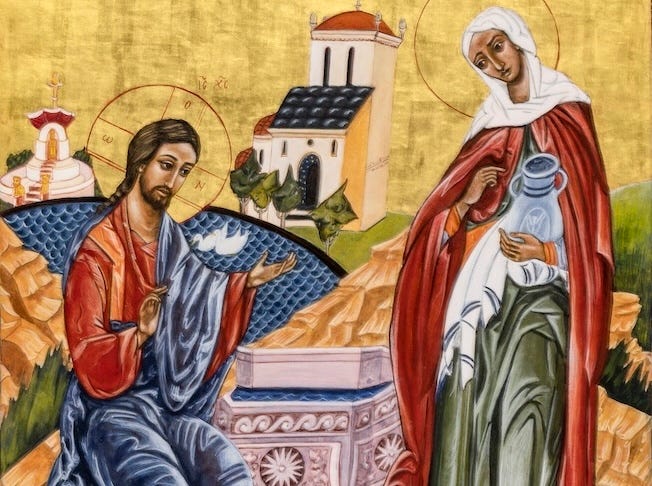
Unsurprisingly, the central importance of the village well makes it a place that people will naturally congregate, perhaps stopping for a chat, before returning home with the precious life-giving water. The rich symbolism of the well and the water it provides also lends itself to a variety of spiritual metaphors, such as may be found in the well-known story recorded in John’s Gospel about the encounter between Jesus and the Samaritan woman (John 4.5-42). Operating at multiple levels, their conversation oscillates between the everyday necessity of water, on the one hand, and the ‘living water’ of spiritual nourishment ‘welling up to eternal life’ on the other.
Stopping for a rest on their journey from Judea to Galilee, Jesus sends his disciples away to buy provisions. He then settles down to spend the afternoon watching the world go by, in much the same way as we might while away an hour or two sitting at a pavement cafe. There he encounters a Samaritan woman who has come to fetch water from the well, and they strike up a conversation: the longest recorded dialogue in the New Testament. This in itself is noteworthy, for a number of reasons, not least because she comes alone to the well at noon, in the heat of the day, rather than early in the morning or later on in the cool of the evening, when everyone else would have been there. Some have suggested that this is because she has been made to feel like an outcast on account of the unconventional domestic circumstances about which we subsequently hear. Moreover, the astonishment of the disciples when they return from their shopping trip to find Jesus chatting to the woman suggests that this was unusual, whether because she was a woman, or because she was a Samaritan, or both. The woman herself expresses surprise that Jesus should talk to her at all, given the hostility that commonly prevailed between Jews and Samaritans. This may be explained by Freud’s concept of the ‘narcissism of small differences’, which is to say that when people are in fact very similar, the minutiae of what distinguishes them can acquire exaggerated significance. Jews and Samaritans shared a common heritage, yet were fiercely antagonistic towards one another. As an interesting aside, the Samaritans still exist today, albeit in very small numbers.
Jesus asks the woman for a drink, but then says that if she had known who he was, she would have been the one to ask him for a drink of ‘living water’. The woman wonders how he can offer her water when he doesn’t even have a bucket. But when he explains that the water of which he speaks is such that one will never thirst again, she enthusiastically asks him to give it to her, so that she won’t have to keep coming to the well every day.
These shifts between literal and symbolic levels of meaning are a typical feature of the gospel narratives, in which Jesus frequently uses figurative language, allegory and metaphor, when imparting his teachings, while his listeners invariably respond by taking him literally. Even his closest disciples are constantly asking him to explain things to them. Whilst the Samaritan woman clearly likes the idea of ‘living water’, she remains unable to understand this in anything other than the most literal terms.
But, of course, Jesus is talking about the unchanging and eternal spiritual reality that is God, the source and sustainer of all that is. Because we can never finally satisfy our physical thirst, always needing at some point to drink something more, so our constant need for liquid sustenance provides a fitting symbol for the human condition. Trapped between not being able to get what we want and having to put up with what we don’t want, we seek satisfaction in objects of desire that inevitably fade or disappoint, with the result that our thirst can never be quenched. Jesus promises that the one who drinks the living water welling up to eternal life will, by contrast, never thirst again. The implication being that our unquenchable thirst can only be satisfied by that which is eternal and unconditioned, namely God.
The woman, however, remains stuck at the literal level, so Jesus changes tack, asking her to fetch her husband. She confesses that she does not have one. And then something really interesting happens. In spite of the fact they have never met before, Jesus discloses details about the woman’s personal life that he could not have known by any ordinary means. This convinces her that he must be a prophet. She rushes back to the town crying, “Come, see a man who told me everything I ever did.”
* * *
The unnerving ability attributed to the saints and mystics of the past to know things about people that they could not possibly know in normal circumstances is sometimes known as ‘reading hearts’ (the heart, in ancient terminology, referring to what we would now call the mind). We may be sceptical of such stories, wise to the art of stage magicians who perform mind-reading tricks for entertainment, yet this sort of thing does actually seem to happen, as Ram Dass, best-selling author of the counter-culture classic Be Here Now, discovered on meeting his guru Neem Karoli Baba.
The experience completely changed his life.
Born Richard Alpert in 1931, he became a professor of psychology at Harvard in the late 1950s, where he established the controversial ‘psychedelic research programme’ with Timothy Leary in the early 1960s. In spite of its popularity with students, the programme was shut down in 1963 and Leary and Alpert were sacked.
For Alpert, taking acid was never just a recreational pastime; it was a spiritual quest, an exploration of consciousness. One of the most interesting things about LSD is not the colourful hallucinations, but the experience of losing all sense of ego. Sometimes, when people encounter spiritual teachings that advocate self-abnegation, such as the Buddhist notion that the self is ultimately illusory, they think this means that if there is no self then there is nothing. In fact, the opposite is true. If there is no self, there is everything. It is the ordinary experience of separate selfhood that limits us; the absence of self implies the oneness of all that is.
In 1967 Alpert went to India, hoping to meet spiritual teachers who might help him further his study of consciousness. After travelling around a bit, and not really making much progress in his endeavours, he was starting to think about heading back to America, when he met – by way of various seemingly random coincidences – an Indian holy man named Neem Karoli Baba.
Alpert wasn’t looking for a guru. He was more interested in Buddhism and was a bit dismissive of the whole guru scene anyway. But at that first meeting, Neem Karoli Baba shared information about Alpert that he could not possibly have known, including details of a dream he’d had just a couple of nights before, as well as information about his family that nobody else knew.
This experience blew his mind. Not because he was impressed by Neem Karoli Baba’s ability to do something seemingly impossible, but because he realised that if the guru knew the secrets of his heart, he knew everything, including all the dark stuff, the repressed regrets and fears and shameful secrets we all carry hidden in our unconscious mind.
In spite of being completely unmasked, what he experienced in the guru’s presence was not judgment or censure, but love. Pure unconditional, boundless, divine love. Instead of feeling vulnerable and exposed, he felt fully accepted, just exactly as he was, including all the things he might have preferred to keep to himself.
Inevitably, one wonders ‘how can this be?’ Is it just some silly nonsense that credulous people want to believe because it makes them feel better? The fact that similar phenomena are so widely reported, throughout history and in all traditions, lends weight to the possibility that something is going on here that merits serious consideration, even if we can’t be sure what it is.
To be honest, I have no idea what to make of stories like this. I certainly don’t have the ability to ’read hearts’. I can barely understand what’s going on in my own head, never mind anyone else’s.
But I could make an educated guess. Might it have something to do with being able to access such depths of consciousness, by going deep into the well of being itself, until one is somehow able to ‘read’ the consciousness that we all share. If we plumb the depths of our own experience, aren’t we also able to understand and relate to the experience of others? Whenever we say to someone ’I know how you feel’, we are saying that we can identify with their experience, and can infer how they might feel, because we have felt something similar ourselves.
The human brain is made up of various components, including the cerebral cortex, where we do our higher level thinking, the limbic system and then, below that, the R-complex. Sometimes known as the ‘reptilian brain’ this is the part of the brain that we share with many other animals. It’s where our basic instincts operate. And the thing about animal instincts is that they are pretty much the same for all members of the species. The animal instincts I have are the same as the animal instincts you have, whereas our higher cognitive functions may be expressed quite differently. Our particular tastes, skills, values and opinions, shaped as they are by culture, experience, education and circumstances will vary hugely, but our instincts will be more or less the same. Thus, to know the self is to know others too.
Perhaps the ability to read hearts can be understood as a very highly developed form of the normal human capacity for compassion and empathy. Whilst anyone with functioning legs can run, some people can run much faster than everybody else. Similarly, anyone with ‘normal’ cognitive abilities will be capable of some basic degree of intuition, but perhaps there are those who can plumb the depths of consciousness all the way down to the very ground of being itself, the bottom of the well so to speak.
* * *
Jesus tells the woman at the well ‘everything she ever did’. He knows everything about her. And everything means everything. She wisely doesn’t try to conceal the truth about her circumstances by lying. Maybe she’s past the point of caring what other people think about her, or maybe she recognises something in this stranger that tells her she wouldn’t get away with it anyway. If he can read her mind, then he also knows all the things she would be embarrassed to share with others. I am sure we all have memories that we have consigned to the storehouse of the unconscious, out of sight if not out of mind. We cannot undo what has been done, but we can hide it away and pretend it never happened.
To some extent, at least.
Jesus knows this person at the deepest level. Knows everything about her, including things that she would rather people didn’t know. And in spite of that, he does not judge her. Instead what she receives from him is love. Pure, limitless love. In spite of knowing everything about her, still he loves her with infinite, unconditional, total acceptance; the love that is God.
At this point, she realises that Jesus must be a prophet, or maybe even the messiah, and the conversation becomes more explicitly theological. She raises the age-old question of rival truth claims, contrasting the beliefs of the Jews with those of her own people, the Samaritans. In his reply, Jesus suggests that God is not confined to religious institutions, temples or rituals. Moreover, a time will come when people will worship God neither in Jerusalem nor on sacred mountaintops, but in spirit and in truth.
There are two ideas being presented here, both of which are worth unpacking in a little more detail. The first relates to questions of religious pluralism, the second is about what it means to worship God in ‘spirit and in truth’. The Samaritan woman makes a point of emphasising the differences between Jews and Samaritans. In spite of their shared religious heritage, they disagree fiercely over specific details. Jesus seems to be saying that such differences are not ultimately important, because there is a universal truth that transcends any particular expression of it. At the same time, however, we should be wary of the sometimes lazy tendency to think that different religions are just different pathways up the same mountain.
To make this claim is to say that religious language is merely metaphorical; the Truth is beyond anything we can comprehend or say. Yet to admit that all religious language is metaphorical is not to say that it is only metaphorical. Truth is much more interesting than that. There may indeed be a bigger picture in which differences of culture and expression are not ultimately significant, but Jesus also makes it clear that the reconciliation of unity and difference is only revealed through his unique relationship, and indeed identity, with God. In other words, by confirming that he is messiah, or the incarnation of God, he asserts that it is this truth alone that resolves the tension between particular and universal, in such a way that maintains the integrity of both, without reducing one to the other.
According to the French theologian Jean-Yves Leloup, when Jesus talks about worshipping God in spirit and in truth he is transmitting an esoteric teaching somewhat akin to mindfulness of breathing. The word ‘spirit’, in Greek pneuma, literally means breath, so it is not too much of an interpretative stretch to parse ‘worship in spirit’ as some sort of spiritual practice related to the breath. In the story of creation recorded in the book of Genesis, God breathes the breath of life into Adam, thus making the breath a symbol of the divine energy, the life force itself, the deepest reality of what we are, that somehow actually is God, because God is spirit. So far so good. The rest of his argument relies on the meaning the Greek word aletheia, usually translated as ‘truth’, being rendered instead as ‘not forgetting’.
Aletheia typically has meanings to do with being disclosed, revealed, made evident. In Greek, the prefix ‘A’ denotes a negative, and lethe is a word for oblivion, forgetfulness and concealment. In Greek mythology, the river Lethe was one of the five rivers of the underworld; the souls of the dead drank from it in order to forget their earthly life prior to being reborn again. So, aletheia literally means unconcealing, hence the usual translation as ‘truth’, but it could also have meanings to do with un-forgetfulness or recollection, which implies being aware, conscious or awake.
If we accept Leloup’s interpretation of aletheia, then the notion of relating to God in spirit (pneuma, breath) and in truth (aletheia, awareness) could start to sound a bit like a recommendation to practice awareness of the breath. Whether this amounts to a convincing case for a Christian doctrine of mindfulness of breathing is debatable, yet having said that there are plenty of hints of mindfulness in the Christian tradition, from St Benedict’s exhortation to keep careful watch over everything we do, to Br Lawrence and the practice of the presence of God. The practice of mindfulness, literally a word for remembering, is typically described as paying attention, in the present, without judgment. These three elements can all be found in the teachings of Jesus, even if not explicitly systematised as a ‘practice’. For example, the idea of paying attention is found in the saying ‘keep awake, for you know not the day nor the hour’ (Matthew 25.13); the notion of being present occurs in the words, ‘do not worry about tomorrow’ (Matthew 6.24) and being non-judgemental is expressed in the phrase, ‘judge not that ye be not judged’ (Matthew 7.1).
The conversation between Jesus and the Samaritan woman presents us with a profound discourse on how to understand God as the ground of being, who we can apprehend in spirit and in truth. For all the significance of this story, which presumably wouldn’t exist if it weren’t for the woman who came to the well in the heat of the day, it is notable that the Bible doesn’t name her. However, in Orthodox tradition she is known as St Photini, literally the luminous, or perhaps enlightened, one, and she is sometimes credited as being the first evangelist, since her testimony leads to the conversion of a great number of the people of her town. Sadly, like many of the early witnesses to the faith, she came to an unhappy end, martyred by being thrown down a dry well on the orders of the emperor Nero.
No posts
Comments
Nothing yet. Say the first thing.
Sign in to join the conversation.