
For me, the most promising use of AI is not code or content generation, but metacognitive augmentation. Less “think for me” and more “help me think further.”
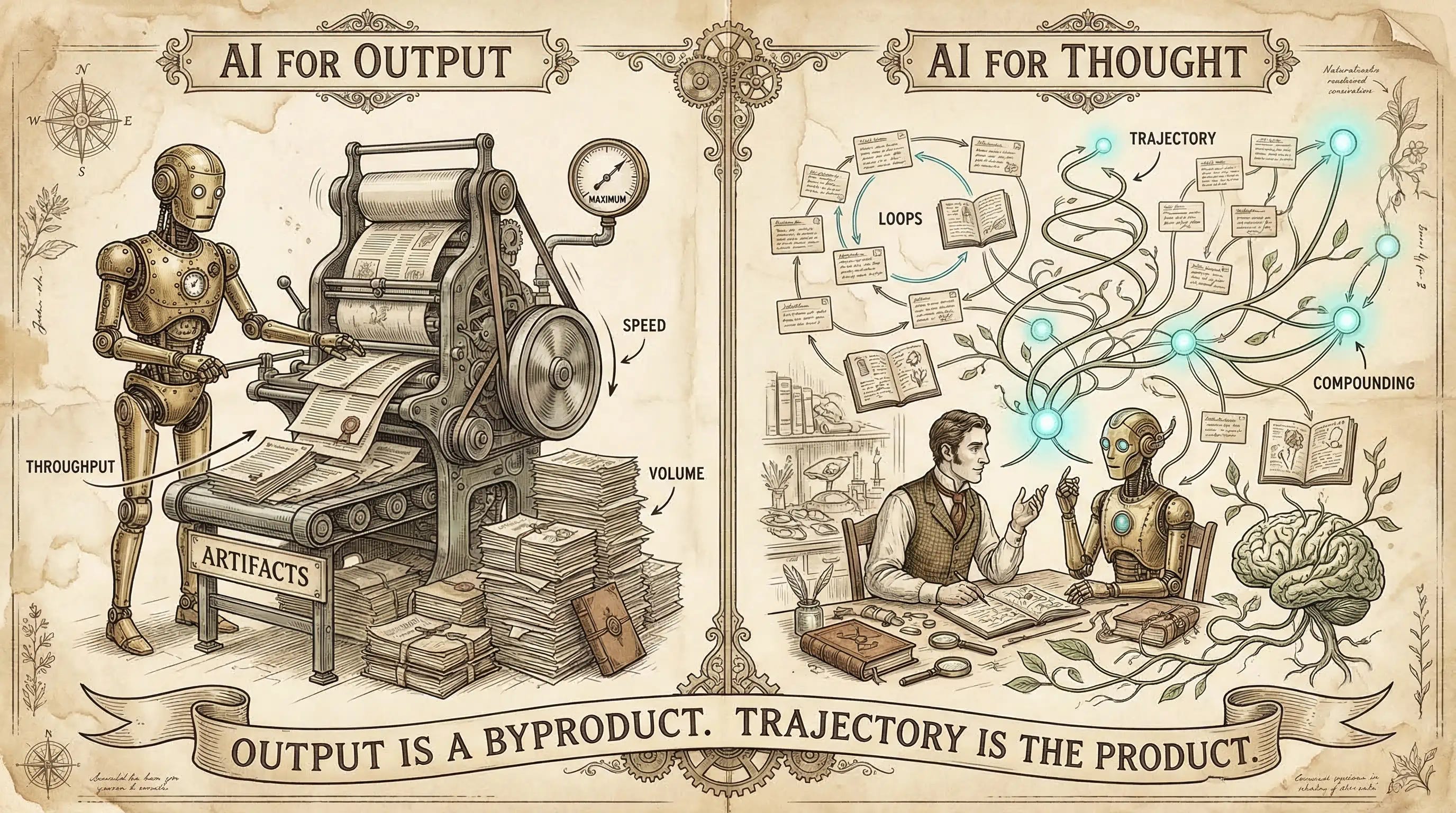
When I say that, I mean that I want the distance between a thought occurring and me being able to work with it to disappear. In the best digital tools you can compute at the speed of thought. Ideally, when an idea occurs to me, the gap between inspiration and action should feel like conversation, rather than to software configuration. It’s hard to beat the speed of pencil and paper or the fluency of spoken conversation with another person here, but perhaps there is room for another category of tool?
Personal Knowledge Management is not new, but the design space has been shaken up by advances in AI. The novel possibility is crafting a cognitive niche: a personal thinking-environment. A network of compounding feedback loops intersecting in a shared, evolving environment enabled by AI agents.
What patterns are you unable to notice in your thoughts merely due to lack of process? Note-taking, reflection, dialogue, reading, and retrieval aren’t just productivity rituals; they are the conditions that shape the trajectory of thought over time.
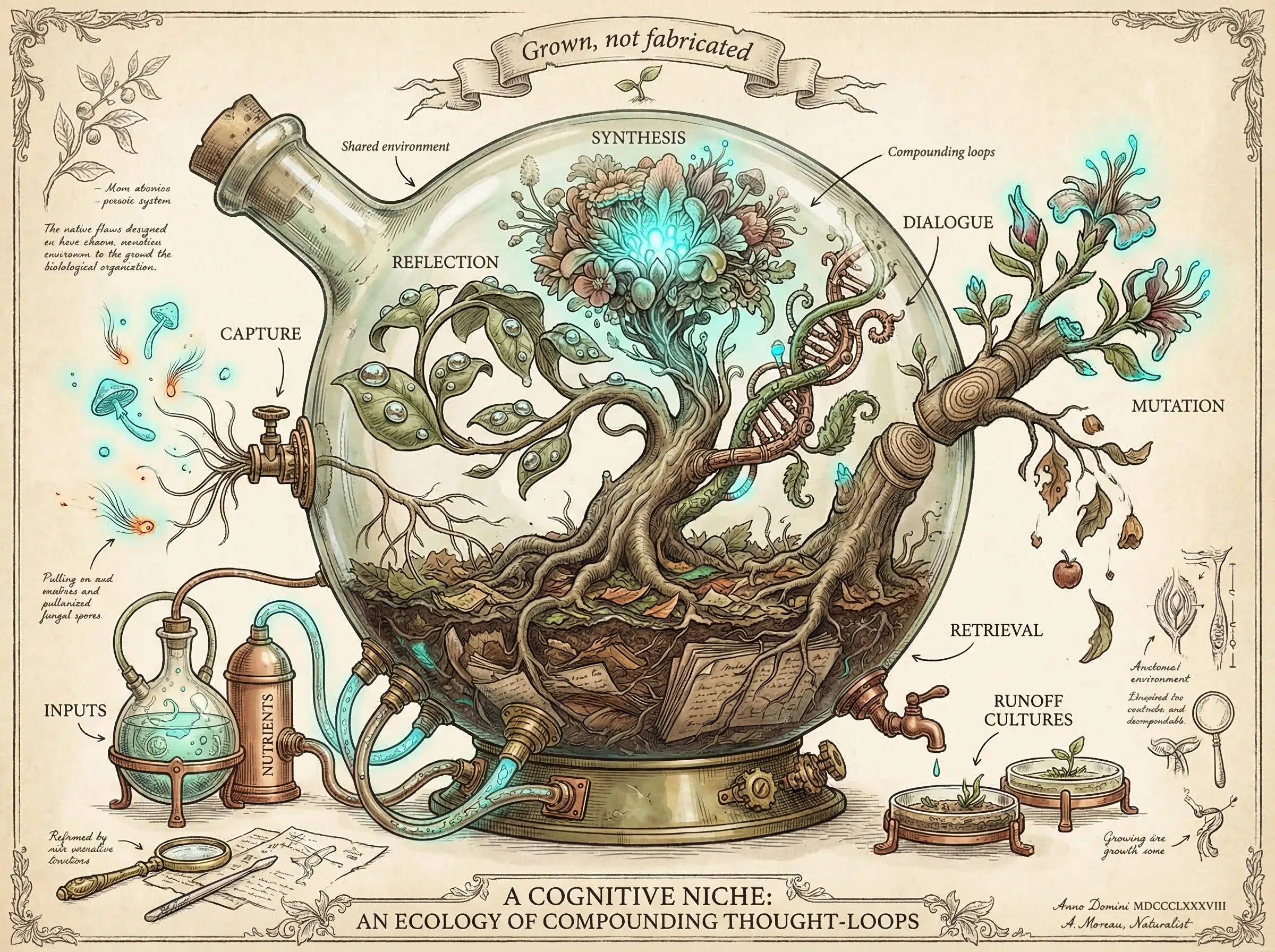
Outputs obviously still matter, but… I think the higher-leverage move is to evolve the process that evolves your thinking.
I’ve tried many PKM systems over the years1. What has stuck is a very minimal structure: daily notes, atomic notes, heavy capture, and fast retrieval.
The criteria for such a system are simple:
When a thought occurs, can I record it instantly?
When a thought resurfaces, can I find it, challenge it, and evolve it?
Can I trace the evolution of of my thoughts over time and gain insight in the process?
Since Claude Code dropped, I’ve been experimenting and iterating with AI in a Zettelkasten-inspired setup. Atomic notes, heavy linking, regular mutation; nothing is fixed. Zettelkasten isn’t mandatory it’s just the shape that fits my thinking. The point is maintaining an active discourse with past and future self.
Much of my thinking happens away from the screen. I come back to become inspired, untangle myself, label patterns, and evolve my mental models. This, again, is pretty straightforward:
Observe: scan recent traces/notes to see what has momentum
Orient: identify what I currently care about, and what has shifted
Act: capture fresh thoughts or update existing atomic notes
Decide: let the system propose mutations, then explicitly choose what to commit
Repeat: run the loop many times per day/week at a sustainable rhythm
In practice there are personalised pieces of the puzzle: voice transcription, linking, breadcrumb reflections, and adversarial passes where I argue against my own notes until the language fits the idea. The takeaway isn’t identifying that this is a useful loop, it’s that this has to be easy, near automatic, or you won’t do it.
Here’s a demo:
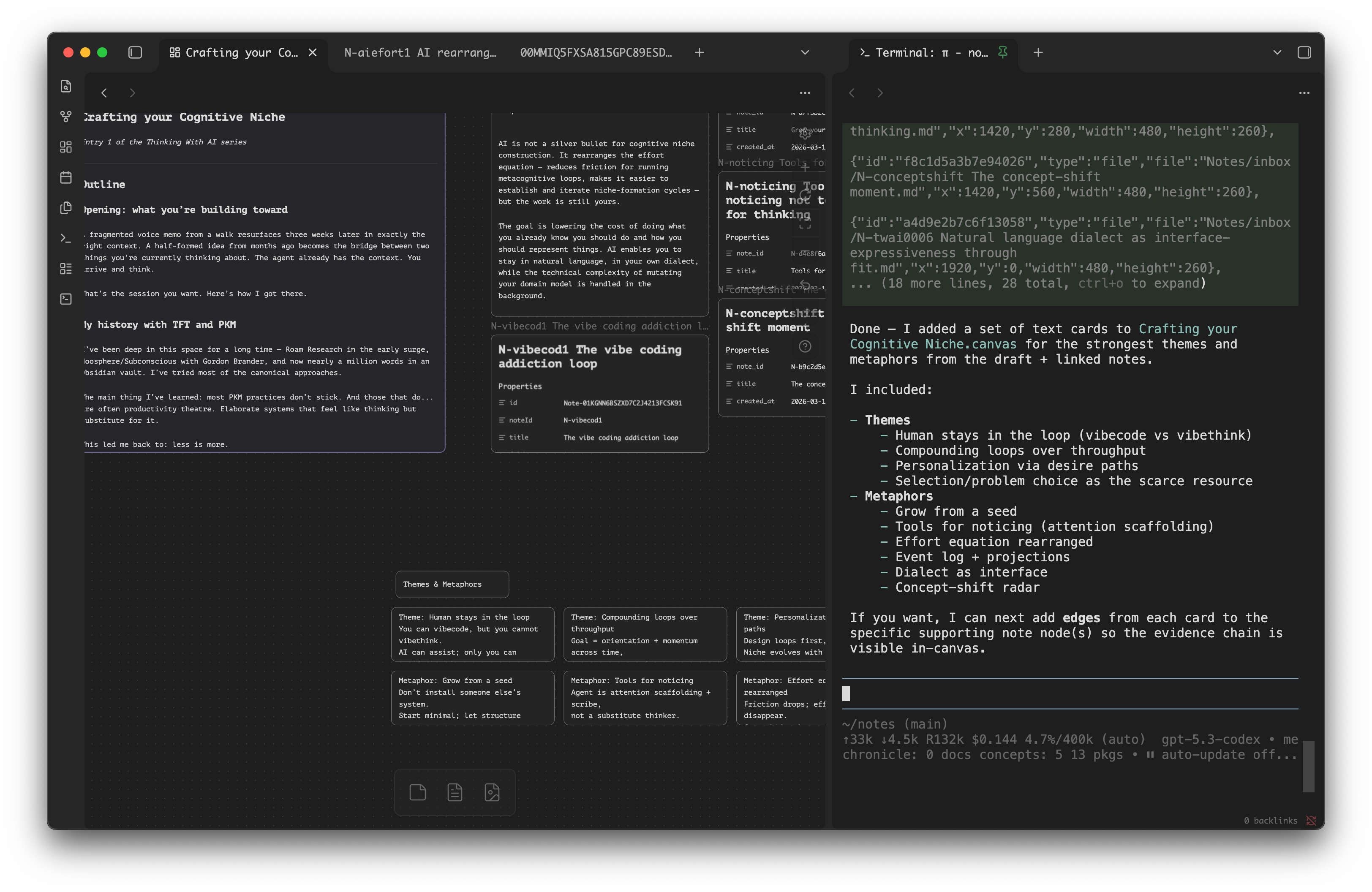
You’re welcome to try my extensions for pi.dev but, when it comes to tools for thought, the human has to stay in the loop. You can vibecode; vibethinking is a different matter. Insight is only real if it changes your mind, and only you can put that change into practice.
These are tools for noticing, not tools for thinking on your behalf. The capture-record-review cycle is automatable; the synthesis in the middle is not. In a system like this the agent is best understood as a scribe and interlocutor, not a stand-in for the user.
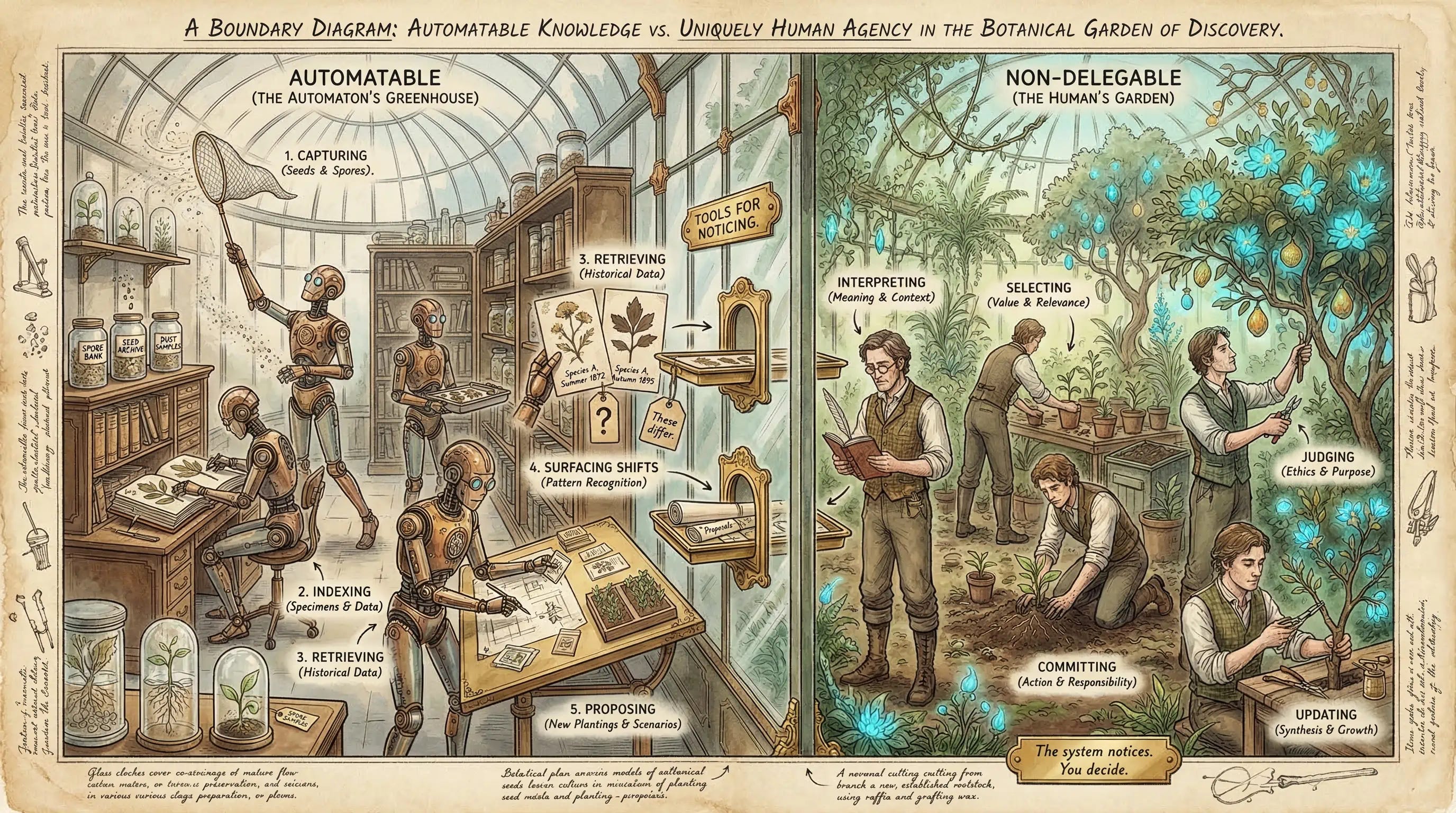
This manifests subtly but compounds over time. The first hints in my research were small: “you’re using this word differently than before.” The system doesn’t need to explain why; it just needs to surface it so you can inspect it.
If you can capture what you mean, retrieve what relates, and store the delta… You already have most of what you need. From there, compounding tends to come from loop quality more than tool complexity.
There are three broad responses to AI:
Think less while doing the same
Think the same while doing more
Think more by making thinking easier
Shipping matters, but over longer time horizons, evolving the process that evolves your thinking tends to matter more. When implementation gets cheap, selection becomes the bottleneck. The practical question shifts to: what is worth thinking, and why now?
Tools get you in the door, but loops are what create compounding, emergent outcomes. I’m not trying to build a robotic brain or digital twin; I’m building a feedback-loop connecting my past, present and future self.
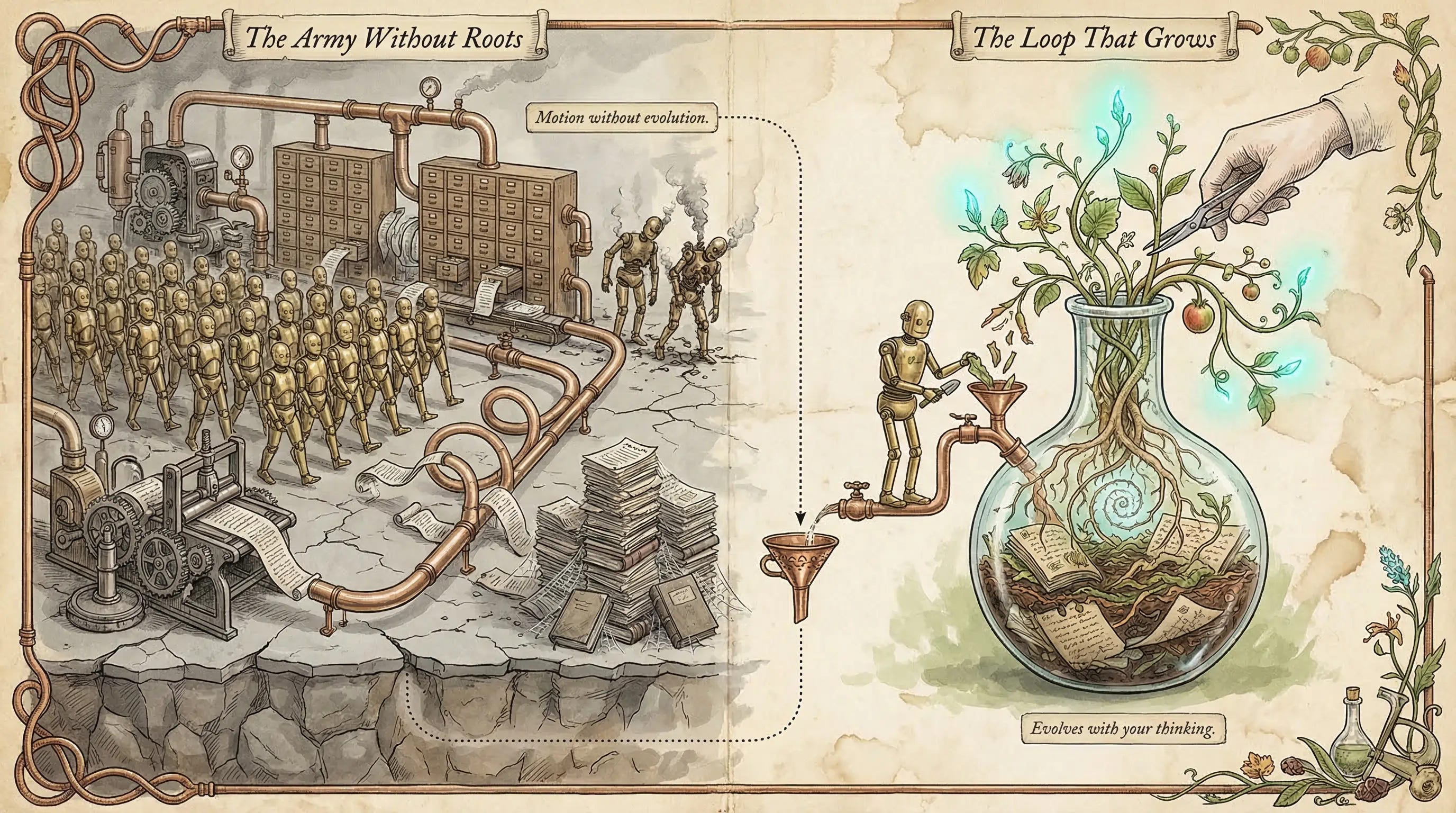
The system has to stay malleable. As an industry, we’re discovering that the most useful tools are extremely minimal. Developer of pi, Mario Zechner: “if I don’t need it, it won’t be built.” In fact, the magic of AI is you can grow everything from a seed: the smallest useful structure that fits the shape of your thinking. Then you iterate in place; adjusting prompts, commands, structure, and rhythm to fit the desire paths of your own mind.
A signal it’s working is that your dialect sharpens over time. Language starts fitting the domain more precisely, and fluency improves. That fluency isn’t cosmetic, it is part of the thinking.
You can run this loop with paper and pencil but AI changes the economics: the laborious parts get cheap enough to run continuously. What was once giant pain-in-the-ass is now a fairly straightforward claude and voice transcription away.
Make it easy to think the thought, then think the easy thought.
Once you see it, it applies everywhere: journalling, research, coding, creative work, even physical training and investing. Any domain where quality of thought matters can benefit, so long as you never delegate full responsibility.
Installing templates is boring. The new2 meta is growing your cognitive niche.
Notion, Tana, Obsidian, Capacities, I interviewed at Roam Research, I worked on Noosphere/Subconscious and I’ve been taking digital daily notes in some form for my entire adult life
Software developers have been able to do this for a while, but now it’s open to everyone.
Comments
Nothing yet. Say the first thing.
Sign in to join the conversation.