
I’m grappling with a plague of AI.
I am not 100% anti-AI. It can be helpful for some people in their work, or when they have real needs around organizing themselves, or they are woeful spellers. Some uses of AI are convincingly beneficial—helping doctors and researchers sort through massive amounts of published research and huge data bases.
However, I am a grouchy Boomer who is worried about the future. So much about AI seems questionable and dangerous. I resent how AI has cannibalized the work of writers and artists. I am worried about how much ecological damage it is doing on top of all the other ecological damage we’re already doing. I am saddened that some people think AI is their real life friend. I am concerned AI makes us less humane such as when I hear about a young person getting dumped by an AI-generated text from a boyfriend. I am worried my grandchild thinks it’s easier to ask ChatGBT to do a basic arithmetic problem than do it himself. Like the many convocation graduates this summer who jeered and booed speakers who praised AI, I am worried about the future of young people. I fear people are being abused and manipulated by a conscienceless-entity, and I’m not talking about the Republican party in the U.S.
I concede I am an old fogey who hasn’t a clue about how AI works or what it is. However, neither, it seems, do the people closest to its development. In an article in the Guardian recently, Iason Gabriel, a philosopher working with DeepMind, Google and AGI (Artificial General Intelligence), said: “There’s this deep mystery there, which is: but what actually is this thing?”
I am worried that the Tech Bros’ AI creature will soon be out of their control and that they’ve unleashed a potential monster upon our world. I think there should be serious guard-rails, laws, and limits on the use of this tool. But it seems there won’t be. Frankenstein always refuses any restraint.

In a more petty and truly old fogey way, I am also completely fed up with AI infiltrating every bloody thing I do online. Take search engines. If I Google “how to fan a peach tree”, I get an AI summary with links to three videos and then right beneath the AI summary are these exact same three videos which presumably Google offered before AI elbowed in with its summary of them.
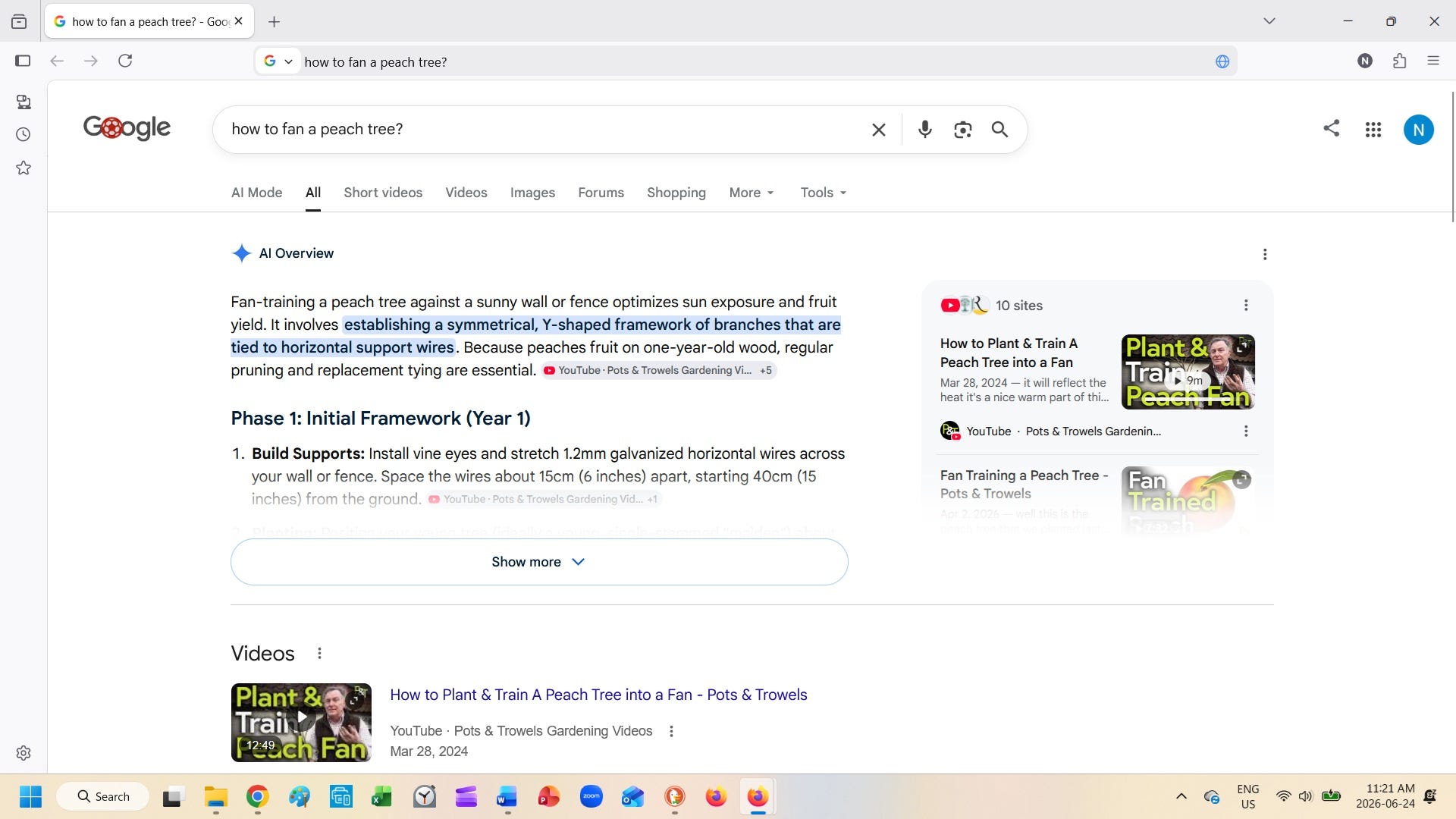
And then after the Google-sourced video listed, AI offers to sum up the nine or ten “key moments in the video.”
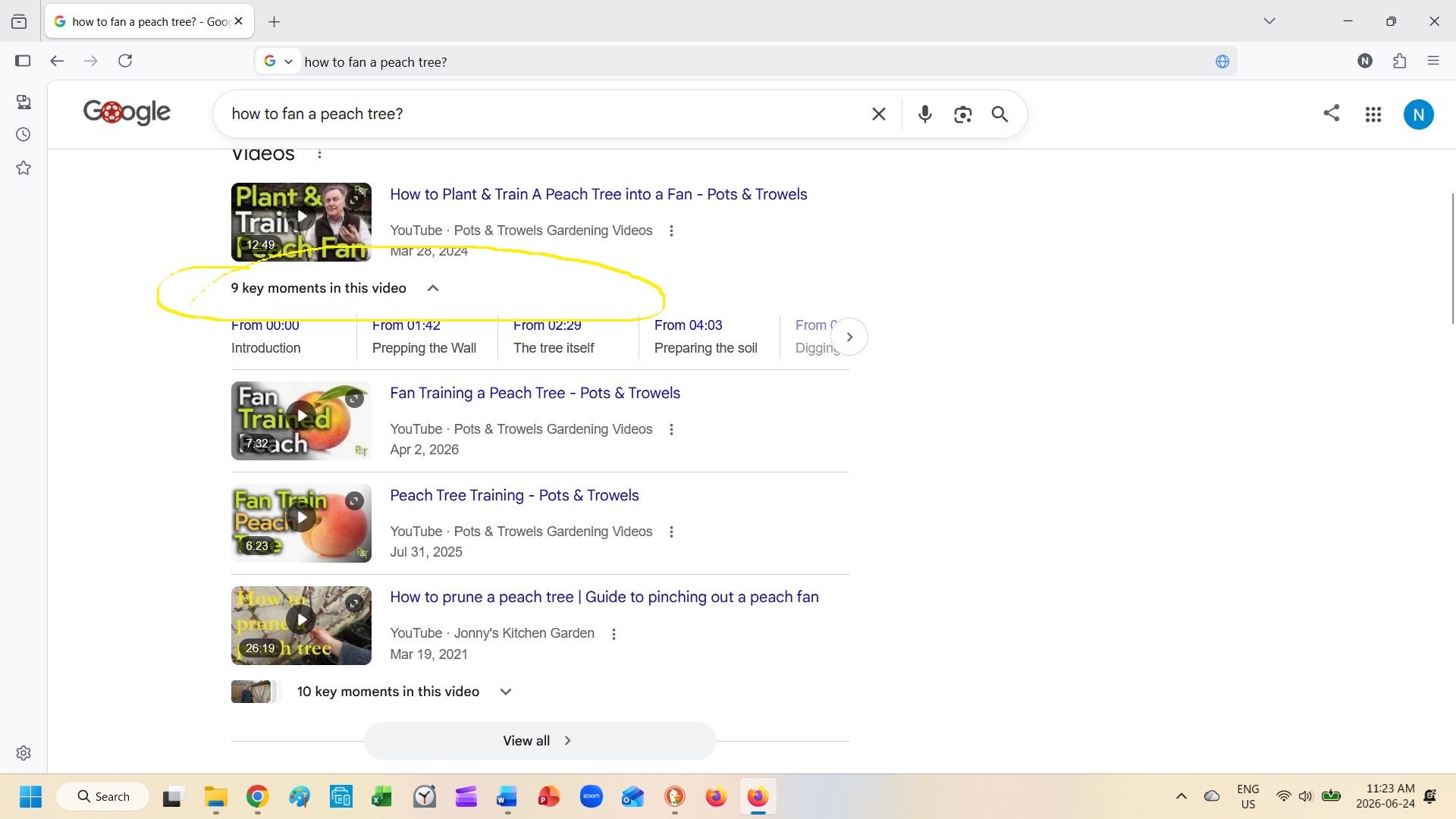
Okay, I know many people want these quick and dirty summaries and I suppose they are harmless in the short term. I mean a lot of crap is on the Internet. I always skip the stories about people’s recipes to get to the recipe itself, and a lot of intros to videos are tedious and the videos themselves benefit from being sped up a good 25%.
But I can’t help thinking of the serious issues arising from this unwelcome AI interference. First, all the energy expended giving me duplication upon duplication of information is sickening. Energy- and water-sucking data centres are being jammed down the throats of hapless communities around the globe just so I can wade through a swamp of redundancy. Google recently did a study of its AI energy use: though it seems efficiencies are reducing some costs, “The company’s total greenhouse gas emissions have risen 51% since 2019, with AI being a key driver.”
Secondly, another great waste is that these AI summaries are often useless. My cable and internet bill came up for renewal this month and the provider’s AI summarized the changes—the summary was long and complicated because cable company contracts are ridiculously opaque, stupidly detailed, and long. Even AI couldn’t make it readable.
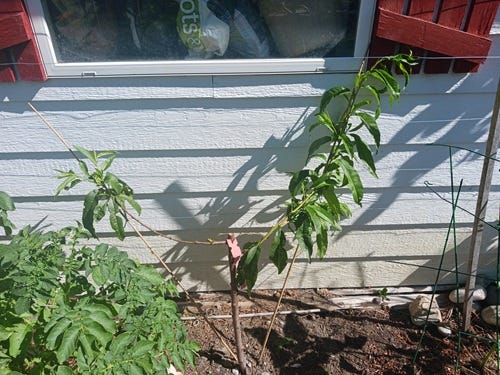
AI summaries are especially weak for hands-on learning. Take my peach tree. A couple of years ago my backyard peach tree died in a freak cold snap so I bought a young one this year and want to train it to “fan” against my south-facing shed. I hope this will be a good climate change adaptation (warm in winter, shaded in the very hottest part of the day.)
Watching a video about how to start the peach tree training process was super useful since I don’t know any arborists or orchardists. On the video that I ended up watching, an old English fellow told me to not be afraid of ruthlessly cutting my baby tree down to an 18-inch stick. Now that was consoling. He understood how anxiety-producing such a drastic pruning was. His was human, sympathetic, and sensitive advice. The AI summary simply says: “Cutting the leader: Buy a young, single-stemmed tree (a “maiden” tree) and cut it back to just above a pair of buds roughly 45 cm from the ground. This forces the buds lower down to break and shoot out.”
Not even an inkling that I might feel trepidatious about doing this. And I won’t even get started on AI’s use of the word “maiden.” There are many horticultural words for a baby tree, usually for a fruit tree it’s a “whip.” But “sapling” or just “young tree” would do. But AI chose “maiden”. I see the icky hand of sexist Tech Bro training.
All in all, many of these summaries are junky, tediously generalized, repetitive, brain-atrophying, insensitive, and possibly haunted by socially dubious attitudes. And we are harnessing an obscene amount of the planet’s resources to create these mile-high piles of glittery shit for entirely unnecessary purposes.
So I am trying to not use AI. First, I have switched off as much automatic AI summarizing as I can on my search engines. (My search engines predictably gave me an AI summary of how to turn off its AI summaries.)
One of my techno-literate sons, who confesses he likes AI summaries, told me that if I add “-ai” to any of my searches on my phone or elsewhere, I also won’t get annoying AI summaries. It works for now. I might get sent straight to Wikipedia for generic information but my search has not used quadruple the energy to tell me the exact same, bland, heartless info duplicated three times over. If only I could “minus AI” my entire digital life.
Because now my email program is asking if I want my emails summarized by AI. In fact, yesterday it DID summarize an email from a friend, a chatty, human, un-summarizable email! I have been hacked by my own app.
Why do I have to spend so much time protecting myself from my own tools because they are constantly coming up with new ways to attack me? I block one AI attack and up comes another. I am like a pathetic Hercules tackling the Lernaean Hydra, that multi-headed monster which grew two new heads every time one was cut off. Sadly, I’m not Hercules and, as I hack off another AI snake head, another springs up.
The Hydra monster reminds me of training a peach tree. You hack off the head of the young tree and it sprouts new twiglets. The whole point of pruning the heck out of a young tree in training is to take advantage of this extraordinary bounce-back power. The life force of a young tree is so powerful, when you cut it, it sprouts multiples, Hydra-like.
I suspect the Greeks were able to imagine their Hydra monster out of a deeply observed understanding of the natural world. For thousands of years, they observed that cutting off a limb or twig from a tree or plant will often cause it to bush-up anew.
Cognitive Metaphor Theory theorizes that the root source of much language and metaphors is embodied experience. Our profound connection to the earth, our hands in the soil, our bodies dancing with gravity, our eyes observing, our brains making wild connections between plant pruning and a imagination-grabbing monster seem to be the core of how humans have come to create complex thought and communication. Our language-enriched intelligence grew out of how we exist in the physical world.
The role of artists and storytellers and poets is to keep translating real life experience into language for other humans. What AI or more accurately AGI (Artificial General Intelligence) will do, I cannot say but I highly doubt the idea of a Hydra would ever have come out of the artificial, body-less brain of a machine. Is it too much to state that I fear the end of art, originality, newness and living language if we let AI do our thinking and making?
Sadly, cutting off the heads of the Hydra is generally futile if you’re not Hercules. I recently read a paper about Hydra symbolism in Shakespeare’s Henry plays, and the scholar Harry Berger says, “In my imagination I never see the Hydra’s body, only its heads gnashing…. And if I try to imagine the body, it takes on the aspect of a densely tangled intertwining root structure creeping laterally in every direction and sending up capital shoots that work like crabgrass. It offers its enemies the wrong targets so that their efforts to curb its growth will not only fail but will invigorate the Hydra’s root structure and multiply its heads.” Berger, Harry, ‘Hydra and Rhizome’, Harrying: Skills of Offense in Shakespeare’s Henriad (New York, NY, 2015; online edn, Fordham Scholarship Online, 21 Jan. 2016), https://doi.org/10.5422/fordham/9780823256624.003.0007, accessed 29 June 2026.
In other words, that bounce-back effect. I too see only AI’s “gnashing heads.” I don’t even understand the body that they are connected to. The deep life core of the peach tree and the thrashing body of the Hydra thrive and grow by all the cutting. I fear all my hacking and cutting just makes AI stronger and more wily. Hercules, like a determined gardener, was able to not only cut back every part of that snaky crabgrass but also to also hack out and bury the very root.
However, this is not the end of the Hydra story. Poor Hercules, after his astonishing and heroic efforts, nevertheless ends up being killed by the poisoned blood of the Hydra many years later. Even though he buries the Hydra’s power in the earth, he couldn’t leave well enough alone. He steals the poisoned blood to supplement his own powers. This poison ends up dooming him.
I can’t help but worry that the efforts of the thinkers and designers who are working on AI safety and ethics are similarly doomed. The creators of AI think they are Hercules – they will prune the beast and harness its power, but the poison blood they are playing with could get them, and maybe all of us, in the end. The lethal Hydra may be the metaphor of our time more than Frankenstein and his monster. The Frankenstein monster was made up of lots of embodied human pieces and it had a conscience. Not so the Hydra.
Although, when you think of it, life itself is a sort of Hydra monster. For some three billion years it has been experimenting with a crazy range of biological stuff. Extinctions happen. Monsters flourish and are snuffed out. Life pushes up over and over again, crawls into every speck of earth’s surface. I suspect our Earth will have some surprises for AGI. Does Life really want to support machine intelligence? I suspect some Hydra blood in the biosphere could bring an end to all this human hubris.
Still, I hope that in a couple of years, my peach tree will produce delicious plush golden balls of juicy sweetness. I hope to share them with my grandchildren. We will eat them and experience a chin-dripping, completely embodied joy. Poor Artificial General Intelligence. Think of all the life it will miss.
No posts
Comments
Nothing yet. Say the first thing.
Sign in to join the conversation.