
Every month we write a piece encompassing themes within our whole-person health thesis. If you would like to receive it directly in your inbox, subscribe now.
Picture your ten most recent dinners and think about how many took place around a kitchen table. The answer is going to be much lower than what it would have been several decades ago. Three quarters of Americans were brought up eating their dinner around a kitchen table. Today, fewer than half still do, with the couch increasingly becoming the preferred place of consumption.1 The meal moved in one generation, and more likely than not, yours moved with it. A kitchen table is oriented around the people seated at it. A couch is oriented around a screen. Ultimately, the meal follows the attention, and once the attention moved, the table lost its primary purpose.
This behavior change is the clearest evidence of a larger dynamic relating to home electronics. To date, the only devices to reach ubiquitous penetration and daily active usage in the modern home have been screen-centric. Televisions and smartphones did not take up residence alongside everything else in the house so much as absorb it, and what they absorbed was not just objects (e.g., alarm clock, radio), but also behaviors. How we fall asleep. How we wake up. How we take in information and coordinate a household. How our children learn to occupy themselves and relate to other people. Each of those daily behaviors once ran through analog items that were emblems of their era. Today, all of them run through hardware whose commercial logic depends on capturing as much of your attention as it can hold.
I have written at length about the societal consequences of attention manipulation and won’t belabor them. What interests me in this piece is the second-order effect of hardware being built in reaction. Culture corrects on a lag, and we have watched the pattern run across history. Processed food spawned the organic movement through the 1990s. Sedentary living spawned the fitness economy through the 2010s. Each correction took roughly a decade to travel from fringe concern to mainstream habit, minting category winners along the way. Notably, these corrections never really end, with organic compounding into today's 'better-for-you' food & bev movement spanning clean labels, functional sodas, and the war on seed oils. Screen-based attention manipulation is the pattern now being corrected, and this time the winners are being built around humane technology. To borrow from the nomenclature, a new cohort of companies is building ‘better-for-you’ home electronics designed around how they make us feel rather than how long they can hold our gaze.
Interestingly, the first wave of health-related hardware skipped the home entirely. Wearables enabled measurement on the body and then, maniacally, compressed us into a number, giving us HRV, RHR, and a composite score waiting for us every morning. That work was necessary since it built both the physiological vocabulary consumers now flex as identity and status, and the willingness to spend several hundred dollars on improving, or on the perception of improving, how they feel. And yet, the primary constraint of these devices is deeper than a missing actionability layer. It’s that the mass market doesn’t experience life as a set of biomarkers. In other words, most people don’t lie awake wishing their HRV were four points higher. Rather, they wish they had slept well, which is to say they want felt efficacy rather than quantification.
The companies we are highlighting in this piece are not chasing biomarkers, but instead improving activities of daily living. Eight Sleep is not selling an HRV delta, it is selling a restful, cooler night. Hatch is selling an enjoyable wind down and awakening experience. Skylight is selling a household that gets out the door at 7am without anyone crying. Tonies is selling a child who plays rather than scrolls. A score is a product for those who wish for a score, but a better experience of life is a product for everyone. Moreover, where wearables diagnose, these devices intervene.
The cleanest way to illustrate the difference is to walk a single day through the house, highlighting where each of these companies provides a healthier solution to daily routines.
Start at 10pm. Eight Sleep is the darling of the movement, having executed the first credible traverse from body-tethered measurement into a genuine in-home intervention layer. It not only collects data ambiently, but also acts on that data by autonomously adjusting the temperature of your bed, the single most impactful physiological variable for falling asleep. While some may push back and say Eight Sleep centers on sleep tracking insights, just look at the difference between their hero SEO copy, which sells an experience, and Whoop’s, which sells an insight, for any indication of how the company views its positioning.


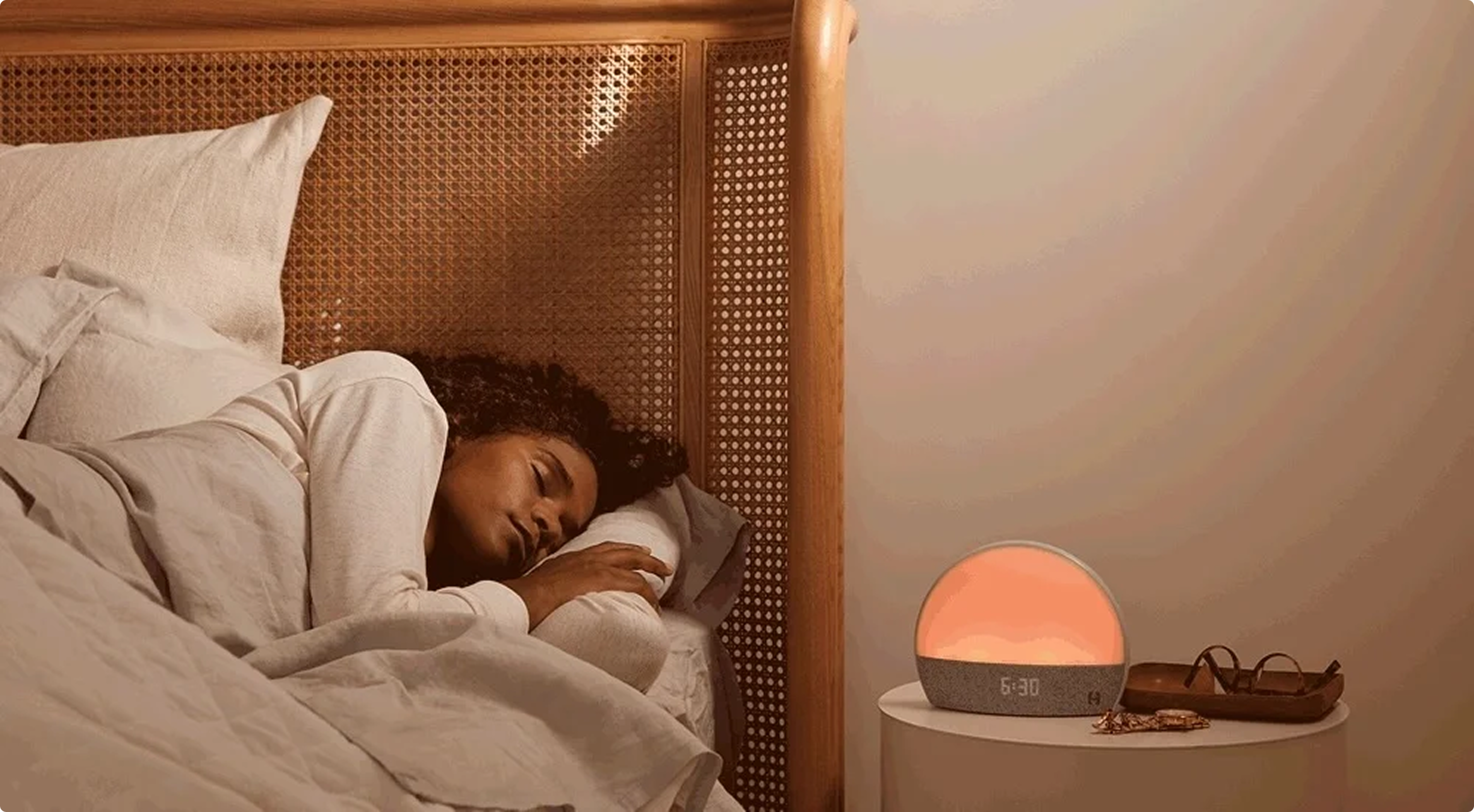
In the morning, Hatch replaces the jarring buzzer with a simulated sunrise, easing you awake with light and sound rather than the stress-hormone spike a sudden alarm sets off. It also breaks the worst habit of the modern morning. When the alarm is your phone, silencing it quickly turns into doom scrolling in bed. With Hatch, the wake-up happens on the nightstand instead, and the first reach for your phone becomes a choice rather than a reflex. The company is reported to have eclipsed $200M in revenue while doing no biometric sensing whatsoever.2
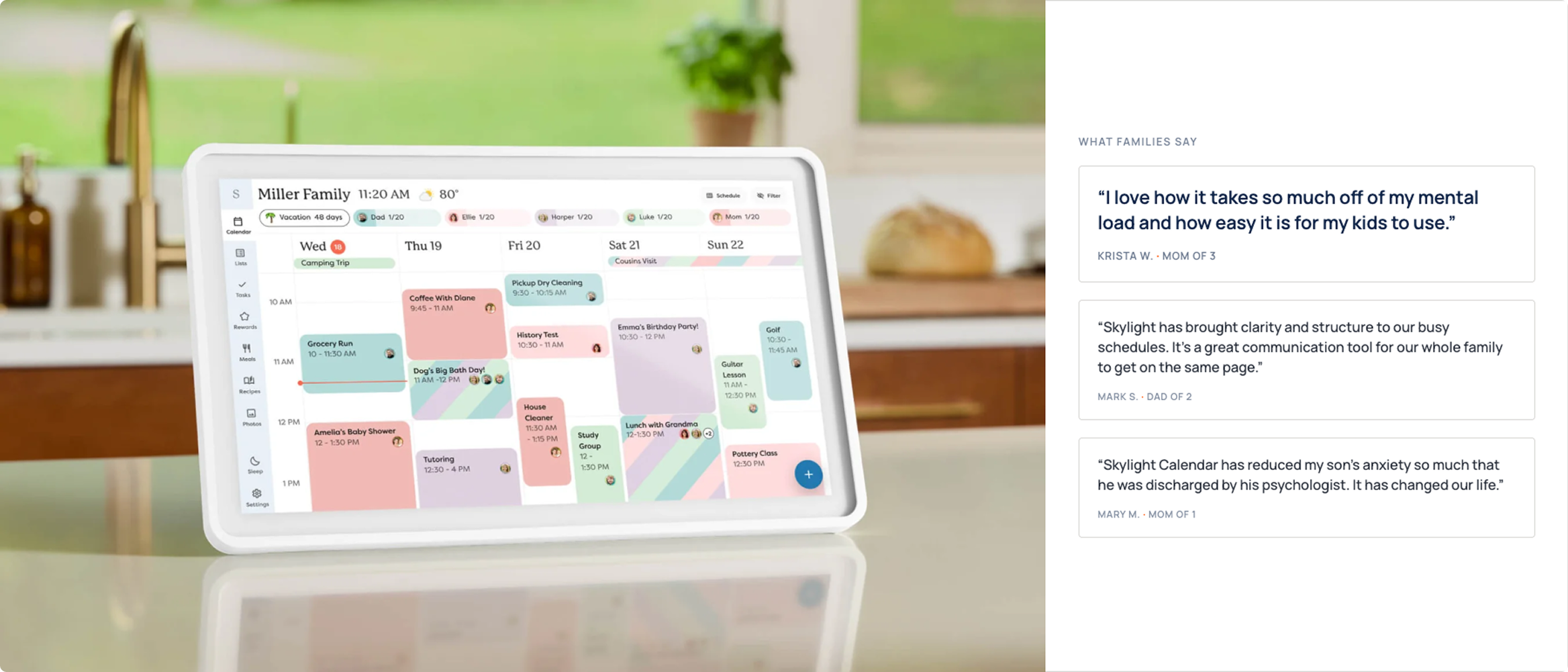
Now it is 7am and you are downstairs. Breakfast needs to be made. Three kids have three schedules after school: band practice, soccer practice, and boy scouts, each one requiring a ride. Each schedule lives on a different device, anxiety is to the moon, and Dad has no idea what is going on whatsoever. Communication is the glue that sustains a happy family, yet the visibility and coordination upstream of it are almost always the constraint.
Skylight went after the system-of-record for all of that, which until now has lived half in one parent’s head and half scattered across everyone’s separate calendar apps. It pulls Google, Apple, Outlook, Yahoo, and Cozi into a single touchscreen the whole house can read at a glance, with chore charts, meal plans, and grocery lists on the same display. Kids too young for a phone can still see their own day. The device cannot reach a browser or a social app at all, which is intentional. Bootstrapped and profitable from day one, the company serves more than 1.3M families and has scaled past $300M in annual revenue.3
Lastly, by 7pm, the kids are home, dinner is eaten and homework is done. There is an hour or two left before bedtime, and the status quo for that time is a tablet or YouTube TV.
Tonies is my personal favorite example and the best illustration of the category’s potential for scale. It sells a screen-free audio cube that plays licensed audio off NFC figurines, each one a branded character the child places on top of the box themselves.
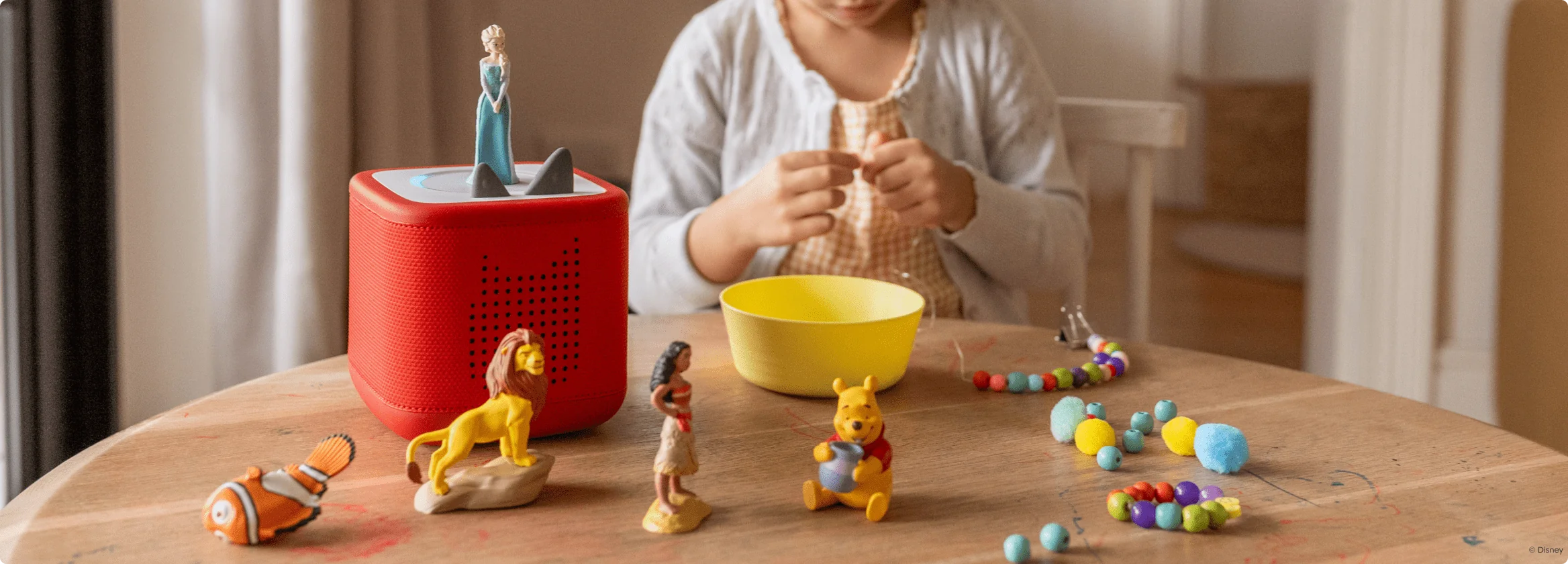
The library runs more than 1,300 of them across 400 licensing partners: Woody, Elsa, Bluey, Spider-Man, the whole sweep of children's franchises from Disney to Sesame Street to PAW Patrol, rendered as collectible toys that hold their own stories and songs. The interaction model is the product. A four-year-old operates the whole thing without help, deciding what to hear and when, and Tonieplay extends that into games, quizzes, and adventures run through a physical controller, still with no screen or ad anywhere. What the child gets back is the hour of self-directed, imaginative play the tablet quietly took away. The company is listed on the Frankfurt Stock Exchange, has sold more than 11.8M Tonieboxes and 156M Tonies (figurines) globally since launch, and did over €630M in FY2025 revenue.4
In an era of deepening subscription fatigue and lock-in, what further distinguishes this cohort is that they operate business models that put agency in the hands of the consumer, which fits the humane technology approach they take to the hardware.
Tonies is the cleanest expression, a razor-and-blade model in which the Toniebox is the entry point and the Tonies, games, and audio content are the ongoing business. Nothing requires a subscription. Monetization is pay-as-you-go, with families buying the next character or game when it’s the appropriate time for a new one.
While Tonies puts agency in the purchase of each subsequent figurine, Hatch and Skylight put it in the subscription decision. You buy the hardware, it works out of the box, and the optional subscription buys premium features on top of a product that already does its job. Hatch runs roughly $50 a year and Skylight $79. The hardware’s core function is never behind the paywall, which is the entire distinction.
Eight Sleep is the honest exception, since the Pod requires an active membership to function. The bet there is that thermoregulation proves valuable enough to earn the lock-in, but it is a real deviation from the pattern and worth flagging.
Zooming out, we underwrite this category on two axes. The first is mass market reach, meaning whether the underlying need is ubiquitous or whether it stays narrow, discretionary, and confined to self-optimizers. The second is embedded routine, meaning whether the behavior embeds deeply enough to lock in daily use or whether the ritual simply never sticks. Hatch, Skylight, and Tonies all cluster at the ubiquitous end because sleep, family logistics, and occupying your child’s imagination are not lifestyle choices anyone opts into. Eight Sleep sits on the same axis with an asterisk, since the need is universal but the price point still confines it to early adopters, at least until the cost of building hydronic systems comes down.
Not everyone clears that bar. Core is the cautionary tale. It was a well-engineered meditation device with built-in medical-grade ECG sensors tracking heart rate and HRV while you meditate, acquired into Hyperice in 2021 before quietly fading. Its problem was never the product. It failed both axes at once, selling a discretionary behavior to a narrow audience with no daily trigger to anchor it. Meditation, for all its documented benefit, never crossed from the self-optimizers to the mass market. For most people it is something to do if and when there is time, and it gets deprioritized behind sleep, work, and family.
The honest caveat is that the path to liquidity for these companies is unclear. The logical strategic acquirers (e.g., Apple, Google, Amazon, Meta) run attention-positive models in direct opposition to what this category sells, and the buyer base beyond them is small and unproven. This cohort has effectively disqualified the deepest pockets by design, which is a real cost of building against the grain, and it likely means earning outcomes the long way through durable profitability and scale rather than a strategic premium. And even then, the public markets are no refuge as the track record for publicly-traded consumer hardware names is abysmal.
Wearables, for all the actionability constraints detailed earlier, likely hold the stronger long-term exit potential. Diagnosis is roughly where their consumer value terminates, but the same biomarker orientation that caps the consumer experience is exactly what makes their data compelling to the healthcare system. Companies like Oura are already building that bridge into clinical care and pharma, creating a future defined less by any single drug, device, or app than by how they all work together.
Either way, the behaviors being reclaimed are a net positive for the households getting them back. The companies are real, the growth is real, and the societal case is refreshingly clean for consumer products, while the path to venture-scale outcomes remains unclear. Whether this becomes a net new category or stays a well-loved niche is the story to watch.
We’d love to talk to more companies building here. If you are building or investing in this space, please reach out to jordan@nextventures.com or head over to our website.
No posts
Comments
Nothing yet. Say the first thing.
Sign in to join the conversation.