
✨ Hey there this is a free edition of next play’s newsletter, where we share under-the-radar opportunities to help you figure out what’s next in your journey. Join our private Slack community here and access $1000s of dollars of product discounts here.
I meet a lot of people who tell me they want a new job but are not really doing anything about it. They are unhappy. They complain. They yearn for more.
And yet, when you look at their actions…when you look at how they actually spend their time…it looks like they are barely even trying. Sure they are filling out a few job applications a week but it’s the quality of their life we’re talking about here, surely they could be doing more.
You probably know these people too. In fact, you may be one of these people.
Part of me is frustrated. Frustrated because I believe in people, and believe that people should be trying harder to take control of their lives. Less complaining. More doing. More getting results.
But another part of me totally gets it. Finding a job is hard. It’s lonely. It’s a lot of denial. It’s a lot of unknowns. It’s not like you were taught how to handle this situation. Not some course you took in high school. And most advice you see on the internet or get passed down isn’t exactly helpful. In fact, a lot of it can be pretty hurtful and lead to tons of wasted time and damaged reputations.

I do not profess to have all the answers, but I do think that if you follow the (rather simple) system I’m about to describe, and follow it consistently, you’ll get results. You can start today. Stick with it, and I believe, truly, that you’ll get a job offer.
If you have questions, please do email me hi@nextplay.so. I’m here to help the best I can.
And if you rather not go through this journey alone, be sure to join the Friends of Next Play slack group.
Like any project, you should start with defining an objective. I’m using the term objective in a kind of fuzzy way - it can be very quantitative like “get a job at a remote startup that’ll pay me $150k/year in cash” or more abstract “get a job working with people I like.” It can be very comprehensive, like “the company must be in the biotech sector, based in Boston, less than 20 people, having great health insurance, etc.” or very very open: “land 3 roles in the next 30 days, then revisit.”
The more specific you make the objective, the easier it’ll be to tailor your system and make it more efficient. Clarity will make this whole process that much easier.
But that may be hard to do. Because, a lot of the time, you don’t actually know what you want to do with your life. “To be or not to be” type question going on here.
It’s reasonable to not have a crystal very clear idea of what will make you happy (or if happiness is even what you care about). Even as an adult.
I find a lot of people get super stuck at this stage (yup the very first stage!). Either they want the perfect goal that perfectly captures what they want to do so they obsess over all the details or they have no idea where to even go and as a result get frozen. Afraid to take the first step.
My suggestion here is to just choose anything, while holding the idea in mind that you’ll revisit this in the next 30 days. This is not a permanent commitment. This is just an interim goal just for yourself, if anything to help you shape your system. A way for you to start to build some momentum. To start training the muscle. To start the process.
Before you go off sending outreach, pause. Get organized. Somewhere to keep track of what you’re doing.
When most people hear this, their brain immediately goes complicated. I don’t know why. I don’t think you need a fancy CRM. You don’t need a ticket tracking tool. You don’t need advanced analytics. You don’t need to vibe code some custom tracker.
I mean you could. You could do all of those things.
But I am not sure they will actually help you. I am not sure they will actually lead you to landing your objective.
What I look for in my organizational home…the number one criteria? I look for something I’ll actually use.
The biggest mistake people make in setting up an organizational home is that they create some fancy thing or launch some application that they never use. Why don’t they use it? Maybe it takes too long to open the app. Seriously. Or maybe it’s too rigid and their random one-off job application doesn’t fit into it. Or it’s just annoying to fill it out.
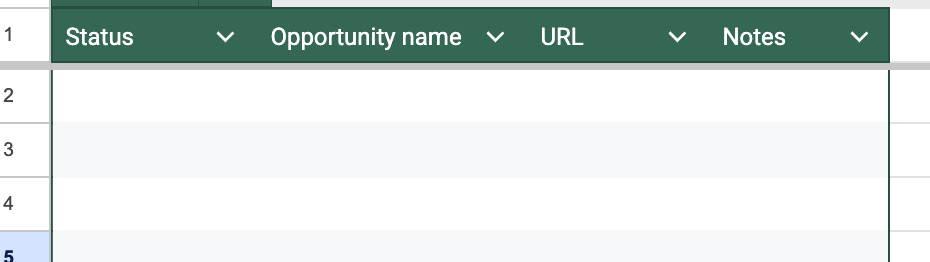
My advice is to make a super simple spreadsheet. Google spreadsheet will do or your favorite notes file.
It can be as simple as this:
One thing you can do is try and make your online presence stand out. You can definitely do this. Start a blog. Start posting. Etc.
But another thing you can do is simply clean up your online profile. Building a brand can take time. And perhaps you want to do that. In the meantime, however, I strongly encourage you to simply audit your profile for red-flags. Get rid of the ai-generated slop. Just have a clean profile. Maybe a clean personal website. In this case, simple will be better than something super “advanced”.
It’ll sound so obvious. And I’m going to spell it out for you as “simply” as I can. But I bet most people won’t take this step. I’m not precisely sure why. But they won’t.
In the next 10 minutes, you can do the following: create a list of 50 startups you find at least a little bit exciting. Note: they do not have to be hiring for any particular role.
To create the list, you can read any recent Next Play article:
What should you put on the list? Well that’s really up to you. Be open-minded. Follow your curiosity. And build your list.
Your list should be a living thing. Something you add to whenever you hear of an interesting opportunity. When you’re scrolling on Twitter and you see an interesting startup, add it. When you are talking to a friend who just found this cool company, add it. For this system, your list should be pretty large. Larger than just 3-5 companies. I don’t think this strategy is set up to work well with very small numbers (disclaimer I think that there is a more concentrated strategy you could try out but it’s riskier and I’ve not yet seen to be more effective particularly for people looking to work at a startup).
Now you’ll want to find the email addresses of the hiring managers. For companies less than 100 people, I suggest finding the email address of one of the founders. If you’re applying for a technical role, you can email the CEO or the CTO. If you’re applying for something non-technical, I recommend emailing the CEO.
There are many tools you can use to find email addresses. You can check out something like contactout - but you can also simply email firstname@companydomain.com and most of the time that’ll work, especially for the founder.
My best thoughts on writing cold emails are probably here:
If you want the TL;DR, though, here it is:
Perhaps more important than what you should do in a cold email is what you shouldn’t do. I think a lot of the existing cold email advice out there, like ‘send an email people want to read!’ falls flat because everyone has different definitions of what ‘an email people want to read’ is. My goal with this section is to establish some consistency; some ground rules.Do not write an email more than ~200 words long.
Do not use fancy words.
Do not send an email without an ask.
Do not be vague.
Do not be spammy or dishonest.
In your email, say: Who you are. Why you are reaching out. Why they should care.
You can have a template. Something like this:
“Hey Ryan - [product] is so good. Used it last week for [reason] and was impressed (especially by how good the notification selection/timing is).
Question: how are you doing on copywriting at the moment?
Asking because I write for startups.
Don’t want to blast you with a wall of text so re: work background, that’s mostly on the site in my email address. Happy to share a bunch of past work if it would be helpful.”
But make sure you personalize it. In your email, prove to the recipient that you’re a real person and not some AI.
If it’s slow at first, realize you’ll get faster. It’s like a muscle. A sport. Practice, and you’ll improve.
It may sound a bit crazy but consider timing yourself. See how much you can improve in a short period of time. More emails.
I’ll say this before and say this again: the easiest way to get a job at a startup is to simply start helping them before you’re actually employed.
Get them leads. Rewrite their job descriptions. Interview potential customers. Just start doing useful stuff. Show you actually care.
Here are a bunch of real examples for you to look at for inspiration:
Email them your learnings. Or bring them up in an interview. Prove to them you’re so valuable that they cannot afford to not hire you. That’s gotta be the mentality.
Now you’ve got the “system.” But it’s not now magically going to get you a job.
A big part of the system’s success is you actually using it. And to do that, my suggestion is to spend 30 minutes a day. At least. 30 minutes a day finding opportunities and sending outreach. I believe in that time you can send something like 10 emails a day (at least).
Without knowing you at all, I think your response rate will be something like at least 10%, so 1 response per day. I think most of those opportunities won’t actually turn into jobs…but if you’re consistent, you’ll eventually have multiple opportunities to choose from.
By the way, even the “Nos” may be worth cultivating. Stay in touch with people. Keep them in mind. You never know what it can lead to.
And during this whole process, you’ll be learning and building momentum. You’ll iterate on your messaging. You’ll talk to companies be like oh I’m actually not interested in those types of roles. Let me adjust this. Etc. Etc. Treat it like you’re building a product almost. You’ll learn from the market and adapt.
I have seen this actually work countless times now. If you need encouragement, consider this essay my encouragement. You got this!
And if you rather not go through this journey alone, be sure to join the Friends of Next Play slack group.
Thanks for reading! If you liked this essay please upvote and share with friends.
Comments
Nothing yet. Say the first thing.
Sign in to join the conversation.