
AI agents are beginning to make purchases, move money and execute financial transactions. The interesting investment question is no longer whether they can do it — but who controls the infrastructure underneath them.
On May 27, Robinhood launched a credit card for someone who does not really exist.
Your AI agent.
The product allows a Robinhood customer to create a virtual card, connect it to an AI agent, define how much it is allowed to spend and decide whether purchases require manual approval.
The agent can then make purchases on the customer’s behalf.
It sounds like a relatively small product announcement.
I think it points toward something much larger.
For most of the history of electronic payments, the person making a purchase and the person authorizing the payment have effectively been the same person.
You find something you want.
You enter your card.
You authenticate.
The payment network processes the transaction.
An AI agent breaks that sequence.
The person deciding what they ultimately want may still be human. But the software searching for the product, choosing when to buy it, negotiating between alternatives and eventually initiating the transaction may not be.
And once software is allowed to spend money, finance has a new problem to solve.
How does a merchant know that an agent is legitimate?
How does a bank know what the human actually authorized?
How much can the agent spend?
For how long?
Can the permission be revoked?
Who is liable when something goes wrong?
How do you distinguish a legitimate shopping agent from an automated fraud attempt?
And once two machines begin transacting with each other, do we even need the same payment rails we built for humans?
These questions are creating an entirely new layer of financial infrastructure.
And over the past several months, some of the largest companies in payments have quietly started building it.
Mastercard has already completed authenticated agent-initiated transactions in live payment environments. Its first Australian transactions in January were visible throughout the payment chain as transactions performed by an agent, while still preserving cardholder consent.
Visa has launched identity, scoring and registry infrastructure for AI commerce and is now working directly with OpenAI to integrate secure Visa payments into agentic experiences.
Fiserv is connecting merchants to these new standards.
Robinhood has moved the concept directly into a consumer financial product.
And Coinbase is building something very different underneath all of them: a payment architecture designed from the beginning for machines.
This is the investment thesis I want to explore today.
We have also started documenting it through a new Next Financial portfolio on Altis Terminal: Agentic Payments Infrastructure.
The Journal began on January 2, 2026.
It currently contains five documented positions across different parts of the emerging stack, with approximately $42,800 in equity, as of August 12.
But the return today is not really the point.
This is a thesis I expect to take years to develop.
The more interesting question is whether AI agents eventually become an entirely new class of economic participant — and, if they do, which financial companies get paid every time an agent spends money.
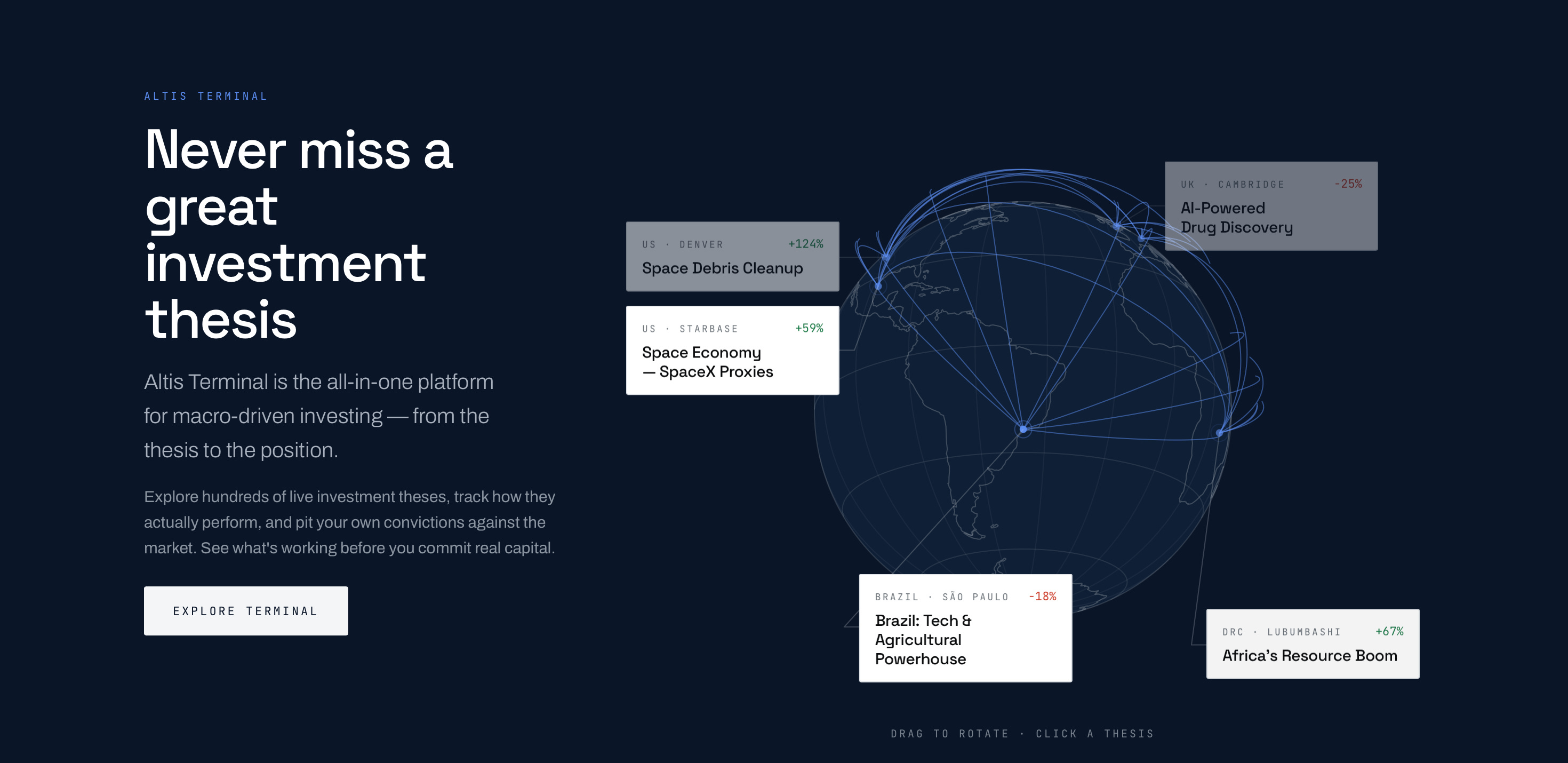
Upgrade to Next Financial Premium and get full access to our premium research, investment theses, and portfolios — plus Altis Terminal included in your subscription.
Altis Terminal will normally cost $499/year on its own.
But as a Next Financial Premium subscriber, you get full access to Terminal as part of your $200/year membership.
That includes:
Every premium Next Financial edition
Full access to Next Financial portfolios and trade histories
Altis Terminal — normally $499/year
Investment theses tracked and updated over time
Portfolio performance, events, trades, and thesis updates
Next Financial Premium will increase to $300/year in the next few days.
If you subscribe today at $200/year, your price will remain $200/year for as long as you keep your subscription active.
No future increase.
Subscribe today and lock in Next Financial Premium + Altis Terminal for $200/year.
Comments
Nothing yet. Say the first thing.
Sign in to join the conversation.