
You’ve probably seen the headlines. Oklo is soaring. NuScale is back in the news. Money is flooding into the companies building small modular reactors — the compact, factory-built nuclear plants that are supposed to finally make nuclear cheap and fast to deploy. And here’s the thing: that bet is built on a real idea. Nuclear genuinely is scaling.
But I think most people are buying the wrong piece of it. Because almost everyone rushing into these reactor stocks is skipping one question — the one that decides whether any of it works. What are you going to put in the tank?
Let me give you two numbers, and the whole story falls out of them.
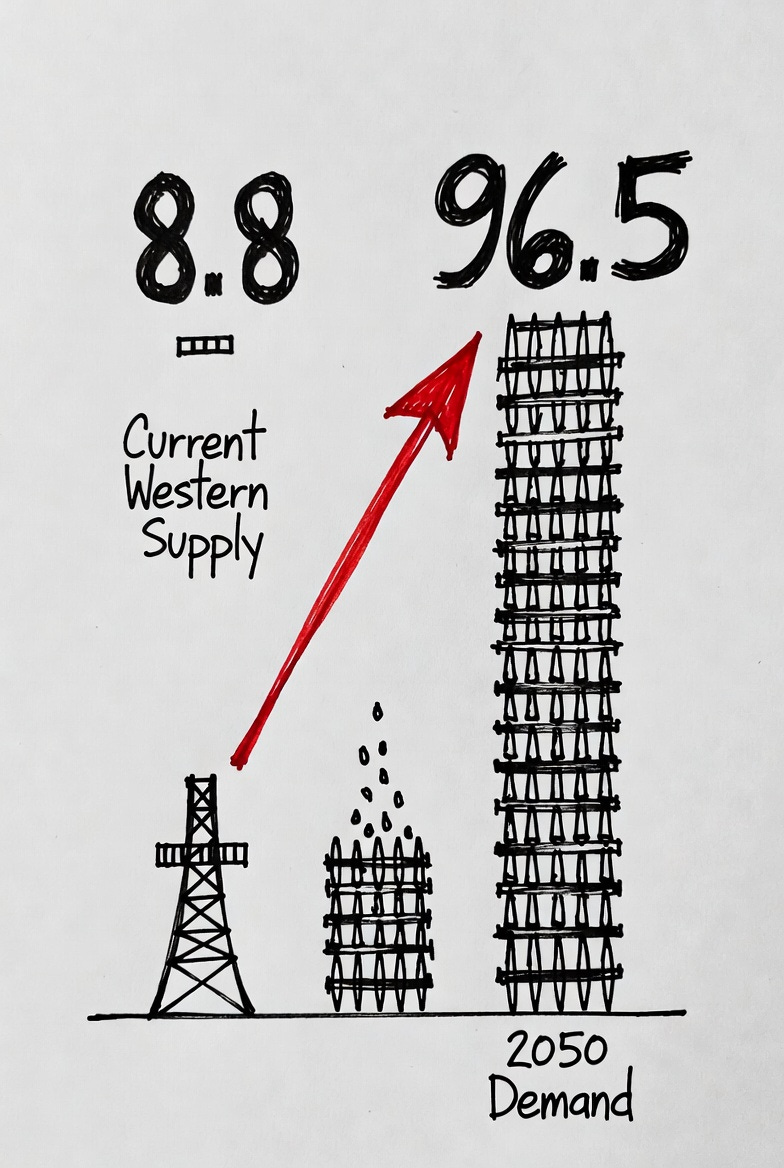
To run a reactor, you need enriched uranium — uranium that’s been processed to concentrate the part that actually splits and releases energy. That processing is measured in “separative work units,” or SWU. Don’t worry about the unit; just treat it as the speedometer for how much enriched fuel the world can produce. Add up the entire capacity of the Western world — every plant in the US, all of Europe, everything — and you get roughly 8.8 million SWU a year.
Now here’s the demand. Projected need by 2050: 96.5 million SWU.
Sit with that for a second. The West can currently produce somewhere between 10% and 25% of what it’s going to need. That’s not a rounding error you fix with a bigger checkbook. You can’t simply spend your way out of it, because the bottleneck isn’t money — it’s time and physics. Building a new enrichment plant means precision-machining thousands of centrifuges and clearing some of the strictest nuclear-security licensing on earth. That takes years, not quarters.
And it gets tighter, because the new reactors don’t even run on the old fuel.
Today’s nuclear fleet runs on uranium enriched below 5%. But the next generation — more than half of the small reactor designs in development — needs something more concentrated, enriched to between 5% and 20%. The industry calls it HALEU (high-assay low-enriched uranium). Think of it as higher-octane fuel: standard reactors take regular, the new ones need premium, and almost nobody makes premium yet.
How few? Until recently, the United States had no commercial source of HALEU at all. And for years, the one country that did dominate its production was the worst imaginable supplier: Russia held a near-monopoly — and Russian deliveries are set to end in 2028 under a 2024 ban.
Read that back slowly, because it’s the heart of the whole thing. The West has committed hundreds of billions of dollars to a reactor technology whose fuel was, until very recently, made almost entirely by its chief geopolitical rival. And that supply line shuts off in two years. The reactors are coming. The fuel is the open question.
The people writing the checks know it. In January 2026, the US Department of Energy finalized contracts with four companies to build domestic HALEU capacity over the next decade, backing it with $2.7 billion. But read that for what it is: the government de-risking the first step, not paying for the whole build. The much larger pile of private capital that has to fill the rest of the gap hasn’t picked its winners yet. That’s the opportunity.
And the first real deals are already landing. On June 18, 2026, reactor developer Oklo and enricher Centrus signed a letter of intent for Centrus to supply enough domestic HALEU to power up to five of Oklo’s plants for years, starting in 2029. One line from the announcement says everything: access to domestically sourced HALEU remains one of the central constraints facing the advanced nuclear sector.
Centrus itself has been even blunter, pointing to a sharp climb in enrichment prices as plain evidence that the world needs far more capacity — driven, in its words, by the coming HALEU market that will help power tomorrow’s data centers and AI.
That last part is the piece most people miss, and it’s the one I’d burn into memory. The nuclear fuel shortage and the AI power boom are colliding into a single chokepoint. The same scarce input gates both. If you’ve been looking for the quiet link between those two stories, this is it.
So here’s where I land. The economics aren’t a matter of hype — they’re structural. When demand outruns supply by a factor of four, and adding new supply takes a decade, the power belongs to whoever already controls the scarce input. Not to whoever builds the flashiest thing sitting on top of it.
The biggest winner of this nuclear cycle may not be the company that builds the most reactors. It may be the small handful that can actually make and deliver the fuel. And right now, that’s a very short list.
The free read ends here. Paid subscribers get the part that maps to actual positions:
🔓 The listed names, ranked by moat — Centrus (LEU) and its contract backlog, the ASP Isotopes (ASPI) thesis, where Urenco, Orano, and the General Matter dark horse fit, and which exposures are priced vs. mispriced.
🔓 Three scenarios, 2030–2035 — Base case, nuclear boom, and supply-shock, with the market impact of each.
🔓 The numbers — SWU pricing curve, the unit economics of a centrifuge cascade, and where the margin actually accrues.
🔓 Portfolio playbook — Sizing this as a 3–10% theme, position construction, and the Russia/China hedge most write-ups ignore.
🔓 The picks-and-shovels list — Centrifuge builders, transport-cask makers, and material suppliers quietly positioned to benefit.
Comments
Nothing yet. Say the first thing.
Sign in to join the conversation.