
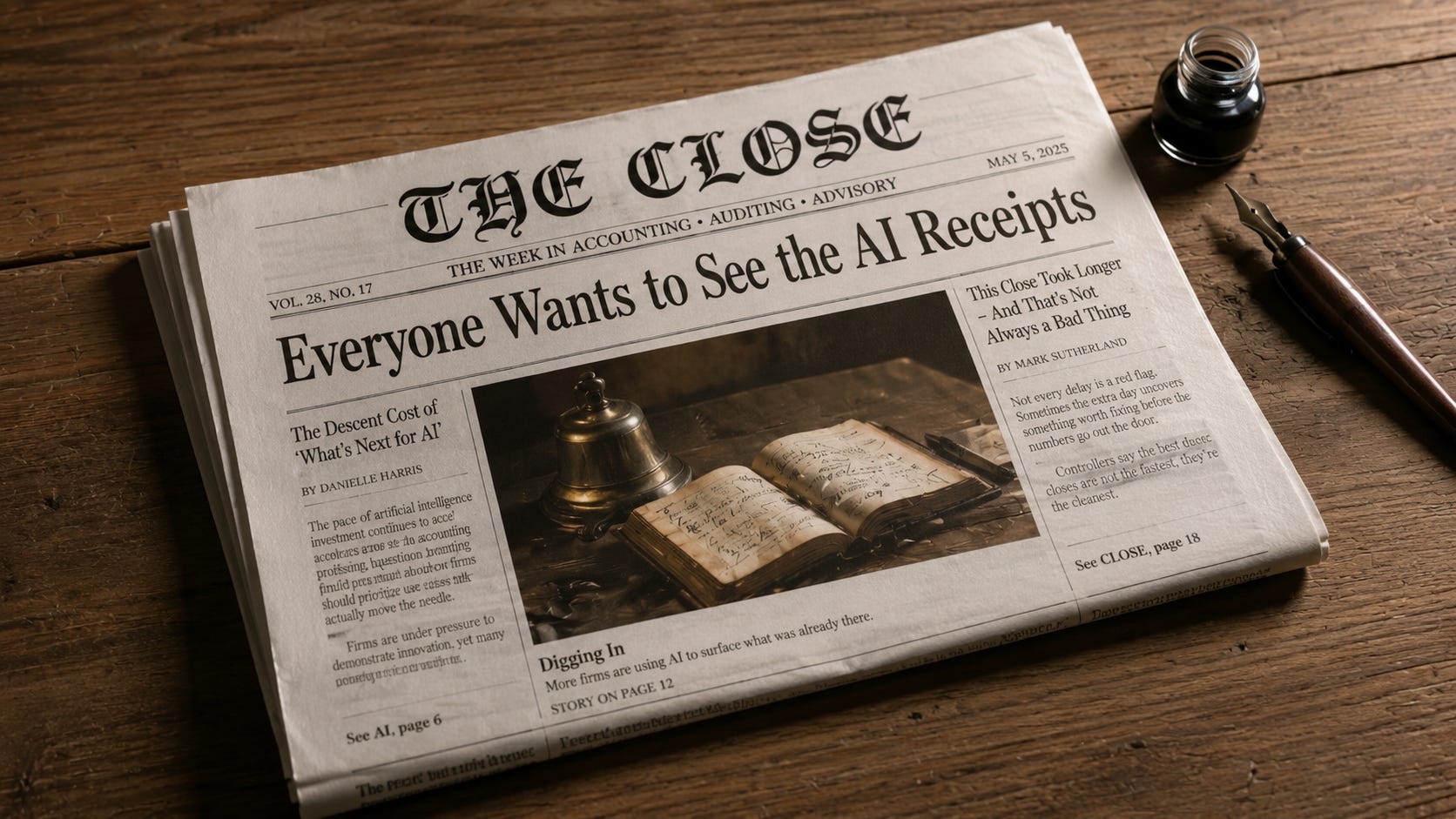
The Close — the week in AI and accounting, every Friday.
We made it through another week!!! Every story I read this week had the same shape. Someone spent money on AI, and now someone else wants proof it was worth it. Alphabet’s CFO had to explain a $205 billion spending number to investors. A regulator opened a public comment period instead of writing a rule, because it isn’t sure yet what “checked” should mean for AI-touched work. A global survey found finance leaders admitting the quiet part out loud: they’re moving faster than they can prove.
Below: the CFO earnings question everyone’s dodging, a new kind of AI coworker showing up at accounting firms, PCAOB’s open comment period, and what happens when speed beats proof.
CFOs Now Have to Show Their AI Math
This earnings season, Wall Street analysts are asking a blunter question than usual: what do your AI tokens actually cost, and is the spend paying off? Bloomberg reported that AI capital spending is on pace to outpace corporate earnings by year end, pushing net free cash flow negative industry-wide into late 2027. Alphabet gave the market a preview on July 22, when CFO Anat Ashkenazi raised the company’s 2026 capex forecast to as much as $205 billion. Free cash flow swung to negative $5.9 billion, down from positive $25 billion a year earlier. Tesla posted a similar drop the same day. Both stocks fell double digits, and CNBC covered the market’s reaction live.
Why it matters: if a company the size of Alphabet can’t yet turn AI spending into cash, what’s the honest payback math on the tools your firm signed up for last quarter?
Bloomberg - https://www.bloomberg.com/news/newsletters/2026-07-19/cfos-face-questions-around-ai-token-costs-zm-jpm-fds)
A New Kind of AI Coworker Just Showed Up at Accounting Firms
Y Combinator startup Rational launched AI agents built to work inside accounting firms on month-end close and tax prep. The agents run through Teams, Slack and email, and can sit in on meetings. The part worth noting: they’re designed to route work back to a human for review before anything gets finalized, not to push output straight out the door.
Why it matters: the agent asks for a human check before it calls something done. Where in your own process does the work quietly skip that step?
Inside Public Accounting - https://insidepublicaccounting.com/2026/07/17/rational-launches-ai-employees-for-accounting-firms/
PCAOB Opens the Floor on How It Will Watch AI-Touched Audits
The Public Company Accounting Oversight Board voted July 20 to seek public comment on its 2026-2030 strategic plan. AI and digital assets made the list of emerging issues the board’s Office of the Chief Accountant is tracking as it figures out how existing auditing standards should stretch to cover AI-generated evidence. Comments close September 4.
Why it matters: a federal regulator is still asking the question, not answering it. What would you tell them right now about how your firm actually checks AI-generated audit evidence?
Thomson Reuters Tax & Accounting - https://tax.thomsonreuters.com/news/pcaob-unveils-draft-strategic-plan-for-2026-2030-seeks-public-feedback/
Finance Leaders Admit They’re Moving Faster Than They Can Prove
A global survey covered in the Journal of Accountancy’s July issue found more than 90% of senior finance leaders feel real career pressure to show that agentic AI is delivering a return. Most described an environment where speed gets rewarded ahead of governance, and accountability lags behind both.
Why it matters: if the person approving the AI budget is under pressure to show a win, who in that room gets to say the number isn’t real yet?
Journal of Accountancy - https://www.journalofaccountancy.com/news/2026/jul/are-finance-leaders-moving-too-fast-on-agentic-ai/

Every one of these stories comes back to the same measurement problem. Alphabet can report a capex number down to the dollar and still not know if the spend is paying off, because “paying off” depends on what you measured in the first place. That’s the same semantic-layer problem I wrote about a couple weeks back: two dashboards can disagree about “revenue” because nobody defined it the same way twice
AI Builds the Dashboard. That Was Never the Hard Part.(https://nexairi.com/article/Finance/agentic-bi-semantic-model-finance-dashboard-trust-2026/)
I can’t tell you how to close a month or price an engagement. What I can tell you is that the fix here is boring on purpose: pick a number, define it once, write the definition down, and check whether two people asking the same AI the same question get the same answer back.
One thing worth noting on the other side of the ledger: not every AI headline this year is about jobs disappearing. Recruiters are already naming new roles built entirely around this measurement gap, things like “AI governance officer” and analysts whose whole job is translating AI output into something a CFO can defend. The demand for people who can explain what a number means isn’t shrinking. It’s just moving to a different desk.
## From the Nexairi Desk This Week
AI is absorbing the manual reporting fractional CFOs used to bill for, which means the interpretation work left over is worth more, not less. Read → (https://nexairi.com/article/Accounting/fractional-cfo-advisory-role-ai-reclaimed-time-2026/)
5 AI Prompts That Make Your Tax Research Defensible (https://nexairi.com/article/Accounting/5-ai-prompts-tax-research-client-questions-cpa-2026/)
Five copy-paste prompts that turn a quick AI tax answer into something a preparer can actually defend later. Read → (https://nexairi.com/article/Accounting/5-ai-prompts-tax-research-client-questions-cpa-2026/)
Pick one AI tool your firm pays for and ask it the same question two different ways this week. If you get two different answers, you’ve found your own version of Alphabet’s problem before an analyst finds it for you.
If you want the full AI policy checklist for CPA firms, what to cover with staff, what to document and what to have ready before any client matter touches AI… it’s free:
Get the free AI policy checklist →
P.S. If your firm needs the full governance framework, here are 11 ready-to-use documents including an acceptable use policy, client data rules, client disclosure language and an incident response checklist . The CPA AI Policy Kit is $29 and ready to download.
No posts
Comments
Nothing yet. Say the first thing.
Sign in to join the conversation.